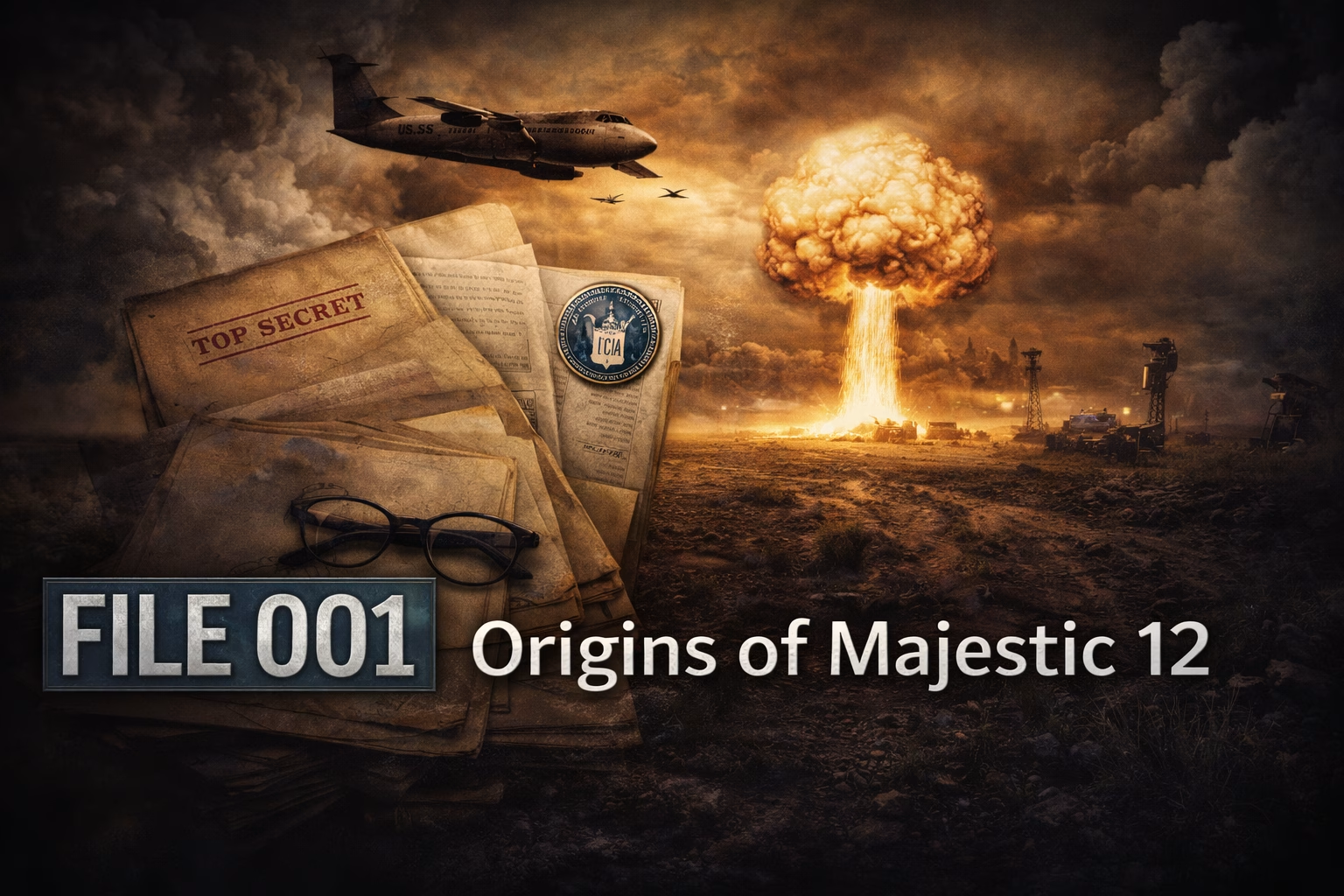
Majestic 12 Explained (FILE 001): Origins of MJ-12 and Cold War Secrecy
The Majestic 12 Files — FILE 001
Origins of Majestic 12: Why the Postwar System Could Produce a “Hidden Committee” (Even If the Name Wasn’t Real)
Case Summary
The MJ-12 story emerges from a post–World War II security environment built for compartmentalization.
The years 1945–1952 saw the expansion of “need-to-know” structures and executive secrecy.
This context does not prove MJ-12 existed—but it explains why a small, insulated oversight group is plausible in principle.
Modern UAP investigations still grapple with the same structural issue: limited visibility and fragmented records. U.S. Department of War
What Is Known
1) The early Cold War rewarded secrecy, not transparency
The period immediately after World War II created a national security model optimized for information control. Sensitive initiatives—nuclear weapons, cryptography, reconnaissance aircraft, foreign intelligence collection—were increasingly structured so that only small circles understood the full picture.
This matters because the MJ-12 narrative is, at its core, a claim about governance under extreme secrecy: an inner circle, limited documentation, and restricted access. Even critics of MJ-12 generally accept that such structures can exist for conventional national security reasons.
2) “Archival silence” can be a feature of compartmentalization
The absence of corroborating records is often treated as fatal to MJ-12. But in classified program history, it is not unusual for names, indices, filing patterns, and oversight paperwork to be minimized, fragmented, or managed under different channels (or later destroyed). This does not validate MJ-12; it explains why the debate persists and why researchers focus on system architecture as much as on any single page.
3) UAP is now a formal government topic—regardless of MJ-12
Whether or not MJ-12 existed, UAP has become a formal subject of U.S. government review. The Department of Defense’s AARO was tasked with reviewing historical records and investigating UAP claims, producing a major “Historical Record Report” in 2024. U.S. Department of War+1
What Is Disputed
Whether a UFO-focused governance body began in 1947 (as MJ-12 stories often allege).
Whether alleged “retrieval and exploitation” activities occurred at all in that era.
Whether later references to “MJ-12” reflect a real entity or a constructed label.
Why It Matters
A key reason MJ-12 remains culturally powerful is that it describes something that feels structurally plausible: a small oversight group created to manage a sensitive matter outside conventional accountability loops.
The modern UAP era has revived this question from a new angle: not “Do we have MJ-12 paperwork?” but “Do we have programs so restricted that even proper oversight cannot see them?” That is the continuity thread that keeps MJ-12 relevant as an investigative framework.
Editorial Assessment
FILE 001 is not a claim that MJ-12 existed. It is a foundation for understanding why the concept persists. The postwar national security system was capable of producing an MJ-12-like structure—and modern UAP controversy is, in part, a debate about whether such structures still operate beyond meaningful visibility.


latest video



news via inbox
Subscribe to our Cosmic newsletter to get notified when we have new articles.