Recent UAP Files: A New Era of UFO Transparency and Discovery
A New Era of UAP Disclosure: What the Recent U.S. Government Files Reveal
For generations, the subject of UFOs — now more formally called UAP, or unidentified anomalous phenomena — has lived between mystery, speculation, witness testimony, and government silence. That is changing.
In recent years, and especially with the latest U.S. government releases, UAP have moved into a new phase: one shaped by transparency, scientific curiosity, public access, and official documentation. The conversation is no longer limited to rumors or leaked footage. Today, the public can explore official videos, archived documents, case-resolution reports, military imagery, annual intelligence summaries, and newly released government records.
This is a remarkable shift.
The recent UAP files released by the U.S. government do not close the mystery. They open it. They give researchers, pilots, scientists, historians, journalists, and curious citizens a clearer view of what has been reported, what has been resolved, what remains unexplained, and how the government is now approaching one of the most fascinating subjects of our time.
This is a remarkable shift.
From UFO secrecy to UAP transparency
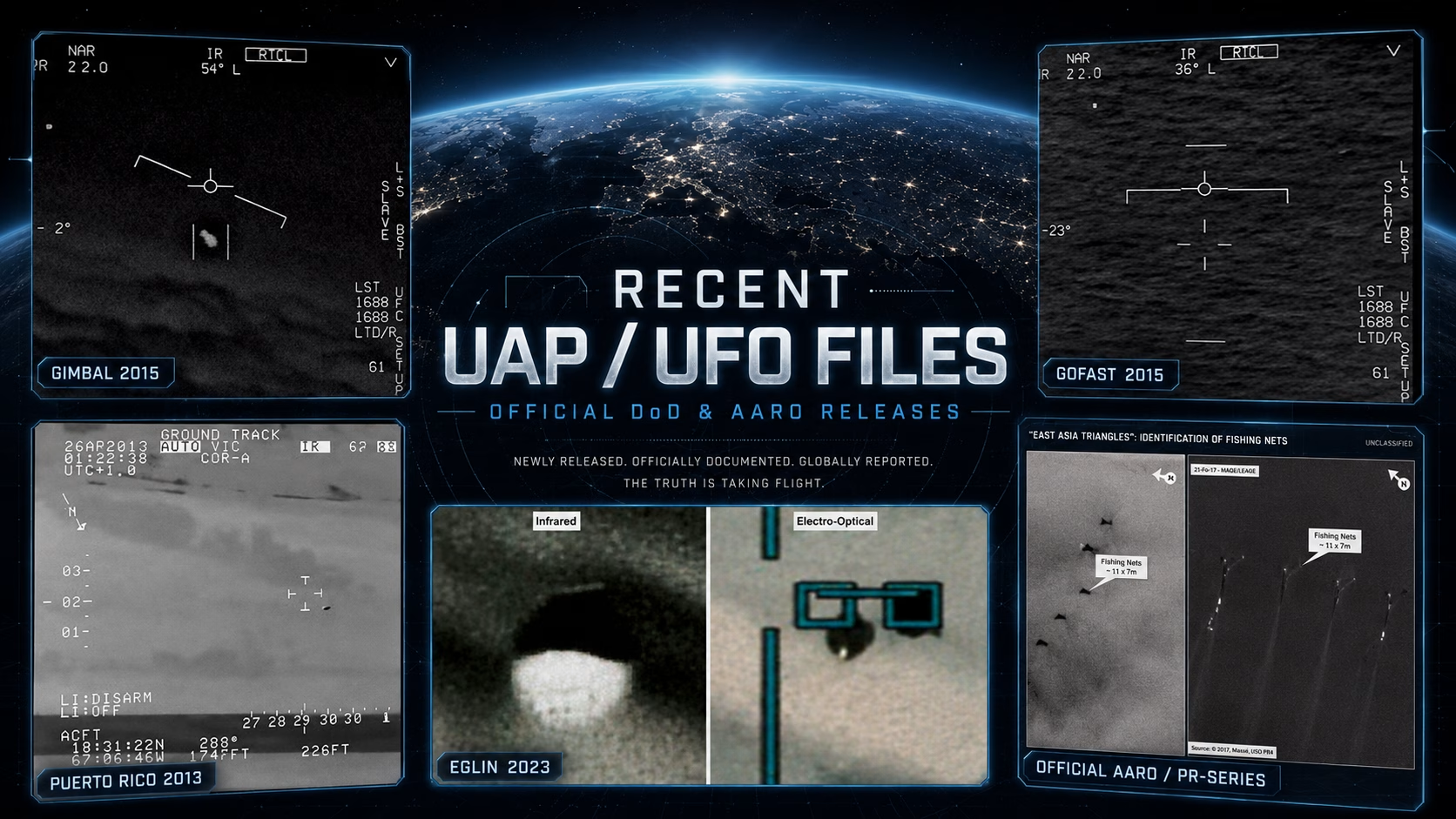
The modern UAP era took a major step forward in April 2020, when the U.S. Department of Defense officially authorized the release of three unclassified Navy videos. These videos, now widely known as FLIR, GIMBAL, and GOFAST, had already circulated publicly, but the official release confirmed that they were authentic Navy recordings. One video was taken in November 2004, while the other two were taken in January 2015.
That moment mattered because it changed the tone of the public conversation. For the first time in a very visible way, the U.S. government acknowledged that some military-recorded aerial events were real observations, captured by real sensors, and worthy of serious analysis.
The most important part was not that the videos gave a final answer. They did something better: they invited a more serious question.
What are we seeing?
That question now sits at the center of the UAP field.
AARO: the office built to investigate the mystery
The U.S. government’s current UAP work is led by the All-domain Anomaly Resolution Office, better known as AARO. AARO was created to collect, analyze, and resolve UAP reports across multiple domains — air, sea, space, and other environments where unusual observations may occur.
This is one of the most encouraging developments in the entire UAP story. Instead of leaving cases scattered across agencies, military branches, archives, and private speculation, AARO gives the subject an official structure.
The Department of Defense has described AARO’s work as a rigorous, scientific, data-driven effort to document, analyze, and, when possible, resolve UAP reports. The department has also emphasized that safety, operational security, and the protection of U.S. forces remain key reasons for taking UAP reports seriously.
That matters. It means UAP are now treated as a real-world reporting and analysis issue — not a joke, not a taboo, and not something to be ignored.
The 2024 annual UAP report: a major public milestone
One of the most important official documents in recent years is the Fiscal Year 2024 Annual Report on Unidentified Anomalous Phenomena, delivered to Congress by the Department of Defense and the Office of the Director of National Intelligence.
The report covers UAP reports from May 1, 2023, to June 1, 2024, plus older reports that had not appeared in previous annual reports. During that period, AARO received 757 UAP reports. Of those, 485 involved incidents from the reporting period, while 272 involved incidents from 2021 and 2022 that were reported later. By June 1, 2024, AARO was reviewing more than 1,600 total cases.
These numbers show how rapidly the reporting environment has changed. UAP are no longer just a handful of famous cases from the past. They are part of an active modern reporting system.
That is a major achievement for transparency. It also gives researchers a better foundation to study patterns, locations, sensor types, witness categories, and recurring explanations.
The latest public UAP file release
The most exciting recent development is the launch of a new official U.S. government UAP release platform: the Presidential Unsealing and Reporting System for UAP Encounters, also known as PURSUE.
According to the official U.S. government release page, the effort is designed to identify, review, declassify, and publicly release unresolved UAP-related records and historical documents from across the federal government. The page describes this as a large, coordinated effort involving many agencies and “tens of millions of records,” with new materials planned for release on a rolling basis.
This is a powerful moment for public access. For decades, people interested in UFO and UAP history had to search scattered archives, file FOIA requests, follow leaks, or rely on secondhand summaries. Now, a dedicated government release pathway exists for unresolved UAP-related records.
The official release also states that the archived materials are unresolved cases, meaning the government has not made a definitive determination about the observed phenomena. It specifically welcomes private-sector analysis, information, and expertise.
That is an important and positive shift. It suggests a more open model: government releases the material, and the wider research community helps study it.
A whole-of-government effort
The recent UAP file release is not limited to one office. The official government release describes an interagency effort involving the White House, ODNI, Department of Energy, AARO, NASA, the FBI, and additional intelligence-community components. It also says additional files will be released on a rolling basis.
That makes this one of the broadest UAP transparency efforts so far.
UAP records do not belong to only one agency. A sighting might involve military aircraft, civilian aviation, satellite data, NASA mission records, FBI historical files, intelligence documents, nuclear-site reporting, or archived federal correspondence. A whole-of-government approach is the only realistic way to bring those materials together.
For researchers, this is one of the most promising parts of the current disclosure era. It means the subject is being treated as complex, multi-agency, and worthy of coordinated public release.
AARO’s public imagery: seeing the cases for ourselves
Alongside the new file-release system, AARO’s public imagery page has become an essential resource. It includes official videos, case summaries, and PR-series UAP entries.
Recent public imagery entries include cases such as PR-018, PR-017, PR-016, PR-015, PR-014, PR-013, PR-012, and PR-011. These include infrared footage from U.S. military platforms, commercial-device video, and reports submitted through U.S. European Command.
Some of these cases remain unresolved. Others have been assessed as likely conventional objects. But every release adds value because it gives the public more data, more context, and more insight into how analysts approach UAP material.
For example, PR-018, a Europe 2024 case, includes ten minutes and thirty seconds of infrared footage from a U.S. military platform. AARO assessed with high confidence that the footage depicts a physical object, while also noting that its features and behavior were unremarkable and did not require further analysis at that stage.
PR-017, also from Europe in 2024, consists of thirty seconds of cellphone video. AARO stated that the footage was not sufficient to make a determination, but that it still contributes to historical and locational trend analysis.
PR-016, from Europe in 2023, was resolved as birds with high confidence. That may sound ordinary, but it is still useful. Each resolved case helps analysts understand how birds, balloons, aircraft, drones, satellites, and sensor artifacts appear in different systems. That improves future investigations.
In other words, even the “ordinary” answers are part of the progress.
Case-resolution reports: how mysteries become data
AARO’s case-resolution reports are especially valuable because they show the careful process behind UAP analysis.
One famous example is the Puerto Rico / Aguadilla case. Infrared footage from a U.S. Customs and Border Protection aircraft appeared to show an object moving quickly, splitting into two, and entering and exiting the water near Puerto Rico. AARO’s public case-resolution page explains that a reconstruction of the flight path and sensor angle indicated something different: two nearby objects traveling together, moving in a straight line at wind speed, without entering the water. AARO assessed that the objects did not demonstrate anomalous speed or flight behavior.
That kind of work is exactly why official UAP analysis matters. A video can look extraordinary at first glance. But when analysts examine sensor geometry, aircraft movement, wind, distance, camera angle, infrared behavior, and object motion, a more complete picture can emerge.
The same is true for GOFAST, one of the Navy videos. AARO’s case-resolution page describes the 2015 event as footage recorded by a U.S. Navy F/A-18F pilot using a Forward Looking Infrared sensor over the Atlantic Ocean off Florida.
The public release of this material helps people move beyond screenshots and speculation. It gives everyone a better way to study the evidence.
NASA’s positive role: science, data, and discovery
NASA’s involvement has also helped move the UAP conversation into a healthier and more scientific space.
NASA’s UAP independent study team described the study of UAP as a “unique scientific opportunity” that requires a rigorous, evidence-based approach and better data-acquisition methods.
That framing is important. NASA is not treating UAP as fantasy. It is treating them as a data challenge.
Better data could mean better sensors, better calibration, improved reporting standards, artificial intelligence tools, satellite correlation, civilian-science participation, and more complete metadata. That is a positive path forward because it gives the subject room to grow without relying only on belief or disbelief.
UAP research becomes stronger when it becomes measurable.
The National Archives: preserving UAP history
Another major development is the creation of Record Group 615: Unidentified Anomalous Phenomena Records Collection at the National Archives.
NARA says this collection was created as a result of the 2024 National Defense Authorization Act and that UAP records received from federal agencies will be accessioned into Record Group 615. The page also states that the collection will be updated as NARA receives additional records from federal agencies.
This is a huge step for long-term transparency.
The National Archives is not just a website. It is the official memory of the U.S. government. Placing UAP records into a dedicated archival collection gives historians, researchers, and the public a more stable way to follow the documentary trail.
NARA also notes that UAP-related records exist across numerous record groups and collections, including photographs, moving images, sound recordings, textual records, microfilm, and presidential-library materials.
That means the UAP story is not confined to one file dump. It is spread across decades of public records, and more of that history is now being organized for access.
Why the recent releases matter
The recent UAP releases matter for several reasons.
First, they reduce stigma. Pilots, service members, and observers are more likely to report unusual events when the subject is treated seriously.
Second, they improve public trust. Even when a case is unresolved, releasing the material allows people to see what is known, what is uncertain, and what still needs study.
Third, they support better science. A mystery cannot be studied well if the data remains hidden. Public imagery, reports, and archived files allow independent researchers to compare cases, test explanations, and contribute insights.
Fourth, they show that many different explanations can exist at once. Some UAP are likely balloons. Some are birds. Some are drones. Some are aircraft. Some are satellite flares. Some are sensor effects. Some remain unresolved. That variety is not a weakness — it is exactly why the subject deserves structured investigation.
Finally, the releases create momentum. The public now has official videos, case summaries, annual reports, historical records, archive collections, and a rolling declassification process. That is more access than ever before.
A more open future for UAP research
The most hopeful part of this new era is not that every question has been answered. It is that the questions can now be asked more openly.
For a long time, UFO and UAP research existed in a difficult space. Witnesses worried about ridicule. Researchers struggled to access records. Government agencies often gave limited information. Public debate was pulled between extreme skepticism and extreme belief.
Now the field is becoming more mature.
There are official reporting channels. There are public videos. There are annual reports. There are case-resolution documents. There is a National Archives collection. There is NASA involvement. There is a growing recognition that UAP can be studied without sensationalism and without dismissal.
That is a genuine step forward.
What should readers take away?
The recent U.S. government UAP files should be seen as the beginning of a wider public research era.
They do not remove the mystery. They organize it.
They show us that the sky is complicated, that modern sensors can produce surprising imagery, that some cases have ordinary explanations, and that some cases still deserve closer study. They also show that government transparency is improving and that the public is being invited into the process in a way that was almost unimaginable a generation ago.
For anyone interested in UFOs, UAP, aviation history, space, intelligence records, or unexplained phenomena, this is an exciting moment.
The story is no longer locked away in rumor. It is entering the public record.
And that means the next chapter of UAP research may be written not only by government agencies, but also by scientists, historians, pilots, engineers, data analysts, and curious people around the world.



latest video


news via inbox
Subscribe to our Cosmic newsletter to get notified when we have new articles.