
Graham Hancock’s Theories: The Lost Ice Age Civilization Case
Graham Hancock and the Missing Chapter of Human History
If Graham Hancock is right, the past is bigger, stranger—and far more advanced—than we’ve allowed ourselves to imagine.
There are writers who summarize the world, and writers who pick at its seams. Graham Hancock is firmly in the second camp. For more than thirty years, he has returned to the same provocation—sometimes patiently, sometimes with a journalist’s impatience for official answers:
What if the story of civilization didn’t begin where the textbooks say it did?
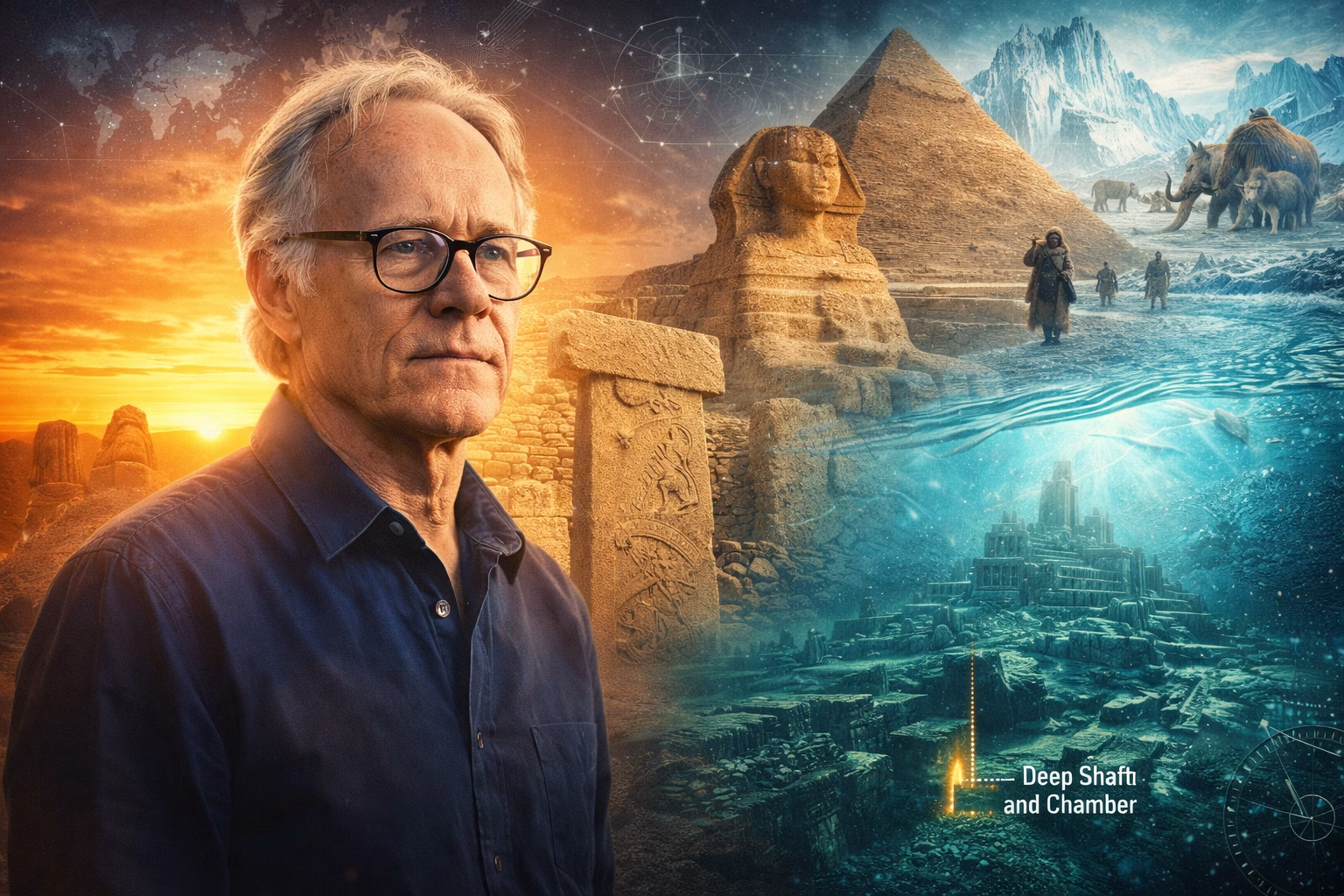
Hancock’s “great idea” is a single, sweeping proposition with many moving parts: that a highly sophisticated civilization existed during the last Ice Age; that it was devastated by a global cataclysm near the end of that era; and that a small number of survivors carried crucial knowledge—astronomy, geometry, agriculture, monument-building—into the cultures that later rose across the world. That thesis sits at the heart of his best-known books and the Netflix series Ancient Apocalypse, first released in November 2022, with a second season focused on the Americas released in October 2024.
This is not a skeptical profile. Consider it a feature written in an open-minded key: a guided tour through Hancock’s worldview, why it grips so many people, and what the world looks like when you follow his clues all the way to their most daring conclusion.
The man behind the provocation
Hancock’s origin story matters because it explains his method. He didn’t arrive as a university archaeologist; he arrived as a journalist. On his official biography page, he describes early years spent in India, later studying sociology at Durham University, then writing for major British newspapers before turning to books.
That background shows in his style: he treats history like an investigation, not a syllabus. He reads widely, travels relentlessly, and builds arguments the way reporters build cases—patterns, anomalies, timelines that don’t quite line up, and the sense that the “official story” is too neat for a messy planet.
The core thesis: a lost Ice Age civilization
Hancock’s foundational claim—popularized in Fingerprints of the Gods (published in 1995) and later expanded in Magicians of the Gods (published in 2015)—is that civilization has a prehistory we have not fully accounted for.
In the Hancock version of events, the Ice Age wasn’t populated only by small bands of hunter-gatherers. Somewhere—he’s careful to say he’s chasing a possibility rather than naming a capital city—there flourished a culture capable of remarkable feats: precise astronomical observation, high-level geometry, and monumental engineering. Then, in a comparatively short span of time, that world was shattered.
If you want a clean elevator pitch for Hancock’s “missing chapter,” it’s this:
-
The Ice Age ends violently.
-
Sea levels rise, coasts vanish, and evidence is drowned.
-
Survivors become “culture-bearers,” seeding knowledge in multiple regions.
-
Later civilizations remember them as gods, sages, or civilizing heroes.
That last point is key: Hancock’s argument is not just geological. It’s mythological. He sees ancient stories as memory—encoded, stylized, but pointing back to real events.
Cataclysm as the great eraser
Every lost-civilization theory needs a mechanism for loss. Hancock’s is catastrophe on a planetary scale—an upheaval associated with the end of the last Ice Age and the dramatic environmental changes that followed. In Ancient Apocalypse, the show’s basic premise is framed around a sophisticated Ice Age civilization destroyed around 12,000 years ago, with survivors carrying knowledge forward.
The psychological power of this idea is obvious: it turns the deep past into a thriller. But the practical power is stronger. Cataclysm explains why so little is left where we might expect it. If early advanced societies were coastal—and sea levels rose dramatically after the Ice Age—then much of the evidence would now be underwater.
In other words: the absence of evidence is not the end of the story; it’s an invitation to look in the places we don’t usually excavate.
The “clues” Hancock likes best: stone that behaves like math
Hancock’s most persuasive moments—at least for readers who enjoy bold syntheses—often come when he’s standing in front of stonework that seems to exceed the conventional narrative of technological development.
His case tends to focus on a few recurring signals:
1) Megalithic ambition
Sites that move, stack, and fit huge stones with striking precision.
2) Astronomical alignment
Monuments apparently oriented toward solstices, equinoxes, cardinal directions, or star risings—suggesting careful sky-watching.
3) Global patterning
Similar motifs, myths, and monumental forms appearing far apart, as if the same ideas traveled.
This is where Hancock is at his most “journalist,” connecting dots across continents and insisting that the pattern itself is a form of evidence. Not proof in a courtroom sense, but the kind of pattern that keeps you awake at night once you’ve seen it.
Göbekli Tepe: the site that changed the vibe of prehistory
Even in mainstream archaeology, Göbekli Tepe has played the role of a narrative disruptor: monumental architecture appearing very early in the Near Eastern Neolithic. Radiocarbon dating places the earliest exposed structures in the 10th millennium BCE, roughly between about 9500 BCE and later phases afterward.
Hancock treats Göbekli Tepe as a hinge point—an example of sophisticated, symbol-rich building activity that invites larger questions about what else might lie beyond the edges of the standard timeline. When you see T-shaped pillars, carved animals, and complex enclosures at such an early date, the imagination naturally pushes further back.
For Hancock, that push is not a leap into fantasy—it’s a demand for a bigger frame.
The Americas chapter: why Hancock keeps returning west
Hancock’s 2019 book America Before pushes his argument hard into North America and the broader Western Hemisphere. It was published in 2019 and positioned as a major pillar of his wider “lost civilization” thesis.
Then Netflix followed, with Season 2 of Ancient Apocalypse—subtitled The Americas—released on October 16, 2024.
In this phase of the story, Hancock’s interest is not only in monumental sites; it’s in the deep antiquity of human presence. One example frequently discussed in popular science coverage is the fossil footprint evidence at White Sands National Park, which multiple studies have supported in a range around 21,000–23,000 years ago.
You don’t have to accept every Hancock inference to appreciate what this does to the mood music of prehistory: the farther back humans are placed in the Americas, the more space there is—chronologically—for complex development, experimentation, and lost chapters.
For Hancock supporters, this is where the door cracks open.
The civilizing survivors: gods, sages, and “teachers after the flood”
Hancock’s most mythic—and, in a way, most human—idea is that catastrophe doesn’t only destroy; it also creates diaspora.
In his narrative, survivors of the cataclysm become travelers. They arrive in shattered worlds and teach: how to plant, how to build, how to count the heavens. Over time, those memories become the familiar archetypes that repeat across cultures: the wise bringer of knowledge, the bearded stranger, the luminous teacher, the serpent god, the sky messenger.
This is the poetic engine of his work: mythology as the long echo of real experience.
If Hancock is right, those myths are not “just stories.” They’re the last surviving headlines of a trauma so vast it reshaped coastlines.
Consciousness: Hancock’s other frontier
Hancock is not only interested in stone and dates. He is also fascinated by altered states, symbolism, and what ancient cultures believed was possible.
His book Visionary (a definitive edition of earlier work) was published in 2022 and focuses on the “mysterious origins of human consciousness.”
This dimension matters because it shapes Hancock’s view of the “advanced civilization” he imagines. He’s not describing a lost Silicon Valley. He’s describing a world with spiritual technology—knowledge of mind, ritual, and meaning—alongside practical skills like astronomy and engineering.
It’s also why his writing attracts readers who aren’t just looking for alternate history, but for alternate possibility.
Why Hancock resonates now
Hancock’s popularity is often explained as controversy. But popularity has its own physics: people return to what feels alive.
A few reasons his work keeps catching:
-
He offers a grand narrative in an age of fragmented information.
-
He treats the past as unfinished business, not a closed case.
-
He makes the reader a participant, inviting you to weigh clues rather than memorize conclusions.
-
He argues that “unknown” is a legitimate category, and that we should be ambitious about investigating it.
And importantly, he delivers all of this through a medium built for modern attention: globe-spanning travel, cinematic sites, and a central question that can be asked in one sentence.
Netflix didn’t invent Hancock’s audience, but Ancient Apocalypse put his thesis on a global stage—first in 2022, then again in 2024 with the Americas-focused season.
A world shaped by loss—and the clues that survive it
Hancock’s work ultimately asks you to picture civilization as fragile. Not fragile in the sense of weak, but fragile in the sense that it can be erased.
If you grant him that premise, a lot begins to feel newly plausible:
-
Coastal settlements swallowed by rising seas.
-
Knowledge preserved through myth when libraries don’t survive.
-
Monumental stone as the medium that outlasts catastrophe.
-
Strange “jumps” in the archaeological record that look less like miracles and more like inheritance.
That is the emotional truth at the heart of Hancock’s case: the past may not be simpler than we think—it may be more complete than we can currently see.
What is Graham Hancock’s main theory?
That a sophisticated civilization existed during the last Ice Age, was devastated by cataclysm, and left knowledge that later cultures inherited.
What are Graham Hancock’s most famous books?
Fingerprints of the Gods (1995), Magicians of the Gods (2015), and America Before (2019) are central to his “lost civilization” thesis.
What is Ancient Apocalypse?
A Netflix documentary series presented by Hancock (first released November 2022), with a second season focused on the Americas released October 2024.


latest video

news via inbox
Subscribe to our Cosmic newsletter to get notified when we have new articles.


