Arctic Methane Release: What Scientists Know—and What They Don’t
Updated August 22, 2026
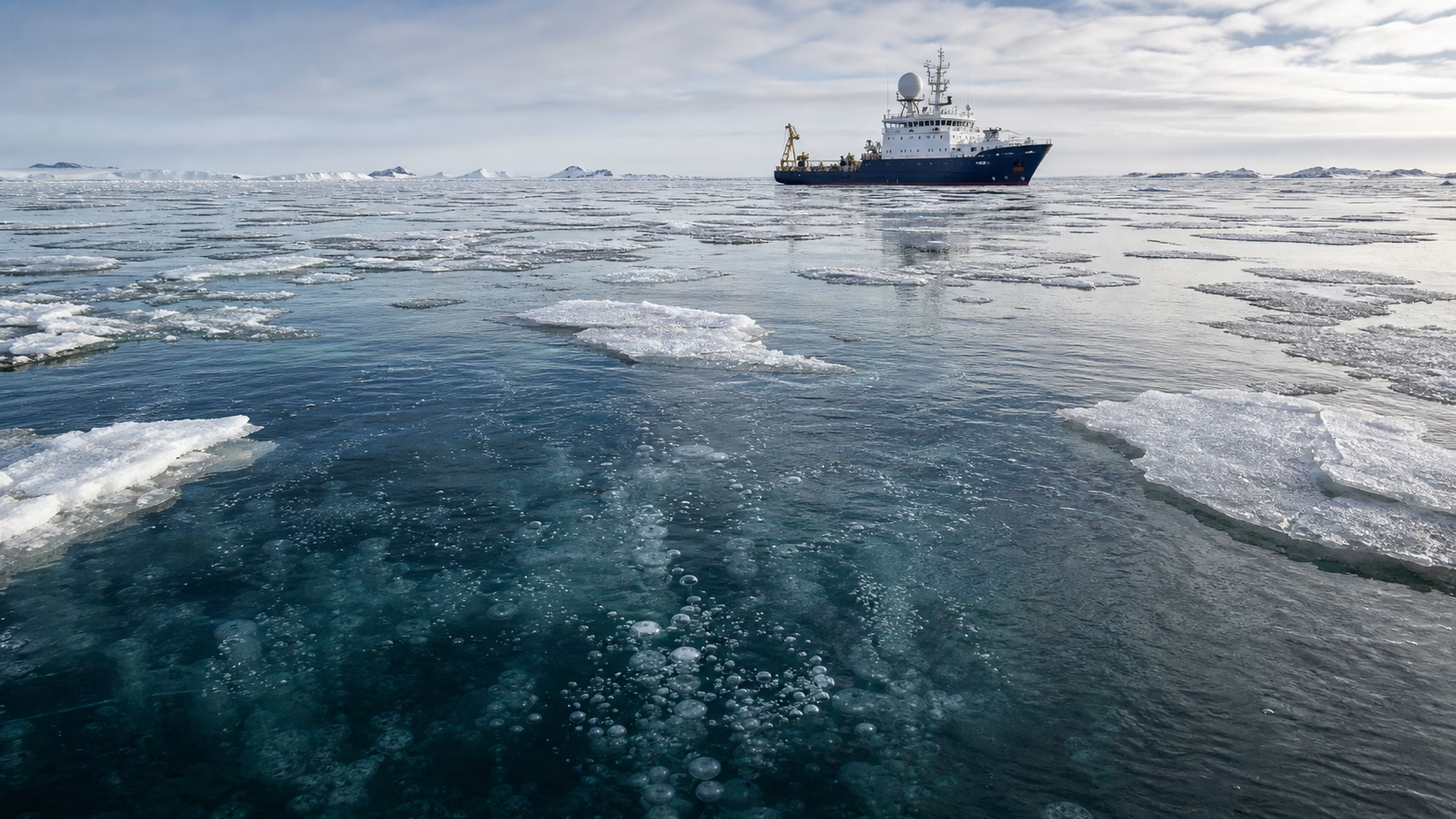
A methane plume rising from the Arctic seabed is an unsettling sight. Bubbles stream through dark water, instruments register concentrations far above background levels, and a dramatic phrase almost writes itself: the methane bomb has begun.
The real story is more complicated—and more useful. Arctic methane emissions are genuine, the region is warming rapidly, and thawing permafrost creates an additional climate feedback. But the best available evidence does not support the idea that an enormous, sudden burst of methane is about to trigger runaway global warming. The serious risk is a slower, persistent feedback that makes every fraction of a degree harder to avoid.
Arctic methane release: the short version
- The Arctic stores an immense amount of carbon. Northern soils and permafrost contain roughly 1.4 to 1.6 trillion tonnes of organic carbon.
- Methane is already escaping. It comes from wetlands, thawing land permafrost, lakes and some shallow seabed areas.
- Measurements vary enormously. Estimates for the East Siberian Arctic Shelf range from only a few to about 17 million tonnes of methane per year, illustrating how difficult the region is to measure.
- A bubble plume is not the same as an atmospheric spike. Methane can dissolve in seawater or be oxidised by microbes before it reaches the air.
- A sudden runaway “methane bomb” is not the leading scientific assessment. The IPCC considers a large abrupt release from Arctic methane hydrates before 2100 unlikely.
- The feedback still matters. Gradual carbon dioxide and methane emissions from thawing permafrost add warming and reduce the remaining carbon budget.
Where the alarm began
Much of the public concern can be traced to research expeditions over the East Siberian Arctic Shelf, or ESAS. This vast, shallow shelf was exposed land during the last ice age. When sea level rose, it was flooded, leaving old permafrost beneath relatively shallow Arctic waters.
In a landmark 2010 Science paper, Natalia Shakhova, Igor Semiletov and colleagues reported widespread methane supersaturation in ESAS waters and estimated that the shelf emitted about 8 teragrams—eight million tonnes—of methane annually. Later fieldwork documented powerful bubble plumes and produced an estimate as high as 17 teragrams per year.
Those observations were scientifically important. They showed that subsea permafrost was not an inert, perfectly sealed lid. Gas was moving through faults, sediments and water. Yet early media coverage often turned a regional emission estimate into a prediction of an imminent global catastrophe. The measurements themselves did not establish that.
What does a methane plume actually tell us?
A plume proves that methane is being released at that location and time. It does not, on its own, tell us the annual flux of an entire sea, how much reaches the atmosphere or whether emissions are accelerating.
The Arctic shelf is patchy. One survey can cross an intense seep while another samples quieter water. Winds and storms stir the sea, seasonal ice changes gas exchange, and measurements made in summer cannot simply be multiplied by twelve. Researchers must also distinguish newly produced microbial methane from old thermogenic or fossil methane rising from deeper layers.
This helps explain why estimates differ. A 2016 direct-measurement study across the shelf estimated about 2.9 teragrams per year—far below the highest earlier estimate. The IPCC’s Sixth Assessment discusses a broad range of roughly 3 to 17 teragrams per year and notes that the upper end is difficult to reconcile with atmospheric measurements across the Arctic.
Three different Arctic methane stories
1. Thawing terrestrial permafrost
Permafrost is ground that remains frozen for at least two consecutive years. It contains plant and animal material accumulated over thousands of years. When the soil thaws, microbes can decompose that material. In oxygen-rich soil they produce mostly carbon dioxide; in waterlogged, oxygen-poor soil they can produce methane.
This is the most firmly established long-term Arctic carbon feedback. It is not a single explosion. It is a growing leak spread across enormous landscapes, with emissions determined by temperature, moisture, vegetation, wildfire and the depth of seasonal thaw.
2. Subsea permafrost and methane hydrates
Beneath parts of the Arctic Ocean, methane can be stored in sediments or trapped in ice-like methane hydrates. Warming water and degrading subsea permafrost may open routes for gas to escape. Shallow water increases the chance that some bubbles reach the surface before dissolving.

However, heat moves slowly into deep sediments. The IPCC concludes that methane-hydrate emissions are not expected to change substantially this century and does not identify an abrupt shelf-wide release as a likely tipping point before 2100. That conclusion does not mean zero emissions; it means the most catastrophic scenario is poorly supported by observations and physical timescales.
3. Wetlands, lakes and abrupt thaw
Natural wetlands are the world’s largest natural methane source. In the Arctic, warming can expand wet areas in some places while drainage dries others. Thermokarst lakes form when ice-rich ground collapses, creating oxygen-poor conditions where microbes produce methane. Abrupt thaw along lake edges and collapsing slopes can expose deep, previously frozen carbon much faster than gradual surface thaw.
These processes are difficult to represent in global climate models, which is why continued field measurements remain essential.
Does seabed methane reach the atmosphere?
Sometimes—but distance matters. Methane released in shallow water has a shorter journey and a better chance of crossing the sea surface. In deeper water, bubbles shrink, gas dissolves and methane-eating microbes convert much of it to carbon dioxide before it reaches the air.
Even in shallow seas, wind, currents, sea ice and microbial activity determine the final atmospheric flux. This is why spectacular sonar images of bubbles cannot be used as a direct measure of climate impact. The missing number is not how much gas leaves the sediment, but how much survives the water column and changes the atmosphere above it.
How powerful is methane?
Methane remains in the atmosphere for much less time than carbon dioxide, but it traps far more heat per unit mass while it is there. Depending on the exact definition used, a tonne of methane has roughly 27 to 30 times the warming effect of a tonne of carbon dioxide over 100 years, and around 80 times the effect over 20 years.
That short, powerful influence creates an opportunity. Cutting methane emissions from fossil-fuel operations, waste and agriculture can slow warming relatively quickly. It also creates a reason to monitor Arctic feedbacks closely: a persistent increase would add to emissions humanity can control directly.
What the atmosphere tells us
Atmospheric methane is now more than two and a half times its pre-industrial level. NOAA’s global monitoring network shows that concentrations are still rising. The 2025 Global Methane Budget attributes about 65 percent of global emissions in the 2010s to human activity, especially agriculture, fossil fuels and waste.
That global accounting matters. If the Arctic seabed had already begun releasing methane on the scale sometimes claimed in “methane bomb” scenarios, atmospheric stations, aircraft and satellite observations should reveal a much larger northern source. So far, they do not.
The Arctic carbon warning is still real
Rejecting an imminent methane apocalypse does not make the Arctic situation harmless. The 2024 NOAA Arctic Report Card found that the tundra region is now a consistent methane source and, when wildfire is included, has shifted from storing carbon dioxide to releasing it on balance.
Wildfires remove insulating vegetation, darken the surface and can thaw frozen ground more deeply. Warmer temperatures lengthen the season in which microbes are active. Coastal erosion exposes old permafrost to air and seawater. Each pathway is different, yet the direction is similar: warming releases more greenhouse gases, which causes additional warming.
The IPCC describes this as an amplifying feedback, not a self-sustaining runaway. Its strength increases with the total amount of warming. That distinction is crucial. It means human decisions still strongly influence the outcome.
Evidence timeline
| Year | Finding | Why it matters |
|---|---|---|
| 2010 | Widespread methane supersaturation reported over the East Siberian Arctic Shelf. | Confirmed that the subsea system was actively emitting methane. |
| 2014 | Strong bubble plumes and storm-driven emissions were documented. | Showed how concentrated and variable shelf emissions can be. |
| 2016 | A broad direct survey estimated a substantially lower shelf-wide flux. | Highlighted uncertainty in scaling local plumes to the whole shelf. |
| 2021 | IPCC AR6 assessed permafrost feedbacks and hydrate-release risks. | Found additional warming likely, but a vast abrupt fossil-methane release unlikely. |
| 2024 | NOAA reported that Arctic tundra is a methane source and a net carbon-dioxide source when wildfire is included. | Shows that the broader Arctic carbon balance is already changing. |
What would count as a genuine escalation?
Scientists would look for a sustained pattern, not a single dramatic expedition result. Warning signs would include rising year-round fluxes across multiple shelf regions; matching increases in atmospheric methane measured by ships, aircraft and satellites; isotope evidence showing a growing fossil or permafrost source; and repeat observations demonstrating acceleration over many years.
That combination has not yet been observed at the scale required for an abrupt global event. Monitoring is nevertheless difficult in a remote region with long winters, clouds, sea ice and sparse stations. Better observations could narrow the uncertainty in either direction.
What can reduce the risk?
The most effective response is not to wait for certainty about every Arctic seep. Rapid reductions in carbon dioxide limit the warming that thaws permafrost. Meanwhile, methane leaks from oil and gas systems, coal mines and landfills can often be identified and stopped quickly. Changes in waste treatment and agricultural practice can reduce other major sources.
Because most present-day methane emissions are human-caused, those actions can influence atmospheric methane much more immediately than attempts to intervene in Arctic sediments. They also buy time for ecosystems and communities facing rapid northern change.
Frequently asked questions
Is the Arctic methane bomb already exploding?
No evidence shows a sudden, self-sustaining methane release on the scale implied by that phrase. Arctic methane emissions and permafrost thaw are real, but assessments point to a gradual amplifying feedback rather than imminent runaway warming.
Are the seabed plumes fake or unimportant?
No. The plumes are real observations and important evidence about subsea permafrost. The uncertainty concerns how representative individual plumes are, how much methane reaches the air and how the regional total is changing.
Why do scientists publish such different emission estimates?
The shelf is immense, remote and highly variable. Different seasons, weather conditions, instruments and scaling methods can produce very different regional totals.
Should we worry more about land permafrost or methane hydrates?
Over this century, the broad carbon release from thawing terrestrial permafrost is the better-established climate concern. A large abrupt hydrate release is considered much less likely.
Bottom line
The Arctic methane story is neither a hoax nor a countdown to an unavoidable apocalypse. It is a difficult measurement problem inside a rapidly changing climate system. Seabed plumes deserve study. Permafrost carbon deserves far more attention. But the strongest evidence points to a persistent feedback that grows with warming—not a single catastrophic burst that makes climate policy irrelevant.
That is, in its own way, a more urgent message. The future is not predetermined. Every reduction in warming limits the thaw, every methane leak repaired has a near-term benefit, and every year of better Arctic observations replaces speculation with evidence.
Sources and further reading
- Shakhova et al. (2010), Science: Extensive methane venting to the atmosphere from the East Siberian Arctic Shelf
- Shakhova et al. (2014), Nature Geoscience: Ebullition and storm-induced methane release
- Thornton et al. (2016), Geophysical Research Letters: Shelf-wide methane flux measurements
- IPCC AR6 Working Group I, Chapter 5: Global Carbon and other Biogeochemical Cycles and Feedbacks
- NOAA Arctic Report Card 2024: Arctic terrestrial carbon cycling
- Saunois et al. (2025): Global Methane Budget 2000–2020

latest video

news via inbox
Subscribe to our Cosmic newsletter to get notified when we have new articles.