Were Humans the First Intelligent Species on Earth?
Updated August 2026: This article has been substantially rewritten to separate the scientific thought experiment from claims of archaeological evidence. The SEO information and featured image have also been reviewed.
Were humans the first intelligent species on Earth? The honest scientific answer depends on what we mean by intelligent. Many animals use tools, solve unfamiliar problems and maintain complex social relationships. Industrial civilisation is a much narrower category: a species that changes energy systems, chemistry and landscapes on a planetary scale.
No accepted fossil, artefact or geological layer demonstrates that an industrial species existed before humans. That matters. The subject is worth investigating as a question about evidence, but possibility by itself is not evidence.
Deep time does erase information
Earth is about 4.5 billion years old, while Homo sapiens has existed for only a small fraction of that time. Erosion removes landscapes, plate tectonics recycles crust and most organisms never fossilise. The farther back we look, the less complete the record becomes.
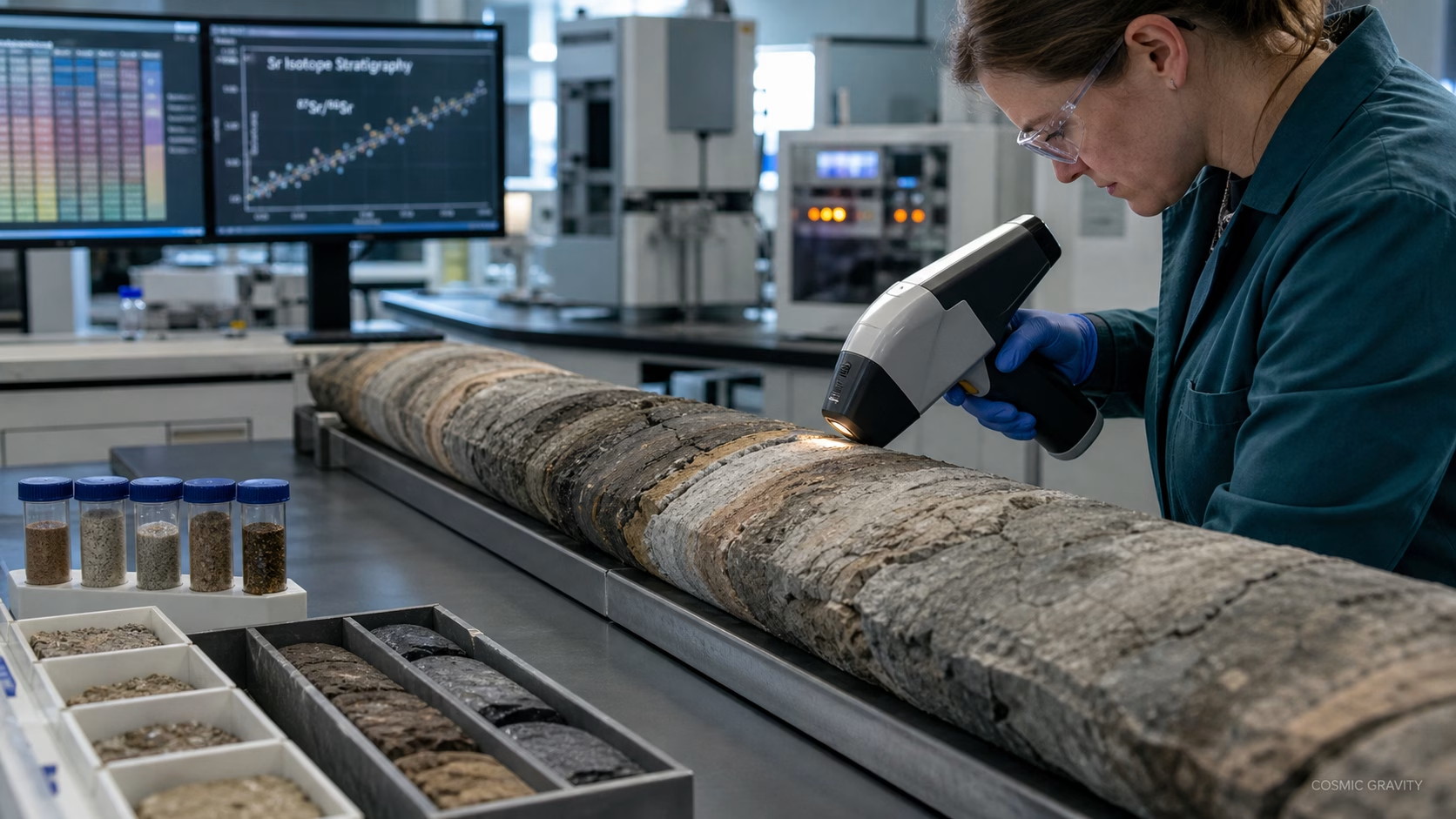
That does not mean every trace would disappear. Fossils, sediments, isotope ratios and minerals preserve remarkably detailed histories. A civilisation lasting only a few thousand years might leave few recognisable machines, but large-scale industry could affect sediments and chemistry far beyond its cities.
What the Silurian Hypothesis actually asks
In 2018, climate scientist Gavin Schmidt and astrophysicist Adam Frank published the Silurian Hypothesis. It is a detection problem, not a claim that a lost civilisation has been found.
The authors asked what our own industrial era might look like in rock millions of years from now. Direct objects would be rare. More widespread signs might include an abrupt change in carbon isotopes, disruption of the nitrogen cycle, unusual metal concentrations, persistent synthetic compounds, rapid warming, erosion and a distinctive pattern of extinctions and species movements.
The name is deliberately playful. The paper does not argue that a civilisation existed during the Silurian geological period, nor does it identify a candidate species.
Why a chemical signal would not be enough
Many proposed industrial markers also occur through natural processes. Volcanism can release enormous amounts of carbon. Climate shifts alter erosion, oxygen levels and biological productivity. Impacts can create unusual mineral layers and mass extinctions.
That overlap is the central difficulty. A carbon-isotope excursion or metal anomaly could justify further study, but it would not establish technology on its own. A credible case would require several independent indicators appearing together, with natural explanations tested first.
What about unusual stones, metals or ancient knowledge?
Spherical rocks, unexpected mineral concentrations and sophisticated ancient astronomy are sometimes collected as evidence for an earlier civilisation. These examples do not form a coherent geological case. Concretions and spheres can form naturally; metals concentrate through well-understood geological processes; and the achievements of historic cultures belong to humans whose tools, settlements and development can be studied directly.
Removing weak examples does not make the central question less interesting. It makes it testable.
What evidence would change the discussion?
A persuasive discovery would need context and replication. Researchers would want a securely dated layer containing multiple unusual signals, evidence that contamination is unlikely, and results confirmed by independent laboratories. A manufactured compound with no plausible natural pathway would be important, especially if accompanied by industrial isotope patterns or materials distributed across several locations.
Nothing meeting that standard has been reported. For a fuller look at possible geological technosignatures, see our newer analysis of the Silurian Hypothesis and industrial traces in ancient rock.
A useful question without a hidden conclusion
The value of this thought experiment is not that it proves somebody came before us. It shows how difficult it may be to recognise industry across deep time, on Earth or on another planet. It also asks what signature our own civilisation is leaving behind.
At present, humans remain the only industrial species known from Earth’s history. Science should stay open to surprising evidence, but it works best when an extraordinary possibility is paired with a clear description of what would count as proof.


latest video


news via inbox
Subscribe to our Cosmic newsletter to get notified when we have new articles.