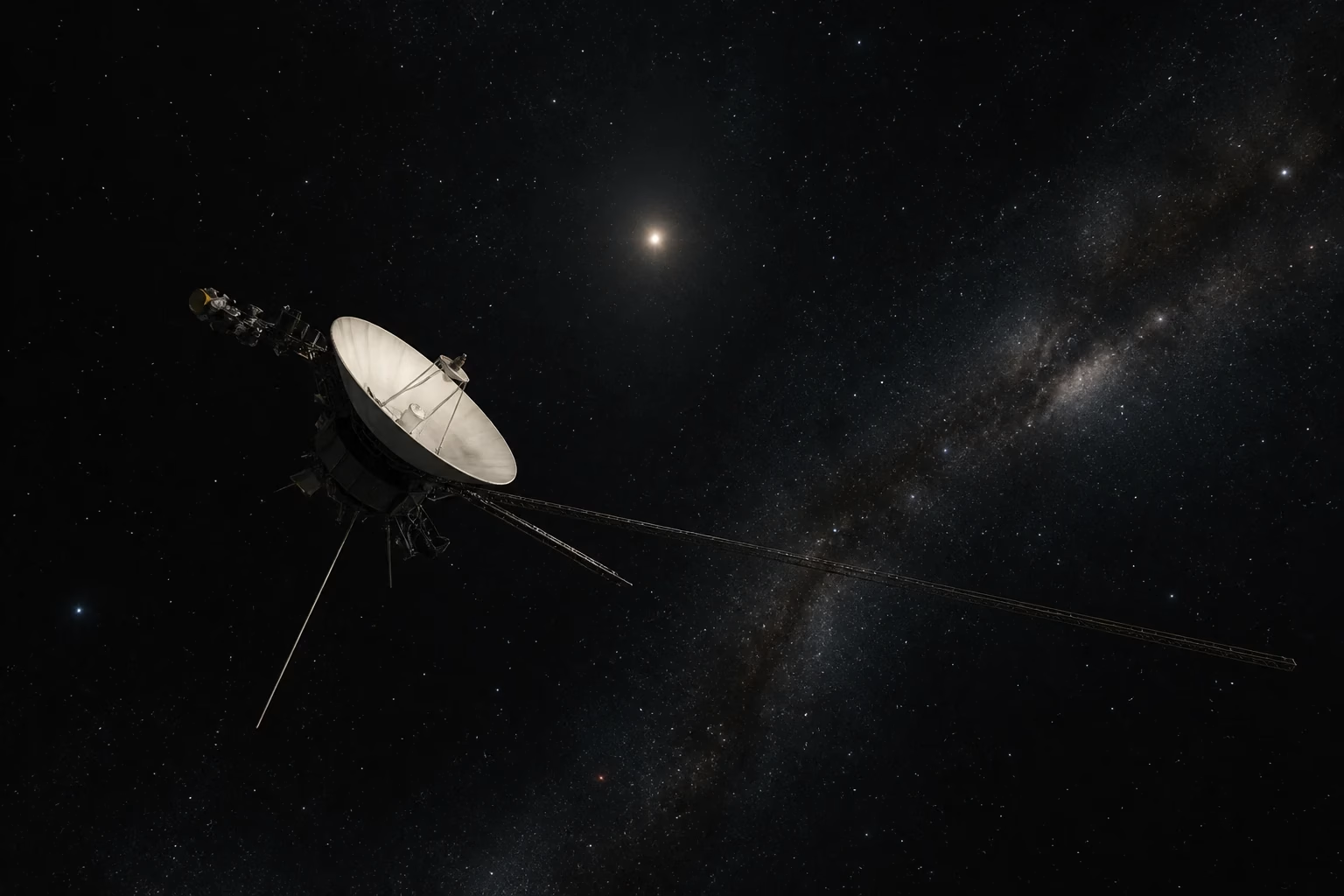
When Voyager Falls Silent: Humanity’s First Interstellar Ghost Ships
One day, somewhere beyond the planets, a carrier tone will fail to rise from the background hiss. Engineers on Earth will listen again. They will check the Deep Space Network, calculate the spacecraft’s position and wait through the long hours required for a command to cross the darkness. Eventually there will be no practical doubt: Voyager has spoken for the last time.
That day is approaching, but it is not scheduled. Voyager 1 and Voyager 2 are powered by radioisotope thermoelectric generators that lose roughly four watts each year. NASA has been turning off heaters and scientific instruments to preserve the remaining power. As of 2026 both probes are still functioning, and careful engineering may keep at least one instrument operating into the 2030s. Their radio signals might remain detectable until roughly the middle of that decade. There is no single official “death date.” There is only a long, disciplined fading.
The spacecraft that gave us the outer planets
Launched in 1977, the Voyagers transformed points of light into worlds. Voyager 1 revealed active volcanoes on Io and intricate rings around Saturn. Voyager 2 remains the only spacecraft to have visited Uranus and Neptune. Its images of Miranda’s broken terrain, Neptune’s storms and Triton’s nitrogen geysers still shape planetary science.
The probes survived because their builders expected the unexpected. Components were redundant, software could be rewritten across billions of kilometres, and teams learned to operate machines using power budgets smaller than a household light bulb. Instruments designed for a five-year planetary tour became the first direct scouts of interstellar space.
Mission timeline
Follow Voyager into silence
Choose a milestone and watch humanity’s longest journey unfold.
Launch from Earth
0 AU · Signal: seconds
Voyager 2 at Neptune
30 AU · Signal: 4.1 h
Voyager 1 enters interstellar space
122 AU · Signal: 17 h
Final contact remains uncertain
>170 AU · Signal: >24 h
Distances and signal times are rounded. There is no fixed official last-contact date.

What silence will mean
The Voyagers will not suddenly run out of fuel and stop. Their plutonium will continue to decay. Their computers may continue following instructions for a time after Earth can no longer hear them. What ends is the relationship: the faint radio bridge joining a 1970s machine to the civilisation that launched it.
Voyager 1 is more than a light-day away, so every exchange already requires patience on a human scale. A question is transmitted. Nearly a day later it arrives. A response takes nearly another day to return. When the final signal disappears, the spacecraft will not know that it has become silent to us.
The Golden Record’s impossible audience
Bolted to each craft is a gold-plated copper record containing sounds and images from Earth: greetings, music, animals, weather, machinery and the pulse of a human heart. The record was never a realistic attempt to communicate with a known recipient. Space is too empty and the trajectories are too remote. It was a statement about the senders.
The records say that for a brief period on a small ocean world, matter learned to remember, to make music and to wonder who might be listening. Even if no intelligence ever recovers them, the gesture remains meaningful because humanity made it.
Ghost ships, but not lost
After radio contact ends, both spacecraft will continue orbiting the centre of the Milky Way. Their motion will be altered by stars over immense spans of time. They are not travelling toward a particular civilisation, and “forever” is poetic rather than literal. Collisions, stellar encounters or the evolution of the Galaxy will eventually change their fate.
On any timescale familiar to us, however, they will endure. Long after their power is gone, the aluminium, titanium and gold will carry the shape of the hands that assembled them.
The final message from Voyager will not be the Golden Record. It will be the mission itself: build carefully, remain curious, and keep listening even when the answer is almost too faint to hear.
Sources and further reading


latest video

news via inbox
Subscribe to our Cosmic newsletter to get notified when we have new articles.