Apophis 2029: Will Earth’s Gravity Trigger an Asteroid-Quake?
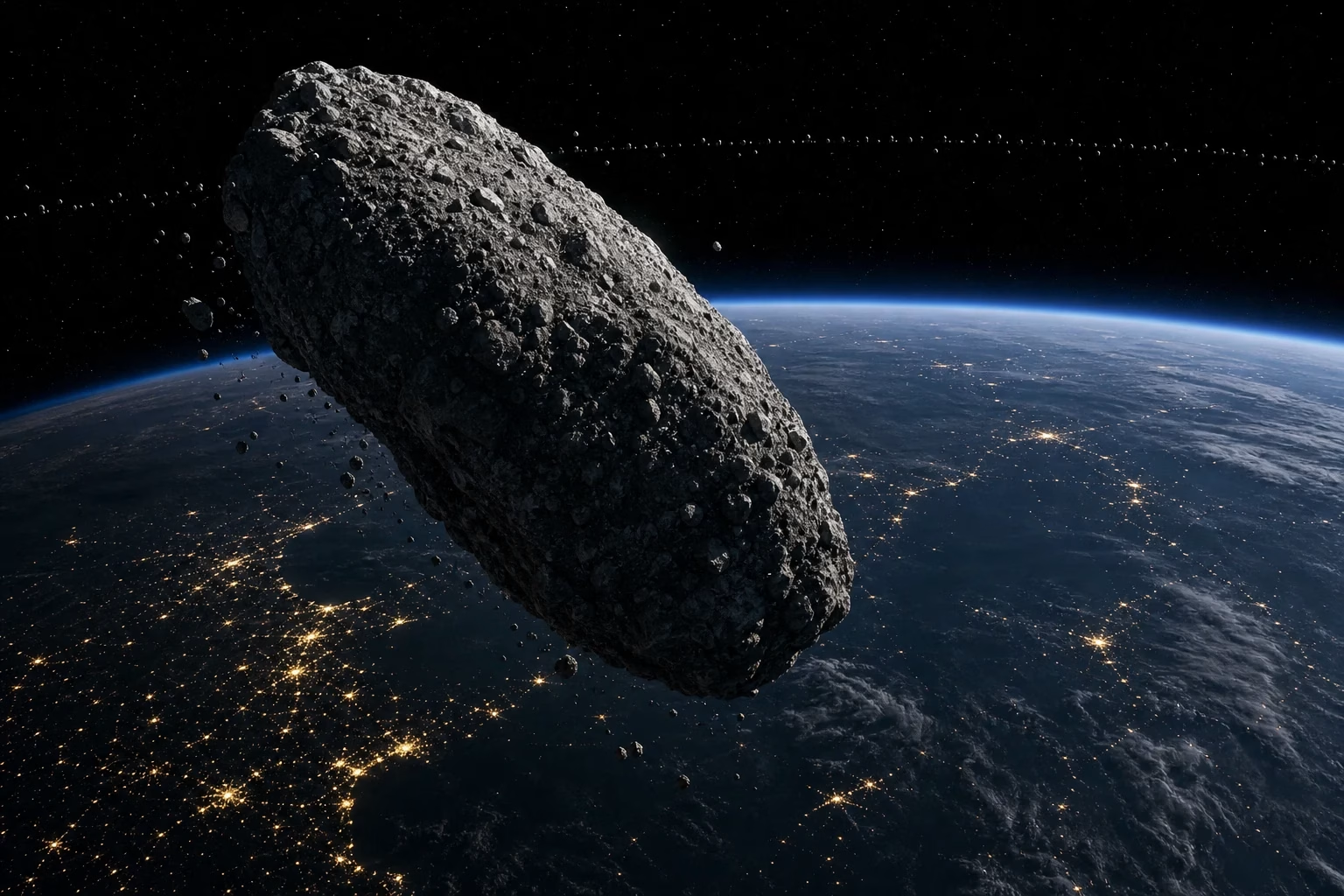
On Friday, April 13, 2029, a rocky body about 340 metres across will race past Earth at a distance of roughly 32,000 kilometres above the surface. Apophis will travel closer than many satellites in geosynchronous orbit and, from parts of the Eastern Hemisphere, appear as a moving point visible without a telescope.
It will not hit Earth. NASA has ruled out an impact for at least a century. The real drama is what Earth may do to Apophis.
A natural stress test
Gravity pulls more strongly on the near side of an object than on the far side. Across a planet the difference creates tides. Across a loosely assembled asteroid, the same gradient can pull, twist, stretch and squeeze the body.
Apophis may be a contact binary or rubble pile: an irregular object held together by weak gravity and friction rather than the strength of solid bedrock. During the flyby, Earth’s tidal forces are expected to alter its orbit dramatically and may change its rotation. Whether they are strong enough to move boulders, open cracks or trigger seismic shaking depends on an interior no one has yet seen.
Scale explorer
How close will Apophis pass?
Select a phase of the safe 2029 encounter.
Approach
~95,000 km above Earth’s surface · no impact
Closest encounter
~32,000 km above Earth’s surface · no impact
Departure
~90,000 km above Earth’s surface · no impact
Scale explainer, not an orbital prediction. Distances away from closest pass are illustrative.

What is an asteroid-quake?
The term does not imply tectonic plates. A small shift inside a rubble pile can send vibrations through the entire body. Loose surface grains might hop in the weak gravity. Steep slopes could collapse. Old weathered material could slide away and expose brighter rock beneath.
Models disagree about how visible the effects will be. Some predict only subtle changes; others allow local landslides or widespread resurfacing. That uncertainty is precisely why the encounter matters. Scientists will observe Apophis before and after the flyby, turning Earth into a known gravitational experiment.
Spacecraft will be watching
NASA redirected the former OSIRIS-REx spacecraft toward Apophis and renamed it OSIRIS-APEX. It will rendezvous shortly after the Earth encounter, map the asteroid and use its thrusters to disturb surface material. ESA is developing the Ramses mission to accompany Apophis through the flyby, allowing a direct comparison of its shape, spin and surface before and after the tidal stress.
Those observations could reveal internal structure that is otherwise almost impossible to measure. Did the spin axis move? Did the shape change? Are fresh patches visible? Do boulders occupy new positions? Each answer improves our understanding of how near-Earth asteroids respond to gravity.
Why this matters for planetary defense
If humanity ever needs to deflect a dangerous asteroid, its interior will matter. A solid monolith, fractured rock and loose rubble pile respond differently to impact or sustained thrust. Apophis provides a rare chance to watch a large near-Earth asteroid undergo a close encounter without the risk of a collision.
The flyby is therefore both spectacle and rehearsal. For several hours, an object once feared as a possible impactor will become the best-observed asteroid in history. If its surface trembles, the quake will not threaten Earth. It will teach us how to protect it.
Sources and further reading


latest video



news via inbox
Subscribe to our Cosmic newsletter to get notified when we have new articles.