AI Chips That Compute With Light: Inside the New 65-TOPS Optical Processor
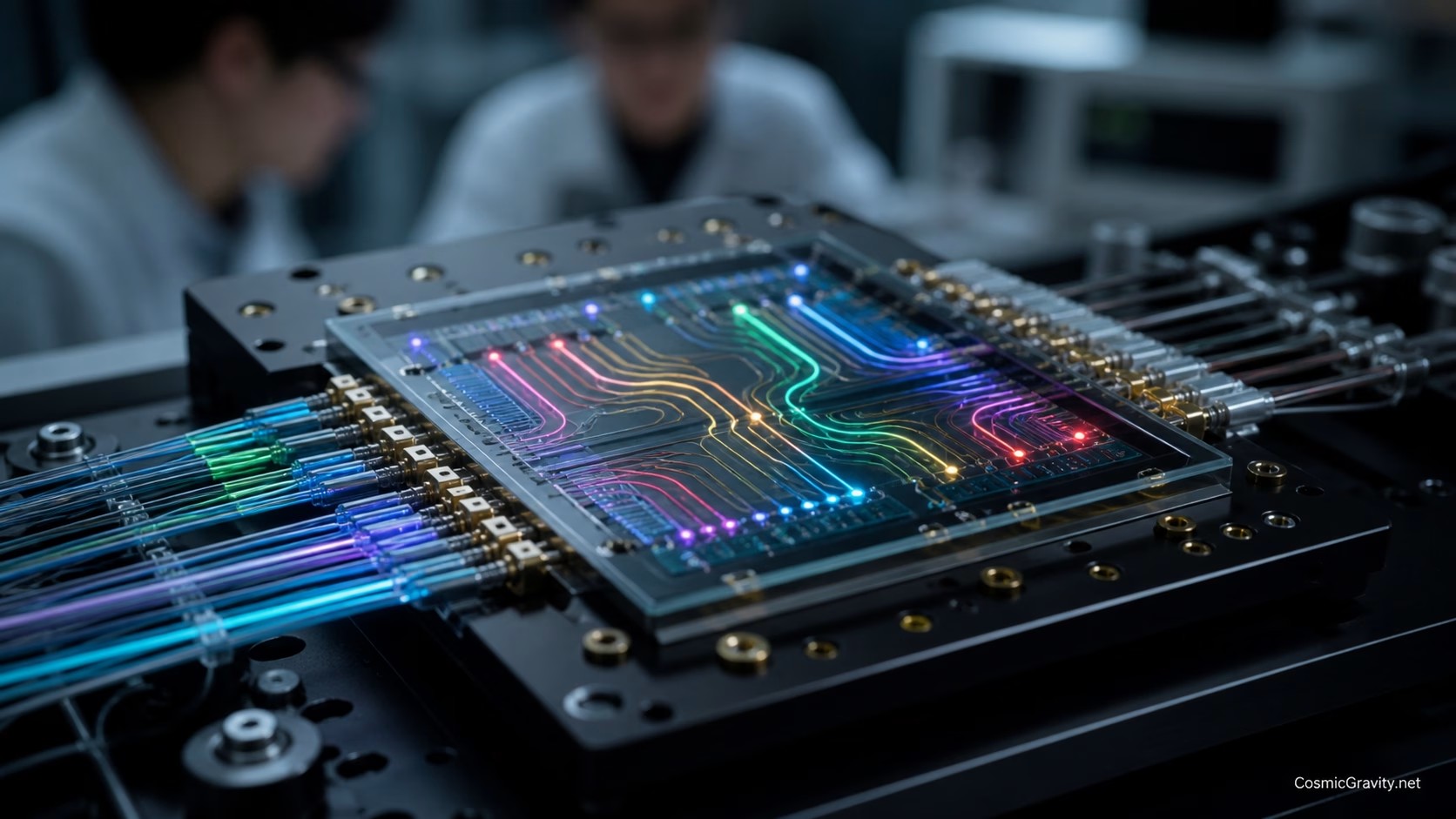
The fastest way to move data across a chip may be to stop treating it as electricity. A photonic processor reported in Nature Communications on 31 July 2026 uses interference, multiple wavelengths and four optical analog cores to perform AI calculations in parallel. The researchers report 65.04 trillion operations per second, or TOPS, on a monolithic device.
The number is impressive. The architecture behind it is more important. Instead of forcing every multiplication through transistors, the chip lets light waves combine so that physics performs much of the linear algebra naturally.
How can light perform a calculation?
Neural networks spend much of their time multiplying numbers and adding the results. In an optical processor, data can be encoded in light intensity, phase or wavelength. When light passes through a configured network of waveguides, splitters and interferometers, the output represents the result of a matrix operation.
That operation happens as the light propagates. There is no electronic clock stepping through every multiplication one by one. Multiple colors of light can carry separate data channels through the same physical path, a technique called wavelength-division multiplexing.
Inside one optical AI operation
- Encode: electronic data modulates several wavelengths of light.
- Distribute: waveguides send signals through four optical cores.
- Interfere: controlled phase and amplitude changes implement mathematical weights.
- Combine: spatial and wavelength channels process many values in parallel.
- Detect: photodetectors convert the optical result back into an electrical signal.
- Activate: electronics apply nonlinear functions and prepare the next layer.
Why four cores are different from one
A single optical core can be fast but limited in the features it extracts. The new optical processing unit integrates four analog cores and applies different convolution kernels in parallel. Their outputs are fused before the rest of the neural network continues electronically.
The authors report 95.08% MNIST classification accuracy and a 9.20% improvement over their single-core counterpart. MNIST is a simple benchmark, so it should not be confused with running a frontier language model. It provides a controlled way to test whether the multi-core architecture improves a complete learning task.
Does 65 TOPS beat today’s GPUs?
The figures are not directly comparable. A GPU TOPS rating typically assumes a digital number format, memory system and defined precision. Optical processors are analog. Noise, calibration and conversion overhead affect their effective accuracy. A meaningful comparison must measure an entire workload from input to output, including lasers, modulators, photodetectors and supporting electronics.
Scoreboard: where optical chips win and struggle
| Potential strength | Remaining bottleneck |
|---|---|
| Massive parallelism across wavelength and space | Electronic-to-optical conversion overhead |
| Fast matrix operations as light propagates | Analog noise and limited precision |
| Low energy for selected linear operations | Memory and data movement outside the optical core |
| High bandwidth inside photonic circuits | Fabrication variation and continual calibration |
| Natural fit for convolution and tensor operations | Nonlinear functions usually remain electronic |
Why AI needs new hardware
Modern AI is increasingly limited by power, cooling and data movement. Moving a value from memory can cost more energy than multiplying it. Data centers therefore need improvements beyond smaller transistors. Photonic computing is attractive because it can process many channels simultaneously while reducing electrical switching inside the mathematical core.
It will probably complement electronics rather than replace them. Digital processors remain excellent at control flow, memory management and precise logic. Photonic accelerators can specialize in the dense linear algebra that dominates inference and some training workloads.
What would make this commercially convincing?
- Results on larger, modern neural networks rather than only MNIST.
- End-to-end energy measurements including lasers and converters.
- Stable accuracy across temperature and manufacturing variation.
- Packaging that connects optical cores to memory at high bandwidth.
- Software tools that let developers use the chip without becoming optical engineers.
The 65-TOPS prototype does not signal the end of silicon computing. It signals a change inside silicon: future chips may combine transistors, memory and optical waveguides on the same package. The cryogenic silicon quantum processor solves a different problem, but both point in the same direction—computing is becoming a systems discipline where physics, packaging and control matter as much as the transistor count.
Light has carried information through fiber networks for decades. The new ambition is to let it transform information before converting it back to electricity. If that transition scales, the AI accelerator of the future may look less like one monolithic processor and more like a carefully choreographed conversation between electrons and photons.
Sources and further reading



latest video


news via inbox
Subscribe to our Cosmic newsletter to get notified when we have new articles.