A Photonic Light Sorter Pulls Hidden Structure from Mixed Beams
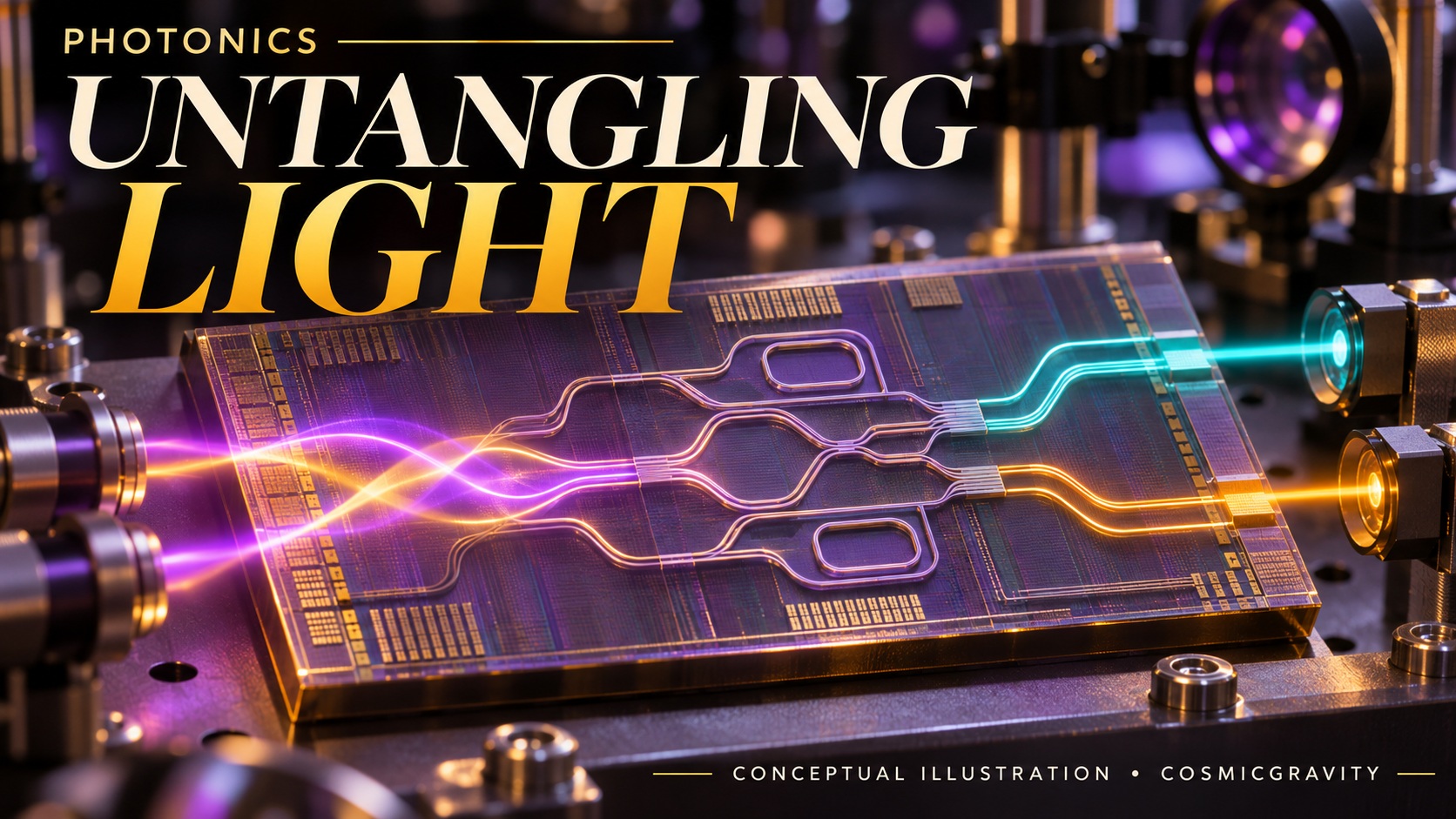
Two light sources can overlap so completely that an ordinary image tells you little about their separate contributions. A new photonic light sorter tackles a deeper property of the light itself: its coherence. Instead of merely calculating what a mixture might contain, a programmable chip directs its underlying components into different output channels.
The study appeared in Nature Photonics on 30 October 2026, followed by a Stanford report on 2 November. It is a laboratory demonstration with possible applications in microscopy and astronomy. It is not yet a new telescope camera or a clinical imaging system.
What the photonic light sorter demonstrated
Paul-Alexis Mor, Anne R. Kroo and colleagues built an integrated silicon-photonic experiment that learns a light field’s coherence modes. Those modes are mathematically orthogonal components with no mutual statistical coherence. The chip physically routes them to separate ports.
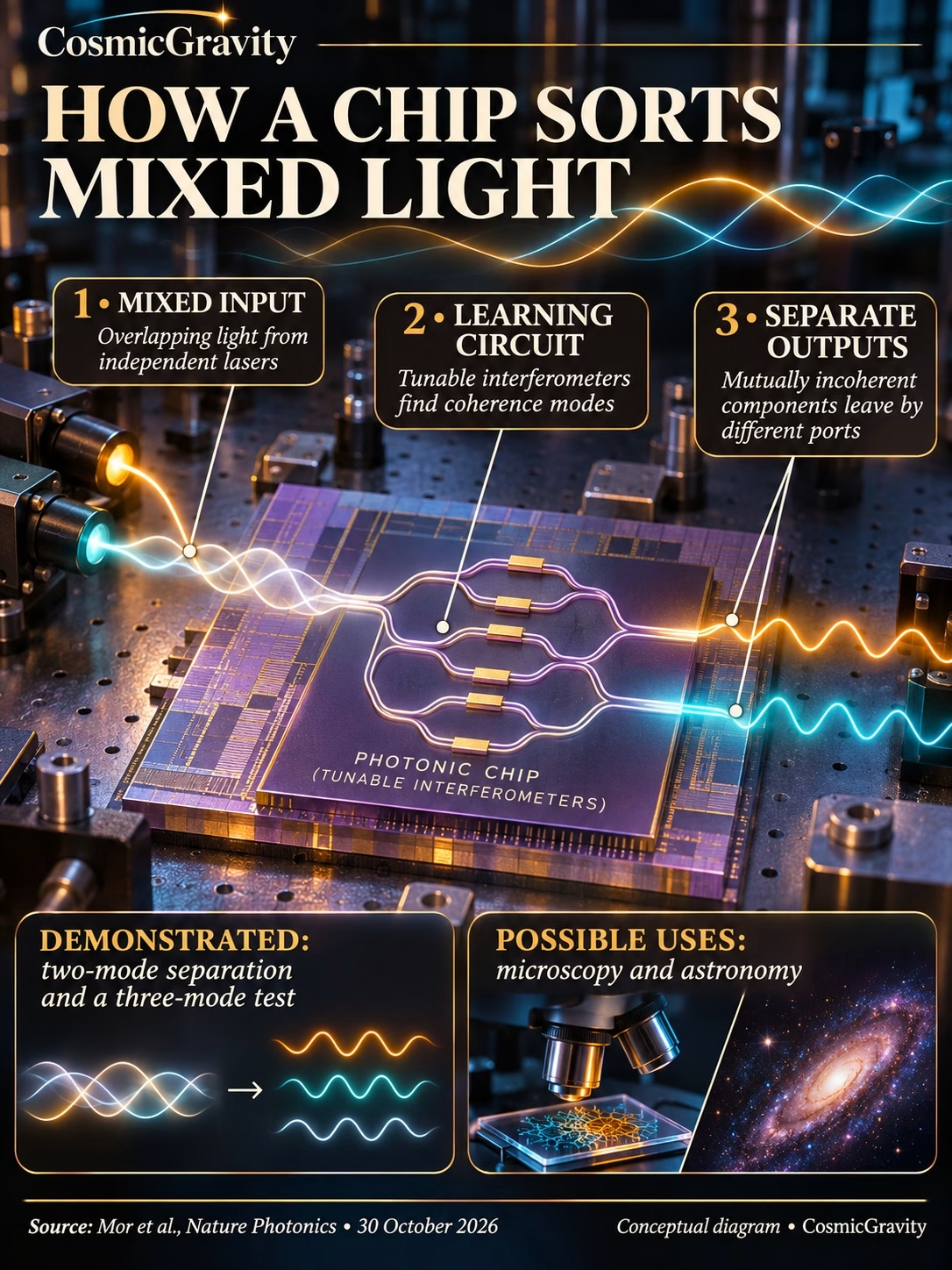
The open-access research paper describes a nine-input experiment separating two dominant modes. A further three-mode test extends the demonstration beyond the simplest pair. These are controlled optical experiments, not a test of every kind of everyday light.
There is an appealing practical distinction here. A numerical reconstruction produces a description of a field. Physical separation leaves light at the output that can undergo more optical processing. A researcher can potentially measure or manipulate those separated contributions next.
Coherence is about relationships between waves
Light has both intensity and wave structure. Intensity tells us how much arrives. Coherence describes statistical relationships within the field: whether wave contributions retain a predictable relationship over the relevant time and space.
A stable laser beam is a familiar example of highly coherent light. Many everyday sources are much less coherent. Partial coherence lies between the idealised extremes. Describing it requires more than taking one brightness reading at each point.
An audio analogy helps, although sound and light are different physical systems. A volume meter can tell you that a room is loud without telling you which voices contribute to the noise. Similarly, an intensity image can hide distinctions that a more complete optical measurement could reveal.
The chip is not reading labels attached to individual photons. It learns statistical structure in the field. That is why “separating coherence modes” is more precise than promising to recover every original source from any arbitrary scene.
How the photonic light sorter learns its settings
The photonic light sorter contains tunable interferometers: structures in which light paths combine and interfere. Changing their settings changes how light moves through the network. A feedback procedure adjusts those settings to extract successive coherence modes.
In the reported experiment, independent infrared lasers supplied overlapping fields. The circuit could separate components even when their intensity patterns overlapped. The researchers also compared the outcome with an on-chip measurement method that reconstructs the mixture.
Calling it a learning circuit does not mean it understands a scene like a person. Here, learning refers to optimisation of an optical network against measurements. That narrower meaning is enough to explain why the experiment matters.
Separate outputs do not mean synchronised outputs
One subtle point can easily get lost in a headline. The output components are mutually incoherent: their fluctuations do not maintain the relevant statistical correlation with one another. Separating them does not force them into a shared rhythm.
Each coherence mode has its own spatial wave structure. The relationship between different modes is a separate issue. Keeping those two ideas apart avoids the misleading suggestion that the chip simply converts messy light into one perfectly synchronised beam.
Stanford’s account of the experiment describes how the team tested the outputs and explains why mutually independent channels are useful. The work brings a theoretical description of partially coherent light into a programmable physical device.
Why microscopists are interested
Two fluorescent emitters may overlap in an image. Distinguishing their light could reveal information that a conventional intensity view obscures. Coherence-sensitive processing therefore offers a different route to studying crowded optical scenes.
That possibility needs testing in realistic conditions. A practical instrument must cope with the light it can collect, noise, losses, stability and the relevant wavelengths. A successful laser experiment does not automatically establish performance on biological samples.
The sensible question is what extra information the method preserves under a defined set of conditions. That question can be measured. A sweeping claim that it will make every microscope sharper cannot yet be supported.
Could a photonic light sorter help astronomers?
Stanford reports that members of the team are exploring astronomical applications with NASA. The motivation is straightforward: light that looks like one unresolved patch can contain structure associated with different emitters. Learning how to separate useful components could expand the information available to an instrument.
The published demonstration does not announce an exoplanet detection. Nor does it remove the difficulties of collecting faint astronomical light. Those are future engineering and observational tests, and readers should be able to distinguish them from the result already achieved.
For another example of how optical measurements shape the search beyond Earth, see our explanation of LaserSETI and brief laser signals. That project asks a different question and uses a different method.
A new optical tool, rather than a universal chip claim
Photonics covers many kinds of devices. Our article on an optical AI chip concerns computing; this experiment concerns the physical structure of partially coherent light. A performance number from one should not be transferred to the other.
The light sorter’s immediate achievement is specific and substantial: a programmable integrated circuit can learn and physically separate coherence modes in controlled mixtures. Whether its next home is a microscope, an astronomical instrument or another optical system will depend on the experiments that follow.



latest video



news via inbox
Subscribe to our Cosmic newsletter to get notified when we have new articles.