
Jersey Airport Drone Sightings: What Two Nights Reveal
The Jersey Airport drone sightings have caused two evenings of flight disruption, a police investigation and an urgent search for the people responsible. Airport and police statements document the disruption. The identity of the operators remains an open question in the statements reviewed for this report.
There is a useful distinction here for anyone who follows UFO and UAP stories: an unidentified operator, an unidentified object and an object of extraordinary origin describe three different things. Jersey’s airport has described the activity as drones. Nothing in the public material examined here establishes an extraterrestrial connection.
This is Jersey in the Channel Islands, off the French coast, rather than the American state of New Jersey. Keeping that geography straight matters when similar search terms bring together very different incidents.
What happened at Jersey Airport?
On Friday, 30 October, police received the first reports at about 8:20pm, with further reports continuing until approximately 10:30pm. Three inbound aircraft initially diverted. One subsequently reached the island later that night. Channel 103’s account of the police appeal records a response involving States and Honorary Police, Channel Islands Air Search, government colleagues and Ports of Jersey.
Searches took place in the west of the island. The appeal sought observations of drones, possible operators, unusual vehicles and relevant recordings. That is a practical investigation into where flights may have originated, rather than an announcement that a particular person or organisation has been identified.
The following evening brought more disruption. In an airport statement reported by Sky News on 1 November, four flights could not land as scheduled on Saturday, 31 October. The airport attributed this to continuing unlawful drone activity. It directed Sunday-morning passengers to their airlines for current information.
Those figures describe different nights and different operational outcomes. They should not be casually added together as seven unique aircraft, seven separate sightings or seven drones. A diverted flight and a cancelled service are also different measures of disruption.
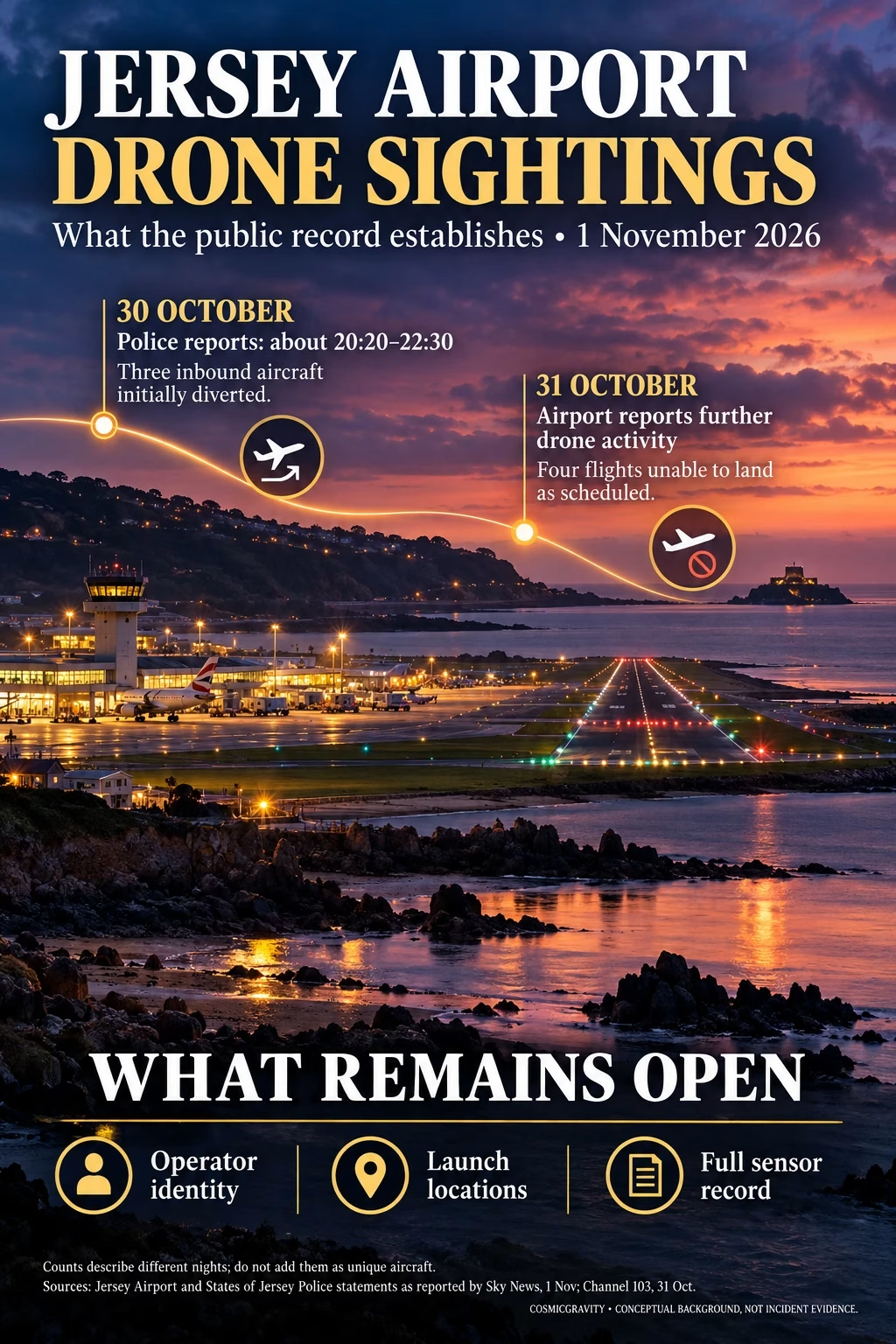
What the Jersey Airport drone sightings establish
The airport’s public response establishes that reports were serious enough to affect operations. Police activity establishes that authorities were investigating. Neither fact, on its own, provides the public with a complete reconstruction of each object’s flight.
Our reading of the evidence is that the strongest part of this story concerns the consequences on the ground. The weaker part concerns attribution: who operated the objects, where they took off and how the individual reports relate to one another. Answering those questions takes evidence beyond an airport closure.
The distinction is especially important with recordings shared online. A short clip can preserve a genuine observation while leaving distance, scale and direction uncertain. A caption may add an identification that the footage itself cannot support. Readers can explore the underlying problems in our guide to UAP video analysis, parallax and sensor effects.
What officials said about the response
Chief Minister Lyndon Farnham said Jersey was working with UK authorities and specialist agencies to explore additional support, better detection and counter-drone technology. His statement, reproduced by Channel 103, also said investigations were continuing and reassured residents about the airport’s safety.
That wording describes work officials are exploring. It does not establish that a new detection system had already been installed, that police had arrested a suspect or that a particular defensive measure had been used. Those would each be separate developments requiring separate confirmation.
A responsible follow-up would therefore look for a dated police update, an airport operational statement or an explanation of what detection equipment actually recorded. Repetition of the same initial statement across multiple websites does not supply additional independent witnesses.
Why airports respond before every detail is known
Jersey Airport’s own drone guidance says that flying within restricted airspace without prior permission from air traffic control is illegal. It also explains that ATC permission does not remove the need to comply with other applicable requirements.
This provides the local context for treating an intrusion seriously. A flight crew does not need to settle every question about a reported object’s origin before air traffic staff make a precautionary decision. Operational caution and a final investigative conclusion serve different purposes.
Consider the questions separately. Is there sufficient concern to delay an approach? What was the object? Can its movement be reconstructed? Can an operator be identified? A defensible answer to the first question does not automatically answer the remaining three.
For readers travelling through Jersey, the useful next step is to check the airline’s current departure or arrival information. A retrospective news article cannot provide a reliable live clearance to travel.
How this relates to UFO and UAP reporting
In the United States, the FAA’s current facility reporting instructions, paragraph 4-7-4, give a useful example of the information investigators seek: the reporting aircraft or observer, location and altitude, the object’s relative position, a description and whether it appeared on radar.
These are US procedures, not the rules governing Jersey. Their value here is explanatory. They show why an original report with timing and position information can be more useful than a dramatic interpretation attached to a compressed video.
Our UFO and UAP case atlas applies the same separation between an observation, the record documenting it and later interpretations. Jersey currently belongs in a developing aviation-security story. It should not acquire an alien explanation merely through association with older unresolved cases.
Detection is a wider technical problem
The European Commission has scheduled the inaugural D-TECT forum for 11 November 2026. Its agenda covers drone and counter-drone cooperation, including detection, tracking, sensors, secure connectivity and navigation. That planned meeting is wider context, rather than a response announced specifically for Jersey.
The range of topics is revealing: spotting something, following its path and establishing its source are connected jobs, but they are not interchangeable. A future equipment announcement should be judged by the specific capability it adds.
Jersey Airport drone sightings: what to watch next
The most informative next developments would be a supported identification of an operator, a clear account of a launch or landing location, or a technical summary linking observations to recorded tracks. If authorities release that material, the assessment can become more precise.
Until then, two propositions can stand together: the disruption deserves serious attention, and its unresolved details deserve careful language. That approach also informed our separate examination of drone reports around nuclear sites. An unanswered question is a reason to investigate, rather than a substitute for an answer.
Reporting note: Checked on 1 November 2026. Incident details above are attributed to airport and police statements reproduced by the linked news organisations; we have not independently examined the underlying surveillance data. The illustrations are labelled conceptual imagery. Sources are linked beside the claims they support.



latest video



news via inbox
Subscribe to our Cosmic newsletter to get notified when we have new articles.