
Drones Over Nuclear Sites: What 67 NRC Reports Do—and Don’t—Show
Reports of drones over nuclear sites deserve serious attention. Newly released records also deserve a careful reading: a count of reports is not a count of aircraft, and an unresolved entry does not identify an exotic origin.
That distinction is especially useful for readers following UFO news. The interesting question here is what witnesses reported near sensitive infrastructure—and what the public paperwork lets us check.
Original AI-assisted CosmicGravity magazine illustration. The scene and any inset imagery are conceptual; this is not a documentary photograph, an actual artefact or measured observational data.
What reports of drones over nuclear sites cover
Liberation Times reported on 7 October that the FOIA release contains 67 reports involving 28 named sites in 17 states. The register dates span February 2024 to March 2026. Those figures describe the released collection, not every drone flight near every American nuclear facility.
The underlying table is more useful than a headline alone. It separates the site, report date, status and incident description. That makes it possible to ask whether a claim comes from an observation, a later update or a summary written elsewhere.
One entry shows why the counting matters
We checked the first pages of the scanned NRC records. A Byron entry dated 25 March 2026 describes activity beginning the previous night. Its narrative says security officers and local law enforcement identified two separate drones.
That is one report describing more than one aircraft. Elsewhere on the first page, another entry describes a group of several reported UAVs. Adding rows therefore cannot produce a reliable aircraft total.
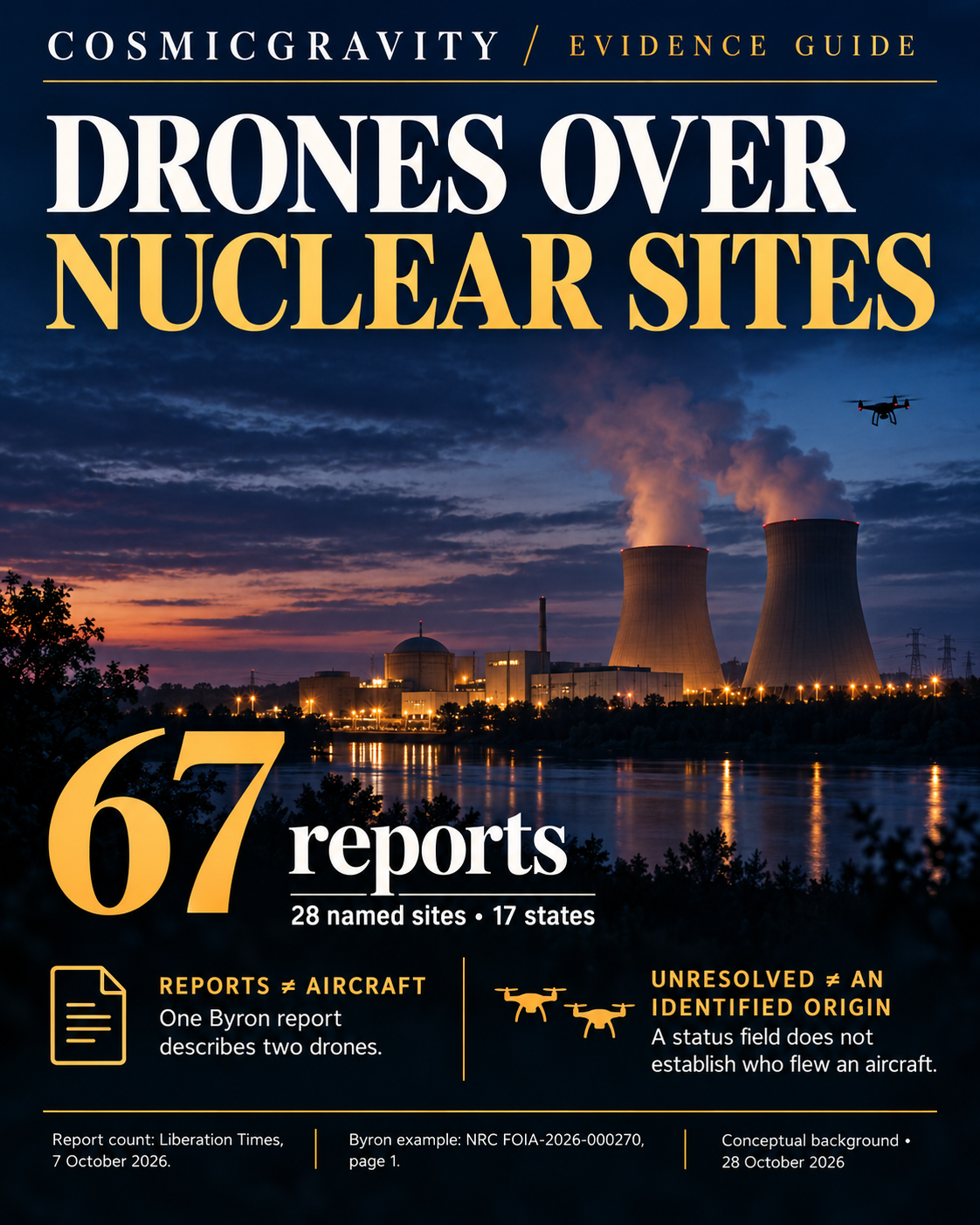
The table contains another trap for hurried readers. The status column says “Closed Unresolved”, while narrative text says a report remains open pending review. Those fields should not be flattened into a claim that every relevant agency permanently failed to identify an operator. The release does not establish that conclusion.
Why nuclear security officials collect these accounts
The NRC’s drone security fact sheet says its 2024 reporting changes require licensees to notify the commission and other authorities about drone sightings. A reporting system is designed to capture information that may need checking. Inclusion alone is not a verdict on intent.
The agency also describes several layers of plant protection, including hardened structures, surveillance and armed security. It says plant security personnel do not have authority to interdict drones. A reported flight and an immediate decision to bring an aircraft down are therefore separate issues.
What would make the evidence stronger?
An account becomes easier to assess when its timing, location and supporting records can be compared independently. An operator identification or a matching flight record would answer different questions from a witness’s description of lights.
Our coverage of the released Utah investigation report uses the same approach: preserve what the document actually says, then keep interpretation visible. These NRC records justify scrutiny of drone activity. They do not establish an extraterrestrial explanation.



latest video



news via inbox
Subscribe to our Cosmic newsletter to get notified when we have new articles.