Carl Sagan: Cosmos, the Search for Life and a Planet Worth Protecting
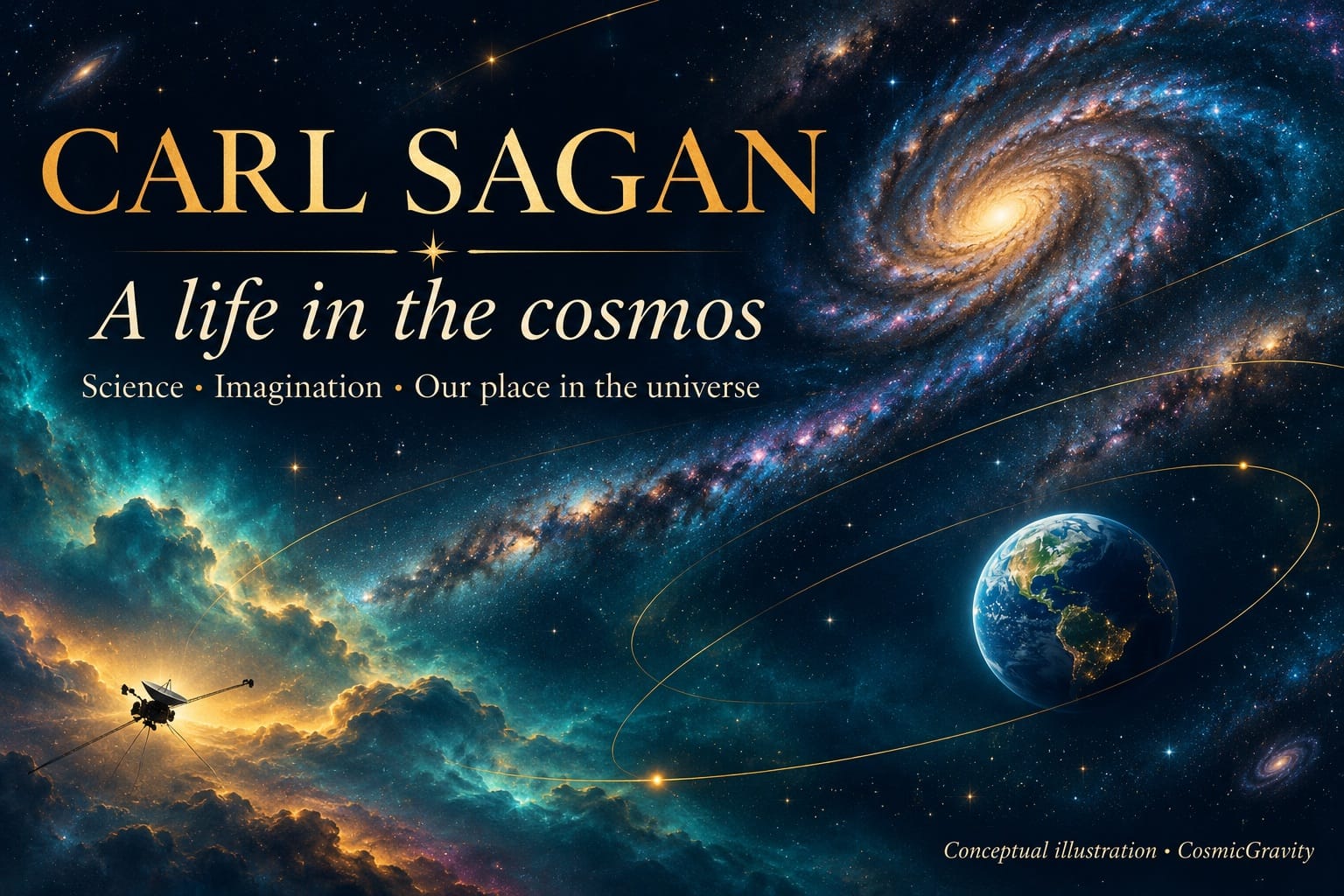
Carl Sagan gave millions of people a way to feel at home in a universe almost beyond imagination. Through Cosmos, his books and his public appearances, he turned planets, stars and the search for life into a shared human story. Behind that voice stood a working scientist whose questions helped shape the exploration of the Solar System.
He wanted to know why Venus was so hot, what changed the appearance of Mars, how complex chemistry developed on other worlds and whether humanity could recognise life at a distance. He also wanted people outside science to understand why those questions mattered. The researcher who studied planetary atmospheres, the presenter who guided viewers through Cosmos and the advocate who asked humanity to protect Earth were pursuing connected concerns. How do worlds work, how do we find out, and what do we do with that knowledge?
The making of a scientist · Research · The original Cosmos · SETI and Voyager · The Pale Blue Dot · Public life · Books and legacy · Sources
Who was Carl Sagan?
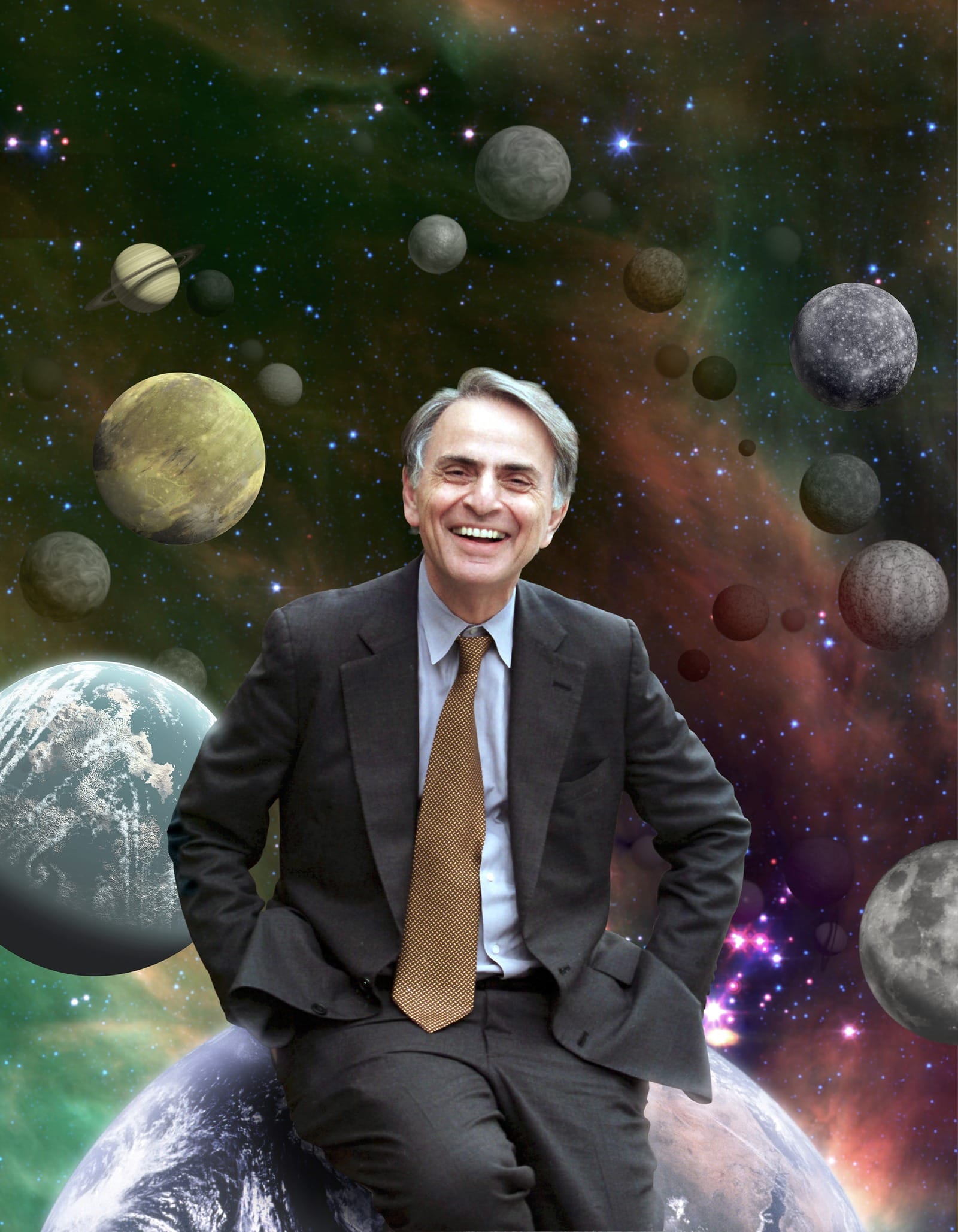
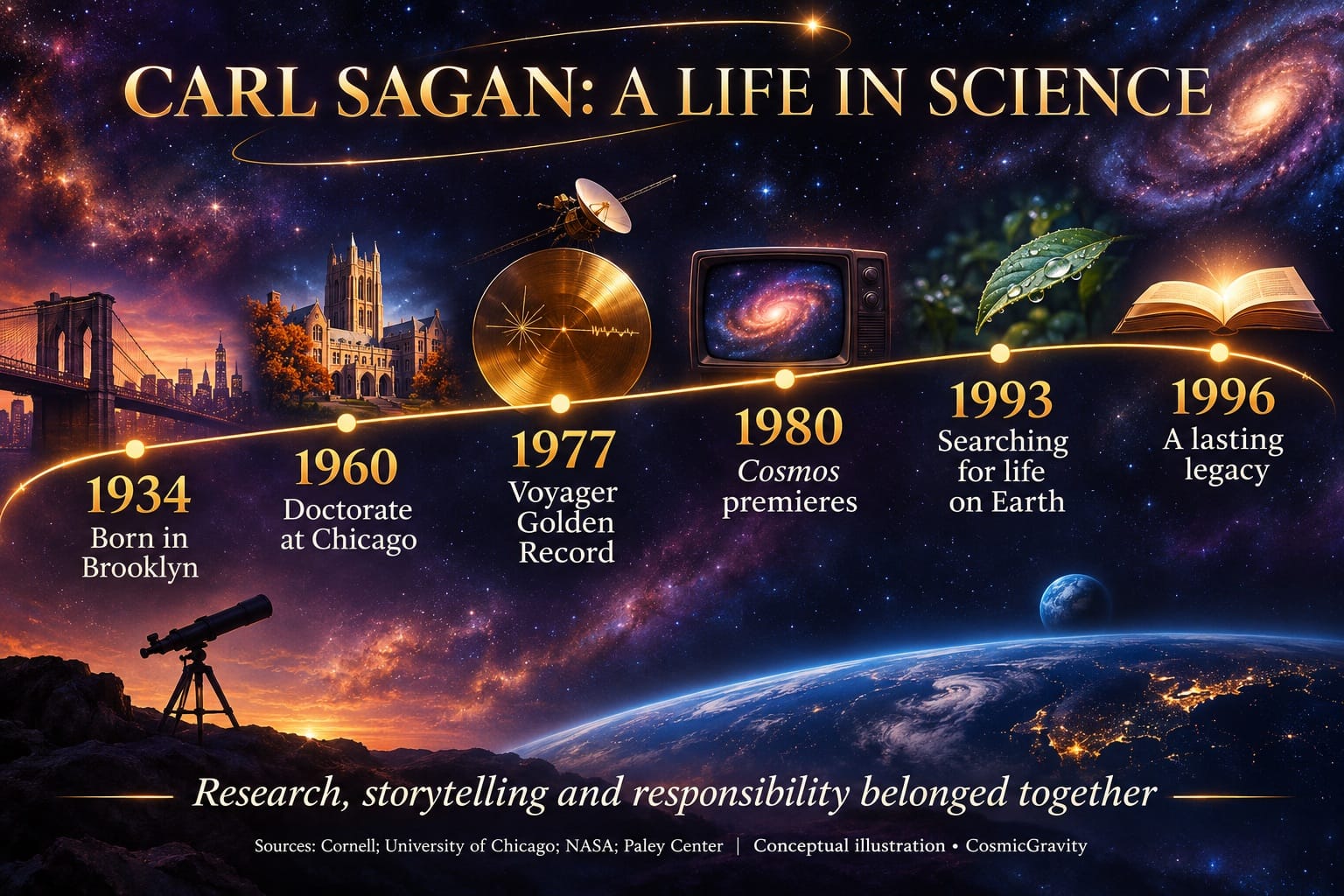
Carl Edward Sagan was born in Brooklyn on 9 November 1934 and died on 20 December 1996, aged 62. He was an astronomer and planetary scientist, an influential science writer, a university teacher and one of the central figures in bringing the search for extraterrestrial life to a broad audience.
David Morrison’s National Academy of Sciences memoir describes a childhood shaped by books, science fiction and curiosity about the natural world. Sagan later studied at the University of Chicago, completing his doctorate in 1960 under astronomer Gerard Kuiper. Chicago also offered a broad intellectual education. A question about a planet could lead Sagan to a question about ancient observers, the reliability of a story or the future of civilisation. National Academy of Sciences memoir.
From Chicago to Cornell
The University of Chicago records four degrees across his years there, an AB in 1954, SB in 1955, SM in 1956 and PhD in 1960. After early academic appointments, including Harvard, he moved to Cornell in 1968. At Cornell he became the David Duncan Professor of Astronomy and Space Sciences and directed the Laboratory for Planetary Studies. He helped build the field as an editor of Icarus and mentored scientists who went on to lead research of their own. University of Chicago alumni record · Cornell faculty memorial.
What did Carl Sagan contribute to science?
Why Venus is so hot
Before spacecraft could measure conditions close to the surface, astronomers had to interpret signals from a planet hidden by clouds. Venus was exceptionally bright at radio wavelengths. A crucial question was whether the emission pointed to heat at depth or to processes high in its atmosphere. Sagan explored the implication that a dense atmosphere could sustain a very hot surface. Spacecraft measurements supplied more direct constraints, and later missions characterised the atmosphere and surface in far greater detail. The work was part of a wider effort to understand how much an atmosphere can change the fate of a world. The Planetary Society’s scientific biography · JPL’s history of early research on Venus.
Why Mars seems to change colour
Seasonal darkening on Mars historically invited comparisons to changing vegetation on Earth. Sagan helped investigate a mechanism that could produce changing patterns by moving dust across the Martian surface. Wind can remove a bright layer or deposit new material over darker ground. Images taken at different times then look different even if the underlying terrain is the same. That lesson is still useful in astrobiology. A changing pattern only becomes a meaningful clue once researchers understand the nonbiological processes that can produce it. JPL images and interpretation of Martian dust deposits.
Titan and the chemistry before biology
Titan’s haze is another example of a puzzle that becomes clearer once researchers can reproduce part of it. Experiments in Titan-like gases generate complex organic materials. Sagan and colleagues helped develop this line of work. Organic chemistry describes compounds and reactions, so it supplies a way to study the raw materials that might matter to life. Organisms would require separate evidence. Later experiments tested how changes in the mix of gases and energy driving the reactions could affect the products. JPL’s Titan haze experiment.
Helping spacecraft ask useful questions
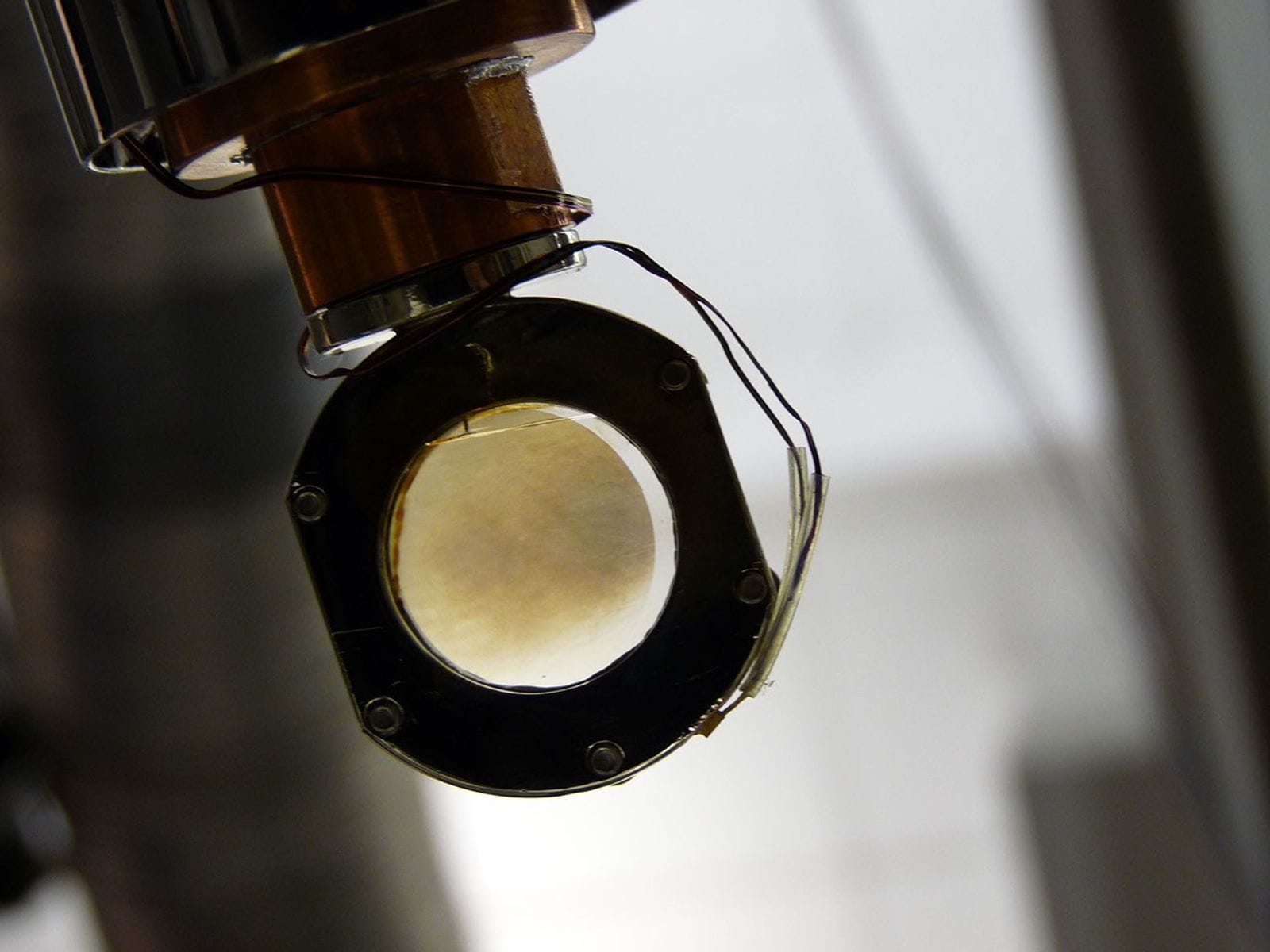
A spacecraft has a limited set of instruments, a finite time to observe and often only one chance to look at a target from a particular position. Scientists have to say in advance which measurements will distinguish their explanations. Sagan helped advise or participate in several U.S. planetary missions, including work associated with Mariner, Viking and Voyager. Cornell’s account records his broader role in planning robotic exploration and communicating what it was finding. Cornell’s obituary and mission history.
Galileo turns the search for life back on Earth
Sagan and colleagues treated an Earth flyby by Galileo as a test of remote life detection. From a spacecraft’s perspective, a living world has to reveal itself through light, chemistry and other measurements. The team assessed oxygen, methane and a near-infrared surface signature associated with photosynthetic vegetation, and examined narrow-band radio emissions in the search for a sign of technology. They had the advantage of knowing the answer and could ask which signals would remain persuasive if Earth were a distant world. Their result helped frame the modern question of how to combine independent clues before interpreting a planet’s atmosphere. 1993 Galileo life-detection paper · CosmicGravity’s report on lifeless-Earth models.
COSMOS and the art of showing how we know
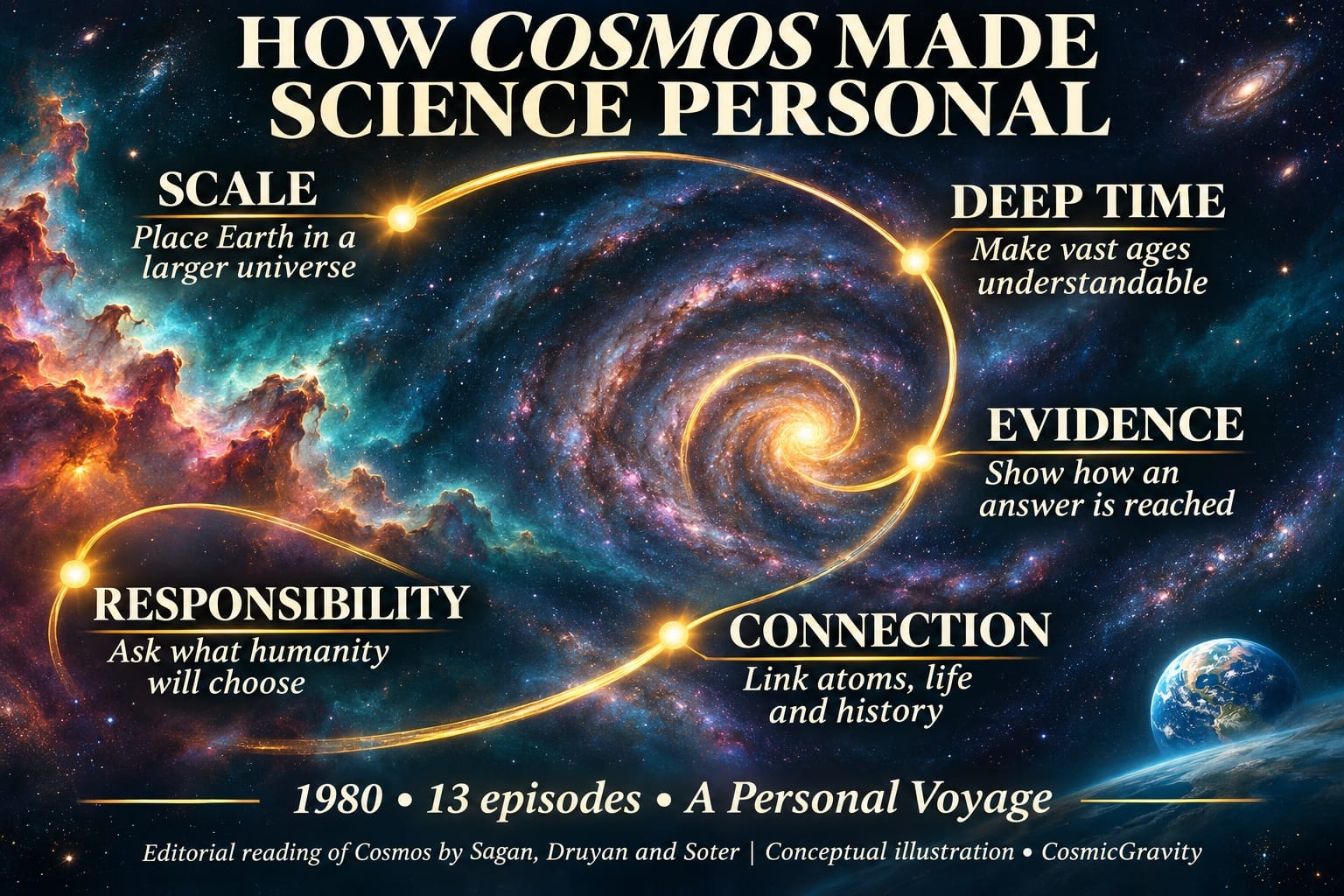
Cosmos: A Personal Voyage began its U.S. public television run on 28 September 1980. Over thirteen episodes it moved between the scale of galaxies, the chemistry of life, the work of historical astronomers and the choices confronting people on Earth. Sagan hosted and co-wrote the series with Ann Druyan and Steven Soter. The programme depended on a production team that could turn an abstract idea into images, sound, pacing and a story an audience could follow. Paley Center premiere and production credits · Peabody’s citation.
The term personal voyage describes a point of view. In the series the viewer moves with a guide who explains why one question leads to another. A sequence about the scale of space might lead to the beginnings of life. A bit of astronomy might give way to the story of someone struggling to make sense of records gathered by someone else. Sagan’s familiarity with planetary science mattered, and Druyan and Soter helped shape the stories that carried the science.
The Ship of the Imagination
The Ship of the Imagination gave the series a way to travel beyond ordinary viewpoints. The camera could move out through the Solar System or bring the viewer down to a scale far smaller than a person. The device carried no claim that an actual spacecraft could make such a journey. It provided a way to keep asking what an object would look like from another distance or what a process would reveal if time moved at a different speed.
That change in viewpoint was one of the show’s most useful choices. People who know the Earth from streets, horizons and maps can see it as a planet among planets. A viewer who knows a star as a point can then ask how light travels, how stars differ, or how an atmosphere changes the view. Each visual decision made a question available to someone who had never taken a course in astronomy.
The Cosmic Calendar makes deep time graspable
The Cosmic Calendar compresses the history of the universe into a single year. Familiar units such as months, days, hours and seconds do the work. Once the Big Bang and the present are placed at opposite ends, stars, planets, complex life and human history have to fit inside the same interval. The striking result is how late recorded human history arrives. The format gives the viewer a way to compare spans that are hard to imagine as numbers alone.
The calendar also provides an exercise in scientific revision. Estimates have changed since the original broadcast. A viewer can use updated dates and build the calendar again. The insight survives because the comparison follows from a method anyone can repeat. It is the same distinction Sagan relied on as a researcher. A result becomes more informative when we can see where it came from and what happens if we change an input.
Eratosthenes and the geometry of shadows
One of the series’ most memorable explanations starts with the difference between two shadows. In the traditional account, the midday Sun was overhead at Syene at the summer solstice and cast a measurable shadow at Alexandria. With sunlight treated as nearly parallel and a distance between the two locations, a difference in angle can be turned into an estimate of Earth’s circumference. The viewer can see a particular measurement become a statement about the whole planet.
The historical details are more complicated than a short reconstruction can show, and the result depends on how accurately the locations and distance are known. Those details strengthen the lesson. Practical problems of measurement are part of science. The series made viewers feel able to ask what the method assumes and where uncertainty enters. Paley Center catalogue for the opening episode.
Stars and the atoms in living things
When Cosmos connects human bodies with stellar history, it gives physical content to a feeling of connection. Stars and stellar explosions helped produce and disperse many elements. Earlier generations of stars changed the material available to later worlds. The carbon and oxygen in an organism have a history that begins long before biology.
There is a useful qualification. Different elements and even different isotopes have different origins. Much of the hydrogen traces back to the early universe. Later astrophysical processes account for many heavier nuclei. The programme’s achievement was to make people curious about a relationship that scientists can now trace in far more detail.
What an analogy can do
The fourth-dimension sequence starts from a world a viewer can picture. A flat world gives its inhabitants a particular set of expectations, and a visitor from a higher dimension could surprise them in ways the viewer understands. The exercise shows that limits of perception can make an ordinary event in one model seem bewildering from within another.
The analogy works because the assumptions are visible. A viewer can follow a chain of reasoning without treating the example as a measurement of the real universe. That care makes Sagan’s demonstrations useful outside their original setting. A classroom, museum or film can use a visual representation to ask a better question, then turn to observation to decide among explanations.
The thirteen episodes in order
- The Shores of the Cosmic Ocean
A journey outward from Earth and a demonstration of how a shadow can help measure our planet. - One Voice in the Cosmic Fugue
The common ancestry of life and the way evolution can generate diversity. - Harmony of the Worlds
Johannes Kepler’s efforts to find laws in records of planetary motion. - Heaven and Hell
Venus and the conditions that can turn a neighbouring world into a very different environment. - Blues for a Red Planet
The history of imagining life on Mars and the arrival of spacecraft evidence. - Travellers’ Tales
The Voyagers and the long history of exploration through unfamiliar territory. - The Backbone of Night
Human attempts to make sense of the lights in the night sky. - Travels in Space and Time
The relationship between looking across space and looking back in time. - The Lives of the Stars
The life cycles of stars and the elements they help make. - The Edge of Forever
The origin, scale and possible futures of the universe. - The Persistence of Memory
Ways that organisms and societies preserve information. - Encyclopaedia Galactica
How to search for intelligence and what an exchange with another civilisation might involve. - Who Speaks for Earth?
The responsibilities that accompany the power to change life on Earth.
The sequence gives Cosmos its shape. Its early episodes build a sense of scale and work back toward questions about life and the motion of the planets. Its middle episodes give travel, history, observation and physical laws room to develop. The final chapters ask what it means for living beings to remember, communicate and make decisions with long consequences. The series can be revisited by following one of those ideas through the run. Paley Center archive.
Why its ending returns to Earth
The final episode asks who can speak for Earth. A small world on a cosmic scale still contains everyone on whose behalf any speaker could claim to act. That fact does not yield a political programme by itself. Sagan makes an argument about responsibility from a shared situation. A civilisation capable of extraordinary technologies has to decide how to use them, and future people have no place at the table when those decisions are made.
You can see the same concern in the earlier history of the series. A persuasive answer takes observation, patience and willingness to be corrected. Achievement is uneven. People who work on a problem can hand on ideas and evidence that outlive them. The last episode applies a version of that thought to the responsibilities of the present.
What happened after the original series?
Cornell’s memorial credits the series with reaching roughly half a billion viewers worldwide over time. The later Cosmos: A Spacetime Odyssey in 2014 and Cosmos: Possible Worlds in 2020 are separate productions presented by Neil deGrasse Tyson. Druyan continued the creative work, drawing on a tradition in which science can invite viewers into questions beyond a single episode. Sagan died in 1996. The separate production histories also explain why they present different snapshots of science. Cornell faculty memorial · Library of Congress Sagan–Druyan archive · CosmicGravity’s report on the later series.
A modern viewer brings a much richer account of planetary systems around other stars than the original audience could have possessed. Contemporary instruments can ask questions about atmospheres and distant worlds that earlier researchers could only begin to frame. Watching the original today gives two perspectives at once. We can experience a well-made work of television and see which questions led to decades of new work. The short archival selections above offer a starting point, with direct watch links beside the players.
SETI and messages to the stars
The search for extraterrestrial intelligence begins with a practical problem. We do not know whether anyone is transmitting, what technology another civilisation might use or when to listen. The question is still amenable to observation. A survey can state which stars, frequencies and times it covered and how sensitive its instruments were. A negative result then tells us something about the portion of the search we actually did.
Sagan was willing to take the possibility of other minds seriously. He also recognised that the more unusual an explanation is, the more work it takes to distinguish it from interference, coincidence and natural processes. Radio observations were attractive because radio waves can cross interstellar distances and because astronomers already had instruments for studying them. The search engages several different questions at once. How often does life begin? Under what conditions does it become detectably technological? And how long does any detectable stage last? Sagan’s work made room for both the scientific programme and the fact that much remained unknown. The Planetary Society’s scientific biography · CosmicGravity on the search for optical signals.
Pioneer and the problem of a shared language
The plaques flown on Pioneer 10 and 11 approached the communication problem from the other direction. A message attached to a spacecraft has to be intelligible to someone who may know nothing about its builders. The team used diagrams, including a representation of the hydrogen transition and a pulsar map, to convey units and a point of origin. Carl Sagan and Frank Drake were involved in the design, and Linda Salzman Sagan drew the human figures.
The plaque makes the constraints visible. The creators had to select which knowledge might be shared with another technological culture and leave out a great deal about the people who made the object. The diagram can be studied today even if the spacecraft never encounters anyone able to read it. NASA’s Pioneer 10 mission account · National Academy memoir.
The Voyager Golden Record as a collective self-portrait
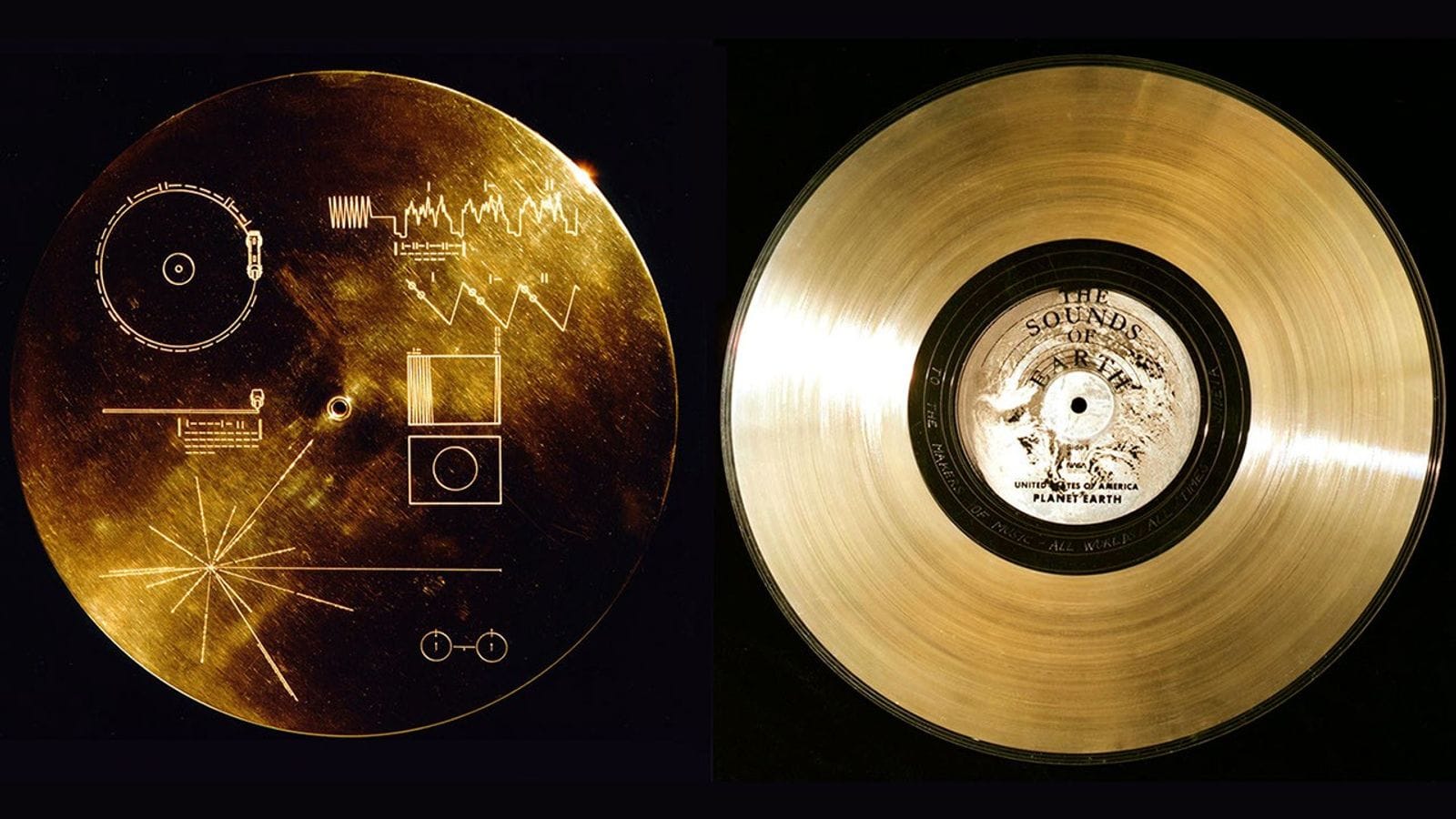
For the Voyager missions, launched in 1977, the message could include more than a plaque. Sagan chaired the committee selecting sounds, music, greetings and images for the Golden Record. Ann Druyan, Frank Drake, Timothy Ferris, Jon Lomberg and Linda Salzman Sagan played important roles in the project. A protective cover carried diagrams for how to play the record and reconstruct its images.
The contents range from natural sounds to human voices and music. They reflect difficult editorial choices about how to present one world, who speaks and what is left out. A record small enough to travel on a spacecraft can only sample life on Earth. Its makers found a way to communicate abundance within that limit. The unlikely prospect of an encounter was also an opportunity for people on Earth to listen to their own choices. NASA’s history of the Golden Record.
The Pale Blue Dot
On 14 February 1990, Voyager 1 turned its cameras back toward the Solar System. Earth appeared as a speck in a band of scattered sunlight. Sagan had advocated for such a view, part of a final family portrait taken after the spacecraft’s planetary encounters. The picture’s meaning depends partly on knowing how little visual information about our world fills the frame. Even on an image that has been carefully reprocessed, the individual people, landscapes and events Sagan talks about cannot be distinguished. NASA’s history of the photograph.
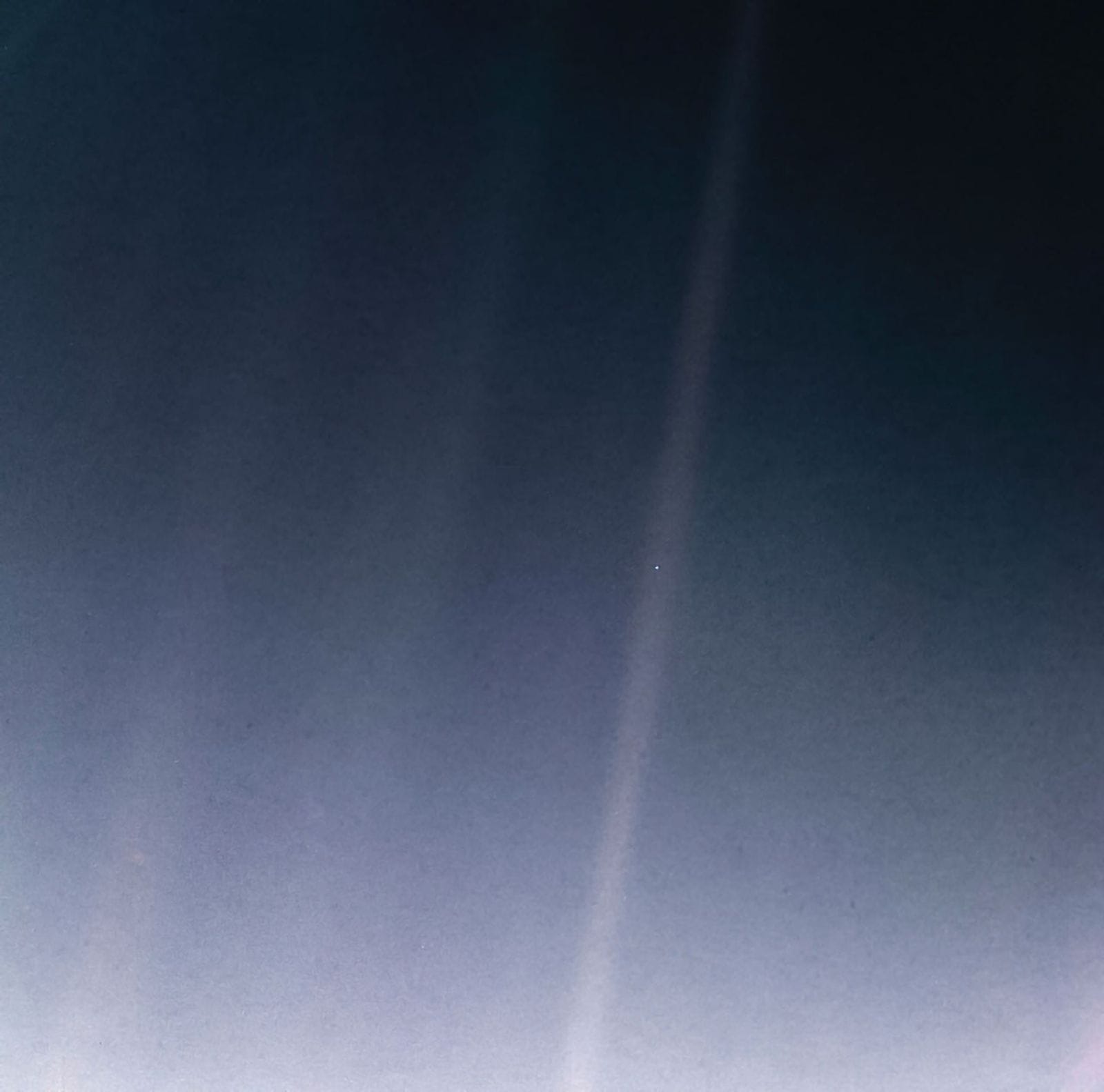
Sagan’s later reflection starts with a physical fact and makes an ethical argument. From Voyager’s vantage point, no country or quarrel stands out. The people involved still matter. The photograph gives us a way to see smallness and consequence together. It could be moving for a person who has never read Sagan’s argument, and people who find it moving can still disagree over what obligations follow from it.
Science, public responsibility and the risks of power
Nuclear winter
Sagan was one of the authors of the 1983 study commonly referred to as TTAPS, after the authors’ surnames. The study examined a possible climate consequence of nuclear war. Smoke from large fires could block incoming sunlight and cool the surface after the immediate destruction. Modelling allowed the researchers to explore a chain from fires and atmospheric particles to changes in climate. Outcomes depend on assumptions about how much material enters the atmosphere, its properties and how long it remains there. The ability to revise those assumptions is part of how the subject developed. The original TTAPS study.
What linked this work to planetary science was a way of thinking about coupled processes. An atmosphere moves substances, scatters and absorbs radiation and connects places far beyond the place where an event started. A small group of people may make the decisions that create the hazard, while societies far away have to live with its effects. Sagan used that connection in public discussion, where the assumptions and consequences of the models both mattered.
Critical thinking as a practice
In his writing Sagan encouraged readers to look for independent confirmation, consider competing explanations and ask what would show that a claim is wrong. Each habit has a consequence for ordinary decisions. An impressive number can depend on an uncertain estimate. A claim can sound convincing because the alternatives have disappeared from view. Several accounts can ultimately come from the same witness. Asking how we know gives readers a way to participate in the argument.
The same habits support curiosity. Someone can consider an explanation seriously and still ask what it predicts. Sagan’s best demonstrations are inviting because they give the audience enough information to do part of the reasoning themselves. His books make room for the further step of testing a favourite idea when new evidence arrives.
The Planetary Society
Sagan co-founded The Planetary Society with Bruce Murray and Louis Friedman. The organisation gave supporters outside the space agencies a way to participate in research, exploration and public advocacy. This was an institutional counterpart to Cosmos. Viewers whose interest survived the end of a series could follow the missions, support projects and argue for priorities. The Planetary Society’s account of his work.
The books and their afterlife
The companion book Cosmos appeared in 1980. A viewer can be carried through the argument by images and voice. A reader can pause at a difficult explanation, look back several pages or compare a prediction with what scientists have since found. The same subject supports different discoveries when the audience controls the pace.
The Dragons of Eden received the 1978 Pulitzer Prize for General Nonfiction and brought questions about the evolution of intelligence to a wide audience. Its historical influence can be appreciated alongside newer neuroscience. Contact, published in 1985 and later adapted as a film, gave Sagan room to imagine what a discovery might do to the people receiving it and who would be allowed to interpret a message. A novel’s freedom lets those consequences unfold without claiming the event has happened. Pulitzer Prize record · The Carl Sagan Portal’s biography.
Pale Blue Dot explores the implications of human exploration, while The Demon-Haunted World makes an argument for thinking clearly about claims. A reader can trace a common thread through the two. Imagine something beyond present experience, then ask what is observable and which conclusions the observations can carry. Sagan bibliography.
What survives beyond the familiar voice?
Cornell’s Carl Sagan Institute, founded in 2015, carries forward questions about the possibility of life within and beyond the Solar System. Its interdisciplinary work is a concrete continuation of a career that reached across atmospheric science, astronomy, chemistry and biology. The instruments available today can do things researchers of Sagan’s generation could only prepare for. They still face the problem the Galileo study made visible. A world may offer a remarkable signal, and the scientist has to work out which combination of processes could have produced it. Carl Sagan Institute mission and history.
A viewer who encounters the shadow demonstration in Cosmos can try part of it. A listener who encounters the Golden Record can think about how other people would represent life today. Someone who studies a planet’s atmosphere can ask how to verify an inference remotely. Sagan made a career out of questions people could keep working on after the show ended.
Sources and further reading


latest video



news via inbox
Subscribe to our Cosmic newsletter to get notified when we have new articles.