Roman Has Launched. What Happens Before Its First Science Images?
CosmicGravity · News & analysis · September 5, 2026
The rocket has gone. Now comes the work that turns a newly launched spacecraft into a scientific observatory.
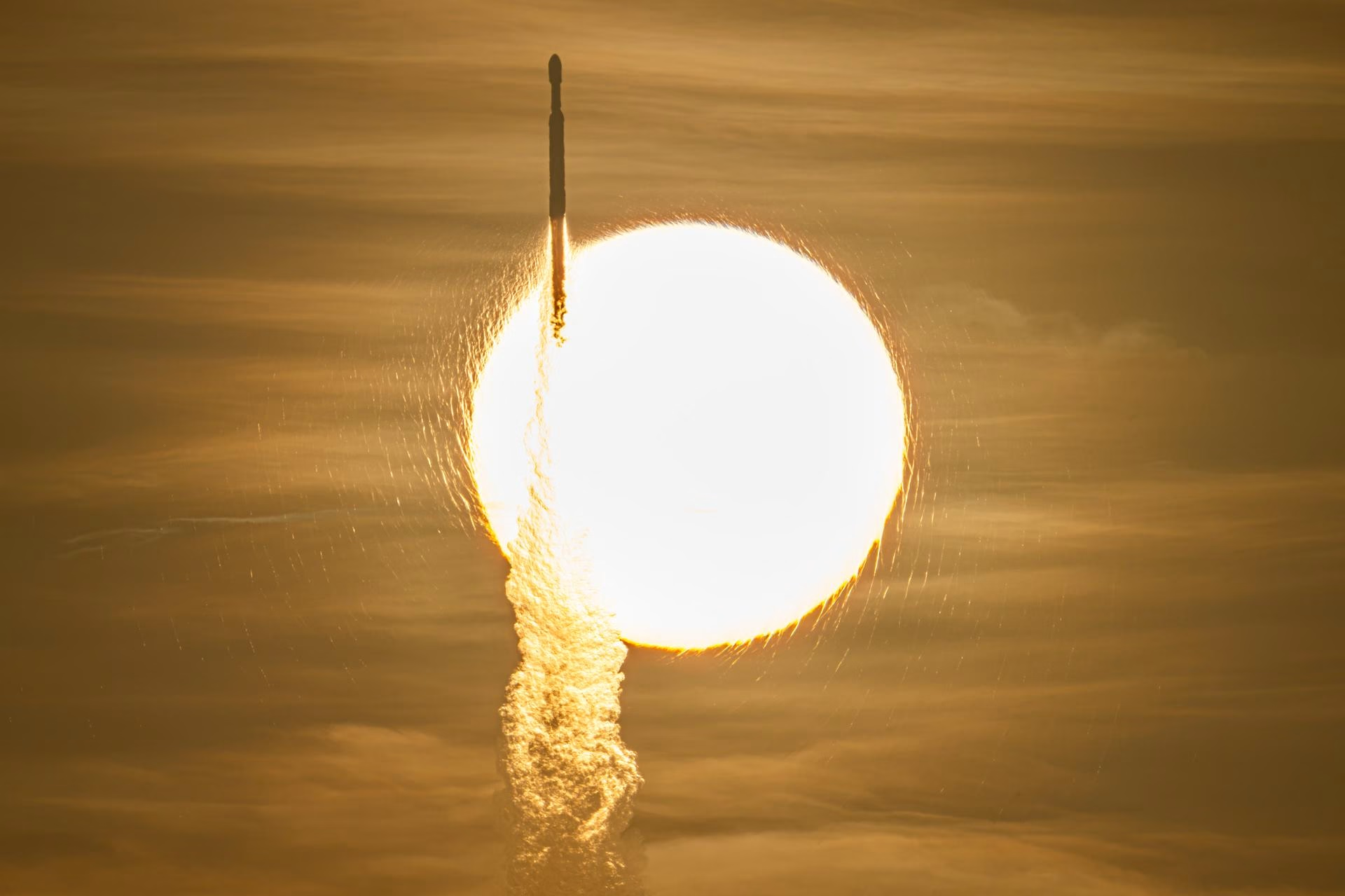
NASA’s Nancy Grace Roman Space Telescope launched on August 30, 2026, aboard a Falcon Heavy from Kennedy Space Center. For readers following the Roman space telescope after launch, the next milestone is not an immediate flood of polished discoveries. The observatory must reach its operating environment, settle down and demonstrate that its instruments are measuring the sky reliably. NASA’s launch announcement outlines the mission ahead.
Why the waiting period matters
Roman is heading toward the region around the Sun–Earth L2 point, roughly a million miles from Earth. NASA describes an initial commissioning period of about three months. That is a plan, not a guarantee that a particular discovery or public image will arrive on an exact date.
Commissioning is where a telescope earns trust. Before interpreting a faint feature as something in the universe, scientists need to understand what the observatory itself contributes to the measurement. A tiny calibration error repeated across a vast survey can become a large scientific problem.
Roman’s advantage is the size of the view
The mission is designed to investigate dark energy, dark matter and worlds beyond our Solar System. Its wide-field observations complement the more targeted views familiar from Webb. NASA’s guide to Roman explains why surveying large areas at high resolution opens a different kind of discovery space.
A useful comparison is a detailed portrait versus a carefully repeated census. Individual objects matter, but so do their numbers, distributions and changes over time. Roman’s value lies partly in allowing researchers to ask those population-level questions.
The first impressive picture is only one milestone
A beautiful release image will be welcome. More important for the mission is whether its observations can support consistent measurements across the survey. Dark-universe research depends on patterns that are subtle enough to demand unusually careful checking.
The same applies to exoplanet searches. Detecting a promising signal and establishing what caused it are separate steps. Readers should distinguish an anticipated yield from an actual catalogue of confirmed worlds.
That gives us a sensible way to follow the next updates: watch for completed commissioning tests, published observing plans, documented data releases and results that other researchers can examine. Those are firmer milestones than speculative dates for Roman’s first big revelation.
This is the follow-up to our pre-launch Roman guide. For the wider scientific context, see why astronomers infer dark matter and what Webb has been revealing.
COSMICGRAVITY · EXPLORE THE EVIDENCE
Roman’s next milestones
Tap a heading to open the explanation.
Launch · completed
NASA reports that Roman launched on August 30, 2026.
Commissioning · next phase
The spacecraft and instruments must be checked and calibrated. NASA’s approximate three-month plan is not a fixed discovery date.
Science · what to look for
Follow observing plans and public data releases, then distinguish candidate findings from confirmed results.
Lead image: The August 30, 2026 launch of NASA’s Nancy Grace Roman Space Telescope. NASA/John Kraus. This is a launch photograph, not a simulated science image. Image source and usage information.
Editorial note: Reporting checked September 5, 2026. Linked sources distinguish the underlying observations from interpretation. Future plans and preliminary results may change.


latest video

news via inbox
Subscribe to our Cosmic newsletter to get notified when we have new articles.