Roman Is Ready to Launch: The Telescope That Could Find 100,000 Worlds
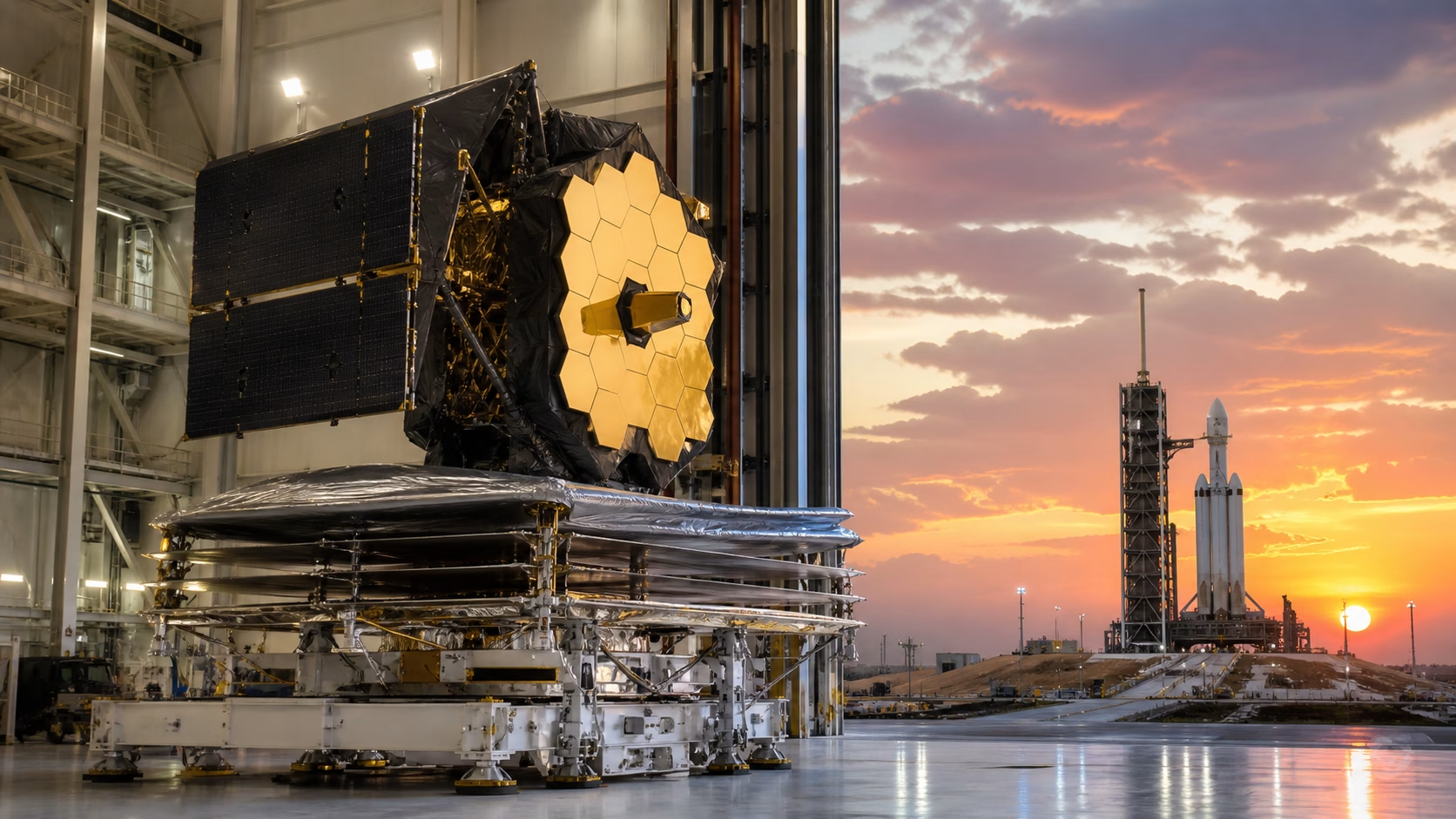
NASA’s next major observatory is almost ready to leave Earth. The Roman Space Telescope launch is scheduled for 30 August 2026 aboard a Falcon Heavy from Kennedy Space Center, with liftoff currently targeted for 11:20 UTC.
If the schedule holds, Roman will begin a mission designed to map billions of galaxies, investigate dark energy and discover an estimated 100,000 exoplanets. Its mirror is Hubble-sized, but its view of the sky is dramatically wider.
A panoramic eye on the universe
Hubble transformed astronomy by taking extremely sharp images of relatively small fields. Roman combines comparable infrared sharpness with a field of view at least 100 times larger. One exposure can therefore capture an enormous cosmic scene without sacrificing the fine detail needed for precise measurements.
Over its first five years, Roman may image more than 50 times as much sky as Hubble covered in three decades. This is not simply a faster version of the same telescope. Roman is built for population studies: instead of examining a few unusual objects, it can measure millions or billions and reveal the patterns among them.
The search for dark energy
The expansion of the universe is accelerating, but the cause remains unknown. Physicists use the name dark energy for whatever drives that acceleration. Roman will attack the problem with several independent methods.
It will map the distribution of galaxies across space and time, measure weak gravitational lensing caused by unseen matter and observe distant supernovae. Each method has different sources of uncertainty. If they point toward the same history of cosmic expansion, the combined result becomes much stronger.
Roman’s enormous survey will also create a three-dimensional map containing hundreds of millions of galaxies. Subtle changes in their clustering may reveal whether dark energy is constant or has evolved during cosmic history.
How Roman could find 100,000 planets
Roman’s main exoplanet survey will use gravitational microlensing. When a foreground star passes almost directly in front of a more distant one, its gravity bends and magnifies the background starlight. A planet orbiting the foreground star can add a short, distinctive bump to that brightening.
Microlensing is sensitive to worlds that other methods often miss: cold planets far from their stars, small planets and even objects that may wander through the galaxy without a host. The technique can reveal analogues of most planets in our solar system at distances of thousands of light-years.
This complements Webb’s close atmospheric studies. Webb recently found Beta Pictoris d through its chemical fingerprint, while Roman will build a statistical census. One telescope characterises selected worlds; the other tells us how common different kinds of planetary systems actually are.
A coronagraph built for the future
Roman also carries a technology-demonstration coronagraph. It blocks starlight so that faint planets and dusty disks nearby become visible. The instrument is not expected to photograph an Earth twin, but it will test advanced optics that future missions need to do exactly that.
Direct imaging is extraordinarily difficult. From far away, a planet is a dim speck beside a star billions of times brighter. Roman’s coronagraph will actively correct tiny wavefront errors and demonstrate contrast levels far beyond earlier space instruments.
A torrent of public data
Roman is expected to send down about 1.4 terabytes of raw scientific data per day. Over the mission, processed products may reach roughly 20 petabytes. NASA plans to make survey data public as soon as it is processed, without the long exclusive-access periods common in some earlier missions.
That openness matters. Independent teams will be able to look for unexpected phenomena, reanalyse events with different methods and combine Roman observations with data from ground-based telescopes. The most important discovery may not be one of the mission’s original headline goals.
The launch is a target, not a guarantee
Spaceflight schedules can change because of weather, technical checks or range conditions. The current target is 30 August at 07:20 EDT, or 11:20 UTC. Roman will travel to the Sun–Earth L2 region about 1.5 million kilometres from Earth, the same broad operational neighbourhood used by Webb.
After arrival, engineers expect about three months of commissioning. They will deploy systems, cool and calibrate the instruments and confirm that the telescope meets performance requirements. First-look observations should follow after that phase.
What Roman may change
The mission’s strength is scale. Roman can find out whether rare-looking systems are truly rare, whether lonely planets are common and how matter is distributed on the largest cosmic scales.
Its survey may also sharpen the search for hidden worlds closer to home by improving techniques for finding faint and moving objects. More broadly, it will generate a map that astronomers have not yet had the tools to explore.
The Roman Space Telescope launch will be only the beginning. The real story will arrive as a panoramic stream of data in which thousands of teams can search for patterns nobody predicted.
Sources: NASA Roman mission page and launch countdown and NASA Roman technical overview.

latest video

news via inbox
Subscribe to our Cosmic newsletter to get notified when we have new articles.