Webb Found a Hidden Third Planet Around Beta Pictoris
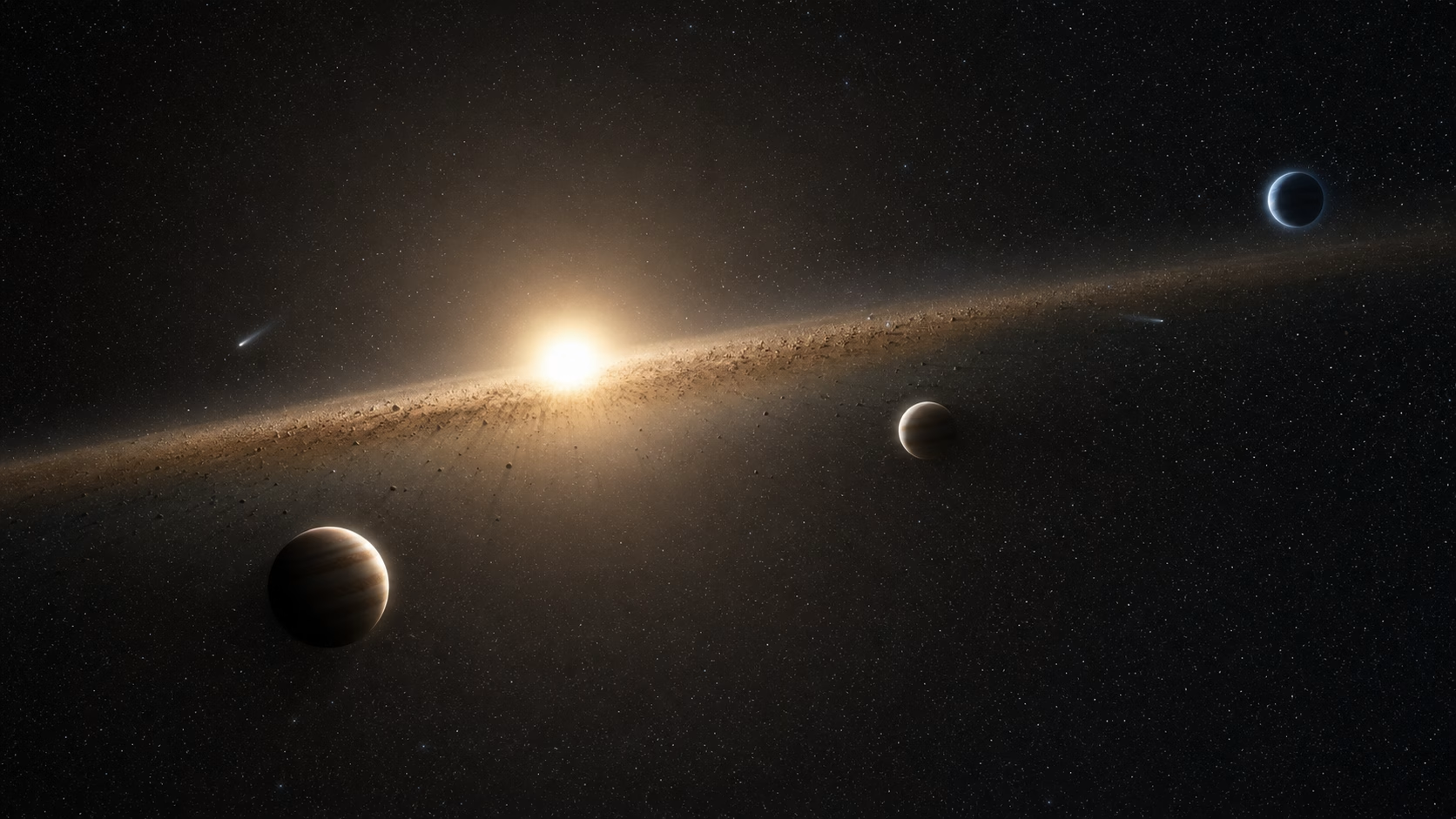
One of the most studied young planetary systems has been hiding an enormous secret. Astronomers using the James Webb Space Telescope have discovered Beta Pictoris d, a third giant planet orbiting the nearby star Beta Pictoris.
The planet did not appear as an obvious dot in an ordinary image. Webb found it by isolating the chemical fingerprint of its atmosphere from the glare and dust surrounding the star. That method may become a powerful way to discover worlds that conventional imaging misses.
A famous system gains another planet
Beta Pictoris is a young star about 63 light-years from Earth. It is surrounded by a bright, edge-on debris disk made of dust and material left from planetary formation. Because the system is young and nearby, astronomers use it as a laboratory for watching planets shape their environment.
Two giant worlds were already known. Beta Pictoris b became one of the first exoplanets to be directly imaged, while planet c was found through the subtle gravitational wobble it produces in the star. The discovery of planet d makes Beta Pictoris only the second planetary system known to contain at least three directly imaged planets.
Why Beta Pictoris d stayed hidden
The debris disk that makes the system scientifically valuable also creates a problem. Dust scatters starlight like fog around a car headlamp. A faint planet can disappear within bright structures and image-processing artefacts.
Researchers initially saw an unexpected bright source in Webb data, but a blob alone was not convincing. Instead, they used the telescope’s NIRSpec instrument to separate the incoming infrared light into a spectrum. Molecules in a planetary atmosphere absorb specific wavelengths, creating a pattern that dust and detector noise cannot easily imitate.
That spectrum revealed a coherent planetary signal. In other words, astronomers detected the atmosphere before they trusted the picture.
A new kind of direct discovery
Beta Pictoris d is the first directly imaged planet discovered primarily through moderate-resolution spectroscopy. Traditional direct imaging tries to block the star and reveal a faint point beside it. Spectroscopic detection asks a different question: does any location contain the molecular pattern expected from a planet?
The advantage is selectivity. Dust may be bright, but it does not have the same atmospheric signature. The technique can effectively see through a cluttered scene and may work in other young systems with disks, rings and planet-forming material.
The planet had been predicted indirectly
The inner edge of the Beta Pictoris debris disk is unusually sharp, and other structures looked as if an unseen object were sculpting them. Astronomers had already suspected that another planet might exist in the right region.
The new world provides a plausible gravitational architect. Its orbit and mass still need tighter measurements, but it may explain why dust is cleared from particular zones and why the disk has the shape we observe.
This is a recurring pattern in astronomy. Sometimes scientists infer an unseen object from its gravitational effects before detecting it directly. The continuing search for Planet Nine uses a related idea, although the evidence and distance are very different.
What we still need to learn
Webb observations should refine the planet’s temperature, atmospheric composition and orbit. Those details will show how it compares with planets b and c and whether all three formed through the same process.
Young giant planets retain heat from formation. Their atmospheres therefore contain information about how rapidly they accumulated gas and whether they formed close to their current positions or migrated through the disk.
A step toward finding smaller worlds
Beta Pictoris d is a giant planet in a young system, not an Earth twin. Even so, the discovery matters to the broader search for habitable worlds. Techniques proven on bright young giants can be refined for fainter and cooler targets.
Spectroscopy already underpins the search for biosignatures in alien atmospheres. In that field, the goal is to measure atmospheric chemistry during a transit or in directly captured light. The Beta Pictoris result shows that a spectrum can also be a discovery tool.
The lesson of the bright blob
The team’s caution is as important as the detection. Researchers did not announce a planet because an image contained an unusual point. They demanded a repeatable physical signature.
That approach is especially valuable in any field dealing with ambiguous images. A compelling picture can start an investigation, but calibrated spectra, geometry and independent observations carry more weight.
Beta Pictoris had been observed for decades, yet a massive planet remained concealed in plain sight. Webb found it by listening to the chemistry hidden inside the light.
Source: NASA Webb: hidden planet in the Beta Pictoris system.


latest video

news via inbox
Subscribe to our Cosmic newsletter to get notified when we have new articles.