Can Artificial Intelligence Discover an Alien Signal?
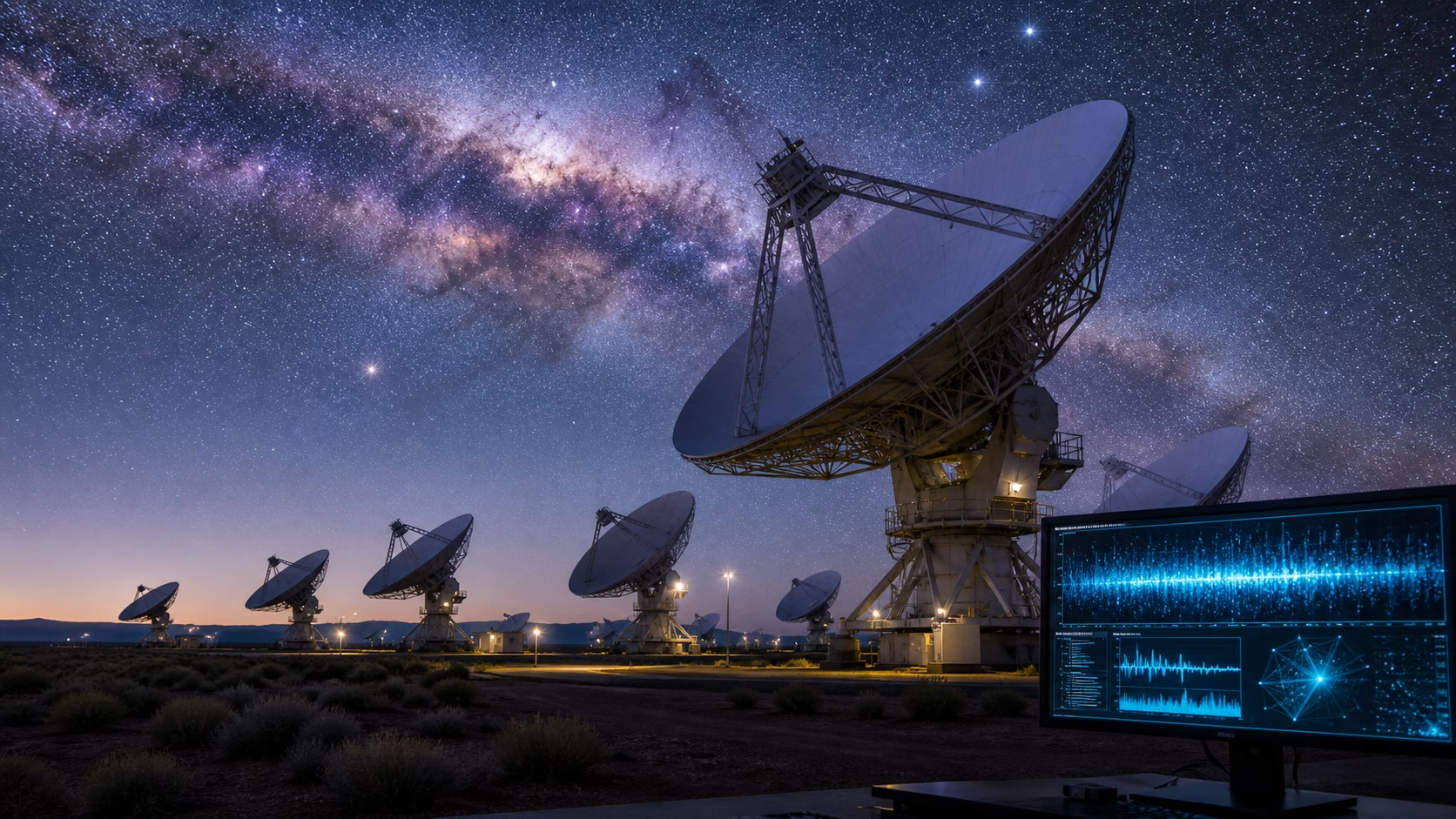
Modern radio telescopes collect more data in one night than a person could examine in a lifetime. Most of it contains natural cosmic noise, satellites, aircraft systems, mobile communications and electronics close to the observatory.
A genuine extraterrestrial transmission—if one reaches Earth—could be buried inside that confusion. Artificial intelligence offers a way to search patterns that older filters reject or humans never inspect.
An AI search for alien signals will not make the final discovery by itself. It can become a powerful first reader, finding unusual candidates for people and independent telescopes to test.
Why SETI produces so much data
Radio observatories examine millions or billions of frequency channels. They observe many stars, repeat scans and record how signals change over time.
A narrowband tone may look interesting because natural sources rarely concentrate energy into an extremely small frequency range. Pulses, repeating patterns or signals whose frequency drifts as a planet rotates could also indicate technology.
The search space is enormous. We do not know which frequency another civilisation would choose, when it would transmit, how wide the signal would be or whether it would resemble human radio at all.
Traditional filters
Earlier SETI pipelines used rules designed by researchers. A program might flag signals above a threshold, require a particular bandwidth and reject events seen in several directions at once.
These filters are fast and understandable. They can also be rigid. A real signal that falls outside the expected shape may be discarded before a person sees it.
Radio-frequency interference is the dominant problem. Human technology creates far more artificial signals than the cosmos. The challenge is not simply detecting technology; it is establishing that the technology is not ours.
What machine learning adds
Machine-learning systems can learn complicated patterns from examples. They can classify familiar interference, group similar events and highlight observations that differ from the training data.
Unsupervised learning is especially interesting. Instead of asking the system to find one known signal shape, researchers ask it to organise the data and reveal outliers.
AI can also re-examine archives. A telescope may have recorded a meaningful signal years ago that was ignored by the software available at the time.
The danger of training on our own imagination
A model learns from its training data and objectives. If researchers train it only on simulated narrowband beacons, it may become excellent at finding our idea of alien communication while missing something truly unfamiliar.
Artificial signals used for training can also be too clean. Real astronomical data contains drifting baselines, missing channels and overlapping interference.
Diverse simulations, real telescope noise and several detection methods help reduce this bias. No single model should control the entire search.
False positives will remain
AI can rank candidates but cannot prove extraterrestrial origin. A satellite with an unusual orbit, a new communication protocol or faulty equipment may look unlike everything in the training set.
The first question after any candidate is whether it repeats when the telescope returns to the target. A second observatory should confirm it from another location. Researchers must check satellites, spacecraft, aircraft and local equipment.
A compelling candidate must follow the sky rather than the telescope or Earth.
Searching for more than radio beacons
Technosignatures can take many forms. Optical telescopes can search for extremely short laser pulses. Infrared surveys can look for unusual waste heat. Exoplanet observations might reveal industrial pollutants or artificial illumination.
Machine learning is useful wherever the dataset is too large or complex for fixed rules. It can search light curves for odd repeating structures, spectra for unexpected molecules and images for shapes that standard pipelines ignore.
Most anomalies will be new natural phenomena or instrument effects. Discovering those is still valuable science.
Could AI recognise an encoded message?
Detection comes before decoding. A signal with prime numbers, repeated mathematical structure or clear modulation would attract attention, but meaning could remain inaccessible without shared context.
AI might identify compression, repetition and statistical structure. It could test many possible symbol boundaries and transformations faster than a human team.
Language models trained on human communication should be used cautiously. They are good at finding patterns and also capable of inventing meaning where none exists.
The importance of transparency
A major candidate cannot depend on an unexplained algorithmic score. Researchers need to preserve raw data, publish the observation conditions and explain how the model selected it.
Independent teams should run different tools on the same material. If only one proprietary model sees the signal, confidence remains limited.
Open methods also help the public distinguish a real scientific candidate from a sensational headline.
AI as a telescope for patterns
A telescope extends human vision. AI can extend our ability to notice structure. Neither replaces judgment.
The greatest contribution may be sensitivity to the unexpected: signals slightly different from our assumptions, hidden in frequency ranges crowded with interference or present in old observations nobody had time to inspect.
If another civilisation transmits, its signal may be obvious. It may also be faint, brief and unlike anything we designed our first searches to find.
AI cannot guarantee that we recognise it. It can give us a better chance of not looking past it.
Related reading



latest video


news via inbox
Subscribe to our Cosmic newsletter to get notified when we have new articles.