The Cat’s Head Nebula Has Three Faces—and Each Tells a Different Story
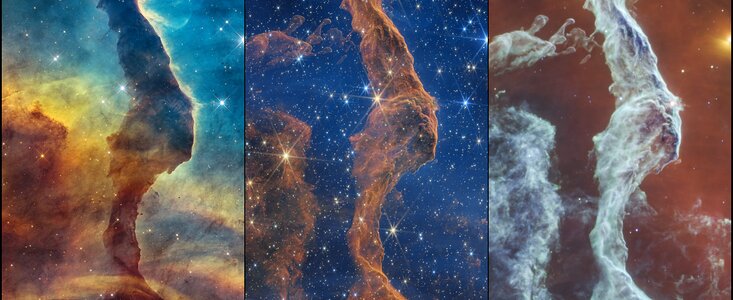
The Cat’s Head Nebula looks almost solid in Hubble’s new portrait: a dark, narrow pillar with a turned head and a single bright eye. Switch to Webb’s infrared view and the apparent silhouette begins to loosen. Stars emerge through the dust. Delicate strands appear around its edges. Change wavelengths again and warm material becomes the main attraction.
Released on 29 October 2026, the images show a small part of the Carina Nebula, a vast stellar nursery roughly 7,500 light-years away. The resemblance to a cat is an inviting way into the picture. The more interesting story is how three views of the same place reveal different parts of an environment that is making stars while steadily being worn away.
Why the Cat’s Head Nebula changes with wavelength
Think of the pictures as complementary measurements. A telescope does not simply remove a curtain and reveal the one definitive appearance of an object. Its instruments collect particular ranges of light. Dust that blocks one range may be less obstructive in another, while material that is faint in one image can shine strongly in the next.
That distinction matters when comparing Hubble and Webb. The visible-light image is especially good at showing the pillar’s outline against surrounding luminous gas. Webb’s near-infrared image exposes more of the star field and the pillar’s surface texture. Its mid-infrared view emphasises emission from warm dust and carbon-based molecules.
The ESA/Webb release describes these as three pieces of a shared picture of star formation. None makes the others obsolete. The dark silhouette is itself useful information about where dense, obscuring material lies.
Hubble catches a pillar under pressure
In visible light, the structure appears as an opaque brown column. Its bright rim helps tell a physical story. Massive stars elsewhere in Carina flood their surroundings with ultraviolet radiation and drive winds into nearby clouds. Dense parts of those clouds can resist erosion longer than their surroundings, leaving pillars behind.
ESA identifies radiation and winds as the likely sculptors of the cat-like shape. Along the right-hand edge, a hazy luminous ridge is consistent with gas illuminated and ionised by neighbouring stars. Ultraviolet energy heats that material and can drive it away through a process called photoevaporation.
It is a striking contrast: the stars whose light makes the nebula visible are also helping dismantle its structure. The pillar’s persistence does not mean it is permanent. The present shape is one stage in a changing cloud.
Hubble’s surrounding colours also carry information. Its filters isolate light associated with oxygen, hydrogen and sulphur, together with scattered starlight. The image combines those measurements into a view that helps distinguish different emitting regions; it is more than a decorative wash of blue and gold.

Webb reveals stars without making all dust disappear
Near-infrared light passes through some obscuring material more readily than visible light. In the NIRCam view, many more stars become apparent and the pillar looks less like a single dark cut-out. Fine wisps to its left show material exposed to the energetic surrounding environment.
But infrared vision has limits. Some stars remain embedded in dust even in Webb’s image. Looking through more of a cloud does not mean seeing every object inside it, nor does every point of light belong to the same physical structure.
The NIRCam image record provides a useful reminder of what a released astronomy picture contains. It combines observations through several filters, with different measured wavelength bands assigned visible colours. Those assignments make information our eyes cannot directly see available for inspection.
The same record dates the NIRCam observations to 27 May 2026. The October date marks their public release, rather than the moment the telescope happened to look. Keeping observation and release dates separate prevents an attractive new picture from being mistaken for a sudden event in the nebula.
The bright “eye” of the Cat’s Head Nebula
The eye is conspicuous in both visible and near-infrared views. ESA says it may mark a young star still partly hidden in dust. That is a cautious interpretation, rather than a confirmed identification derived from the resemblance itself.
Another bright source appears to the right of the pillar in the mid-infrared image. It is likely an infant star embedded in dusty material. A narrow filament seems to cross that source, but the release explicitly notes that the picture alone cannot establish a physical connection.
This is an easy trap in astronomical images. Two features can share the same direction on the sky while lying at different depths. A line that appears to connect them in a two-dimensional picture is a reason to investigate, not a measurement of a connection.
A nursery with a changing future
The Cat’s Head Nebula brings the competing effects of stellar birth into one small scene. Dense gas and dust can shelter forming stars. Radiation from massive neighbours can illuminate, heat and erode that material. Different wavelengths help astronomers examine those processes together.
The useful question is therefore not which telescope took the better picture. It is what each instrument contributes. Hubble traces the visible silhouette and excited gas. NIRCam gives a deeper look into the star field. MIRI highlights dust and molecular emission that the other views cannot present in the same way.
For a contrasting look at what happens much later in stellar life, explore our report on the double debris rings around a white dwarf. That system concerns material around a stellar remnant; Carina is a place where stars are still taking shape.
The cat will not keep its silhouette forever. What the new portraits preserve is a moment in the interaction between a dense cloud and its brilliant surroundings—and a demonstration of how much is missed when we look in only one kind of light.
Sources and image information

latest video



news via inbox
Subscribe to our Cosmic newsletter to get notified when we have new articles.