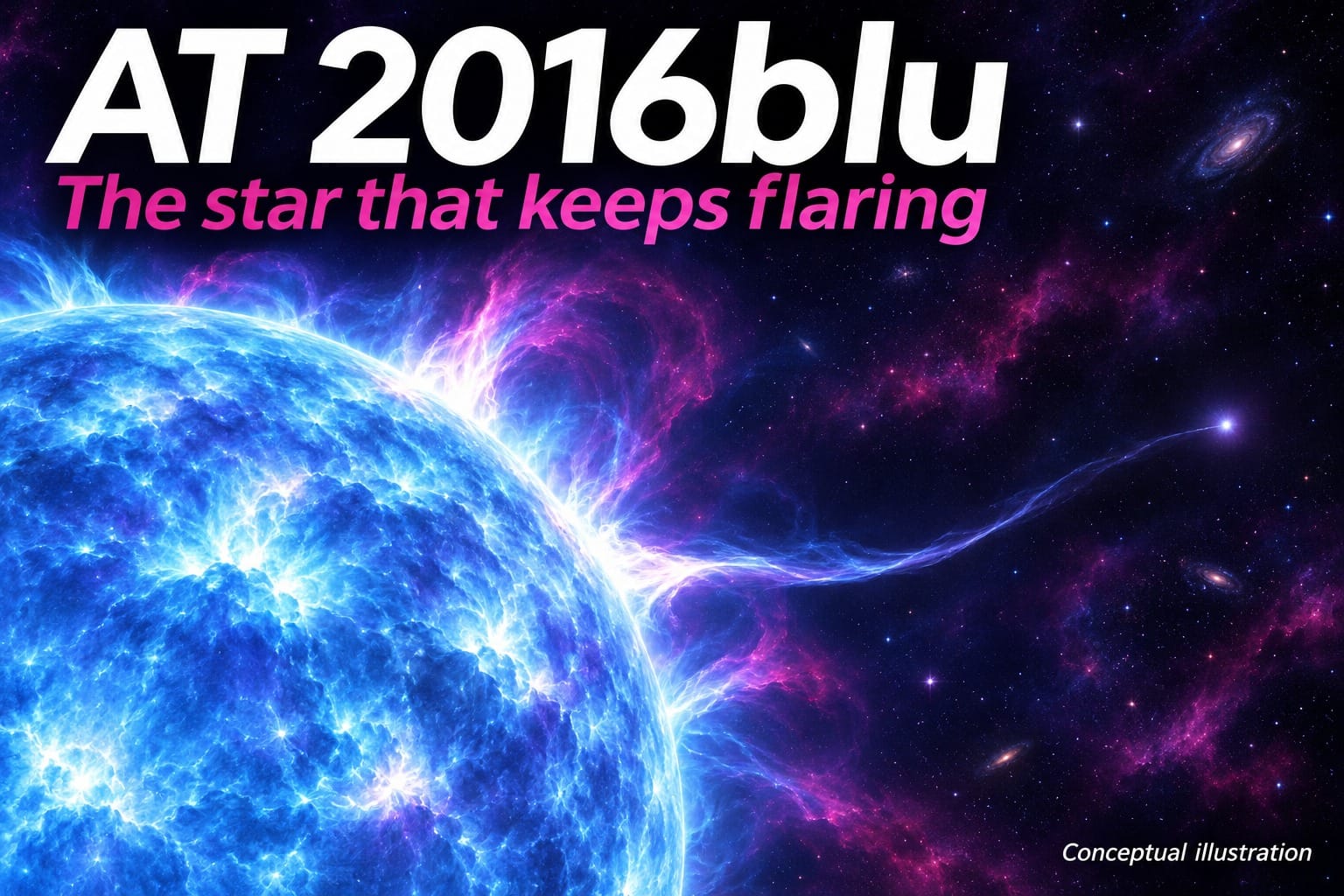
AT 2016blu: Why a Star Keeps Flaring Roughly Every 113 Days
AT 2016blu has had more than one chance to fool astronomers. In the galaxy NGC 4559, about 30 million light-years away, the star has brightened and faded repeatedly. A genuine supernova would destroy the original star as it was. This one kept coming back. The question was what kept setting it off, and the best new clue arrived in a wavelength human eyes cannot see.
Why astronomers call AT 2016blu a supernova impostor
A supernova impostor is an outburst bright enough to resemble a stellar explosion, after which the original star survives. AT 2016blu is associated with a luminous blue variable, a massive star prone to dramatic changes in brightness and episodes of mass loss. The Chandra X-ray Observatory team describes a star with at least 33 times the Sun’s mass. That number refers to mass, rather than to the star’s diameter.
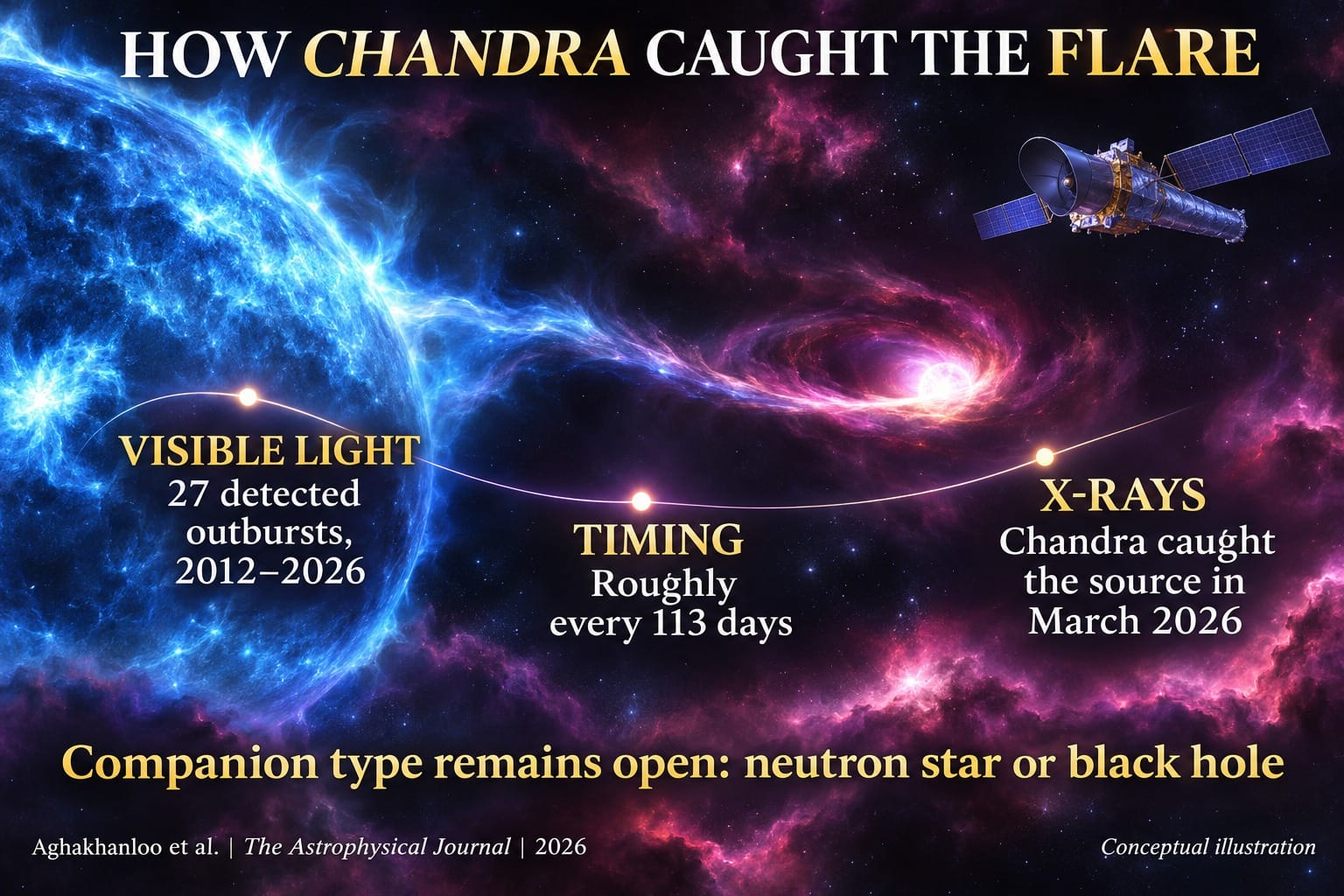
The observing record counted 27 outbursts in visible light between 2012 and June 2026. Many arrived at intervals near 113 days. That pattern is approximate, and the record counts detected outbursts rather than every episode that may have occurred. Even an imperfect rhythm, however, gives astronomers a better idea of when to point a telescope at the source.
The X-rays arrived when observers were watching
Observers who monitor the sky in visible light, including contributors to the American Association of Variable Star Observers, helped identify the March 2026 outburst. The team used the alert to start a series of five Chandra observations. Earlier Chandra images from 2001 and 2002 had yielded no detection at that position. They set a limit on what could have been present on those visits; they do not establish that the system emitted no X-rays.
This time the source was bright in X-rays. The study in The Astrophysical Journal, published in November, estimated an X-ray luminosity of about 4.4 × 1038 ergs per second. For scale, that is roughly 100,000 times the Sun’s total luminosity, emitted here as X-rays. The contrast between the detection and the earlier limits is one reason the timing matters. The authors interpret the high-energy emission as evidence of matter falling onto a compact object.
What a hidden companion could be doing
In the team’s preferred picture, a compact companion travels on an elongated orbit and passes through denser material near the luminous star at its closest approach. Some of that gas falls toward the compact object, heats up and shines in X-rays. A neutron star or a stellar-mass black hole could provide the necessary gravity. Neither possibility requires the compact object to emit the X-rays itself: the infalling matter can do that work.
The orbit and the object’s identity have not been measured directly. Earlier spectroscopy had already given astronomers reasons to consider a binary system. The newer X-rays strengthen the case for a compact companion, while leaving room to investigate what drives the optical outbursts and how closely their timing tracks the orbit. More observations at different phases could show whether the strongest X-ray emission recurs near the predicted encounters.
What the next flare could tell us
There is no forecast here for when the luminous star itself might explode. The 113-day rhythm is a clue to repeated activity in the system. If another predicted brightening is accompanied by strong X-rays, the timing would be another test of the close-passage explanation. If the two signals repeatedly fail to coincide, the simple version of that explanation would need work.
Our look at an Einstein Probe X-ray flash likely associated with a supernova shows a different reason to observe a brief brightening quickly. In that case the flash may help investigate an explosion. Here the point is that the star survives, giving astronomers repeated opportunities to check what the two wavelengths are telling them.



latest video



news via inbox
Subscribe to our Cosmic newsletter to get notified when we have new articles.