What Burials in Peru’s Lambayeque Valley Reveal About Violence and El Niño
Floods could damage the canals that carried water to farms on Peru’s northern coast. Did periods of more frequent flooding also leave more evidence of people hurting one another? Thomas Snyder and Haagen Klaus looked for that pattern across more than 3,000 years of burials in the Lambayeque Valley Complex. They found few injuries consistent with interpersonal violence and no clear long-term association with their measures of flooding or rainfall. The dates and condition of the bones put limits on what that result can tell us. Snyder and Klaus’s study, published 9 November 2026.
Where is the Lambayeque Valley Complex?
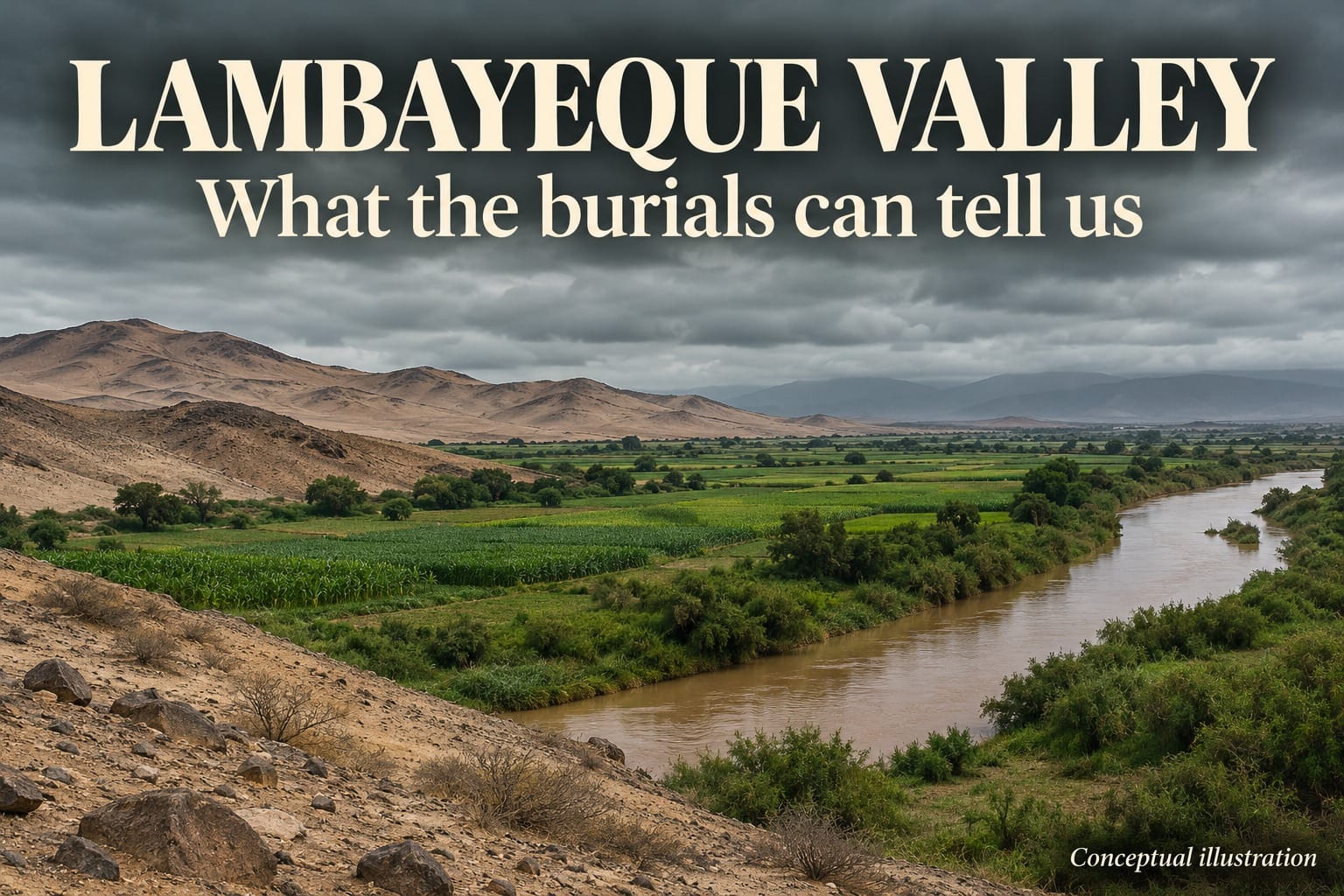
Lambayeque lies on Peru’s arid north coast. The valley complex spans five river drainages, including the Lambayeque and La Leche. Water from higher ground could be routed through canals to support farming on the coastal plain. In this setting, both too little runoff and sudden heavy rain posed problems. Heavy flows could damage the channels, while reduced flows left less water to distribute. The study’s background and methods.
What did the researchers count?
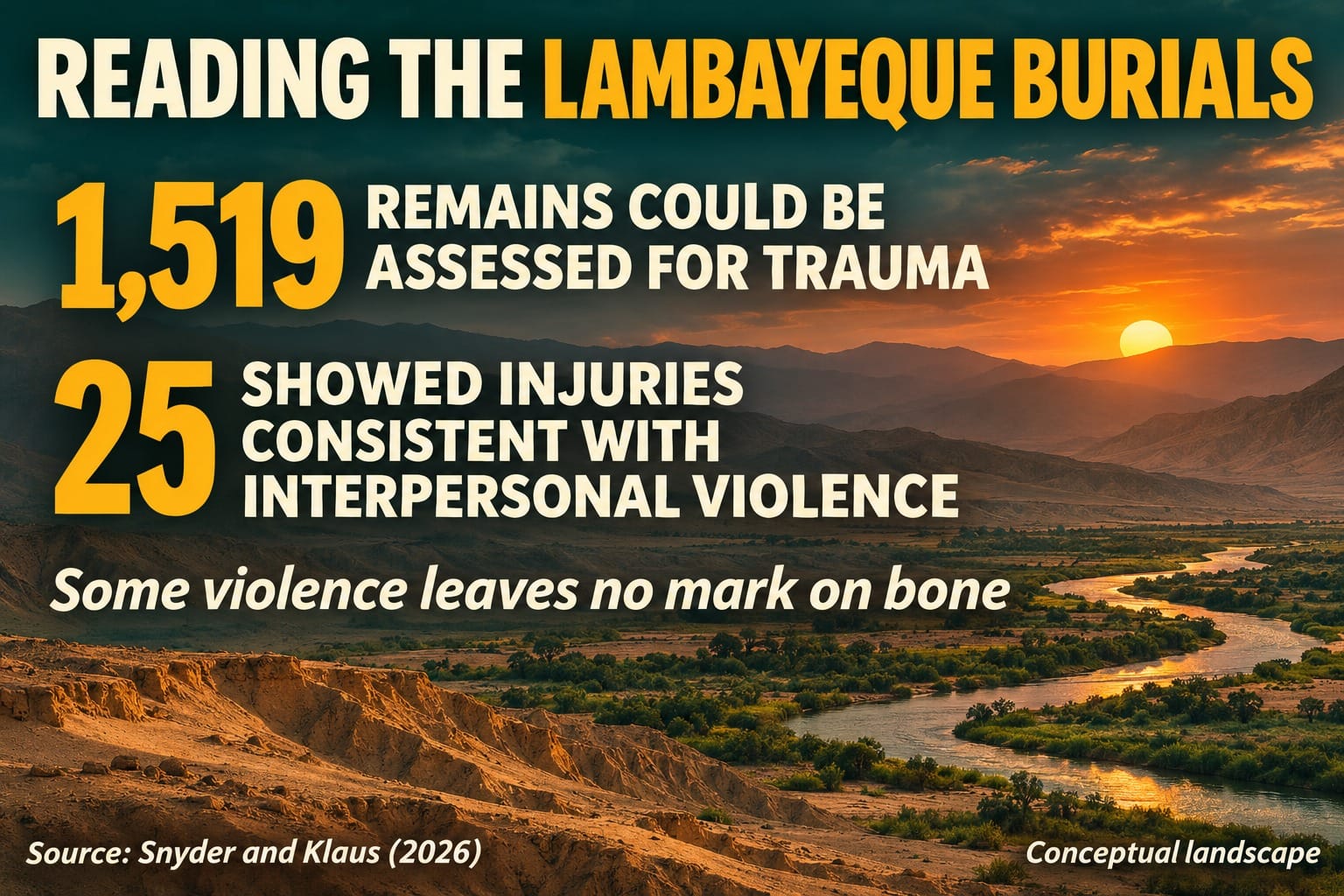
The researchers assembled records for 1,659 people from 30 archaeological sites. They kept 1,633 in the analysis after excluding people whose remains could not be assigned to a period confidently enough. The paper reports a separate count of 1,519 individuals whose remains were preserved well enough to assess for trauma. Among those, 25 had injuries consistent with interpersonal violence, about 1.6 per cent. The two totals answer different questions about dating and preservation.
Injury patterns can help researchers judge whether a blow or an accident is more plausible, but there is rarely a complete account of how an injury happened. An attack can leave no marks on bone. Bones may also be missing, poorly preserved or drawn from cemeteries that represent only part of the living community. The percentage therefore describes the observable sample and the authors’ classification criteria.
The paper reports accidental injury separately. Seventy-seven people had injuries outside the skull consistent with accidents. The distinction matters for the climate question, because flood damage and repairs might change people’s exposure to accidents even if interpersonal conflict stayed at the same level.
What can El Niño records tell us?
The researchers compared injury records with reconstructed highland precipitation and a sediment-based estimate of El Niño frequency. Both environmental records work on a scale of centuries. They can help test whether periods with more of a particular environmental stress also had more skeletal injuries. They are too coarse to follow changes in a community during or immediately after one flood. With only 25 injuries classed as consistent with interpersonal violence, the model also had limited power to identify a small effect.
Other archaeological research in northern Peru has linked some episodes of mass sacrifice to periods of environmental disruption. The new paper asks a different question about recurring interpersonal violence beyond those ritual episodes. Its results cannot show what the sacrifice itself did to day-to-day relations. Such a claim would need evidence connecting the two kinds of events over the same short period.
The comparisons also cover many communities and political systems. People living several centuries apart did not necessarily face the same risks or respond to damaged canals in the same way. A local episode could be visible in a well-dated cemetery and still be hard to detect in a model built from broad periods.
A burial’s context determines what researchers can ask of it. Our coverage of excavations at Göbekli Tepe follows another case in which the placement and preservation of remains affect the story they can tell. Read about the Göbekli Tepe burials.



latest video



news via inbox
Subscribe to our Cosmic newsletter to get notified when we have new articles.