
How Ultrasound Revealed Two Superconducting Components in Uranium Ditelluride
Sound took a little longer or a little less time to pass through a crystal as researchers cooled and squeezed it. Those tiny changes helped redraw the map of superconductivity in uranium ditelluride. They found a range of conditions where two components coexist, and another where cooling the crystal farther makes one of those components disappear. The experiment by Kamat and colleagues in Nature Physics.
What is uranium ditelluride?
Uranium ditelluride, written UTe2, is a compound that can become superconducting at temperatures only a few degrees above absolute zero. In a superconductor, electrons form pairs that participate in a collective quantum state, allowing electrical current to flow without resistance. The arrangement and symmetry of that state can differ from one superconductor to another. In UTe2, researchers have long had evidence for different superconducting phases under different conditions.
A phase diagram helps keep those conditions straight. It shows which state is present as variables such as temperature and pressure change. In the earlier picture of UTe2, two boundaries appeared to meet and one simply stopped. Given the evidence about how the material changed across those boundaries, thermodynamics suggested that an additional boundary should exist or that the old map had been misread. The authors’ public manuscript.
Why probe a superconductor with ultrasound?
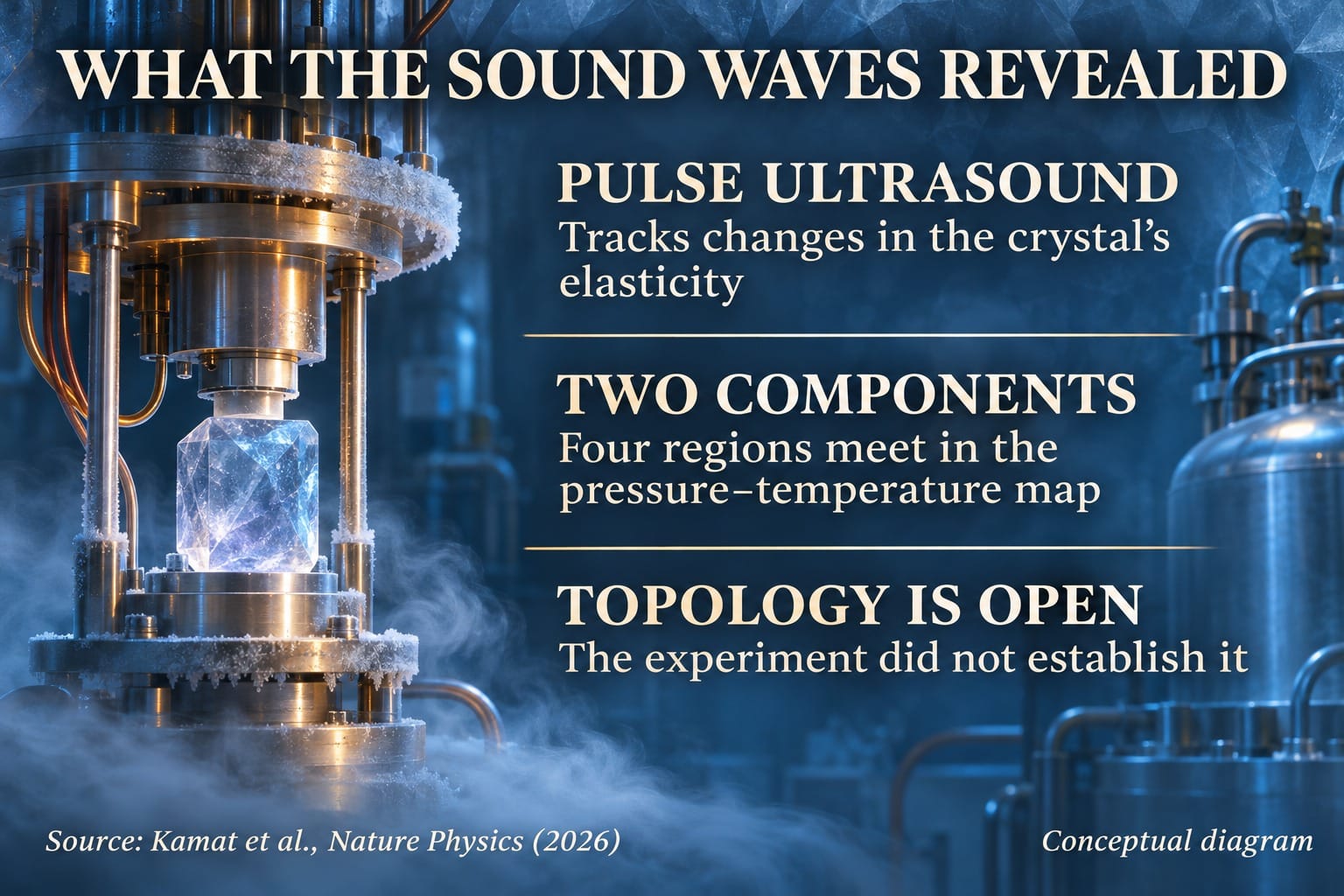
The team sent short sound pulses through the crystal and timed the returning echoes. Sound speed changes with the crystal’s elastic response, which can shift abruptly when the electronic state changes. By measuring those shifts as the team varied temperature and pressure, it could look for transitions in the bulk crystal. This gives the experiment information beyond the temperature at which electrical resistance first falls.
At zero applied magnetic field, the team found a missing boundary near the point where four regions meet. In the immediate neighbourhood of that point, the regions are the normal state, either superconducting component on its own, and the state containing both. The joint state has its own set of conditions. At some pressures, lowering the temperature further takes the crystal back into a state with just one component. The authors modelled that behaviour as competition between the two forms of superconducting order. The pressure–temperature map and analysis.
The researchers also varied the magnetic field. With the field applied along one crystal axis, the region where both components coexist extended down to ambient pressure. That gives experimentalists another route to the same combination of components. The temperature still has to be low and the field strong. The authors published the ultrasound data behind the diagrams for others to examine. The research group’s supporting data.
Is uranium ditelluride a topological superconductor?
The coexistence is one reason researchers are interested in that possibility. The answer depends on how the components combine at the quantum level and which symmetries the combined state has. Two components can coexist in more than one arrangement. The ultrasound results constrain some of those possibilities, but do not establish the topology of the combined state. Cornell’s account of the result and its limits.
Future measurements that can distinguish the relative phase or test which symmetries survive would narrow the possibilities. The useful connection to quantum computing is a research question about what a confirmed material could support. These measurements concern a crystal’s superconducting states. A working device would need evidence of its own. Our article on a quantum gas microscope describes another way of testing how components of a quantum system interact under controlled conditions. Read about the quantum gas microscope.



latest video



news via inbox
Subscribe to our Cosmic newsletter to get notified when we have new articles.