
A quantum gas microscope reveals how three atomic states share a lattice
A quantum gas microscope has opened a more detailed view of a deceptively simple problem: how particles behave when they can move through a lattice, interact and choose between different kinds of neighbours. In a newly reported experiment, researchers could distinguish three internal atomic states and adjust their interactions.
The result is a laboratory system for exploring collective quantum behaviour. Its strength lies in the combination of control and visibility: researchers can alter the conditions, then examine how individual lattice sites are occupied.
The study, Quantum gas microscopy of three-flavor Hubbard systems, appears in Science. The University of Hamburg and Rice University announced the work on 5 November 2026. Here is what the experiment reveals and why adding a third state changes the questions researchers can ask.
What is a quantum gas microscope looking at?
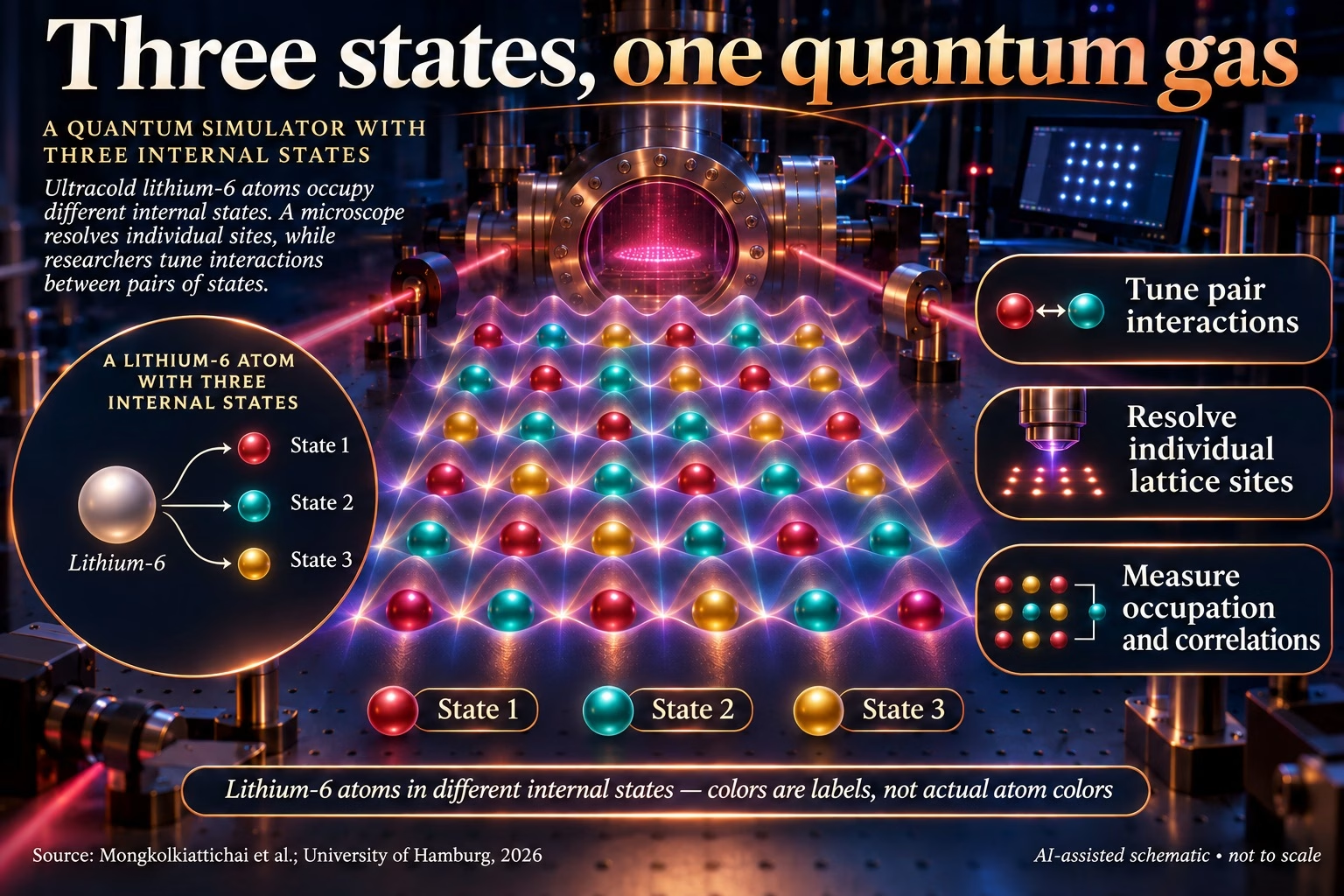
The “gas” consists of ultracold atoms in an optical lattice, a pattern of trapping sites made with light. Atoms can tunnel between neighbouring sites. Their interactions make the collective behaviour much richer than a picture of independent particles sitting in neat rows.
A quantum gas microscope that resolves individual sites lets researchers count occupations and compare them. Repeating measurements reveals patterns that a single image cannot establish on its own. Think of the difference between seeing a crowd and being able to check, over many occasions, which kinds of people tend to stand together.
The analogy is only about measurement. The atoms obey quantum rules, and the experiment controls physical interactions rather than preferences. Its value is that the patterns can be compared directly with mathematical predictions.
Three states in the quantum gas microscope
The researchers use lithium-6 atoms in three different internal states. “Flavor” is their label for those components. It does not mean that the apparatus contains three chemical elements. The authors’ publicly available 2025 preprint describes the atomic states and the site- and flavor-resolved measurements behind the work.
In a three-component system there are three distinct pair combinations: first with second, first with third, and second with third. That extra relationship makes a real difference. A pair may respond differently from another pair in the same sample.
As a simple counting exercise, compare it with two components. There is just one pairing between different labels. Add a third label and there are three. This arithmetic does not explain the quantum outcome, but it shows why the third component introduces more than one extra case to inspect.
The Hubbard model, in everyday terms
A Hubbard model describes particles moving between sites while interacting when they share a site. It is a deliberately stripped-down way to study a collective system. A small set of rules can still produce behaviour that is difficult to calculate.
Rice physicist and co-author Kaden Hazzard stresses that difficulty in the university’s report. The team compared numerical calculations with the experiment, providing a test of theoretical tools as well as a physical system to investigate.
This is a useful reason to build a quantum simulator. Instead of asking only a conventional computer to calculate a model, researchers arrange another controllable quantum system to behave according to the relevant rules. They still need calculations to interpret and check what happens.
That makes the comparison a conversation between experiment and theory. Agreement supports the description within the tested conditions. Disagreement would be a reason to investigate the preparation, measurement, approximation or model rather than immediately claim a new law of nature.
How interactions can stop a gas from flowing
The University of Hamburg’s research account reports a Mott insulating state. In this regime, strong interactions suppress double occupation of sites and inhibit free motion through the lattice. The team also found different magnetic correlations between different pairs of internal states in the same system.
“Insulating” here describes the behaviour of the model gas. It should not be read as a claim that the researchers manufactured an everyday electrical insulator. The experiment uses atoms to explore physics relevant to interacting particles in materials.
The authors’ preprint reports signatures of selective pairing and compares measured correlations with numerical linked-cluster calculations. It also identifies a further pair Mott phase as a possible target with improved phase-space density. That future target is separate from the states and signatures already measured.
Why quantum gas microscope correlations matter
A correlation asks whether two measured things occur together more or less often than a suitable comparison would suggest. Merely spotting two atoms close together in one image would not be enough. A pattern must emerge across measurements.
This distinction is important whenever a striking atom image accompanies a headline. The image is part of the measurement process. The scientific result depends on how images were collected, how occupations were inferred and how the resulting statistics compare with expectations.
Our report on controlling a single atom’s nuclear spin explores a different scale of control. The three-state lattice experiment asks what happens when controllable components interact as a many-body system. Both stories depend on measuring the right physical quantity, rather than relying on a spectacular-looking picture.
A route toward nuclear-physics models
Three components also motivate comparisons with nuclear physics, where quarks carry a property called colour. The researchers describe adapting their interactions further so they can explore aspects of lattice models of quantum chromodynamics.
The comparison is mathematical and experimental. The atoms remain atoms; the coloured spheres in diagrams are labels. The apparatus has not turned lithium into quarks or reproduced every feature of the strong force.
It is also a specialised quantum simulator. A claim about understanding a Hubbard system should not be translated into a claim about a universal machine solving arbitrary tasks. The scientific achievement is more specific: richer controllable interactions paired with measurements that can distinguish the components.
What comes next?
The published study gives researchers a new platform for testing collective behaviour. The useful next questions concern colder conditions, more refined interactions and further comparisons with theory.
For readers, the best test of future progress is equally concrete. Which quantity was measured? Which model was tested? What new regime became accessible? Those questions make it easier to follow real advances without confusing a promising laboratory system with a finished technology.
For another example of light becoming a precision measurement tool, see our article on sorting hidden structure in mixed light beams. The systems are different, but both show how better access to a physical system can open questions that were previously difficult to ask.
Sources and further reading
- Mongkolkiattichai, J., Liu, L., Dasgupta, S., Hazzard, K. R. A., and Schauss, P., Quantum gas microscopy of three-flavor Hubbard systems, Science (2026), DOI: 10.1126/science.adv1247.
- Public preprint, first posted 7 March 2025; technical details may differ from the final publication.
- Rice University announcement and University of Hamburg announcement, 5 November 2026.



latest video



news via inbox
Subscribe to our Cosmic newsletter to get notified when we have new articles.