The Day Webb Finds a Biosignature: What TRAPPIST-1 Can—and Cannot—Tell Us
Imagine the announcement: a rocky planet forty light-years away has an atmosphere containing gases that should not coexist for long unless something continually replenishes them. The result survives review, independent teams find the same spectral pattern, and every known geological explanation begins to look strained.
That would change history. It is also not a result NASA has scheduled for 2030.
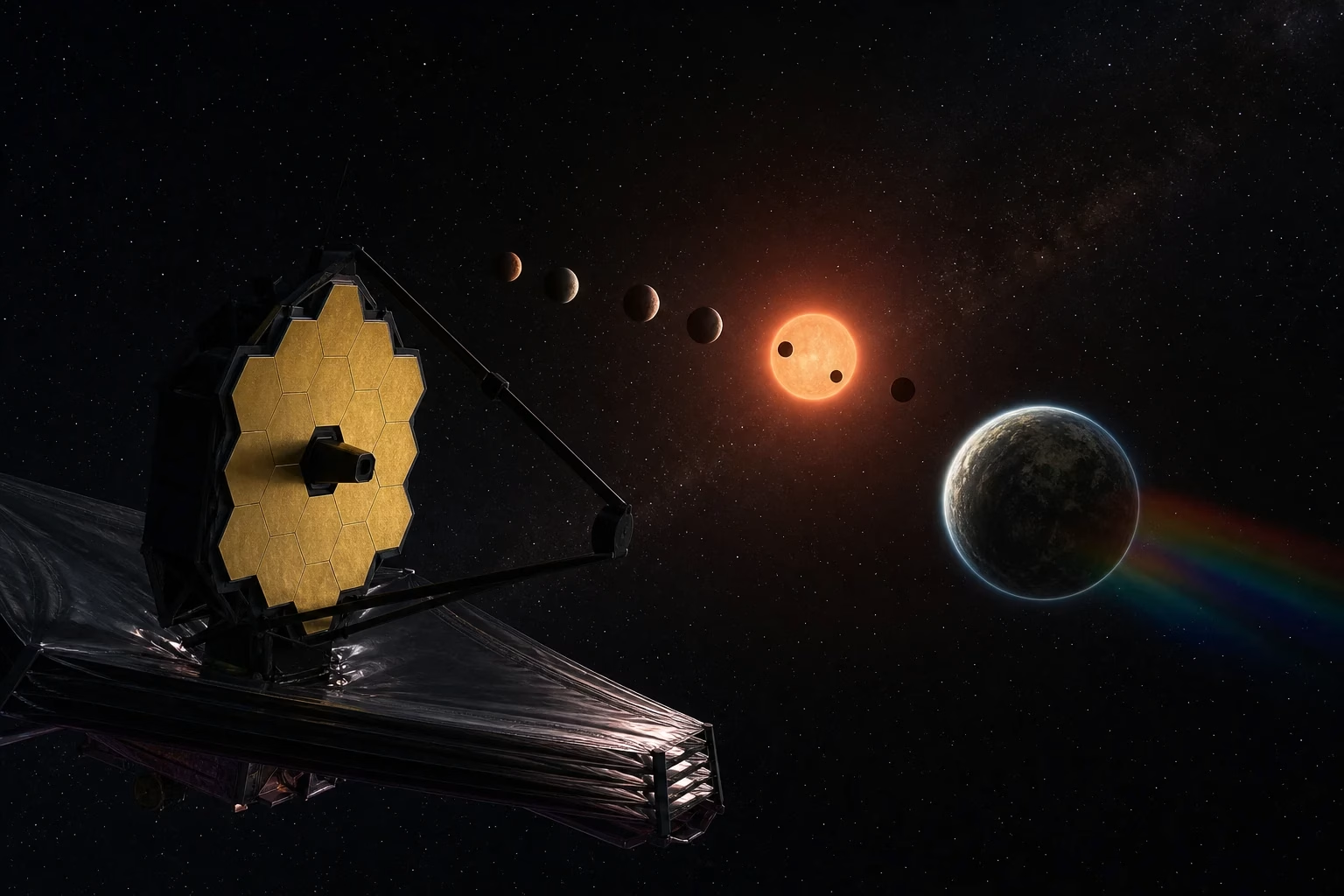
The James Webb Space Telescope is collecting data on all seven TRAPPIST-1 planets, but there is no official “2030 biosignature tranche.” Science releases appear as observations are analysed, and the system is much harder to interpret than early headlines suggested.
What Webb has learned so far
TRAPPIST-1 contains seven roughly Earth-sized rocky worlds orbiting a small red dwarf. Webb has found little evidence for thick atmospheres on the hot inner planets b and c. Observations rule out an Earth-like atmosphere on planet d, although a thin atmosphere or high clouds remain possible. For planet e, a leading habitable-zone target, the initial data rule out a thick hydrogen envelope but do not yet establish whether a secondary atmosphere exists.
The star itself is the problem. Flares and changing star spots contaminate the light that filters through a planet’s atmosphere. NASA notes that hundreds of transits over several years may be needed for robust atmospheric characterisation.
Evidence lab
Build a biosignature case
Compare how the strength of a claim changes as independent evidence accumulates.
Ambiguous signal
One gas can usually be produced by non-biological chemistry.
Interesting disequilibrium
A compatible combination deserves follow-up, but false positives remain.
Strong candidate—not proof
Independent instruments, stellar modelling and repeated observations are still required.
Educational reasoning tool—not a probability calculator or a report of detected life.

Biosignature is not the same as proof
A biosignature is evidence that may have a biological origin. Oxygen, methane, ozone and other gases become interesting in context, especially when they appear in chemical disequilibrium. Each can also be produced without life under some conditions.
Dimethyl sulfide became famous in discussion of the sub-Neptune K2-18 b, not TRAPPIST-1. Even there, the interpretation is disputed and the planet may be very different from Earth. Moving that claim to TRAPPIST-1 would combine two separate stories.
Industrial pollutants would be technosignatures: possible evidence of technology rather than biology in general. Detecting them in a small TRAPPIST-1 atmosphere would be exceptionally difficult and is not a promised Webb capability.
What a credible discovery would look like
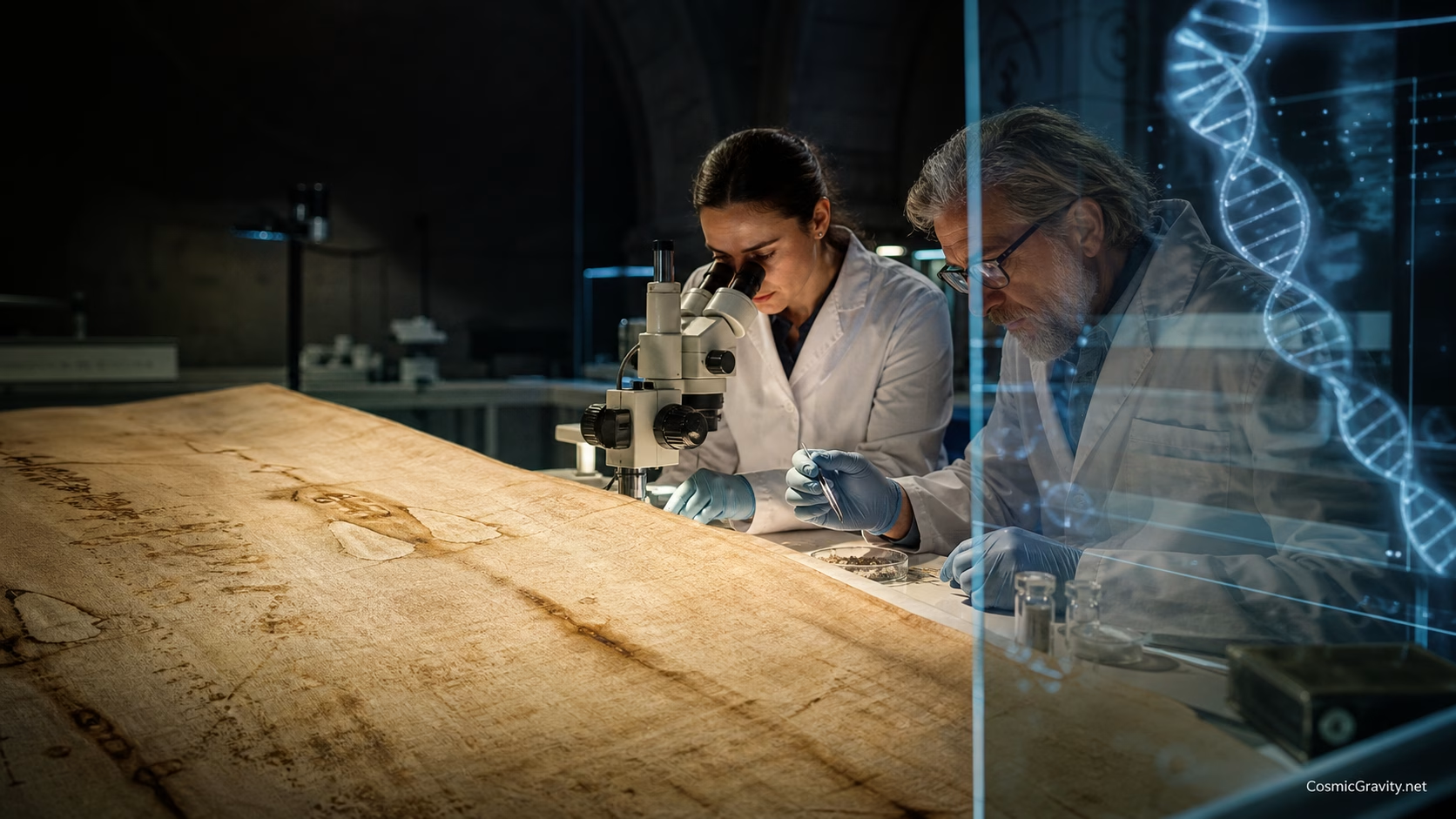
The strongest case would combine multiple gases, a plausible atmosphere and climate, repeated observations, careful modelling of the host star and confirmation by independent instruments. Researchers would ask whether volcanoes, ultraviolet chemistry, oceans or impacts could produce the same pattern.
The first announcement would therefore be cautious. Headlines might say “life found,” while the paper says “candidate biosignature.” Months of reanalysis would follow. Telescope time would be redirected, rival teams would inspect the data, and future observatories would target the same world.
How society might react
A microbial biosignature would not arrive as a spacecraft over a capital city. Daily life would continue. Markets might move briefly; political leaders would speak; religious and philosophical traditions would absorb the news in different ways. The deeper change would be gradual: biology would no longer appear to be a single known accident.
A convincing industrial pollutant would be more disruptive because it implies technology. Yet even then, a forty-light-year distance prevents conversation on a human timescale. We would be looking at chemistry that left the planet decades earlier.
The honest story is already remarkable. Webb is attempting to read the atmospheres of Earth-sized worlds around another star. It may not deliver a scheduled revelation in 2030. It is teaching us what evidence strong enough to change civilisation would actually have to look like.
Sources and further reading
latest video

news via inbox
Subscribe to our Cosmic newsletter to get notified when we have new articles.