Aberlemno Pictish Stones: What Archaeologists Found Beneath a Fallen Cross-Slab
One of the Aberlemno Pictish stones fell in March 2025. The immediate problem was how to conserve the roadside cross-slab. Taking the damaged stone away gave archaeologists an unusual opportunity to look under its base. A fragment of an older Pictish carving turned up where someone had used it as a prop. Another piece of sculpture, part of a human face, came from the topsoil. The two finds pose different questions about what once stood in this corner of Angus. Historic Environment Scotland’s 5 November 2026 excavation update.
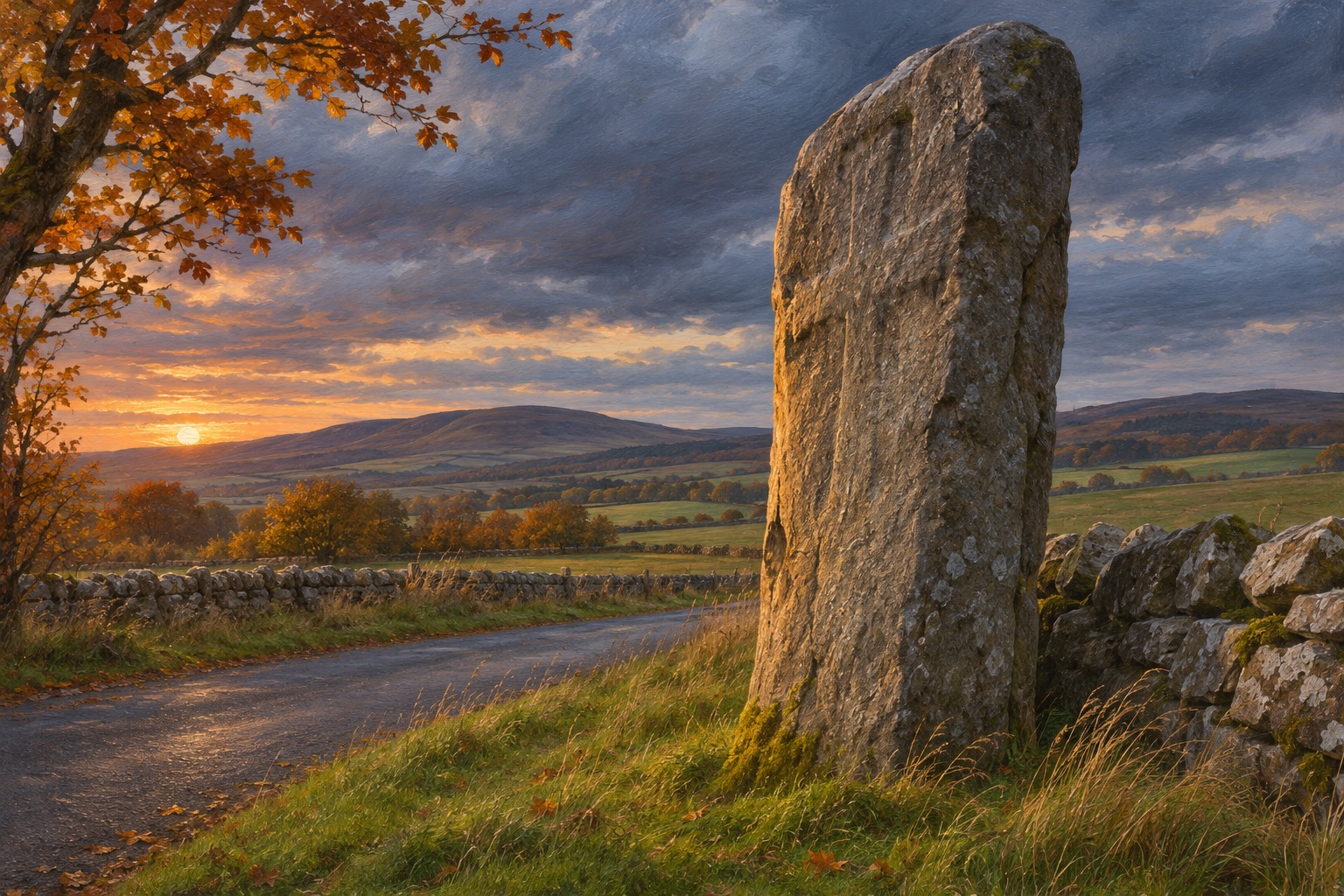
Several carved monuments survive in the village. The one involved here is Aberlemno III, the carved roadside slab with a cross. A separate carved stone stands at the kirk. Keeping those locations straight matters because one of the excavators’ ideas is that the roadside monument once faced towards the church.
What the Aberlemno Pictish stones can tell us from below
A standing monument has two histories. You can read one on the surface in the carving and the wear. You can sometimes read the other in the ground, where the weight of the stone and the work of holding it upright leave traces. At Aberlemno, the excavators from Historic Environment Scotland and AOC Archaeology could examine that second history while the slab was away for conservation.
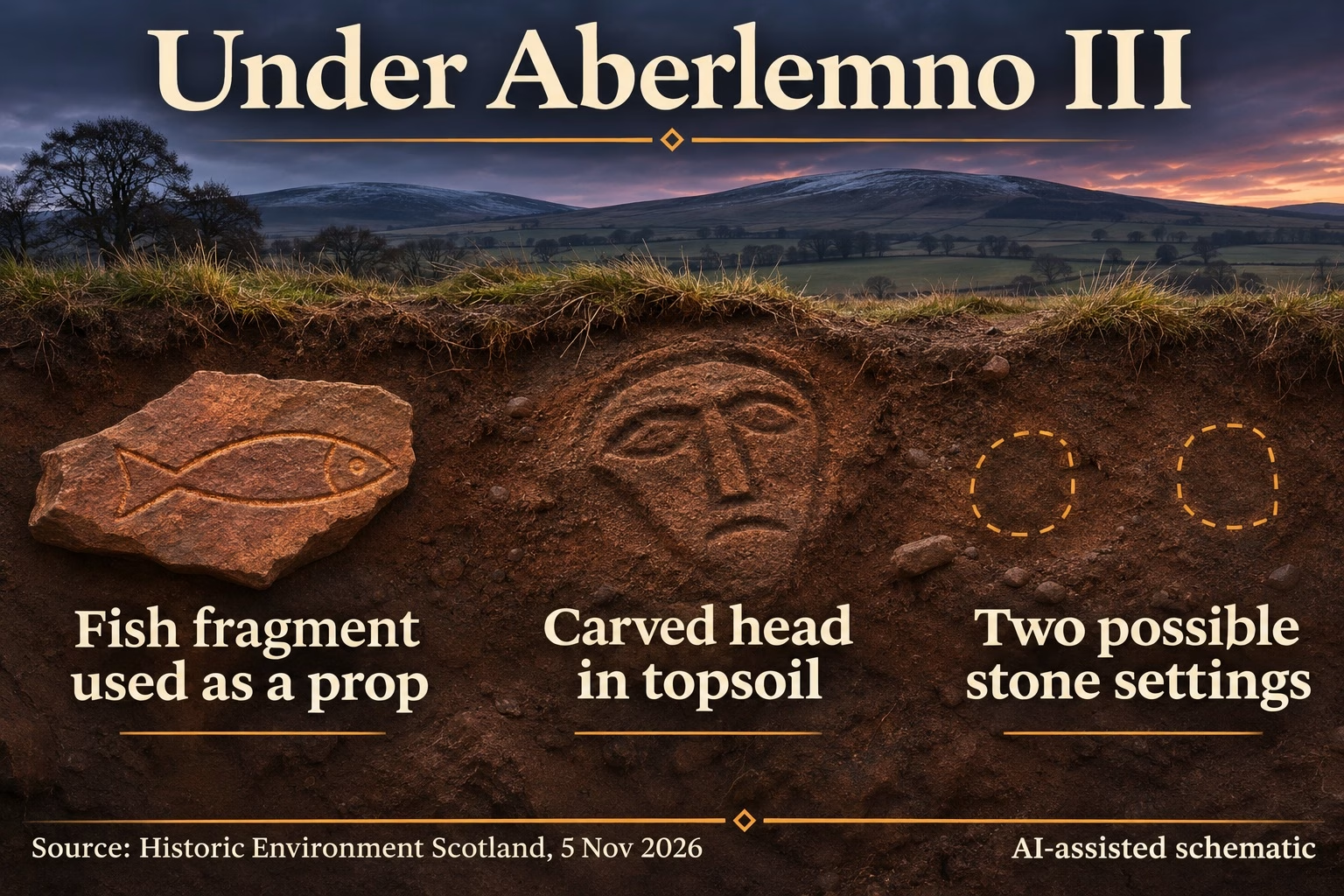
The fish fragment came from beneath the base stone, where it had a practical job. It helped support the base. The design appears to be part of a salmon, a motif familiar from Pictish sculpture in northern and eastern Scotland. The excavators think it came from an older carved stone that may already have broken by the time the base was installed. The fragment’s position gives a relative sequence. The carving had to exist before someone used the piece as a prop. Dating either step more precisely will require other evidence.
The face fragment came from a different setting. The excavators found it in topsoil around the monument, and it does not appear to fit the roadside slab. Historic Environment Scotland considers an Early Medieval date plausible from its appearance. The original object is still unidentified. In disturbed or mixed upper soil, even a find close to a known monument can have arrived independently of it. Find locations and preliminary identifications.
Did Aberlemno III once face the kirk?
Below the base, the team identified two features that could be settings for standing stones. One might represent an earlier position of Aberlemno III. If so, the slab may once have faced along a north–south alignment, towards the kirk. When a base was added, the slab could have been set on the east–west alignment described by the excavators. They note that this is a familiar Christian orientation. Its presence alone cannot establish why the slab was repositioned.
The proposal describes a change within the same spot, on the scale of an installation. It leaves open what prompted the work. An earlier fall and a deliberate repositioning are both possibilities. A small feature can record the footprint of an intervention even when it gives few clues about the people or circumstances behind it.
The recent fall that led to the excavation is much easier to place in time. Historic Environment Scotland attributes the March 2025 incident probably to exceptionally strong winds. The excavated features concern earlier stages in the slab’s history. Historic Environment Scotland’s site history.
What comes next for the Aberlemno Pictish stones?
The base stone is in Edinburgh for analysis. Part of the broken roadside slab is still embedded in it, and the team plans to retrieve that section. Until it has been examined, the possibility of further carving is just that. Post-excavation research may also help put the installation sequence and the reused fragment on a firmer timeline.
For now, the easiest detail to overlook may also be the most revealing. The person who reused the fish carving could treat it as a piece of stone that happened to be the right shape. For the archaeologists, the same object marks a point where two histories meet. One belongs to the older sculpture. The other belongs to the people who kept a later cross-slab standing.
Read more about how archaeologists distinguish observations from interpretations of ancient designs in our account of the Nebra Sky Disc and Bronze Age astronomy.



latest video

news via inbox
Subscribe to our Cosmic newsletter to get notified when we have new articles.