When to watch the 2026 Geminid meteor shower, and why one peak time isn’t enough
At the predicted peak of the 2026 Geminid meteor shower, it will be three in the afternoon in Amsterdam. The same moment falls at nine in the morning in New York and eleven at night in Tokyo. All three cities will be passing through the same stream of debris. Only one of them will have a dark sky at that hour. That is why the most useful entry in an observing diary is a local night, even when a forecast gives a precise universal time.
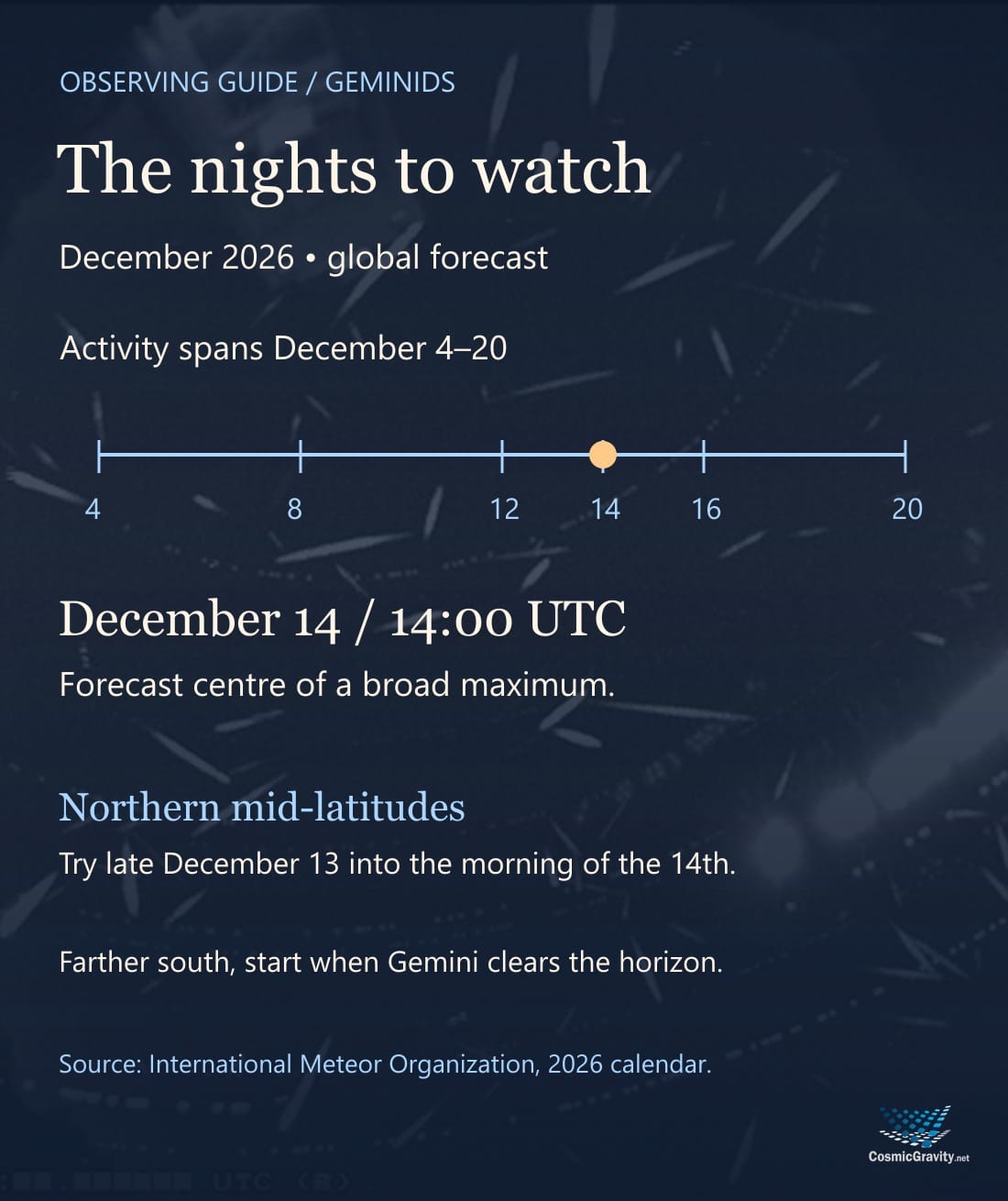
The International Meteor Organization (IMO) puts the centre of the broad maximum at 14:00 UTC on Monday, December 14. For much of northern Europe and North America, plan around the night of Sunday, December 13, into Monday morning, December 14. In East Asia the evening of the 14th leads into useful hours with Gemini higher in the sky. The IMO lists activity from December 4 through 20, so a clear night on either side of the maximum is worth using. Read the Geminid forecast in the IMO’s 2026 calendar.
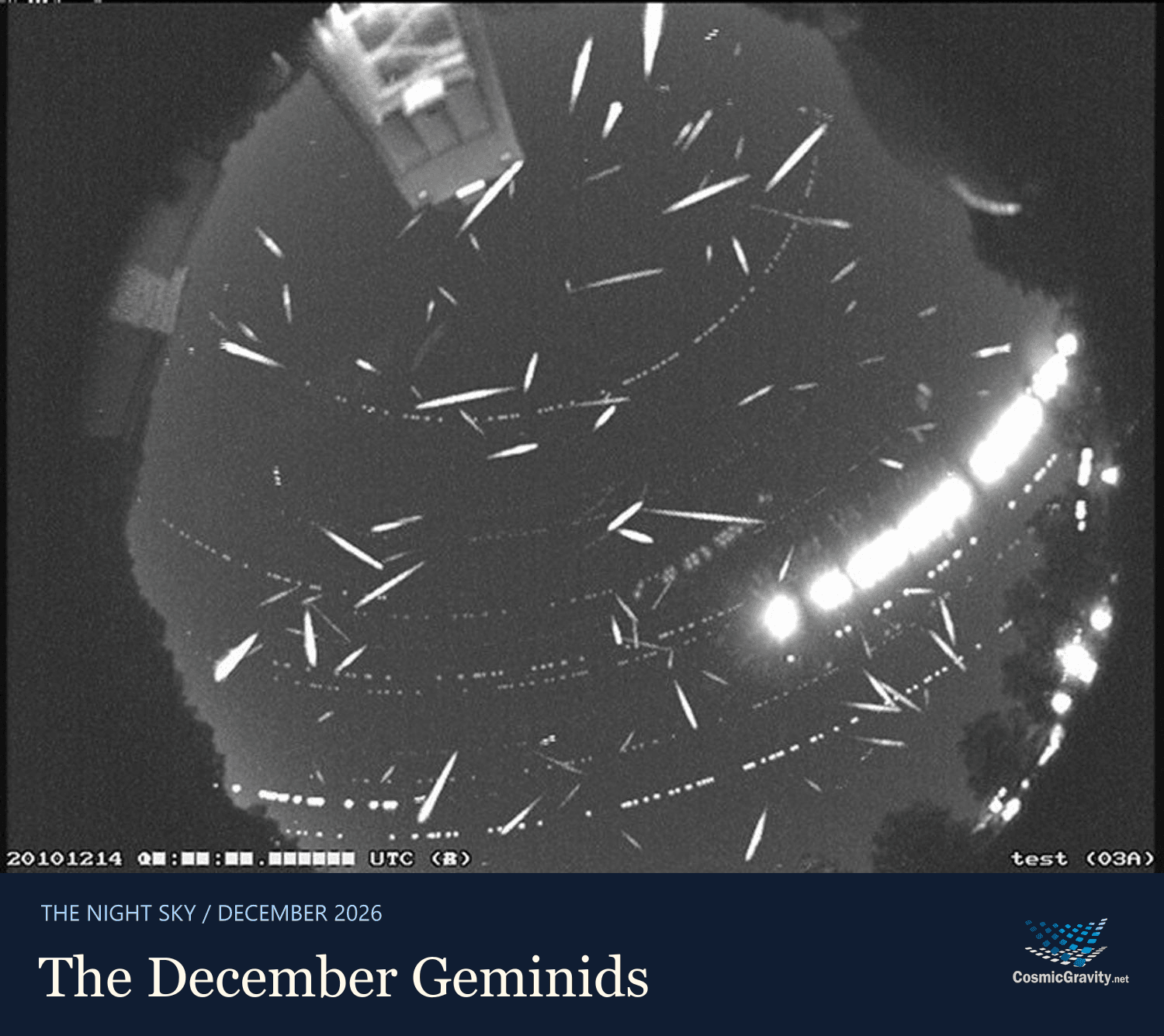
Feature image. This composite combines more than 100 meteors recorded at the 2014 Geminid peak. Credit to NASA/MSFC/Danielle Moser, NASA’s Meteoroid Environment Office. Image source.
Where to look for the Geminids
Under a dark sky a meteor can appear almost anywhere in your field of view. If you extend a Geminid’s trail backwards, it points towards the constellation Gemini, near the bright star Castor. Astronomers call that apparent starting area the radiant. It is an effect of perspective, like parallel railway tracks appearing to meet in the distance. The particles reach Earth on similar paths, and from the ground those paths appear to fan out.
You can put that fact to use without learning a star chart. Pick a spot with a broad view of the sky, well away from lamps, and allow about half an hour for your eyes to adjust. Look across a wide patch of open sky. Staring directly at the radiant tends to give you the shortest-looking trails. A telescope or binoculars would show only a fraction of the area your eyes can cover. NASA’s Geminid observing guide explains the radiant and dark adaptation.
What the 2026 peak forecast means for your night
At middle northern latitudes Gemini rises towards evening and climbs as the night goes on. Near its highest point, around 2 a.m. local time, more of the stream is visible above the horizon. From southern mid-latitudes Gemini sits lower. The hours after it rises, often around local midnight, give a better chance than early evening. Weather, nearby lights and obstructions can matter more than a small difference in longitude. A clear patch of sky on the 13th is worth more than a precise peak time behind cloud.
The number 150 per hour in the IMO calendar has a particular meaning. It is the estimated zenithal hourly rate, a standard used to compare showers under a dark sky with the radiant directly overhead. A garden observer with Gemini partway up and a streetlight over the fence should expect fewer. Even under excellent skies, arrivals can cluster. A quiet ten minutes does not tell you what the next ten will bring.
The maximum is broad, too. The IMO notes that high normalized rates in previous returns have extended over roughly ten to twelve hours. The waxing crescent Moon leaves useful dark hours later in the night. Give yourself a stretch of uninterrupted observing time. If you want to compare two nights, jot down the start and end times, how much cloud crossed your view and how many trails seemed to lead back towards Gemini.
Why an asteroid produces a meteor shower
The Geminid stream shares an orbit with the asteroid 3200 Phaethon. Earth encounters particles distributed along that orbit each December. Incoming grains produce light high in the atmosphere, long before they could reach an observer on the ground. The flights themselves are brief. The stream can keep producing them for nights because it takes Earth time to cross its width.
How Phaethon supplied so much debris remains an open question. When it approaches the Sun it can develop a tail. A 2023 analysis using solar observatories found that sodium emission explained the observed tail much better than a trail of dust. The sight of a tail alone therefore cannot account for the mass in the Geminid stream. That is a separate puzzle from forecasting when Earth passes through material already there. Read the solar-observatory study’s findings and compare the Geminids with November’s Leonids.
latest video

news via inbox
Subscribe to our Cosmic newsletter to get notified when we have new articles.