
How a Lattice Algorithm Found a Pulsar Hidden in 15 Years of Data
A star can rotate hundreds of times while its signal remains almost invisible in a telescope’s event list. A new gamma-ray pulsar search has recovered one of those hidden rhythms by turning the problem into geometry.
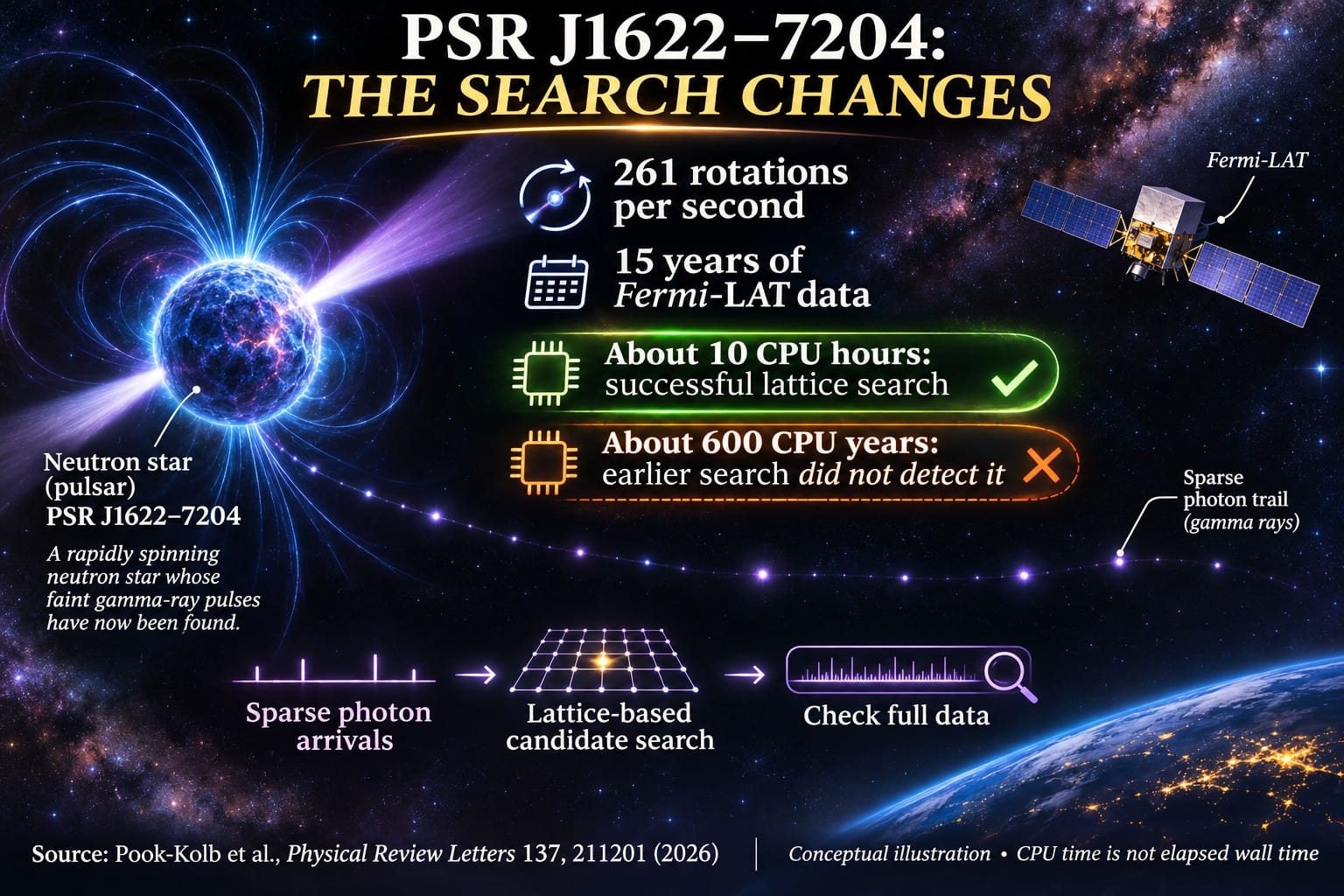
In a paper published on 19 November 2026 in Physical Review Letters, Daniel Pook-Kolb and colleagues report the discovery of PSR J1622−7204. This isolated neutron star rotates 261 times per second. The team identified its pulsations in 15 years of Fermi-LAT observations, using about ten CPU hours.
Why a gamma-ray pulsar search is difficult
A pulsar is a rotating neutron star whose radiation sweeps across our line of sight. In gamma rays, detections can be extraordinarily sparse. The paper describes the challenge as roughly one detected photon per hundred million rotations. The telescope therefore supplies widely separated arrival times, rather than a neat recording of every pulse.
Working backwards requires a model that keeps those arrivals aligned over years. The spin frequency, its change over time and the object’s sky position affect that model. Small errors accumulate: a proposed rhythm that appears plausible over a short interval may drift out of alignment across a longer observation.
Imagine receiving occasional, irregularly selected ticks from a fast clock while other unrelated clicks are mixed in. Counting adjacent events will not reveal the clock rate. Many possible rhythms must be evaluated against the same sparse evidence.
How the gamma-ray pulsar search uses a lattice
The approach builds on a 2025 paper by Dotan Gazith, Aaron Pearlman and Barak Zackay. It recasts recovery of a periodic signal from arrival times as a search for a short vector in a high-dimensional lattice. A lattice is a regular mathematical arrangement of points; it is not a physical structure surrounding the star.
Algorithms for finding short lattice vectors have an extensive history in mathematics and cryptography. Here they provide a different way to locate promising periodic solutions. The new work extends that approach to discover an actual gamma-ray pulsar, moving beyond a purely methodological proposal.
The Albert Einstein Institute’s account describes a collaboration involving Hannover, the Weizmann Institute and Chalmers University. Candidate signals from the new search were checked against the full data set. This verification step matters: an efficient candidate generator must still lead to a convincing astrophysical detection.
What “a million times faster” means here
The study contrasts its roughly ten CPU hours with a previous semicoherent search that failed to find this pulsar after approximately 600 CPU years. The institute summarises the improvement as about a millionfold. This is a comparison for this demanding discovery problem, with different outcomes, rather than a universal benchmark for every astronomy calculation.
A CPU year represents the work a processor core would perform over a year. Many cores can share work, so it is not necessarily a year on the calendar. Likewise, a successful search and an unsuccessful one are not identical tasks completed at different speeds. Keeping both qualifications makes the result easier to assess.
What can come next
NASA’s discussion of the open Fermi archive highlights the broader opportunity: researchers outside a mission can bring new mathematical tools to observations already collected. The team hopes to extend searches to binary pulsars, whose orbital motion complicates the timing model. That is a research goal, not a catalogue of binaries already discovered by this method.
Our feature on the CORALIE spectral archive offers a parallel example of old observations enabling new investigations. In both cases, keeping data accessible allows the next advance to come from a better question or algorithm, as well as a new instrument.



latest video


news via inbox
Subscribe to our Cosmic newsletter to get notified when we have new articles.