Inside the Duurlig Nars Tomb: A Steppe Empire’s Far-Reaching Connections
A handled glass cup, carved jade and an immense investment of labour make the Duurlig Nars tomb a compelling place to ask how a mobile empire connected distant societies. The most interesting story is the relationship between objects, burial architecture and the people who used them.
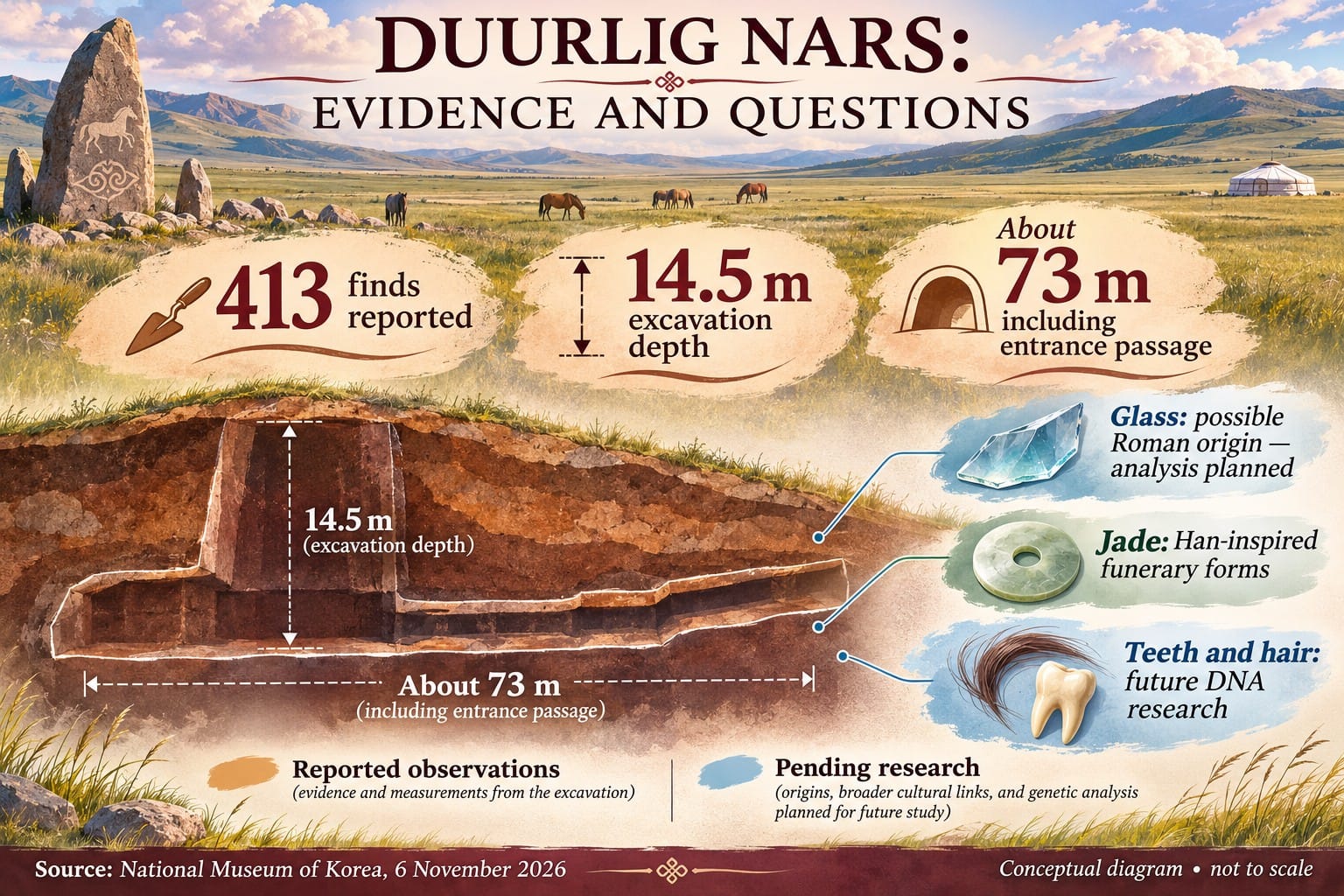
The National Museum of Korea announced the completion of its latest joint investigation on 6 November 2026. Its partners are Mongolia’s Institute of Archaeology and National Museum. The release reports 413 finds from Tomb 160, an excavation reaching about 14.5 metres, and a length of roughly 73 metres including the entrance passage. Read the museum’s original announcement.
What the Duurlig Nars tomb actually establishes
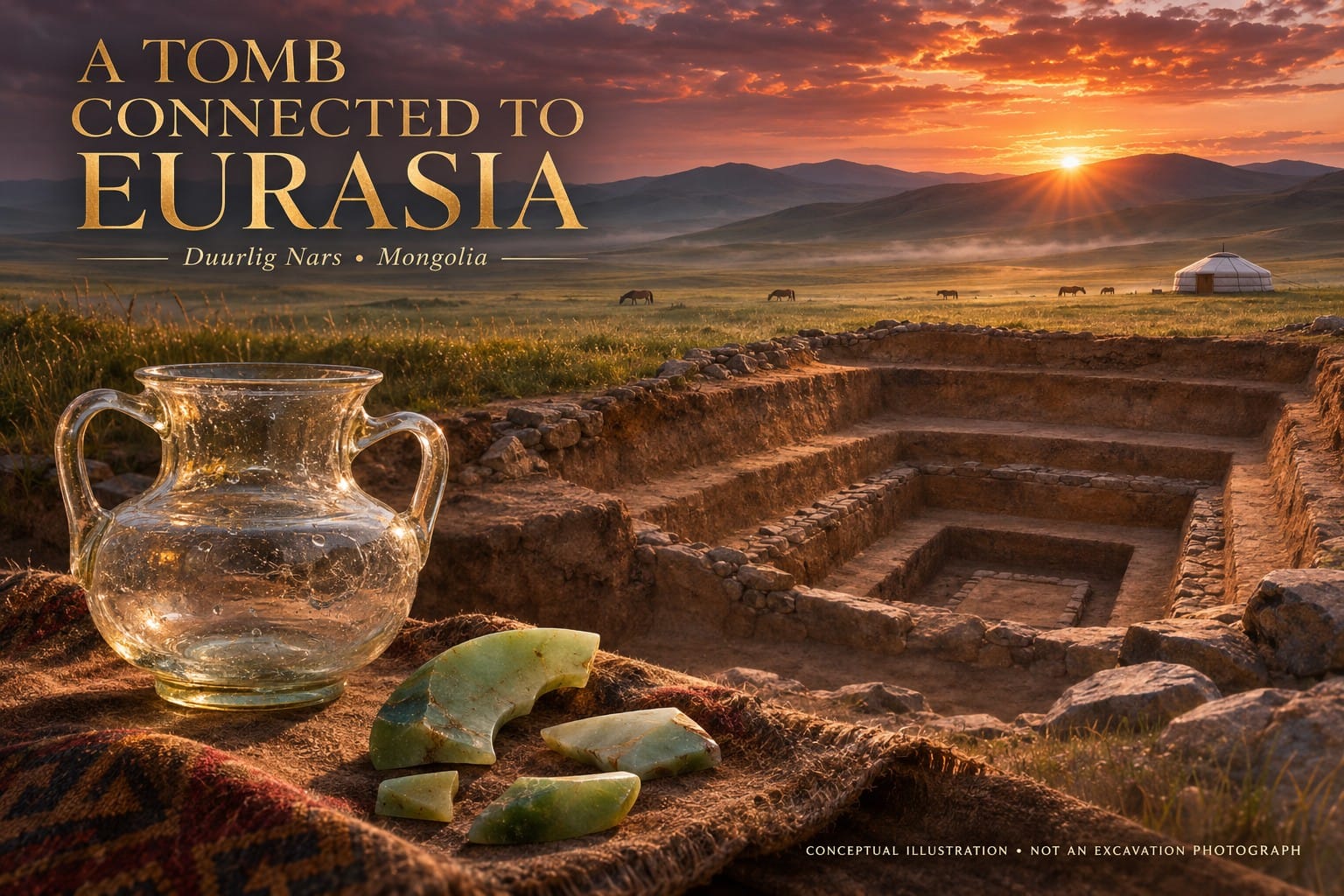
The museum describes a transparent handled cup as possibly made in Roman territory; compositional work is planned. Fifteen jade pieces draw on Han funerary traditions while departing from conventional circular forms. Silver horse ornaments also invite comparisons with finds from ancient Lelang, on the Korean Peninsula. These are identified similarities and research questions, rather than a completed itinerary across Eurasia.
The distinction matters. An object’s manufacturing origin, the route it travelled and the identity of its final owner are three separate questions. A recognizable style can suggest where to investigate. It cannot, by itself, tell us how many exchanges occurred before an object entered a grave.
A nomadic society capable of monumental construction
UNESCO’s account of the Cemetery Complexes of the Xiongnu Nobility places these sites within an empire centred on present-day Mongolia, spanning the third century BCE to the second century CE. Its eight-component World Heritage property was inscribed in 2026. The Xiongnu interacted with Han China and controlled important nodes on the Steppe Route of the Silk Roads.
The cemeteries preserve large, deep principal graves alongside smaller satellite burials and sacrificial structures. Horse equipment, chariots, weapons, tools and food offerings help researchers examine social organisation and funerary practice. UNESCO stresses the engineering and organisational achievement represented by these places.
That context helps explain why a tomb is more than a container for spectacular objects. Its construction records coordinated work. Its relationship to surrounding graves records deliberate choices about proximity and status. Both can be studied even when a buried person’s name remains unknown.
What DNA may reveal about the Duurlig Nars tomb
The Duurlig Nars tomb is dated by the museum to the later first through second centuries CE. Its relatively modest central chamber, beneath such an imposing monument, is interpreted as a possible clue to changing circumstances late in Xiongnu history. Teeth and hair may support future DNA work. The occupant’s identity and relationships remain open questions.
A separate 2023 Science Advances study demonstrates why genetic sampling can be informative. Researchers analysed 18 people from two western Xiongnu cemeteries and found substantial diversity within communities and extended families. Burial status was associated with differences in genetic heterogeneity; women occupied some of the most richly furnished graves.
Those results concern other cemeteries. They do not identify the occupant of Tomb 160, establish that person’s sex or supply a missing biography. They show why combining human remains with burial context can test assumptions that wealth or imported goods alone cannot settle.
Following connections without inventing a journey
Future analyses can narrow the gap between an evocative object and a defensible historical explanation. Glass chemistry may help assess production origin; genetic data may clarify kinship. Neither automatically reconstructs an entire trade route.
For a different example of the care needed when moving from material evidence to cultural interpretation, explore our report on Sanxingdui’s silk evidence. At Duurlig Nars, the strongest discovery is already clear: a monumental burial offers several independent ways to investigate a connected and internally complex steppe society.


latest video



news via inbox
Subscribe to our Cosmic newsletter to get notified when we have new articles.