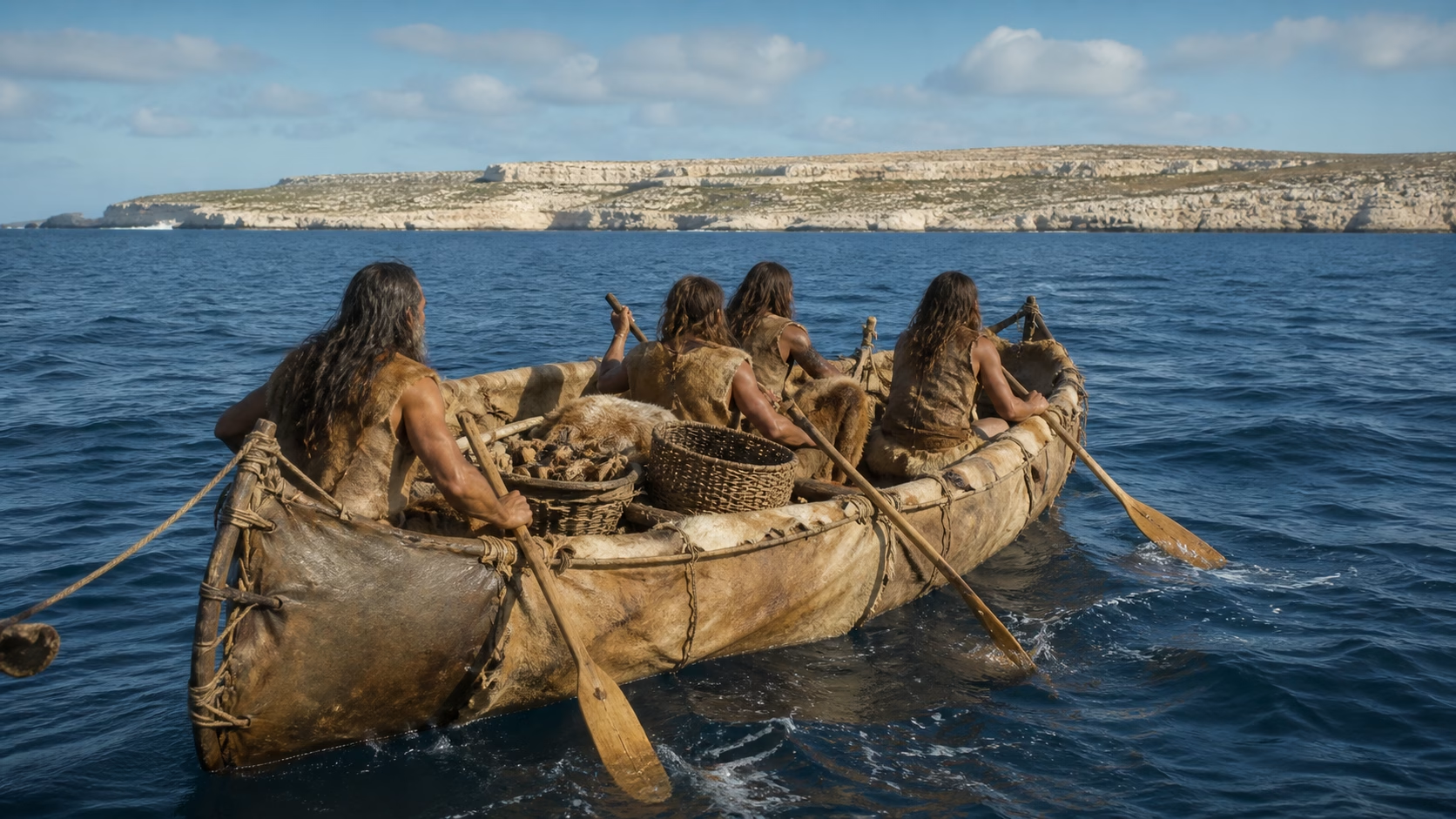
Malta’s First Settlers Were Crossing Open Sea for a Thousand Years
Long before farming reached the central Mediterranean, hunter-gatherers were making repeated open-sea voyages to Malta. New research indicates that prehistoric Malta sea journeys of at least 100 kilometres continued for roughly a thousand years.
The result challenges the image of Europe’s last foragers as people limited to coastlines and short island hops. Reaching Malta from Sicily required planning, seaworthy craft and the ability to navigate beyond easy sight of land.
An island too small for complete isolation
Archaeological work at Latnija, a cave site in northern Malta, has documented hunter-gatherer occupation across about a millennium. The key question was whether one founding group could have survived on the islands for that entire period.
The new study combined archaeology, ethnographic comparisons, palaeoclimate data and sea-level models. Researchers estimated how many people Malta’s landscape could support before agriculture and whether that population would be large enough to remain demographically stable.
The answer was probably no. A small isolated community is vulnerable to accidents, disease, infertility and random changes in birth ratios. Continued occupation therefore implies repeated contact with larger populations, most likely in Sicily.
At least 100 kilometres across open water
Sea levels and coastlines were different in the Mesolithic, but Malta was still separated by a serious stretch of open water. The likely routes required crossings of at least 100 kilometres.
On a clear day, experienced sailors might use cloud patterns, birds, currents and distant land visibility. Yet a voyage of that scale cannot depend on luck alone. Travellers needed knowledge of seasonal winds, water and food for the journey, and craft that could carry several people safely.
No complete boat survives from these crossings. Organic materials such as wood, fibre and hide usually decay. The voyages are reconstructed from island occupation, environmental limits and the absence of a plausible isolated population.
Voyages were sustained, not accidental
A single arrival could be explained by people blown off course. A thousand years of occupation is different. It suggests a maintained maritime network, with journeys repeated often enough to bring new people, knowledge and perhaps resources.
That network may not have operated continuously every year. Contacts could have been intermittent and still prevented total isolation. The central point is that the sea functioned as a route rather than an absolute barrier.
Before farmers and temples
Malta is famous for its later Neolithic temples, built by farming communities after about 3600 BCE. The new work reaches further back, to people living by hunting, gathering and fishing before agriculture transformed the islands.
This earlier maritime ability changes the background to Malta’s later history. Farmers did not necessarily introduce the idea of long-distance seafaring to an isolated world. They entered a region where knowledge of sea routes may already have existed for many generations.
What the travellers carried
People crossing from Sicily may have brought stone, tools, food and social connections. Even small exchanges could help an island community adapt to shortages. Marriage partners and visiting relatives would have been especially important for long-term survival.
The archaeological record may eventually reveal whether particular raw materials moved along the same route. Detailed sourcing of stone and shells can identify objects that originated outside Malta.
A broader change in prehistoric Europe
The finding joins a growing body of evidence that ancient hunter-gatherers possessed sophisticated planning and technology. Monumental sites such as Göbekli Tepe already challenged older assumptions about what foraging societies could organise on land. Malta extends that reassessment to the sea.
It also offers an early chapter in the maritime world that later connected Bronze Age cultures across the Mediterranean. By the era of the Antikythera mechanism, sea routes carried complex technology and written knowledge. The first crossings were humbler, but no less consequential.
Reading travel from absence
The research is a good example of archaeological reasoning. There is no surviving passenger list and no intact Mesolithic boat. Instead, several independent facts converge: sustained occupation, limited island resources, demographic risk and a plausible route to Sicily.
That convergence makes repeated contact the strongest explanation, while leaving details open. We do not yet know the exact craft, departure points or frequency of travel.
The prehistoric Malta sea journeys reveal that open water was not the edge of the known world for these communities. It was a difficult road—one they learned to travel for a thousand years.
Source: University of Liverpool: sustained hunter-gatherer sea journeys to Malta.



latest video



news via inbox
Subscribe to our Cosmic newsletter to get notified when we have new articles.