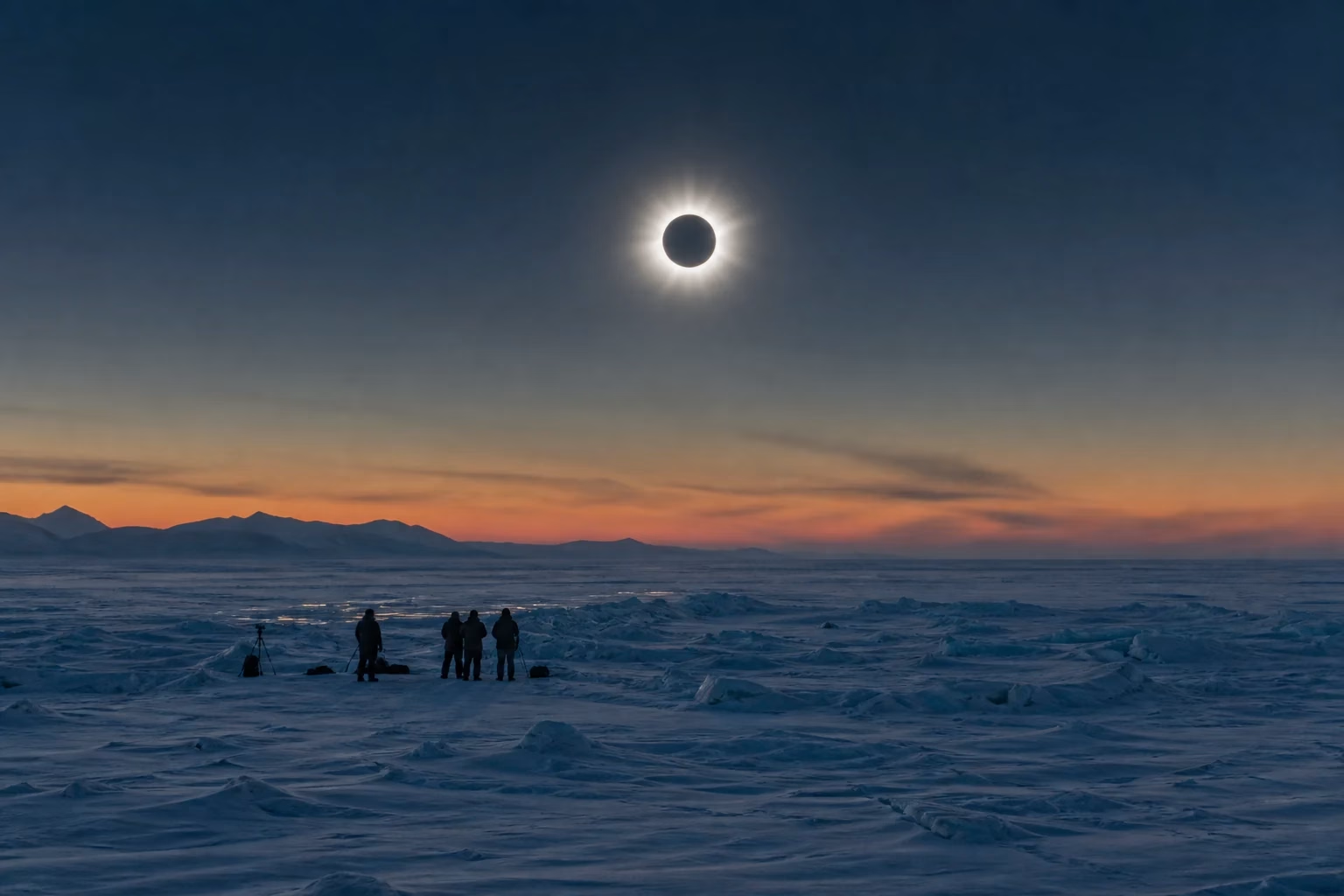
The 2033 Alaska Total Solar Eclipse: Path, Timing and Best Places
On March 30, 2033, the Moon’s shadow will sweep across Alaska and the Arctic Ocean, producing the only total solar eclipse to touch the United States between 2024 and 2044. It will not cross the Lower 48. This is an Arctic eclipse: cold, low in the sky and potentially magnificent.
NASA’s calculations give a maximum totality of about 2 minutes 37 seconds near 71 degrees north latitude, close to Alaska’s North Slope. The path is unusually broad—roughly 780 kilometres near greatest eclipse—so a large section of western and northern Alaska lies within totality.
Where the shadow goes
The umbra begins near the western Aleutian region, crosses the Bering Sea and western Alaska, then moves north-east across the Arctic. Nome and communities across the North Slope are expected to be inside the path. Greatest eclipse occurs near the longitude of Utqiagvik, where the Sun will stand only about 11 degrees above the horizon.
Exact local times and the final path edges will be refined closer to 2033. NASA notes that mountains and valleys on the Moon’s limb can shift the predicted limits by one to three kilometres and alter duration by a few seconds. Anyone planning near an edge should wait for modern local calculations.
Path of totality
Choose an Alaska viewing region
Compare three locations near the broad 2033 total-eclipse path.
Nome region
~17:48 UTC · ~2m 31s · Sun ~9°
Kotzebue region
~17:54 UTC · ~2m 35s · Sun ~11°
Utqiagvik region
~18:00 UTC · ~2m 37s · Sun ~11°
Central-line approximations; check certified local circumstances before travel.

Why a low Sun changes everything
A low-altitude eclipse looks different from one overhead. The black lunar disk and pearly corona hang near the horizon, framed by snow, sea ice and distant terrain. Shadow bands may race across bright surfaces. The approaching umbra can appear as a dark wall in the sky.
It also makes observation more fragile. A bank of cloud near the horizon can hide the entire event even when much of the sky is clear. Buildings, hills and coastal fog become important. A site needs an unobstructed view toward the Sun, not simply a position inside the path.
The real challenge is Alaska in March
Late March brings severe cold, blowing snow, variable cloud and limited infrastructure. Remote roads may be closed or nonexistent. Flights and accommodation in small communities are limited even during normal periods. The best astronomical position on a map may not be the safest or most practical viewing site.
Planning should include flexible travel days, insulated equipment, spare batteries kept warm, local guides where appropriate and respect for Indigenous communities. Visitors should not assume that tundra or sea ice is open, stable or safe.
How to watch safely
Certified eclipse glasses or properly filtered optics are required during every partial phase. Filters come off only during totality, when the photosphere is completely covered, and go back on as soon as direct sunlight returns. Cameras and telescopes need solar filters over the front aperture; ordinary sunglasses are not enough.
The 2033 eclipse rewards early preparation, but it also rewards restraint. Do not spend totality looking only at a screen. Watch the horizon darken, notice the temperature fall, listen for changes in the landscape—and then look up at a Sun transformed into a black circle surrounded by its atmosphere.
Sources and further reading


latest video


news via inbox
Subscribe to our Cosmic newsletter to get notified when we have new articles.