
San Diego Drone Files: What the FAA Reports Establish
The most revealing detail in the San Diego drone files may be how often the observers qualified what they could see. Pilots reported objects. Controllers stopped departures. A helicopter crew reportedly obtained a visual but no video. Nearby military personnel told the tower they were preparing to engage a reported drone. Each statement belongs to a different stage of the evidence.
The incident happened on 4 September 2026. The new development is the publication of released FAA records by The Black Vault on 3 November. The documents make the operational response clearer while leaving the identity, number and ultimate fate of the reported objects unresolved.
What is in the San Diego drone files?
John Greenewald’s published document archive includes two FAA Mandatory Occurrence Reports and tower audio recordings obtained through the Freedom of Information Act. The written reports are contemporaneous records of what aviation personnel reported and how officials reviewed the event.
The larger report, SAN-M-2026/09/04-0004, is particularly useful. Its summary separates three reported strands of activity. Yet it also acknowledges that two sightings might have involved the same object. Numbered entries therefore should not be turned into a confident count of three independent aircraft.
A record can establish that a statement was received without settling whether every description within it was correct. That distinction is central to reading these files fairly.
Why departures stopped before the tower had a visual
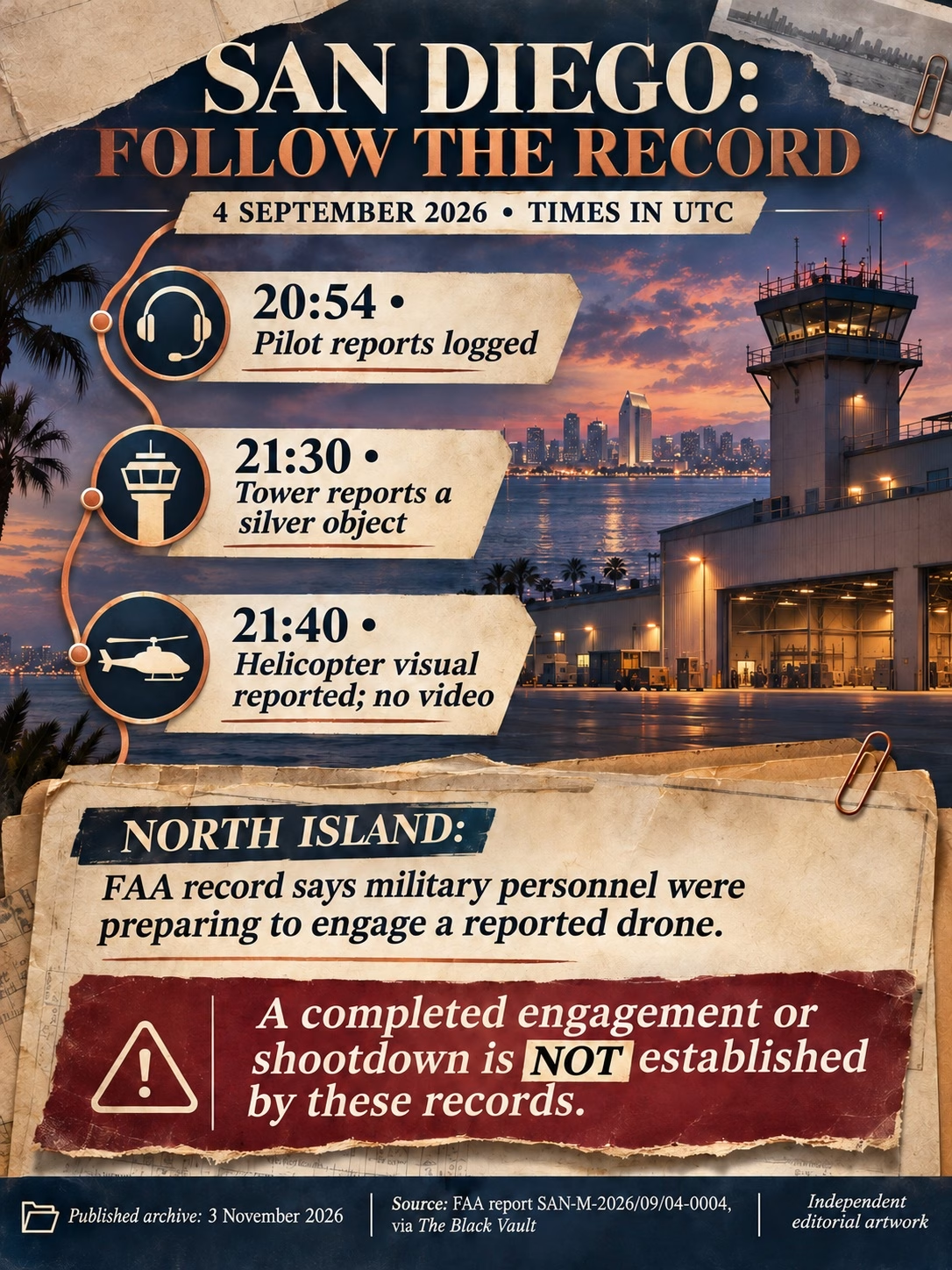
The summary begins with pilot reports logged at 20:54 UTC, or 1:54 p.m. in San Diego that day. Multiple taxiing aircraft reported an object near the departure end of the runway. The tower initially could not see it, while reports continued from at least seven aircraft. Departures stopped.
This sequence matters because a safety response does not require a final identification. Controllers must manage the possibility of an obstruction or collision hazard while information is incomplete. Waiting for a perfect photograph could be the wrong operational decision.
The initial lack of a tower visual also does not erase the pilots’ reports. It tells us that observers had different vantage points and that the tower’s own confirmation came later.
What the San Diego drone files say about a silver object
At approximately 21:30 UTC, the summary says the tower obtained a visual of a silver object hovering north of the runway over Taxiway F. It then records an ASTREA police-helicopter visual at 21:40 UTC, accompanied by an explicit limitation: the crew could not obtain video.
“Silver” describes an appearance. It is not a manufacturer, a propulsion system or an origin. Reflective surfaces can be difficult to judge against a bright sky, and the released report does not supply the imagery needed for an independent shape or motion analysis.
The document also contains compressed altitude notation in its narrative. Its quality-assurance findings describe reported altitudes of roughly 300–1,500 feet. Those are reported values in an administrative record, not measurements we can independently refine from a picture.
Why the number of objects remains uncertain
A later entry describes a Southwest flight reporting another silver object around 22:00 UTC. Another flight reported a similar object eight minutes later. By then the tower had lost sight of the first object, and the summary specifically allows that the later observation could have been that same one.
That is a useful example of uncertainty being preserved rather than concealed. Two reports can be separate observations of one object. Conversely, one broad incident can include several unrelated objects. Establishing a count requires matched times, locations and continuous tracking.
The released second occurrence report provides another record to examine alongside the larger summary. Readers should compare the reports rather than treating repeated references as independent confirmation of every detail.
What was reported from North Island?
The larger report separately records a call from Navy North Island at approximately 21:30 UTC. According to the FAA summary, military personnel had an unauthorised drone that they were preparing to engage.
This is a consequential entry, but its wording stops at preparation. It does not document a completed engagement, a destroyed aircraft, a recovered object or a confirmed operator. It also does not establish that the North Island report concerned the object seen beside the civilian runway.
The Black Vault discusses a possible shootdown statement in its software-generated transcription of tower audio. Those working transcripts were not prepared by the FAA. A claim of a completed military action needs verification against the recording and corroborating records; the written occurrence report does not provide that confirmation.
How the San Diego drone files fit the UAP discussion
The reports use drone and UAS terminology. The documents available here do not establish extraterrestrial origin or extraordinary flight performance. Their value is more concrete: they show how a real aviation disruption was recorded when observations were incomplete.
Our guide to FAA UAP reporting explains the wider reporting process. The Jersey Airport sightings offer another example of the difficulty of moving from a report to an identification. Neither comparison determines what happened in San Diego.
The next useful evidence would be continuous imagery or tracking data, records describing the North Island response, and documentation connecting any identified object to a particular observation. Until then, the files support a serious account of reports and decisions, with room left for the questions they cannot answer.



latest video



news via inbox
Subscribe to our Cosmic newsletter to get notified when we have new articles.