Inside the Pentagon’s eighth UAP release
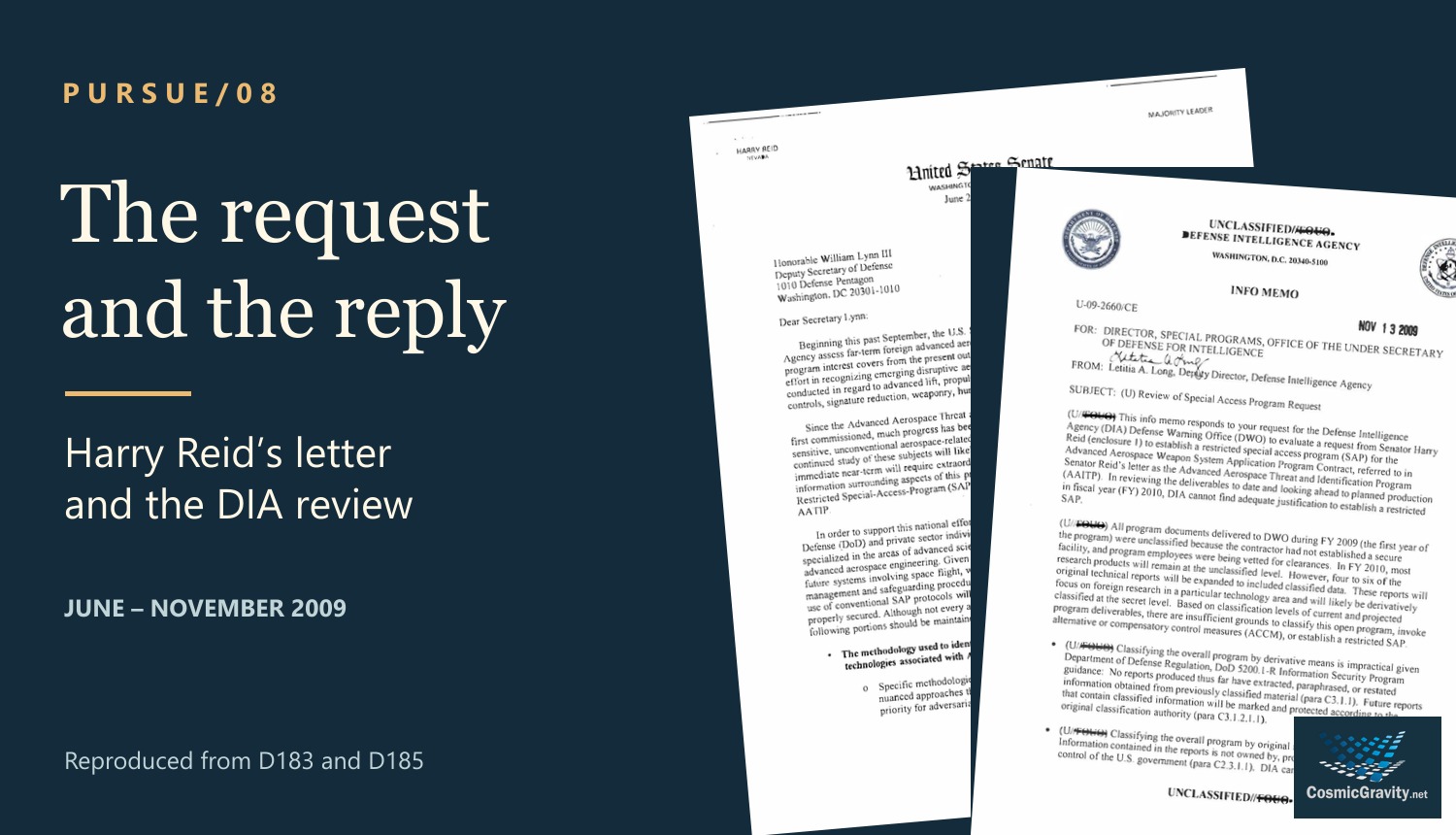
Feature image. Two first pages from the eighth release. Reid addressed Deputy Secretary of Defense William Lynn III. Long sent the agency’s review to the Pentagon office responsible for special programs. Document excerpts from the U.S. Senate and Defense Intelligence Agency, files D183 and D185. Layout by CosmicGravity.
On June 24, 2009, Senator Harry Reid asked the Pentagon to restrict who could see parts of an aerospace research program. He believed the work might soon produce discoveries that needed exceptional protection. Five months later, Letitia Long, deputy director of the Defense Intelligence Agency, put her agency’s answer in writing. The two documents, now public in the Pentagon’s eighth UAP release, record what happened to that request. Her staff had reviewed what the contractor had delivered. They could find no adequate grounds for the restrictions Reid wanted.
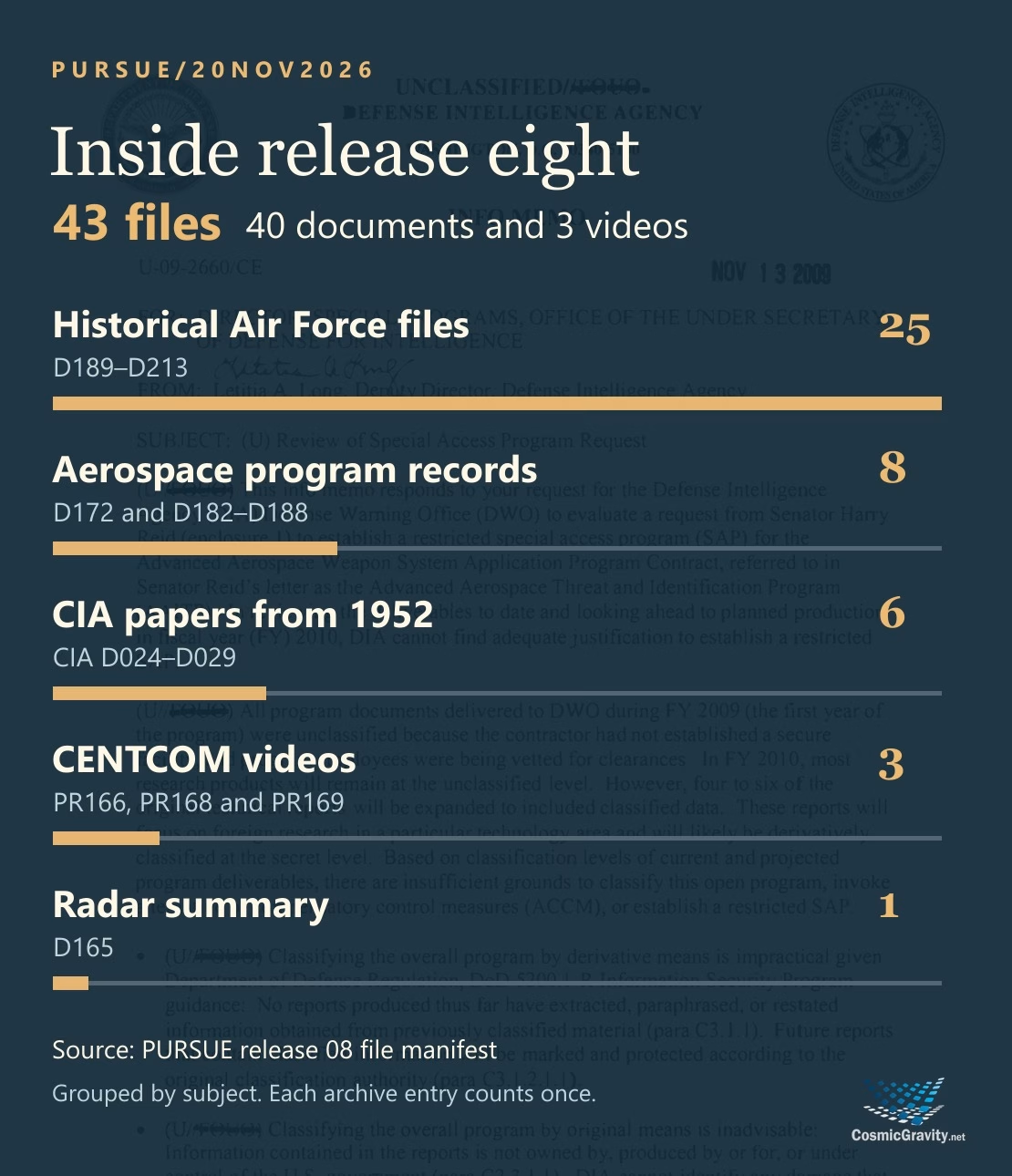
The Pentagon published both documents on November 20, 2026. The 43 files include three military videos from the Middle East, six CIA papers from 1952, and accounts written by people who saw something they struggled to identify. The collection is part of PURSUE, the Presidential Unsealing and Reporting System for UAP Encounters. UAP stands for unidentified anomalous phenomena. Some of the people speaking to us through these files put pen to paper more than seventy years ago. Pentagon announcement · File-by-file index.
The senator, the contractor and the proposed vault
Start with the second paragraph of Reid’s letter. He shifts from findings he considered sensitive to his expectation that further research would yield technology worth protecting. That shift in tense matters. The letter tells us what the Senate majority leader believed and what he thought might happen next. It gives no example of a piece of recovered hardware that a reader could trace or examine. Read Reid’s letter, D183, page 1.
Between the letter and the agency’s review came a July progress report from Bigelow Aerospace Advanced Space Studies, the contractor hired under the Defense Intelligence Agency’s Advanced Aerospace Weapon System Applications Program (AAWSAP). In a section on facilities, the company described a design for an underground vault in North Las Vegas where unusual material or tissue could be stored. This is the document behind an especially intriguing part of the story. Look at the verbs the company used about the facility, then look for the records that would accompany a delivery. A drawing can show where the contractor intended to put something. To establish what actually arrived, a researcher would want a dated receipt, an inventory entry and a laboratory record tied to the same specimen. The vault passage supplies none of those. Contractor’s ten-month report, D172, section 1.
Long’s November 13 memo explains how the agency reached its answer. All the work delivered in the program’s first fiscal year had been unclassified. The contractor had yet to establish a secure facility, and employees were being vetted. Long allowed that a handful of later reports on foreign research might incorporate classified information. Her office could protect those reports individually. The material it had reviewed gave it insufficient reason to put the whole research effort behind a new barrier. Read together, the three files let us follow a proposal from a senator’s desk to the officials who had to decide whether it met their criteria. DIA review, D185, pages 1–2.
What do the eighth UAP release videos show?
U.S. Central Command submitted all three clips to the All-domain Anomaly Resolution Office, or AARO. Try watching the edges of each frame as well as its center. The camera operator pans and changes magnification. An object that stays near the crosshairs can owe its place there to the person tracking it. The timestamps below follow AARO’s descriptions, and each link opens the original government player.
- 2020 · 20 seconds. An area of contrast enters from the right and crosses toward the left. Around ten seconds in, the sensor pans and the magnification changes. The point is easier to follow once the operator catches up with it. Watch PR166.
- 2023 · 13 seconds. The camera follows one area of contrast and holds it near the center for most of the clip. There is little in the description to tell a viewer how far away it is. The same apparent movement could cover very different distances depending on the range. Watch PR169.
- 2026 · 54 seconds. Several areas of contrast cross the field of view. At about 29 seconds the operator zooms in on two and tracks up and to the left, losing contact intermittently. Knowing where to watch makes this the most informative clip for seeing what a change of camera framing does. It also explains why counting marks on the screen is a poor way to count vehicles. Watch PR168.
AARO describes what is visible and leaves the identity open. An independent speed estimate would need more than a stopwatch. Distance to the target, the platform’s own motion and the camera’s changing line of sight all matter. The radar file in this release poses a different problem: whether eight returns can be attributed to one object in the first place. We worked through that calculation separately. How AARO arrived at the conditional 1,650 mph figure.
What a Lockheed engineer could see from his window
At about five o’clock on December 16, 1953, Clarence “Kelly” Johnson was looking west through the plate-glass window of his ranch house near Agoura, California. The Lockheed chief engineer saw a dark shape above a mountain. In his written account two days later, he walked the Air Force through his first guesses: a cloud, then a smoke trail. He asked his wife to fetch binoculars so he could keep watching. By the time he had stepped outside and brought the shape into focus, he reported, it was moving behind haze.
Page 6 contains a detail worth more than any later adjective applied to the sighting. Johnson offered an estimate of the outline’s proportions but declined to estimate its dimensions because he didn’t know its distance. The same file preserves an account from a Lockheed test flight that evening. A reader can compare the viewing positions and the sequence in which the witnesses discussed the event. Johnson left us enough detail to examine his judgment, including the point at which he stopped guessing. Read Johnson’s statement on pages 6–7 and the flight account beginning on page 9 of D206.
The file from Levelland, Texas, takes a different form. The Air Force gathered accounts from the night of November 2–3, 1957, including reports of vehicles losing power near a light. Those statements preserve what individual people remembered happening to their vehicles. Working out whether the same cause stopped different engines would require evidence about the condition of each vehicle and the timing at each location. One good reason to read the file is that it lets you hear the witnesses separately before deciding which details belong together. Levelland investigation, D191.
Why did the CIA care in 1952?
Six documents come from the CIA. In an August 14 briefing, the Office of Scientific Intelligence described requests for information pouring in to the Air Force, including one from the White House. The CIA wanted to know how the Air Force was evaluating the reports and what intelligence implications remained. A separate paper sought approval for outside scientific research. The distinction would be familiar to any investigator today. Officials could reasonably want better observations while still disagreeing about what had prompted the reports. The August briefing, D027 · The research proposal, D024.
The public gain from this release is easiest to see by opening two files side by side. Reid wanted researchers to have a way to protect a future discovery. Long had to decide what the government could justify on the work already in hand. Both positions survive in their authors’ own words. For the videos, the comparable next piece of evidence would be a range measurement or a second observation tied to the same time. For the proposed vault, it would be a record of an actual transfer. If a receipt or a second observation surfaces later, readers now have a particular document or a particular thirteen seconds of film to compare it with.



latest video


news via inbox
Subscribe to our Cosmic newsletter to get notified when we have new articles.