Thessaloniki’s Painted Frieze May Preserve a Scene from Troy
The Thessaloniki painted frieze has spent a century asking viewers to make sense of damaged colour. Now researchers are proposing a connection with the Trojan mythological cycle, particularly the fall of Troy. Six surviving stone blocks will be presented in Seeing the Unseen, an exhibition whose opening is scheduled for 19 November at the Archaeological Museum of Thessaloniki. Scientific examination has recovered evidence that makes the scenes easier to investigate, while their identification remains a hypothesis. Museum research announcement.
What survives of the Thessaloniki painted frieze?
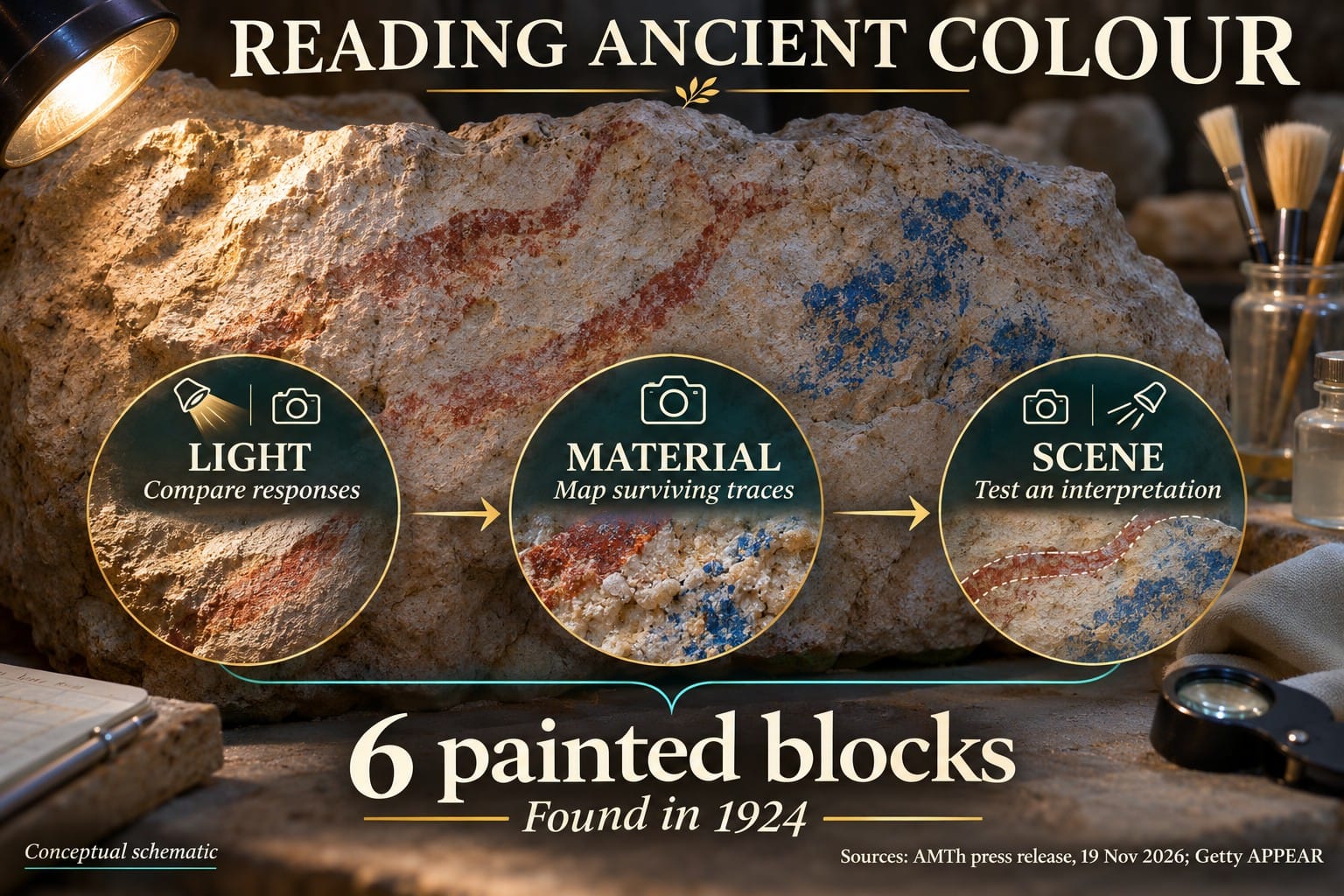
The blocks were excavated in 1924, immediately north of the Ancient Agora. The museum describes them as parts of a painted frieze from a public building in Hellenistic Thessaloniki. They preserve an architectural setting for Greek painting, with figures distributed across stone surfaces. Their condition makes every surviving contour and patch of colour significant. Museum exhibition description, in Greek.
The National Hellenic Research Foundation identifies the objects as AMTh 900–905 and considers a temple building their most likely original setting. Its project combines study of the figures, painting technique and style with architectural analysis and photogrammetry. The researchers include Myrina Kalaitzi, Maria Stamatopoulou and Giovanni Verri, working with specialists in conservation science and archaeometry. Research project.
How is the Thessaloniki frieze’s paint examined?
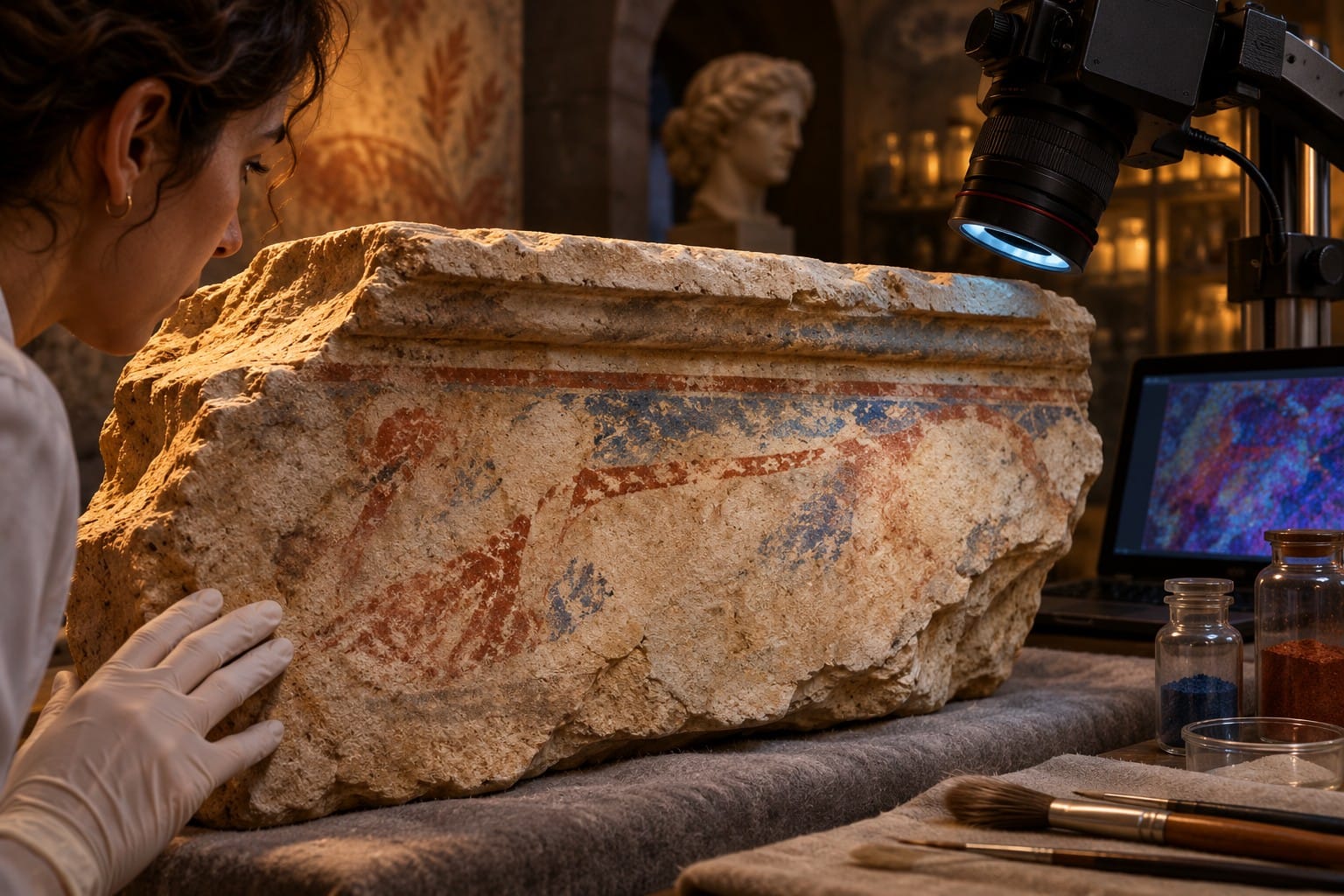
The museum reports that non-invasive imaging and analysis have revealed surviving pigments and details on the weathered blocks. Different kinds of examination answer different questions. Surface lighting can make a faint edge easier to follow, while a material-sensitive image can help establish where a particular trace survives.
Getty’s APPEAR project provides examples of the broader methods used to investigate ancient painting. Light directed almost parallel to a surface reveals its texture. Reflected infrared imaging can sometimes disclose drawing or changes beneath paint layers. Visible-induced infrared luminescence can identify the response associated with Egyptian blue, even where the pigment is hard to see. These are general conservation methods that explain the possibilities of this field. The Thessaloniki announcement gives a broader account of its own analytical work. Getty’s illustrated methodology.
Why does the proposed Trojan scene need testing?
A pigment trace establishes something about the physical painting. Identifying a story requires another step, connecting figures, gestures and objects with a particular episode. A damaged outline may support several readings. The museum therefore presents the Trojan connection as a proposal and includes unresolved questions in the exhibition.
A useful comparison comes from British Museum researchers studying ancient funerary portraits. Their published account explains how images made in different wavelength bands can distinguish materials that appear similar under ordinary light. They also emphasise consistent acquisition and processing, so images from different researchers can be compared. That care matters when an interpretation depends on a subtle surviving feature. British Museum research on multispectral imaging.
What will visitors be able to examine?
The exhibition brings the blocks together with the research process behind their interpretation. Tactile representations, audio descriptions and sign-language videos provide several ways to explore the material. The announced opening is at 18:00 local time on 19 November, with free admission to that event. Official opening notice.
Collections can produce new archaeological questions long after excavation. Our account of CT examination of the Schaalby bronze vessels follows another case in which an instrument helped researchers see evidence before making an interpretation.



latest video



news via inbox
Subscribe to our Cosmic newsletter to get notified when we have new articles.