How Researchers Dated the Taung Child to About Three Million Years Ago
The Taung Child has been in the scientific record for a century. The limestone quarry in South Africa where workers found the fossil has changed considerably in that time. To work out when the child lived, researchers have had to reconstruct the geology of the discovery and find something nearby they could date. A study published on 5 November 2026 places the fossil at about three million years old. Its proposed range combines measurements of a mineral layer with earlier evidence from the Earth’s magnetic record. Macho and colleagues’ study.
Why does the Taung Child matter?
Quarry workers recovered the fossil in 1924. Raymond Dart described it the following year and named Australopithecus africanus. The Taung Child is the species’ type specimen, the fossil to which the name is formally attached. The position of the opening where the spinal cord enters the skull helped establish that this early hominin walked upright. Smithsonian Human Origins Program fossil record.
The age of the individual when it died and the age of the fossil are different measurements. Estimates of the child’s age at death come from development, especially its teeth. Dating the fossil asks how far back in geological time that childhood took place. Researchers have proposed several answers since the find was first described.
How did researchers estimate the fossil’s age?
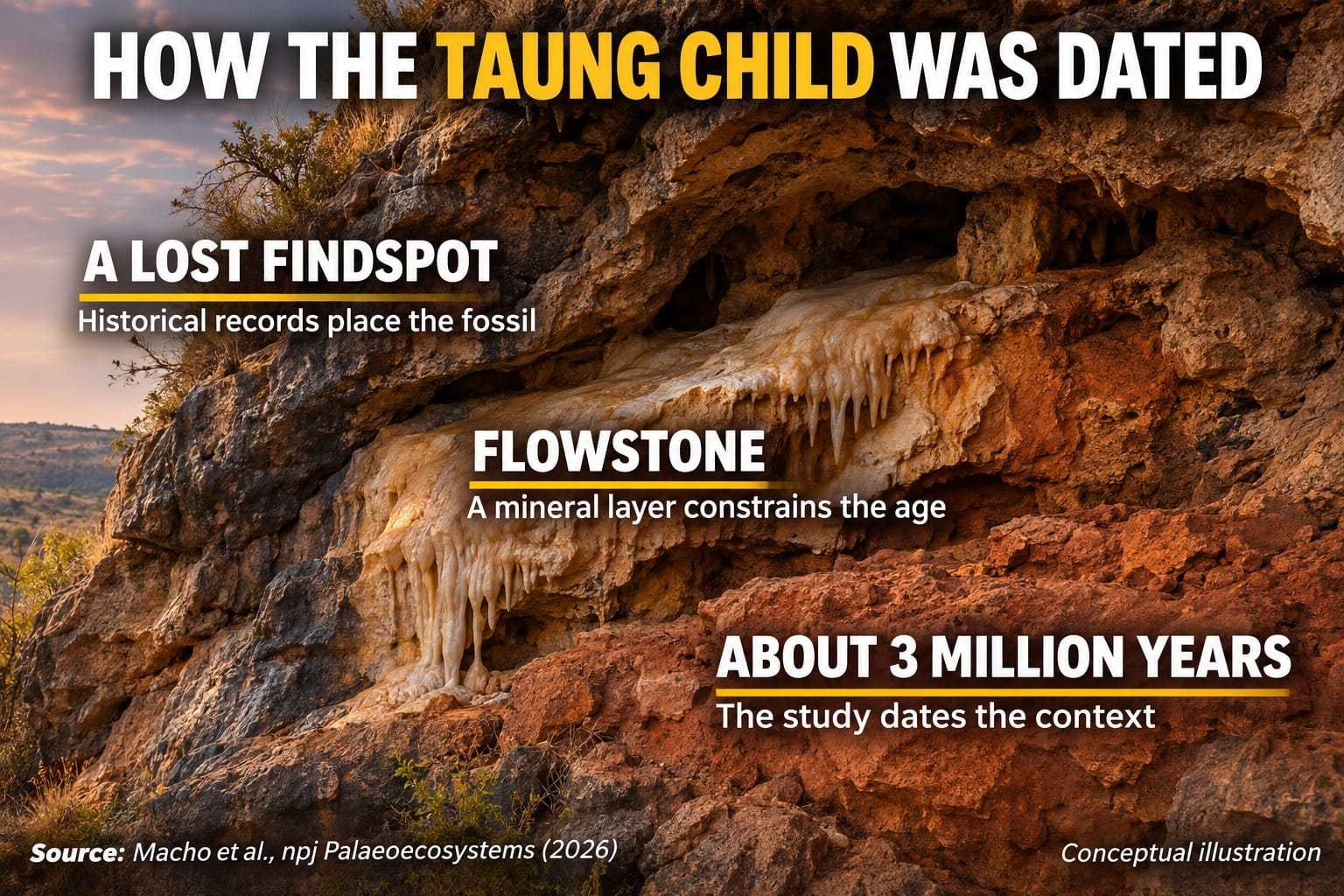
The team used uranium–lead measurements on flowstone, a mineral deposit that can accumulate from water moving over rock. The dated layer overlies the fossil-bearing deposit in the reconstructed sequence. The researchers treated the best flowstone result, about 2.962 million years with an uncertainty of 59,000 years, as a minimum age constraint under their assumptions about how uranium moved through the sample. It places the fossil in the Pliocene. Technical account of the dating work.
The team combined that constraint with an older limit of about 3.03 million years from prior palaeomagnetic work. Palaeomagnetism uses evidence of Earth’s past magnetic polarity in rocks and sediments to constrain the time when they formed. The resulting 2.96 to 3.03 million year interval is the study’s proposed age bracket. There is still no radiometric upper limit, so the two ends of the bracket rest on different evidence. Vrije Universiteit Brussel’s research account.
Earlier estimates varied partly because the quarry contains several deposits that formed in different ways. A number from one layer can help only if researchers can relate that layer to the fossil’s original setting. Earlier fieldwork re-examined what survived in the quarry and brought the history of mining into that assessment. Research on the Taung quarry’s geology and mining history.
What the date changes for other fossils
Macho and colleagues also compared teeth and the shape of the space that held the brain. A juvenile skull changes as it grows, so researchers considered how features develop before using them to compare the child with adults. The team argues that several adult fossils commonly assigned to A. africanus are difficult to reconcile with Taung’s inferred development. That raises the possibility that more than one species is represented in the southern African material.
The classification of those adults remains an interpretation of the comparisons. The new date helps by placing Taung in a clearer time frame, but matching fossils to a species still depends on the traits available to compare. Our coverage of the Xujiayao fossils follows a separate case where preserved proteins gave researchers a different way to test an identification. Read about the Xujiayao Denisovans.



latest video



news via inbox
Subscribe to our Cosmic newsletter to get notified when we have new articles.