A “Supervolcano” Beneath England? What the Ancient Crystals Reveal
CosmicGravity · News & analysis · September 5, 2026
The phrase “supervolcano beneath England” sounds like the beginning of a disaster film. The actual story begins with tiny crystals and an eruption around 454 million years ago.
Research publicized by the British Geological Survey on August 28 links buried igneous rocks beneath eastern England with a widespread ancient ash deposit farther across northern Europe. The proposed source is the Wash Igneous Complex. This is an investigation of a vanished landscape, not an alert about an awakening volcano. BGS describes the evidence here.
How crystals connect places that no longer look related
The researchers compared minerals in rocks recovered from boreholes in Lincolnshire and Norfolk with material associated with the Kinnekulle ash layer in Scandinavia and surrounding regions. Zircon ages and chemical evidence from apatite helped make the connection. Borehole samples separated by about 65 kilometres contributed to the investigation.
The crucial word is candidate: matching age and mineral chemistry can build a strong case for a source, but the evidence still has to be assessed alongside the geology. An ash layer can travel far from an eruption. The place where it survives is not necessarily the place where it began.
What earns the word “supervolcano”?
The US Geological Survey explains that the term usually refers to a volcanic centre that has produced an eruption of magnitude 8 on the Volcanic Explosivity Index—more than 1,000 cubic kilometres of erupted material. That is a statement about eruption volume, not simply the age, depth or width of buried rocks. See the USGS definition.
It is therefore worth keeping two questions separate. Where did this ancient ash originate? And how much material did the eruption produce? Evidence that helps answer the first does not automatically settle the second. The dramatic label should not do the work of a measurement.
No countdown is hidden in the date
An eruption date hundreds of millions of years old is not a forecast. Nor does the discovery of ancient volcanic rock demonstrate that a modern magma reservoir is present. A claim about current hazard would require a different investigation and current evidence.
The real fascination is historical. Beneath a familiar coast lies a record of an Earth whose geography was profoundly different. A drilling sample can connect that buried history with a thin layer preserved across a former sea.
For anyone drawn to hidden landscapes, this is a good reminder that spectacular discoveries need not involve an imminent threat. Sometimes the astonishing part is that a few surviving grains can tell us anything at all.
Compare the methods with our guide to investigating what is hidden underground, and the very different, modern geological failure behind the Lake Peigneur disaster.
COSMICGRAVITY · EXPLORE THE EVIDENCE
Keep these three claims separate
Tap a heading to open the explanation.
Ancient eruption
The report concerns volcanic activity around 454 million years ago. It is deep-time research.
Candidate source
Mineral dates and chemistry connect buried eastern English rocks with distant ash deposits. Source attribution is a scientific argument to evaluate.
Present-day hazard
Ancient rocks alone do not establish an active magma system. This study is not an eruption warning for England.
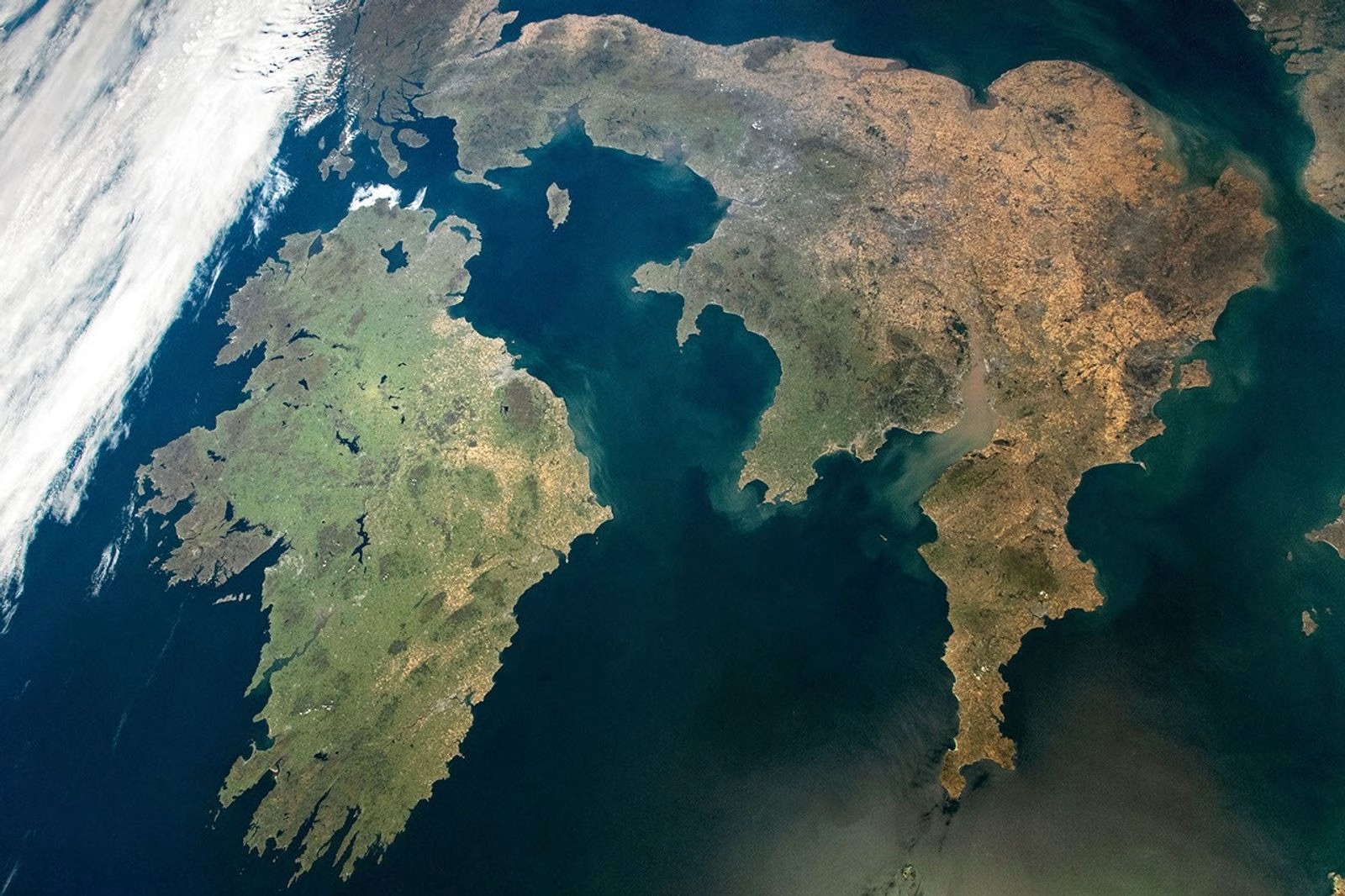
Lead image: Great Britain and Ireland photographed from the International Space Station on August 11, 2022. A modern geographical context image, not a view of an erupting volcano. NASA Earth Observatory/ISS Expedition 67. Image source and usage information.
Editorial note: Reporting checked September 5, 2026. Linked sources distinguish the underlying observations from interpretation. Future plans and preliminary results may change.



latest video



news via inbox
Subscribe to our Cosmic newsletter to get notified when we have new articles.