What Is Really Hidden Underground? Muons, Radar and the New Archaeology
Archaeologists no longer need to dig first and ask questions later. Cosmic-ray particles, radar pulses, electrical currents and ultrasound can reveal density changes beneath monuments before a single stone is moved.
These subterranean anomalies can be chambers, cracks, construction gaps, geological features or modern disturbances. The instruments detect physical contrasts—not lost civilisations, treasure or purpose. Understanding that distinction is the key to separating a genuine discovery from an exciting but premature claim.
Muon tomography uses particles from the sky
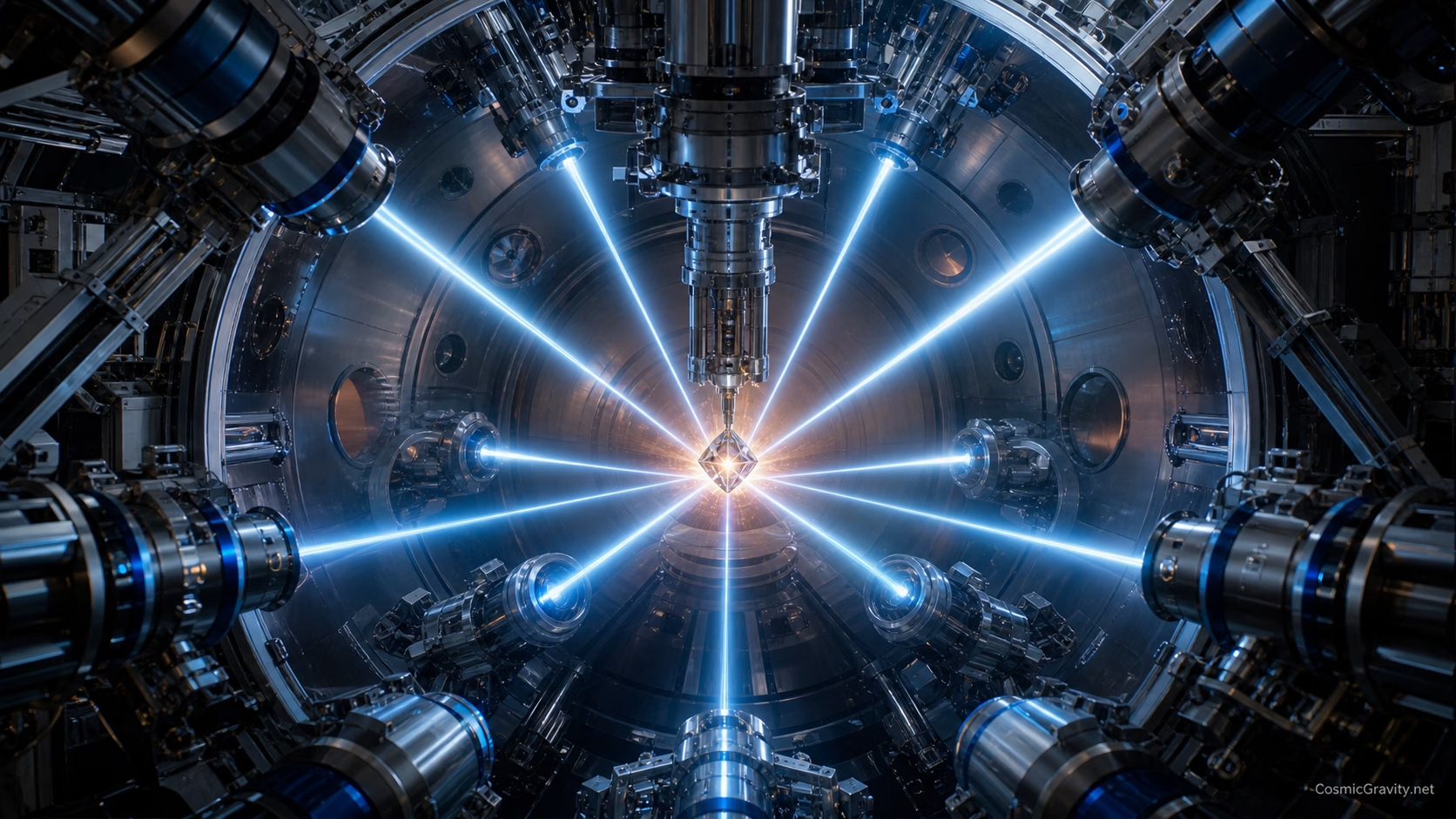
Cosmic rays striking Earth’s atmosphere create muons, fast particles capable of passing through hundreds of metres of rock. Dense material absorbs more muons; a cavity lets more pass through.
Place a detector inside or below a structure and count the arrival direction of millions of muons. An excess from one angle suggests lower density along that path. Measurements from several positions can reconstruct the location and approximate shape of a void.
Muon imaging is slow but penetrates far deeper than ordinary radar. It works best when detectors can be positioned around or beneath the target and when the surrounding geology is modelled accurately.
The Great Pyramid’s Big Void is a confirmed anomaly
In 2017, the ScanPyramids team reported a void at least 30 metres long above the Grand Gallery in the Great Pyramid of Khufu. Three independent muon technologies detected the same excess from different positions.
That makes the Big Void a high-confidence physical finding. It does not tell us whether the space is one chamber, several construction gaps or a stress-relieving structure. No inscription, entrance or artefact has been identified.
This is an important lesson: existence can be strongly established while function remains completely open.
New measurements refine the North Face Corridor
ScanPyramids later identified a corridor behind the north face. A 2025 Scientific Reports study used electrical resistivity tomography to investigate the same region. Electrical methods send current through the structure and measure how strongly different materials resist it.
Air-filled spaces behave differently from solid limestone. The results added an independent geophysical constraint, although resolution still depends on electrode layout, depth and the condition of the masonry.
Two air-filled anomalies in Menkaure’s Pyramid
In 2025, Cairo University and the Technical University of Munich reported two air-filled anomalies beneath the eastern facade of the Menkaure Pyramid. The team combined ground-penetrating radar, ultrasound and electrical resistivity tomography.
Agreement among three methods is encouraging because each has different weaknesses. The result provides evidence for voids near the facade and supports investigation of a possible additional entrance. It does not yet prove that a full corridor or chamber continues deep inside.
Jerusalem tests underground muon imaging
A 2025 peer-reviewed demonstration placed a muon detector in a large ancient cistern at Jerusalem’s City of David site. The experiment mapped differences in the amount of material above the detector and showed that muography could work in a complex urban archaeological setting.
This was primarily a method demonstration, not an announcement of a spectacular lost chamber. Its importance is practical: underground detectors may guide later surveys while reducing unnecessary excavation in sensitive sites.
What ground-penetrating radar actually sees
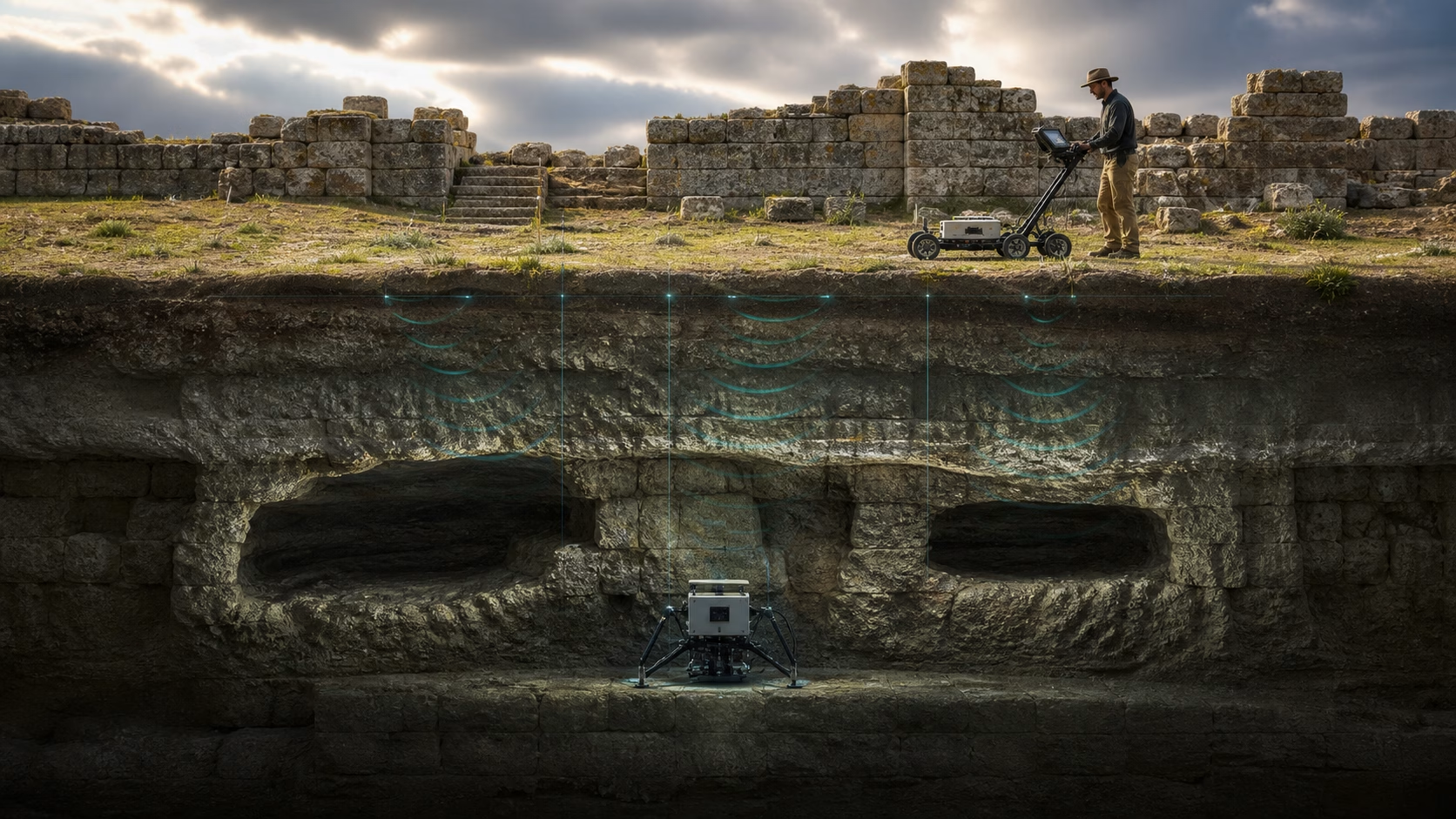
Ground-penetrating radar sends electromagnetic pulses into the ground and records reflections from boundaries between materials. It can identify walls, disturbed soil, floors and voids, but depth and clarity depend heavily on moisture, clay, salt and antenna frequency.
A radar “structure” is not automatically architecture. Natural bedding, utilities and processing artefacts can create regular-looking patterns. Three-dimensional visualisations are especially persuasive, which makes raw profiles, survey geometry and independent replication essential.
Why multiple methods matter
Muon imaging measures integrated density. Radar measures electromagnetic contrasts. Electrical tomography measures resistivity, ultrasound measures acoustic properties and gravimetry detects tiny changes in gravitational pull.
If several methods indicate a void in the same location, confidence rises. If only one highly processed technique reports an enormous structure, the correct response is interest plus verification—not instant acceptance or dismissal.
That is the central issue in debates around the Biondi pyramid scan and ScanPyramids. Scale, penetration depth and published validation must match the size of the claim.
An anomaly is the start of a question
Archaeological geophysics can estimate where a void is, but usually cannot date it or explain who made it. A cavity may be ancient, geological or a later intrusion. Dating requires connection to stratigraphy, materials or artefacts.
Even advanced digital methods need human interpretation. The virtual recovery of the Herculaneum scrolls succeeds because imaging, algorithms and papyrology check one another. Underground archaeology requires the same chain of evidence.
The next generation of non-invasive archaeology
Smaller muon detectors, longer surveys and improved joint modelling will make subsurface maps more precise. The goal is not to replace excavation but to make it safer, more targeted and less destructive.
The best subterranean anomalies are not the biggest shapes in a colourful rendering. They are signals reproduced by independent instruments, published with enough detail to test, and eventually connected to physical evidence.
Sources: ScanPyramids Big Void study, 2025 Menkaure anomalies, North Face Corridor resistivity research, and Jerusalem muon-imaging study.


latest video

news via inbox
Subscribe to our Cosmic newsletter to get notified when we have new articles.