Bob Lazar: S-4, Element 115 and the Evidence Behind His Story
COSMICGRAVITY CORNERSTONE · THE BOB LAZAR FILE
Bob Lazar’s story begins with a remarkably concrete claim: he says he stood inside a flying saucer, worked beside a compact reactor and helped investigate a propulsion system that human science could not explain. The setting was S-4, an alleged installation near Papoose Lake, south of Area 51. The fuel, he said, was element 115.
For some readers, the hand scanner he described and his documented connection with Los Alamos make the account difficult to dismiss. For others, questions about his education and the absence of a publicly testable reactor remain decisive obstacles. Between those positions lies a substantial historical record worth reading carefully.
This guide takes Bob Lazar seriously. It follows his account, examines the documents, explains the physics and gives you the interviews to assess for yourself. It also separates things that are often bundled together: a real biometric device, a real laboratory connection, a real chemical element and an unverified claim about extraterrestrial engineering.
Reading the Bob Lazar evidence
The central finding: there are genuine, interesting details around Lazar’s story. However, the public material reviewed here does not independently establish that he reverse-engineered an alien spacecraft. That distinction leaves plenty to investigate. It also protects the strongest evidence from being weakened by claims that go beyond it.
Research checked 4 November 2026. This is a historical investigation and science explainer. Accounts of S-4 activities are attributed to their speakers. Original illustrations are conceptual, including the illustrated portrait and craft; they are not photographs from a classified installation.
Navigate the investigation
What does Bob Lazar actually claim?
A short assignment with enormous implications
Lazar’s core account concerns work in late 1988 and early 1989. He describes recruitment through contacts connected with EG&G, travel from Las Vegas to Groom Lake and onward transport to S-4. There, he says, a small group was studying recovered craft rather than designing an ordinary experimental aircraft.
His account includes nine discs, a craft he called the Sport Model, a colleague named Barry and a supervisor named Dennis. Lazar says his particular responsibility involved the propulsion system. These names and descriptions belong to his testimony; they should not be mistaken for an independently authenticated project roster.
The essential allegation was already public in George Knapp’s original KLAS reporting. That matters historically. Later podcasts did not invent the basic S-4 narrative. At the same time, an early statement establishes when a claim was made, rather than establishing that the event occurred.
Observation, explanation and briefing material
Three different kinds of information run through the Bob Lazar story. First are his reported experiences: entering a hangar, touching a surface, seeing a device operate and observing flight. Second are technical explanations he says colleagues offered. Third are extraordinary background claims he attributes to briefing material.
These categories deserve different treatment. A witness may accurately describe what a machine seemed to do while misunderstanding its mechanism. Someone may faithfully repeat a briefing without knowing whether the briefing itself is accurate. A remembered conversation can be sincere while its subject remains unverified.
That is why a statement such as “Lazar says he saw a disc” carries a different meaning from “Lazar demonstrated an extraterrestrial vehicle.” The first accurately reports testimony. The second requires a chain of additional evidence about the object, its performance and its origin. Taking the story seriously means preserving those distinctions throughout.
Why the account remains compelling
The story offers unusually memorable physical details. There is a journey through a restricted landscape, a workplace with unsettling security procedures, machinery that seems deceptively simple and the frustration of working backward from a finished object. Those details make it easy to imagine the experience.
They also create opportunities for investigation. Investigators can compare a flight route with contemporary transport arrangements. Directories can establish a laboratory affiliation. A patent can explain a scanner. In principle, independent laboratories can test a material. Lazar’s account therefore invites more productive questions than whether a speaker merely seems convincing on camera.
A serious investigation should welcome that concreteness. It should also resist letting the vividness of one scene decide the status of every other claim. The historical question is not whether the account has atmosphere. It plainly does. The question is which parts can acquire support that exists independently of the storyteller.
Bob Lazar timeline: from Los Alamos to the 2026 interviews
1982: a public footprint before the UFO controversy
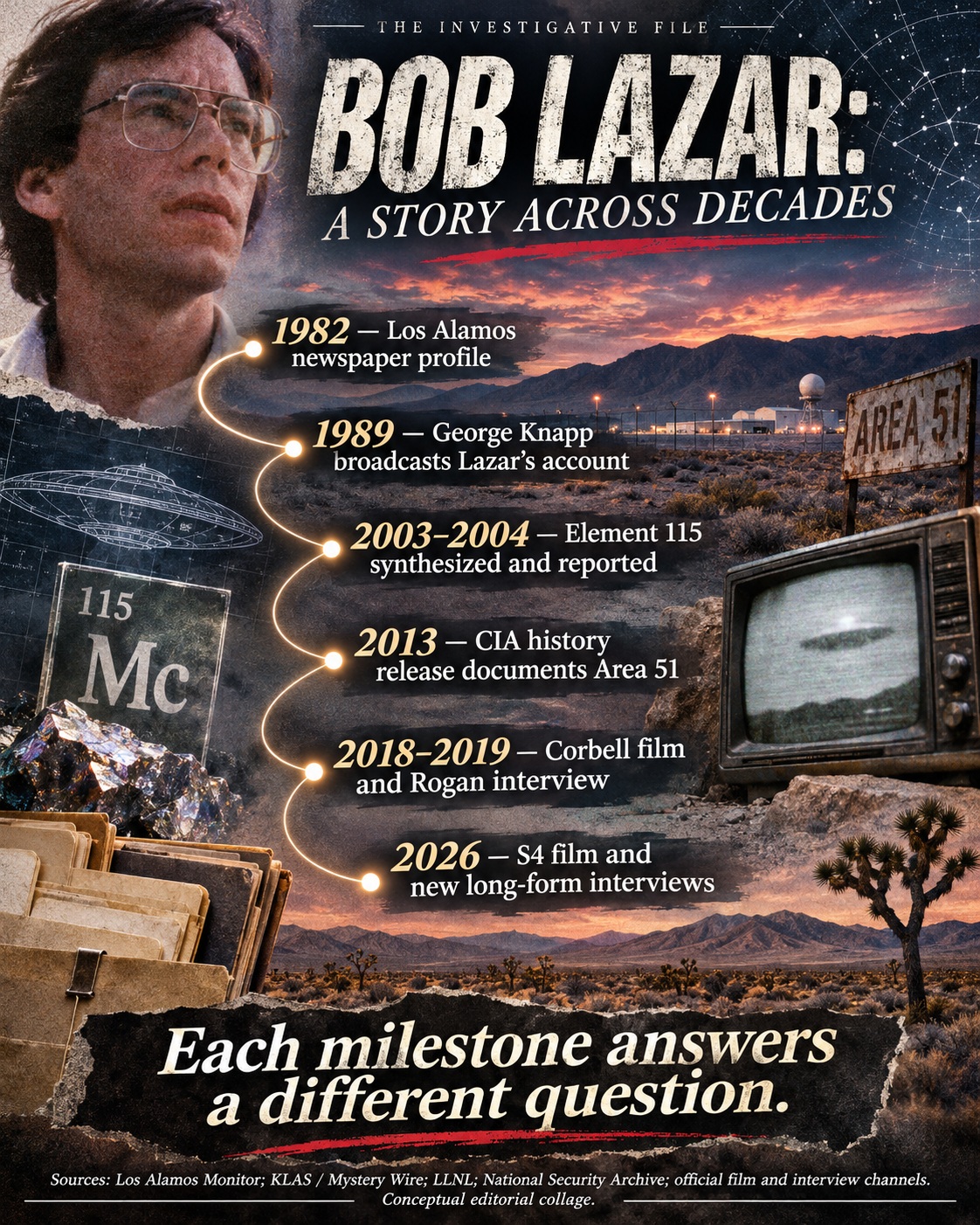
A Los Alamos Monitor profile dated 27 June 1982 describes Lazar and his jet-powered Honda. It identifies him as a physicist at the Los Alamos Meson Physics Facility. The article predates the public S-4 story by almost seven years, making it an important contemporary trace.
The date matters more than the colorful car. A record created before a controversy can preserve information that later publicity did not shape. Nevertheless, a newspaper’s description of an occupation does not substitute for a personnel file or a university transcript. It is valuable evidence with a specific scope.
1989: an anonymous source becomes a named witness
Lazar first appeared anonymously in Knapp’s television reporting in May 1989, using the name Dennis. By November, viewers knew his identity. The broadcaster’s archive dates the major named report to 10 November 1989. A December television conversation added detail about the alleged reactor and element 115.
For readers checking online clips, three dates can easily become confused: the alleged event date, the original broadcast date and the date an archive uploaded the footage. A video posted in 2019 may contain a report from 1989. A recent caption may describe an old recording. Keeping those layers apart prevents accidental changes to the chronology.
2003–2016: science supplies a real element
Experiments conducted in 2003 produced evidence for element 115, with results announced and published in 2004. Scientists later secured formal recognition of the discovery, and IUPAC approved the name moscovium in 2016. These are separate milestones: synthesis, publication, recognition and naming are not interchangeable events.
That sequence is relevant to Lazar because he discussed 115 before its synthesis. It does not mean that every property he attributed to the material was subsequently observed. The known experiments produced fleeting radioactive nuclei. However, the claimed stable fuel and gravity system remain separate questions, examined in detail below.
2013 onward: documents, films and a much larger audience
The 2013 release of a less-redacted CIA history made Area 51’s reconnaissance role explicit in an important official record. Jeremy Corbell’s 2018 film and the 2019 Rogan interview then brought Lazar to another generation. In 2026, Luigi Vendittelli’s S4: The Bob Lazar Story and new long interviews renewed the discussion.
This is a timeline of several kinds of development. An official document concerns a real installation. A laboratory announcement concerns nuclei. A documentary concerns a witness’s account. Their coexistence makes an intriguing history, but each milestone must answer its own question before the pieces can support a larger conclusion.
Area 51 was real. What does that establish about S-4?
A landscape built for secrecy
The Nevada setting is not imaginary. Groom Lake became part of a genuine world of secret aircraft testing, restricted access and compartmented information. The National Security Archive’s 2013 release presents the CIA history of the U-2 and OXCART programs and explains the newly visible Area 51 references.
This history helps explain why unusual aircraft and military secrecy were plausible subjects for local reporting. It also explains why residents, aviation observers and journalists had questions before Lazar became famous. Knapp’s own broadcaster preserves an Area 51 reporting history that reaches back to 1984.
Consequently, it is too broad to say Lazar revealed a location nobody had previously known existed. His distinctive contribution was the public allegation of recovered extraterrestrial craft at S-4. That is a more precise claim, and it is sufficiently remarkable without rewriting the earlier history of the Nevada range.
Groom Lake and Papoose Lake are different locations
In the Bob Lazar account, Area 51 is the transit point and S-4 is a separate destination. Confusing them makes it seem that a photograph of any Groom Lake hangar verifies his workplace. It does not. To test the story geographically, evidence has to connect the alleged facility near Papoose Lake with the described activities and period.
An authentic map can establish a place name. A road can establish a route. A structure can establish construction. None of those findings, alone, establishes the contents of a building. Conversely, an ambiguous satellite view cannot show every underground space or settle every question about a site’s earlier use.
Both limits matter. The absence of a clearly visible hangar is not a comprehensive survey of a mountain. An interpretation of a blurry feature is not a confirmed entrance. The useful next step is better geographical evidence: original imagery, dates, viewing geometry, resolution and independent comparison, rather than a more confident caption.
Why declassification is often overstated
Declassification is a specific documentary event. It means identifiable information that was withheld under a classification system has been released. Discovering an old public patent, recognizing equipment in a photograph or hearing a retired worker describe a base are different events.
The distinction becomes especially important with the hand scanner. A security device may be unfamiliar to the general public and still have a publicly available technical history. A particular installation’s use of that device could be secret even when the device itself is commercial. We need evidence for both propositions before calling it a later-declassified confirmation.
For the same reason, the CIA’s Area 51 history should receive its proper credit. It documents real secrecy and real aircraft programs. It does not authenticate an S-4 extraterrestrial engineering project. Readers should be able to acknowledge the significance of that release without being asked to accept an additional conclusion the document does not contain.
Bob Lazar at Los Alamos: reading the evidence
The newspaper and the directory
Two items recur in the Los Alamos discussion: the 1982 newspaper profile and a laboratory telephone-directory entry. Knapp’s original report showed both. Together, they support an association between Robert Lazar and the Los Alamos environment. Treating him as someone with no documented connection there would ignore relevant material.
The more difficult question concerns the nature of that connection. Laboratories employ staff directly and also use contractors, technicians, specialists and outside services. A site directory can include several categories of people. Its evidentiary strength depends on the exact entry, its legend and the employment arrangements behind it.
The distinction is not a judgment about the worth of technical work. Technicians often possess formidable practical skills. A contractor can have access to sophisticated equipment. The point is that presence, job classification, responsibilities, academic credentials and security clearance are separate claims. A document that establishes one should not silently be made to establish all five.
The 1993 laboratory letter
A particularly useful source is the 5 August 1993 letter from Los Alamos public-information specialist Diane Banegas to George Knapp, preserved as a scan. It explains that the laboratory archived records for its own employees and that contractor records would be held by Kirk Mayer. The letter says the absence of laboratory personnel records was therefore not unusual.
The letter also discusses the requirements for a Tech 3 position in 1982. It explains that a four-year degree was not required and describes the role as between journeyman and senior technician. Its comments on clearance requirements explicitly stop short of confirming that Lazar actually received a clearance.
This is more informative than an isolated “no records” quotation. The document offers an administrative explanation for a gap. It neither erases the laboratory association nor verifies the full version of Lazar’s career. The most useful reading preserves all of that context instead of extracting the sentence that best supports a preferred verdict.
What would settle the employment question more firmly?
A contractor’s authenticated personnel record could establish dates, title, supervisor and assignment. Meanwhile, a contemporaneous project roster might clarify responsibilities. Someone with direct knowledge could describe specific work, provided investigators could check the testimony against the period rather than merely repeating later publicity.
A clearance record would answer another question. Even then, access to one classified project would not automatically demonstrate access to another. Security clearance is permission to be considered for particular access under defined conditions; it is not a universal pass to every secret program.
Bob Lazar’s supporters are right to insist that the Los Alamos evidence belongs in the story. The record becomes more persuasive when stated accurately. It establishes a meaningful connection and leaves the precise professional claims open to further documentation. There is no reason to diminish the first finding or pretend the second has already been resolved.
Bob Lazar and the education question
Degrees, classes and specialist training are different
Lazar’s MIT and Caltech claims have drawn scrutiny since the original reporting. The early KLAS investigation said the institutions contacted did not confirm his account. In subsequent interviews, Lazar has maintained that his history was interfered with. However, the public record reviewed for this article does not independently verify the claimed degrees.
In the 2026 Jesse Michels conversation, the MIT discussion includes an assertion about being sent there for a particular purpose. That is a claim about a possible training arrangement. It should not be substituted, without explanation, for an authenticated degree record. Enrollment, attendance, instruction at a facility and completion of a degree are distinct events.
That distinction is useful far beyond this case. People can attend short courses, visit a laboratory or work alongside university researchers without becoming graduates of that institution. Establishing exactly what is claimed makes verification fairer. It also avoids forcing every educational experience into an all-or-nothing choice between a conventional degree and no involvement at all.
Why missing records do not identify their own cause
A missing record can have several explanations. The search may have used the wrong name or category; records may be held elsewhere; the underlying event may not have occurred as described; or records may have been removed. The absence itself does not tell us which explanation is correct.
Deliberate erasure would be a substantial additional allegation. Evidence of that action might include an earlier authenticated record, a later alteration, correspondence ordering removal or testimony from someone who participated. Without that bridge, “the records are absent” and “the records were deliberately erased” remain different statements.
Equally, an educational dispute should not become permission to dismiss every unrelated piece of evidence. A real directory remains a real directory. A genuine hand-reader patent remains genuine. The proper response is to assess each claim on its own record, while recognizing that background verification reasonably affects confidence in a witness’s technical authority.
Bob Lazar, Edward Teller and the recruitment story
A memorable encounter, an unverified referral
In the 2019 Rogan interview, Bob Lazar describes meeting Edward Teller around the time his jet car appeared in the local newspaper. He says he later referred to that encounter when seeking scientific work and received a direction to contact someone at EG&G. This is Lazar’s account of how the recruitment chain began.
The story contains at least three independently testable questions: was Teller present for the relevant event, did the two men meet and did Teller later provide a referral? An event advertisement can help with the first. A witness or contemporaneous note can help with the second. Correspondence could address the third.
Answering the first would be worthwhile without settling the other two. This is a recurring feature of the case: an intriguing overlap can be genuine while the crucial causal connection remains unverified. A newspaper beside a lecture announcement is a historical lead; it does not, by itself, document a hiring recommendation.
Reading the Teller interview cautiously
A filmed response by Teller is discussed in later interviews, including Michels’s 2026 conversation. Viewers often interpret hesitation, wording or demeanor as revealing more than the words expressly say. Such reactions can suggest questions, but they are poor substitutes for a clear statement of what the speaker actually knows.
For instance, someone may decline a subject because it is classified, irritating, unfamiliar, legally awkward or simply outside the conversation they agreed to have. Choosing one explanation requires evidence. It would be unfair either to treat an ambiguous response as an admission or to treat it as a comprehensive disproof of a meeting.
The recruitment question remains open in the public material examined here. A serious future investigation would seek correspondence, calendars and a traceable employment chain. Those items would tell us substantially more than repeatedly replaying a facial expression. Respect for both men requires that their statements carry only the meaning the evidence can support.
Bob Lazar inside the Sport Model: the physical story
Why a description of an interior matters
Lazar’s account is unusually focused on an interior. He describes a small central working area, seats, a reactor and equipment below the main level. The craft he calls the Sport Model is not presented as a familiar aircraft with exposed plumbing, conventional engines and a cockpit full of recognizable controls.
That difference is central to the experience he describes. He says the apparent simplicity was itself disorienting: a finished system could operate while its underlying mechanism remained obscure. In his telling, the task was to discover what the object could do before understanding how to reproduce it.
This is a plausible description of the difficulty of reverse engineering in general. A modern integrated circuit would be extraordinarily difficult to reconstruct from appearance alone. Yet a useful analogy does not authenticate a particular recovered object. It explains why the claimed task would be hard if the object existed as described.
Reconstruction is useful when its limits stay visible
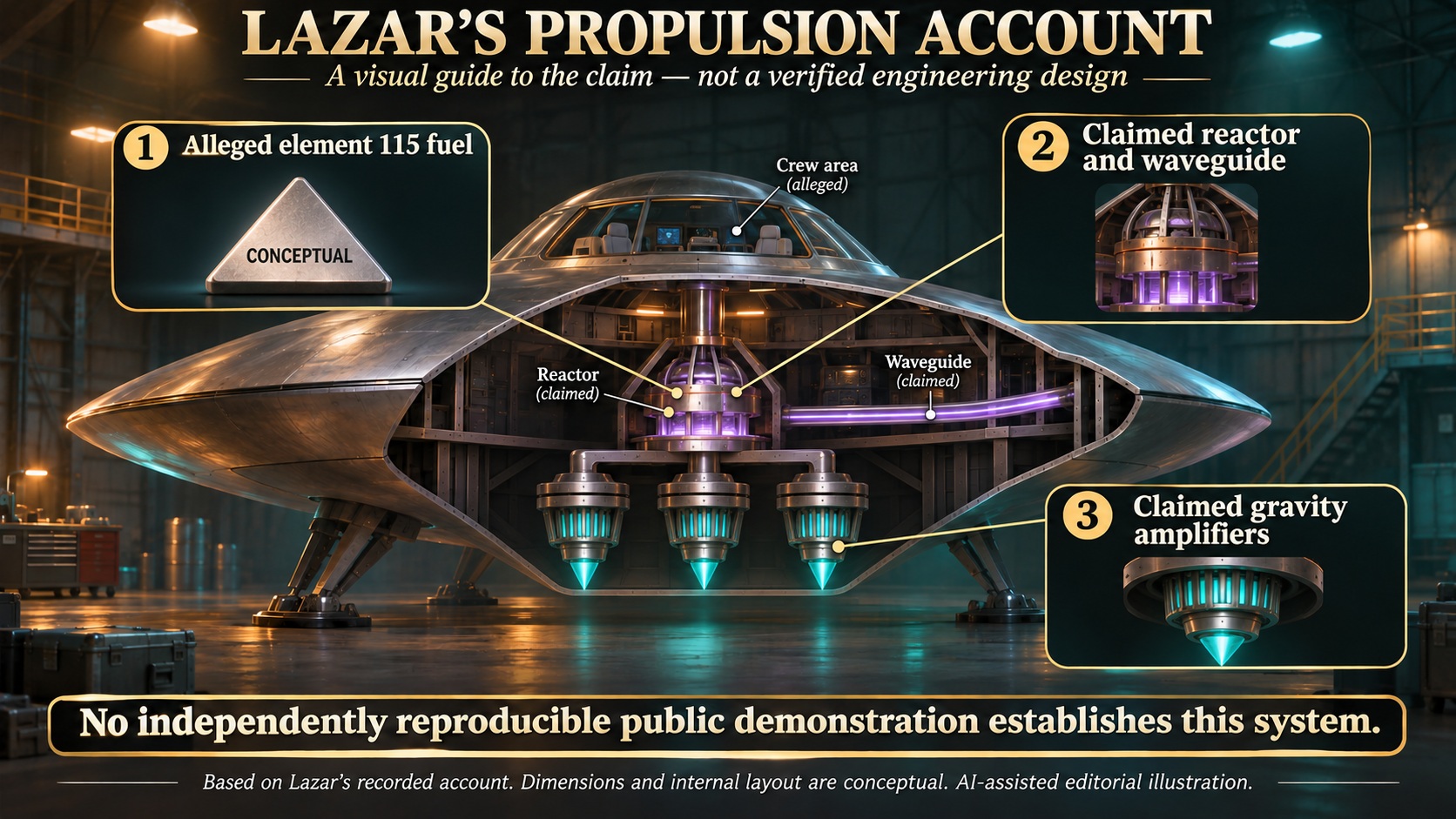
A carefully labeled reconstruction can help readers understand a witness’s spatial description. It can show the difference between a central reactor and equipment below it, or why a person standing in one compartment might not know what lay in another. It should not introduce extra hardware as if Lazar had reported it.
That is especially important with attractive digital imagery. A detailed surface, dramatic lighting and a moving camera can make a reconstruction feel like recovered footage. The image’s realism tells us about the artist’s tools. It does not add independent confirmation of the depicted room.
The conceptual graphic below therefore serves as an orientation aid. It is not a measured blueprint, an exact rendering of the Sport Model or evidence that such a reactor exists. Readers who want the actual description should return to the interviews, where the distinction between remembered observation and technical interpretation can be heard directly.
Bob Lazar’s hand scanner: what the evidence really shows
The detail that made many people stop and listen
The hand scanner is one of the most frequently repeated supporting details in the Bob Lazar story. In the 2019 Rogan conversation, Lazar describes a plate, positioning pins, a bright light and a sensor. He associates it with receiving a badge and gaining access at S-4. An image shown during the discussion prompts his recognition.
His description invokes measuring bones in the fingers. Online retellings often strengthen this into a “bone-density scanner” that supposedly did not exist publicly until much later. Those are additional propositions. The correct investigation starts with the device’s physical features and its documented operating principle, rather than with the strongest version of a social-media caption.
There is a real and interesting match at the level of equipment type. Hand-geometry identification systems existed. The question is how much further that match reaches. Does it establish technological plausibility, recognition of a particular model, personal use somewhere or use at the alleged S-4 facility? Each step requires additional evidence.
A patent from 1971 changes the chronology
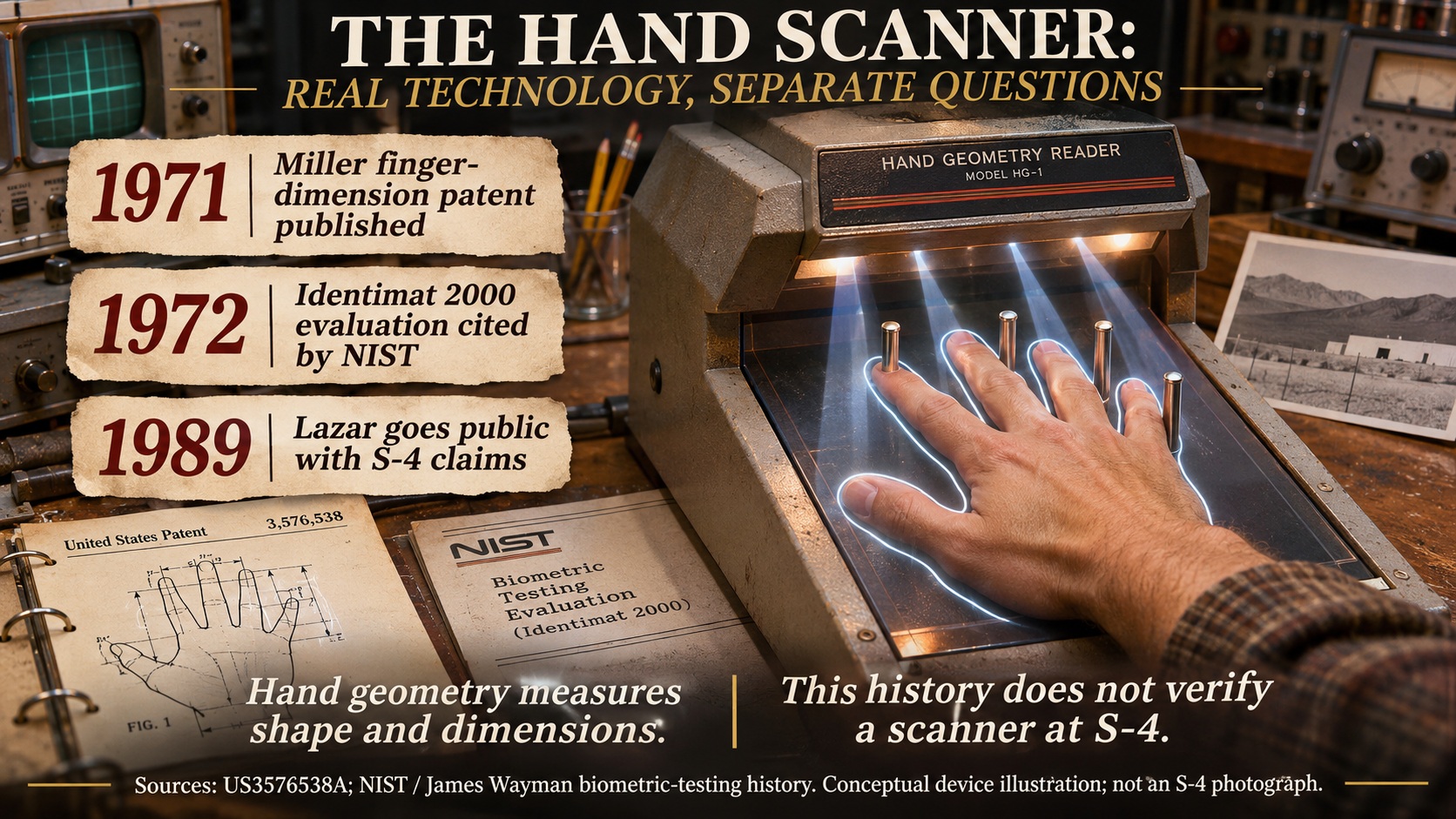
US patent 3,576,538, assigned to Identimation Corporation and naming Robert P. Miller as inventor, was published on 27 April 1971. Its subject is a finger-dimension comparison identification system. It describes identifying a person through physical finger measurements and comparison with recorded information.
A patent is a particularly helpful source here because it has a date and a technical description. It establishes that this class of identification technology was publicly documented well before 1989. It does not require us to rely on a modern recollection that such devices were once common.
Importantly, an old patent does not prove that Lazar copied his story from it. Public availability establishes an alternative route by which someone could know about a technology. Establishing that a particular person actually used that route would require separate evidence. Therefore, the same standard should apply to arguments supporting and challenging him.
The Identimat 2000 was being evaluated in 1972
A historical presentation hosted by NIST, by biometric researcher James Wayman, cites an October 1972 MITRE evaluation of the Identimat 2000 hand-geometry identifier. It also traces later biometric testing, including work at Sandia. That places the technology in a documented testing history.
This is stronger than simply finding a similar object in a recent photograph. It identifies a named device and an early evaluation. It supports the conclusion that hand identification was an established engineering subject rather than an impossible futuristic detail that only a secret UFO employee could have described.
The narrower conclusion remains worthwhile: Lazar described recognizable security equipment, rather than an obviously nonexistent category of machine. Recognizable equipment can make a setting more plausible. However, plausibility is not the same as locating the equipment, and the device’s existence does not identify which installation a witness visited.
Hand geometry is not the same measurement as bone density
A hand-geometry system uses dimensions such as finger length, width, thickness or relationships among hand features. The GAO’s biometric technology assessment explains this approach. Positioning guides help a person place the hand consistently, allowing the machine to compare measurements with an enrolled template.
Bone density is a different property. A machine that measures a silhouette or external dimensions does not thereby measure the mineral density of the bones beneath the skin. Ordinary language about “bone structure” can blur that distinction, particularly when a witness is describing a device as a user rather than explaining its engineering.
That distinction leaves room for a fair interpretation. A user could accurately remember the shape of a machine and misunderstand how it worked. Such a misunderstanding would not prove the experience invented. It would mean that the visual resemblance supports the device’s appearance more strongly than the explanation attached to it.
Was the scanner declassified after Lazar described it?
The sources reviewed for this article do not establish that the underlying hand-reader technology was first declassified after Lazar’s account. The 1971 patent and the cited 1972 evaluation show a much earlier public technical trail. Calling the device itself a later-declassified revelation therefore goes beyond the evidence found here.
A more specific claim could still be investigated: perhaps a particular model’s use at a particular secure facility was disclosed later. To establish that, we would need the installation, model, original classification and release record. Consequently, a newly circulated image without that provenance cannot supply the missing chain.
This correction does not make the scanner uninteresting. It makes the question more precise. The strongest next discovery would be a dated procurement record, an authenticated installation photograph or testimony from a verified coworker identifying the same equipment at the same place. That would advance the case beyond resemblance.
The Close Encounters comparison
Another widely circulated comparison points to a hand-reader scene in Close Encounters of the Third Kind, released in 1977. The comparison is relevant as a cultural lead, but it is unnecessary to make the basic historical point: the patent and testing record already establish pre-1989 technology.
Nor would a device’s appearance in a film prove that a later witness took the detail from that film. Movies use real technology, invented technology and combinations of both. An equipment match has to be examined on its own merits. An allegation about a person’s source requires a separate evidentiary bridge.
For that reason, this article does not use the movie comparison as a verdict on Bob Lazar. It directs readers to the stronger dated technical record. We can say the scanner’s general technology predates his public account without pretending to know exactly when or where he first encountered it.
Bob Lazar and element 115: the missing isotope
What Lazar said before synthesis
In the archived December 1989 Knapp interview transcript, Lazar identifies element 115 as material associated with the alleged reactor. The account connects it with power generation and a gravity-related effect. This predates the laboratory synthesis experiments that established element 115 in the scientific literature.
That chronology is real and should be acknowledged plainly. It is also necessary to identify what was anticipated. An element with atomic number 115 is one proposition. A stable, usable quantity of that element is another. A material with a particular propulsion effect is a third.
When someone says “science confirmed Lazar’s element,” the statement can slide between those meanings. Science confirmed nuclei with 115 protons. It did not thereby confirm the claimed stable fuel, a recovered stockpile or a working gravity amplifier. The discovery is important enough to describe without changing its scope.

What the 2003 experiment actually established
Lawrence Livermore’s 2004 announcement describes experiments performed at JINR between 14 July and 10 August 2003. Researchers identified decay chains associated with new superheavy nuclei. The results were accepted for publication in Physical Review C.
This was not an experiment in which scientists obtained a durable metal wedge and ran it through an engine. A few newly created nuclei could be identified through their decay behavior. The difference between detecting individual atoms and manufacturing a macroscopic object is enormous, both experimentally and practically.
It also matters where the work happened. The discovery came from the Dubna–Livermore collaboration; it was not a discovery at CERN’s Large Hadron Collider. Long interviews sometimes include casual location errors. A research article should use the laboratory’s original report to resolve those details, rather than inherit the error from a conversation.
Moscovium acquired its name in 2016
IUPAC approved the name moscovium and symbol Mc on 28 November 2016. The name honors the Moscow region associated with JINR. The naming decision followed scientific discovery and assessment; it was not the first moment anyone imagined a nucleus with 115 protons.
Atomic numbers follow a sequence. Physicists could discuss elements beyond the known table before producing them. Saying “element 115 may exist” therefore differs from predicting a previously unsuspected natural phenomenon. The more demanding prediction concerns a specific isotope and a set of measurable properties.
Bob Lazar’s distinctive claim lies in those properties and the alleged experience behind them. That is why the responsible test is not whether a periodic-table square eventually received a name. It is whether measurements establish the stable material and behavior he described. That stronger test remains open to evidence.
Why the isotope issue is a legitimate question
An element’s identity comes from its proton count. Isotopes of that element have different neutron counts. The same element can therefore have versions with very different lifetimes. Lazar has argued that the unstable atoms produced in laboratories need not be the same isotope as the material he says he encountered.
The underlying distinction is scientifically valid. Testing one isotope does not automatically measure every possible isotope. It would be an overstatement to say that a short lifetime for one nucleus logically rules out every longer-lived neighboring nucleus. Nuclear structure is exactly why scientists study these differences.
However, that reasoning establishes a possibility to investigate, rather than the existence of the required material. A hypothetical isotope needs a mass number, a defensible identification and observed properties. “A different isotope” cannot do the work of a measurement indefinitely. It is the beginning of a testable proposal, not the result of one.
Not every element must have a stable isotope
The isotope argument sometimes includes a broader assumption that every element has stable and unstable forms. That is incorrect. Some elements have no known stable isotopes. The Royal Society of Chemistry’s moscovium entry describes an artificial, radioactive element with no ordinary practical uses beyond research.
Consequently, the existence of several isotopes does not guarantee that one will be nonradioactive, obtainable in useful quantities or suitable for handling as fuel. Those are separate empirical questions. A longer half-life would be interesting, but “longer” is relative: longer than a millisecond need not mean stable for a human lifetime.
The balanced position is neither “all possible 115 has been exhaustively ruled out” nor “a stable version must eventually be found.” The known material does not establish Lazar’s fuel. Unknown nuclear territory remains a legitimate scientific subject. Future discoveries will have to be judged by their actual properties.
Bob Lazar and the island of stability
An idea older than the Bob Lazar controversy
The island of stability concerns nuclear structures that could make some superheavy nuclei more resistant to decay than surrounding nuclei. The idea developed through nuclear theory in the 1960s. A historical account by superheavy-element researchers traces the contributions of several groups, including Myers and Świątecki, and Viola and Seaborg.
This history matters because it gives element 115 an existing scientific context before 1989. Superheavy elements were not an empty topic waiting for a UFO witness to invent it. Researchers had theoretical reasons to explore nuclear stability beyond the experimentally accessible table.
Recognizing that background does not identify Lazar’s source of knowledge. He could have encountered the idea in ordinary scientific material, heard it from someone else or, as he maintains, worked with something extraordinary. The earlier theory tells us what was publicly thinkable. It does not reconstruct a person’s private experience.
“Stable” can mean different things in conversation
In technical discussion, relative stability can describe a nucleus that survives longer than another. In everyday language, stable often means something that does not visibly change. In a fuel claim, it may imply a piece of material that can be stored, machined and used repeatedly. Those meanings should not be exchanged without explanation.
A predicted enhancement in nuclear lifetime is therefore not automatically a prediction of a workshop-ready metal. Nor does a shell-model calculation predict a gravity-control effect simply because the same material is involved. Nuclear lifetime, chemical behavior, material fabrication and propulsion are different layers of the problem.
That is a useful way to keep the investigation constructive. A new experiment could improve our understanding of superheavy nuclei without validating an alien reactor. Conversely, an authenticated unusual sample would deserve study even if its properties did not match the story attached to it. Interesting evidence does not have to deliver an all-or-nothing verdict.
What would make the element claim much stronger?
A material sample with a documented history would transform the discussion. It would need independent identification of its elemental and isotopic composition, clear custody records and measurements that other qualified laboratories could reproduce. A photograph of a metallic object cannot provide those things.
If the sample exhibited a novel force, the test would need to separate that force from electric charge, magnetism, heat, vibration, airflow and ordinary experimental error. If it emitted radiation, that would need measurement too. Those controls do not assume the result must be mundane. They make an extraordinary result credible if it survives.
Much of the public debate jumps from a promising word, “isotope,” to a completed propulsion system. A serious investigation instead follows the entire chain. Is the material identified? Is it stable on the relevant timescale? Does it produce the claimed effect? Can others repeat it? Every successful step would be a substantial result.
Bob Lazar’s reactor: engineering questions worth asking
A working machine and an explanation are different evidence
Lazar describes a compact reactor associated with three amplifier or emitter assemblies. He also describes an apparent force that prevented his hand from touching part of the equipment. These are elements of his reported experience, not independently published measurements of the system.
If a device produced an unfamiliar effect, an observer’s first explanation could be incomplete. A force could be real while its cause remained misunderstood. The scientifically useful question would be what instruments measured, what conditions changed and which alternatives were excluded.
For instance, an apparent repulsion would lead an investigator to ask whether it acted on different materials, whether it depended on charge, whether shields altered it and whether its strength followed a consistent relationship with distance. A phenomenon becomes easier to understand when the account moves from “it felt impossible” to reproducible measurements.
The energy source is only one part of propulsion
Even a remarkably powerful energy source would not automatically explain a vehicle’s motion. An engine needs some account of momentum exchange or of the physical conditions that produce acceleration. In ordinary propulsion, that might involve a propeller acting on air, exhaust leaving a rocket or another measurable interaction.
Proposing a different mechanism is legitimate. It also creates a demanding test: what is interacting with what, and what changes can we observe? A new gravitational effect would need to be distinguished from an electrically driven effect. A reduction in apparent weight would need to be separated from support, buoyancy or an instrumental offset.
These questions should not be mistaken for a demand that an advanced civilization use familiar engines. They are a demand that a claim about motion connect with observable consequences. If new physics operates, its consequences still have to appear somewhere in measurements. Otherwise, the proposed mechanism cannot yet be evaluated as engineering.
Why a simple-looking device can be difficult to reverse-engineer
Supporters often ask why a recovered craft could remain difficult to reproduce after decades. That is a reasonable question. Knowing a device’s external shape does not reveal its internal materials, manufacturing tolerances, operating conditions or control logic. Reverse engineering can stall at any of those levels.
Yet “the technology is too advanced to understand” also has a limitation as evidence. It can explain why success might be slow, but it does not document that a particular object was recovered. An explanation for missing results must not be confused with a result itself.
The productive position allows both ideas to coexist. An advanced system could be hard to reconstruct. The public Bob Lazar case still needs independently accessible evidence of the system. That leaves room for serious inquiry without turning technological difficulty into a claim that cannot be tested in any possible circumstance.
Bob Lazar’s physics: gravity waves and antimatter
LIGO did not discover the principle of Lazar’s engine
Gravitational waves are real. The LIGO and Virgo collaborations announced their first confirmed direct detection in 2016, from a signal observed in September 2015. Einstein’s general relativity had predicted such waves long before Lazar’s public account.
The detection concerned ripples in spacetime from a distant astrophysical event. It was not a demonstration of a compact laboratory device amplifying a controllable gravity field for flight. The shared word “wave” does not establish that the same physical process is involved.
That distinction makes the scientific discovery more interesting rather than less. LIGO shows how a difficult prediction can acquire compelling support through instruments, analysis and independent checks. If a gravity-control claim eventually reaches a comparable standard, it will deserve recognition for its own evidence. It does not inherit that recognition from an unrelated detection.
Antimatter is real; its existence does not settle the reactor claim
Matter–antimatter annihilation can release energy. Antimatter is also difficult to produce, handle and confine. A proposed compact system would therefore need to explain production, containment, energy conversion and unwanted outputs, rather than rely on the impressive energy associated with annihilation alone.
CERN’s ALPHA collaboration reported in 2023 that antihydrogen falls downward under gravity, within the precision of its experiment. That result directly addressed a longstanding experimental question. It did not provide an antigravity engine, and it did not test the alleged S-4 apparatus.
It would therefore be wrong to cite either antimatter’s existence or the ALPHA measurement as a direct verification of Lazar. Equally, the experiment does not evaluate every hypothetical device one could imagine. Its importance is specific: a measured behavior of antihydrogen under controlled conditions, with an uncertainty that can be improved.
Bismuth, electrostatics and other promising-sounding comparisons
The 2026 interviews range into bismuth, unusual materials and possible alternative propulsion ideas. These subjects can be scientifically interesting. Bismuth and moscovium occupy the same periodic-table group, but neighboring chemical relationships do not automatically imply a shared ability to manipulate gravity.
A material’s response to a magnetic field, a high-voltage effect and a change in gravitational interaction are different phenomena. An investigator must identify which effect the experiment measures. For example, a device can move because it accelerates surrounding air even when the initial appearance suggests an unexplained force.
The right response to a provocative comparison is a clear experimental proposal. Specify the material, geometry, environment, power input and predicted force. Make the controls strong enough that an unexpected result survives. That approach gives unconventional ideas a fairer hearing than either enthusiastic analogy or dismissal based on an unfamiliar vocabulary.
Bob Lazar’s test-flight witnesses: why they matter
A potentially stronger claim than a private experience
One of the most interesting parts of Bob Lazar’s account is his assertion that he took friends into the desert to watch scheduled tests. Gene Huff and John Lear figure prominently in the associated history. The important proposition is not simply that people saw lights near a military range. It is that Lazar allegedly knew in advance when something unusual would appear.
Advance knowledge could matter. A prediction recorded before an event is potentially more informative than a description supplied afterward. For example, it could indicate a source of real scheduling information, familiarity with range activity or another explanation that would itself deserve investigation.
The value of that evidence depends on documentation. What exactly did Lazar predict? Did anyone preserve the statement beforehand? Furthermore, what did each observer independently report afterward? A vague expectation of lights on a frequently active range is different from a precise prediction of a distinctive event at a specified place and time.
Witnesses can corroborate an outing without identifying an aircraft
A companion can directly confirm traveling with Lazar and seeing something in the sky. That does not automatically give the companion direct knowledge of S-4’s interior. It also does not establish how the object moved in three dimensions if the observation consisted mainly of a distant light against a dark background.
Those limits do not make witnesses irrelevant. Agreement about an outing, a schedule and a visible event would support a real shared experience. However, it would leave additional questions about the object’s identity, distance, scale and propulsion.
The strongest presentation would preserve each witness’s earliest account separately. Later group discussions can influence vocabulary and emphasis even when nobody intends to embellish anything. Independent records help distinguish genuinely shared observations from a common interpretation formed afterward.
What the footage would need to establish
A distant light on video can be difficult to interpret without a stable reference. Apparent acceleration may involve camera motion, zoom, changes in exposure or uncertainty about distance. Establishing unusual performance requires more than a bright object crossing a dark frame.
Original recordings would allow a better examination of continuity, timestamps, lens behavior and the surrounding scene. Multiple cameras with known positions could help constrain geometry. A synchronized radar record could add another measurement, provided its origin and relationship to the video were authenticated.
None of those requirements assumes the witnesses saw an ordinary aircraft. They explain how to tell whether the evidence supports something more extraordinary. A recovered original tape with useful context could be important even if it ultimately resolved only a modest part of the story.
The distinction between an inside source and extraterrestrial origin
Suppose, for argument’s sake, that a new document conclusively established advance knowledge of a flight test. That would be a substantial finding about access or information. It would still not, by itself, establish that the aircraft came from another civilization.
A test range exists to develop unusual technology. Classified human engineering is therefore one of the hypotheses that an investigation must consider. To move beyond it, evidence would have to establish properties or provenance that the human-program explanation cannot adequately address.
This is why the test-flight story deserves serious attention without being treated as an automatic solution. It offers a possible bridge between private testimony and observable events. A careful investigation should try to strengthen that bridge, rather than load it with a conclusion before its foundations have been checked.
Bob Lazar’s paperwork: W-2 forms and project names
A document’s appearance is the start of authentication
A purported W-2 associated with Lazar’s account is frequently offered as evidence of government employment. Readers should distinguish an image circulating in a documentary or archive from a record whose issuing office, payroll history and original custody have been independently authenticated.
Several different questions arise. Does the document use a historically appropriate format? Is the named employer an identifiable entity? Does an employer identification number match relevant records? Is there a traceable original, rather than a succession of screenshots? Does any independent payroll or tax record corroborate it?
Even successful authentication would need careful interpretation. A payment from a government-associated employer could establish a financial relationship. It would not, by itself, establish the contents of a classified assignment. The document’s actual fields should determine the conclusion, rather than the reputation of the film in which it appears.
Real people and unverified roles
Lazar’s story includes named or partly named individuals. Supporters have highlighted efforts to identify people associated with security or recruitment. In some cases, later interviewers describe private conversations that they regard as corroboration.
For example, a person can exist without having the role attributed to them. A security professional can have worked in Nevada without confirming a particular extraterrestrial project. The evidentiary chain needs to connect identity, dates, responsibilities and direct knowledge of the specific claim.
That approach also protects individuals who may have no wish to become characters in a public controversy. An investigator can verify a professional role responsibly without publishing private contact details or encouraging readers to confront someone. The goal is a documented account, not pressure on a person to produce the desired answer.
Galileo, Sidekick and Looking Glass
Project names associated with Lazar’s narrative, including Galileo, Sidekick and Looking Glass, appear in the broader discussion of alleged S-4 work. Their presence in a recollection is a claim. Finding a similarly named real project elsewhere is not sufficient authentication, especially when project names can be reused.
To connect a name to an activity, an investigator would want provenance, dates, organizational context and enough technical content to distinguish it from unrelated uses. A document with an evocative title can otherwise become a magnet for material that has little historical connection.
The same caution applies to alleged briefing claims about alien origins, human history or extraordinary capabilities. If Lazar learned something from a document rather than direct observation, the document itself becomes a separate source that needs authentication. A witness can sincerely describe reading a statement without being in a position to prove the statement true.
Bob Lazar, Zeta Reticuli and the origin question
A reported origin is not an astronomical identification
The Bob Lazar story is often linked with Zeta Reticuli. In later discussions, he attributes that origin information to what he was told or read. He did not independently track a craft’s journey from that star system to Nevada. That distinction changes the evidentiary status of the claim.
A real star system can become part of a narrative without providing support for the narrative’s journey. Establishing an extraterrestrial origin would require something beyond a familiar name: independently measurable provenance, a traceable route, unmistakably nonterrestrial engineering or another strong line of evidence.
Readers interested in how reported origins recur across different cases can explore our Alien Encounter Atlas. It distinguishes places named in encounter accounts from scientifically established origins. A shared star name can be an interesting cultural connection while remaining a weak physical connection.
Recovered does not automatically mean extraterrestrial
Even an authenticated unusual object would present several possible questions about origin. Did a known organization manufacture it? Was it a foreign experimental system? Could an unfamiliar but terrestrial technology explain its construction? Could its production history be established?
The extraterrestrial hypothesis becomes stronger when competing explanations are tested and evidence points positively toward it. It does not become established simply because investigators have not yet identified an object. “Unknown” describes the state of knowledge. It does not identify a birthplace.
That is not a closed-minded position. It leaves room for an extraordinary origin while requiring the evidence to do the identifying. If a future sample, record or demonstration supplies that evidence, the conclusion should change accordingly. Until then, the origin question remains more demanding than the question of whether a witness encountered something unusual.
Bob Lazar and Robert Bigelow: the aerogel correction
What Bigelow actually said
A persistent account says Robert Bigelow broke with Lazar after discovering that supposed element 115 was merely aerogel. The 2021 Mystery Wire interview published by KLAS directly challenges that telling. Bigelow said Lazar had not represented the aerogel itself as element 115.
The interview describes the aerogel as material Lazar associated with packaging around the alleged 115. Bigelow also expressed a broadly favorable personal assessment of Lazar. Those statements matter because Bigelow is a participant in the history, rather than a commentator reconstructing someone else’s relationship.
This correction should be included even by an investigator who remains unconvinced about S-4. An inaccurate criticism does not become acceptable because other questions remain unanswered. Correcting it improves the record; it does not obligate readers to adopt every other claim connected with the case.
What the correction does not establish
Bigelow’s clarification is evidence about what he says Lazar told him. It is not a laboratory identification of element 115. Nor does a favorable assessment by a knowledgeable person replace independent access to the alleged sample.
The distinction keeps both the personal testimony and the material question in view. Bigelow may be well placed to describe his own dealings with Lazar. A laboratory would be better placed to identify a sample’s composition. One source should not be asked to perform the other’s role.
This is an example of how serious coverage can become more balanced without becoming vague. The aerogel accusation should be corrected. The claimed stable 115 still needs testing. Both statements can be true, and together they give a more accurate account than a simplified story of either exposure or complete vindication.
Bob Lazar and the 2017 United Nuclear search
The event happened; its interpretation needs evidence
The search of Lazar’s United Nuclear business in July 2017 is part of the later documentary story. A local police account was obtained through records research by Tim McMillan and reproduced by The Black Vault. It describes assistance with an investigation involving poison and records.
This supports the existence of a real, coordinated law-enforcement event. It does not establish that officers were searching for extraterrestrial fuel. The interpretation that the operation concerned element 115 is an additional claim that would need evidence beyond the fact of the search itself.
Nor should the business search be used to imply that Lazar committed the underlying homicide. That would be a serious and unsupported leap. The relevant question for this article is much narrower: what do the available records establish about the operation, and do they independently connect it to S-4 material?
Timing can generate a lead without establishing a motive
Supporters have drawn attention to the timing of discussions and filming around the search. Timing can be worth investigating, especially when it can be established through dated messages, production records or official documents. It becomes more informative when several independent records agree.
But a sequence of events does not, on its own, identify the reason one caused another. Investigations can begin before a witness learns of them. Public knowledge can arrive after planning has already occurred. A coincidence may be suggestive without being a demonstrated causal connection.
The appropriate next evidence would concern the operation’s scope and rationale: authenticated warrants, affidavits, returns and other lawfully released records. Their availability may be limited. An absence of public access should be recorded as a limitation, rather than filled with certainty about either a mundane purpose or a hidden extraterrestrial one.
Bob Lazar’s polygraphs and the limits of credibility tests
The original testing history was mixed
The original KLAS account describes an inconclusive examination, later testing viewed favorably by another examiner and disagreement among people reviewing the charts. It does not support a simple claim that every examiner reached the same final conclusion. The mixed record belongs in any careful telling.
A polygraph measures physiological responses while questions are asked. It does not directly observe whether a craft existed, what a material contained or where a witness worked. Even a favorable assessment is therefore different from independent corroboration of the underlying event.
The National Academies’ review of polygraph evidence explains substantial limitations, particularly for personnel screening. That review is broader scientific context, not a new analysis of Lazar’s individual charts. It gives readers a reason to avoid treating a polygraph result as a physical detector of truth.
Consistency matters, but it needs a fair comparison
A story repeated across decades should be compared with its earliest surviving versions. Major contradictions can matter. So can stable descriptions that predate later publicity. However, a comparison must use complete context and distinguish the witness’s words from an interviewer’s suggestion or a documentary reconstruction.
Small differences are not automatically proof of fabrication. Memory, conversational shorthand and changing questions can affect wording. Conversely, a stable central storyline does not independently verify an event. Repetition can preserve a truthful memory or a mistaken account.
The most useful comparisons specify the exact statement, the date and why the difference changes the claim. A vague accusation that “the story changed” is difficult to evaluate. So is a blanket assurance that “nothing ever changed.” A well-documented case deserves a more discriminating treatment than either slogan.
Bob Lazar on film: Corbell in 2018 and S4 in 2026
What Jeremy Corbell’s film contributed
Jeremy Corbell’s Bob Lazar: Area 51 & Flying Saucers brought the witness’s later life, relationships and continuing account to a wide audience. Its official trailer on Corbell’s channel makes its sympathetic approach clear. The film is part of the case’s media history and a primary source for Corbell’s presentation.
A documentary can provide valuable interviews and recover archival material. It also selects scenes, builds a narrative and uses music, editing and images to shape attention. Those choices are not inherently improper; they are part of filmmaking. Readers should nevertheless distinguish an effective narrative from an independently demonstrated conclusion.
The useful way to watch is to ask what each scene contributes. Does it present an original record? Is the witness discussing something they personally observed, or is the filmmaker describing a private conversation? Perhaps the scene is a reconstruction. These can all belong in a documentary while carrying very different evidentiary weight.
Watch on the original YouTube upload.
The 2026 S4 film and its recreated environments
S4: The Bob Lazar Story, directed by Luigi Vendittelli and narrated by Lazar, was released in 2026. The official WANA site presents the film and associated material. In their April 2026 Rogan conversation, Lazar and Vendittelli discuss the reconstruction process directly.
The filmmaker describes the use of digital modeling and AI-assisted work. That is particularly relevant when images of a young Lazar or an S-4 interior circulate without their context. These are recreations of an account, not automatically archival images of the events.
A recreation can improve the communication of spatial detail. It cannot independently verify the source memory that supplied the detail. This guide therefore treats the film’s existence and its makers’ explanations as verifiable media facts, while treating the depicted S-4 events as allegations requiring their own support.
The 2026 imagery claims need original files
In the 2026 Rogan discussion, Vendittelli also describes imagery he interprets as relevant to the alleged facility. Such a lead is worth examining. It requires the original files, acquisition dates, geographical references and a reproducible explanation of the interpretation.
An enlarged patch of terrain can suggest a door, track or structure. The suggestion becomes stronger when independent analysts can identify the same feature without being led to the desired answer. It becomes stronger again if another source confirms the feature’s construction and use.
This article does not certify a hangar from an interview screen capture. The claim remains an open geographical question. Publishing the best available originals with a clear method would be more useful than increasing a screenshot’s contrast until its ambiguity disappears visually but not evidentially.
Watch Bob Lazar in his own words
These videos are embedded from the broadcaster, interviewers and filmmaker’s own YouTube uploads. They give you access to the speakers’ words and the surrounding questions. An interview is evidence that a statement was made; its presence here is not a claim that every assertion in it has been independently verified.
1. The broadcaster’s archive of the 1989 account
Start with 8 News Now’s compilation of Lazar’s original interview and subsequent coverage. It is useful for separating the early public narrative from later additions and interpretations. Watch the dates and identify when the presenter is speaking, when Lazar is speaking and when the footage shifts to a later report.
Watch on the original YouTube upload.
2. Joe Rogan Experience #1315: Lazar and Jeremy Corbell
The 2019 conversation is particularly useful for the hand scanner and isotope discussion. The element 115 exchange begins around 27 minutes, while the scanner discussion is around two hours into the episode. These are approximate guideposts; use the full exchange to hear qualifications and corrections.
Watch on the original YouTube upload.
3. Joe Rogan Experience #2479: Lazar and Luigi Vendittelli
The April 2026 return places the new S4 film alongside Lazar’s account. The opening discussion explains how recreated scenes were produced. Later sections revisit propulsion and imagery. It offers a chance to compare the witness’s current language with earlier interviews, rather than relying on a short promotional extract.
Watch on the original YouTube upload.
4. Jesse Michels / American Alchemy: the extended 2026 visit
Michels’s long conversation explores recruitment, the laboratory background, the alleged hardware and scientific comparisons. The video has circulated under more than one title; the linked upload is the same identified video. Distinguish Lazar’s answers from the host’s interpretations, particularly where an interesting scientific analogy becomes a stronger claim.
Watch on the original YouTube upload.
Viewing note: titles, thumbnails, availability and platform recommendations can change. External videos may include advertising, adult language or speculation. The written investigation and source links remain usable without starting a player.
Does the modern UAP debate change the Bob Lazar case?
Government attention is an important development
UAP are now the subject of formal hearings, official reporting and renewed public discussion. The 26 July 2023 House hearing, featuring Ryan Graves, David Fravor and David Grusch, is a primary record of that change. It deserves to be read directly rather than only through viral excerpts.
However, government interest in unidentified observations and allegations about retrieval programs are different propositions. A pilot’s unusual encounter is not a direct observation of Lazar’s workplace. A witness’s allegation about a program is not automatically authentication of another witness’s account decades earlier.
Connections could become important if they were specific and independent. A newly authenticated record identifying Lazar, the alleged site, relevant dates and the described hardware would be much more informative than a general statement that secret programs exist. The closer the connection, the more it can contribute to this particular case.
Official skepticism should also be assessed by its evidence
AARO’s 2024 historical report said it found no verifiable evidence that the US government or private industry possessed or reverse-engineered extraterrestrial technology. That is an official finding. It belongs in the record, with its stated scope and methodology available for scrutiny.
An official conclusion is not exempt from investigation. Researchers can reasonably ask which records were examined, how witnesses were selected and what evidence can be independently reviewed. The same principle applies to a documentary that claims corroboration: readers need access to the reasoning and supporting material.
The fair position evaluates both official and unofficial assertions through their evidence. Secrecy can make independent verification difficult, but difficulty does not establish either side’s preferred explanation. Where the public cannot reproduce a review, that limitation should remain visible.
The Bob Lazar evidence, claim by claim
| Item | What it supports | What remains unresolved |
|---|---|---|
| 1982 newspaper and directory | A real Los Alamos association before the UFO publicity. | Exact duties, employment status and all claimed qualifications. |
| 1993 laboratory letter | Contractor records explain why laboratory personnel files may be absent. | Lazar’s specific clearance and detailed assignment. |
| Hand-reader history | The technology was real and documented before 1989. | Personal use at the alleged S-4 installation. |
| Element 115 synthesis | Nuclei with 115 protons exist. | A stable macroscopic fuel and the claimed propulsion properties. |
| Friends’ test-flight accounts | Potential corroboration of outings, observations and claimed advance knowledge. | Object identity, measured performance and extraterrestrial origin. |
| Bigelow’s clarification | Correction of the aerogel-as-115 accusation. | Independent identification of the alleged 115 sample. |
| 2017 search records | A real law-enforcement operation. | An independently established connection to extraterrestrial material. |
| Films and long interviews | A detailed, accessible record of statements and interpretations. | Independent verification of the central recovered-craft claim. |
Why a mixed record is still worth studying
A case can contain genuine records, unresolved claims and mistaken interpretations at the same time. That is ordinary historical complexity. It does not require every document to be declared meaningless or every unusual detail to be declared a breakthrough.
The Los Alamos paper trail is a useful example. It improves our understanding of Lazar’s background. The scanner’s public history improves our understanding of the technology. Neither finding must be exaggerated to deserve attention. Their value lies in replacing a vague argument with something more precise.
This also helps readers avoid the temptation to decide the entire case through one detail. A strong corroboration should increase confidence in the proposition it actually addresses. A weakness should reduce confidence in the relevant proposition. Neither should automatically be allowed to determine every other question.
What could meaningfully advance the investigation?
1. A sample with an independently testable identity
The most direct route would be authenticated physical material. Its custody history should begin before analysis, not be reconstructed after an exciting result. Analysts would need to know what was received, how it was divided, how contamination was controlled and whether independent laboratories obtained compatible findings.
Testing could establish an unusual material without establishing its alleged origin. That would still be a result. If the material were ordinary, publishing that finding would also improve the record. A useful test allows more than one possible outcome and does not redefine failure as hidden success.
2. Contemporary records with a verifiable chain
Employment, travel, procurement and project records could connect the narrative to a specific place and time. An original with a clear chain from its creating organization is more useful than a cropped image with an unexplained history. Independent records that agree can establish relationships one document alone cannot.
Classification markings should be checked rather than admired. A document can look convincing without being authentic; conversely, readers can misunderstand an authentic document. Researchers need both provenance and interpretation: where did it come from, and what does it actually say?
3. A firsthand coworker whose role can be checked
A verified colleague could be important, particularly if their account were documented before exposure to the latest films. The strongest testimony would identify direct involvement, distinguish observation from briefing information and provide details that can be checked independently.
Anonymous statements can be useful leads, especially where disclosure has consequences. Their public evidentiary value remains limited if nobody outside a small circle can evaluate the speaker’s role. Responsible reporting should explain what has been verified privately and what readers are being asked to accept on trust.
4. Original imagery with an open method
Geographical claims would benefit from original images, metadata and a reproducible account of the analysis. Readers should be able to locate the feature, compare other dates and assess whether the proposed structure is distinguishable at the available resolution.
There is little value in circulating an enhancement without its original. Enhancement may improve visibility, but it can also encourage patterns the data do not resolve. Keeping the original beside the interpretation lets readers distinguish recorded detail from analytical expectation.
5. A demonstration with measurements and controls
A reproducible device would be more consequential than another interview. The demonstration should measure input, output, force, environmental conditions and uncertainty. Independent observers should be able to test competing explanations and repeat the result.
It would not need to solve every mystery at once. A small, reliable anomaly could be scientifically important. The crucial step is moving from a narrative about an effect to a measured effect that survives inspection. That is how a provocative claim becomes a research program others can actually join.
Bob Lazar questions readers keep asking
Did Bob Lazar predict element 115?
He publicly associated element 115 with his alleged reactor before the element was synthesized in 2003. Scientists had already discussed superheavy elements and possible enhanced stability. The later synthesis established short-lived radioactive nuclei, rather than the stable fuel and gravity effects in his account. The chronology is interesting; the stronger material claim remains unverified.
Was the hand scanner real?
Hand-geometry identification technology was real. A Miller patent was published in 1971, and NIST-hosted historical material cites a 1972 Identimat 2000 evaluation. That supports the device type’s plausibility. It does not independently establish a particular scanner’s installation at S-4 or prove that its operating principle involved bone-density measurement.
Did the scanner prove he knew classified technology?
The available technical history does not establish that conclusion. Public documentation predates 1989. A particular secure installation could use commercial equipment, but verifying that installation would require its own evidence. It is fair to note the resemblance while remaining precise about what has actually been confirmed.
Did Bob Lazar work at Los Alamos?
The contemporary newspaper, directory material shown by KLAS and later laboratory correspondence support a Los Alamos association. The exact role and all claimed qualifications require separate documentation. A contractor connection should not be dismissed because the laboratory lacked direct-employee personnel records; neither should it automatically be described as proof of a senior physicist position.
Are MIT and Caltech degrees verified?
The public sources reviewed here do not independently verify the claimed degrees. Lazar has offered explanations involving interference with his history and, in later discussion, a particular training purpose. Those explanations are part of his account. They need evidence distinguishing attendance, training and completion of a degree.
Did the CIA confirm S-4 in 2013?
The notable 2013 release concerns the CIA’s U-2 and OXCART history, including Area 51. It is an important official record about secret reconnaissance programs. It is not an authentication of Lazar’s alleged recovered-craft workplace near Papoose Lake. Confusing the two changes the meaning of the release.
Did Robert Bigelow expose fake element 115?
Bigelow’s 2021 interview says Lazar did not present the aerogel itself as 115. That corrects a frequently repeated accusation. The correction is about what was represented to Bigelow; it is not an independent chemical identification of an extraterrestrial fuel sample.
Has a stable moscovium sample been publicly verified?
The sources reviewed for this article establish no independently verified, stable macroscopic sample. Known moscovium isotopes are radioactive and short-lived. Different isotopes can have different lifetimes, but that fact does not establish the particular stable material Lazar describes.
Where should a new reader start?
Start with the broadcaster’s archive, then watch the complete 2019 and 2026 conversations. Compare the hand-reader account with the patent and the element claim with Livermore’s discovery announcement. Reading sources with different roles is more informative than collecting many summaries that all repeat the same clip.
A serious assessment of Bob Lazar
Bob Lazar helped give the modern Area 51 story its most enduring human voice. His account is specific enough to investigate and influential enough to deserve an accurate record. That includes acknowledging the Los Alamos connection, correcting the aerogel accusation and explaining his isotope argument in its strongest defensible form.
It also includes being clear about the unanswered central question. A real scanner, a real laboratory association and a real element do not yet establish a recovered extraterrestrial craft. The strongest future evidence would connect those separate pieces through authenticated records, independently testable material or a reproducible demonstration.
There is room to remain curious without pretending the case is settled. Readers can find Lazar compelling, recognize weaknesses in particular criticisms and still ask for better evidence. They can also question a technical claim while respecting the person making it. That is the standard this investigation follows.
For other long investigations, continue with our Roswell crash-site and evidence guide, the Varginha case and James Fox investigation, or the Ariel School witness study. Each case has its own witnesses, documents and unresolved questions. Similarities can generate research leads; they should not substitute for evidence within each case.
Sources and research notes
This investigation uses original broadcaster reporting, interviews, a historical laboratory letter, a published patent and scientific institutions. Archive-hosted records are identified as such. Auto-generated captions were used as navigation aids and may contain transcription errors. We have not inspected a classified S-4 facility, tested an alleged 115 sample or authenticated private employment files. The 2026 film discussion is based on official release information and its makers’ public interviews; this article does not claim a frame-by-frame verification of the full film.
- KLAS / George Knapp: original 10 November 1989 report, preserved by Mystery Wire.
- KLAS / Mystery Wire: archive guide to the Area 51 reporting.
- December 1989 Knapp–Lazar interview transcript, archived by Disclosdex.
- Los Alamos Monitor, 27 June 1982: scanned newspaper profile, hosted by Papoose Lake.
- Los Alamos National Laboratory letter to Knapp, 5 August 1993: archive-hosted scan.
- Miller / Identimation: US3576538A, published 27 April 1971.
- James Wayman / NIST-hosted history of biometric testing.
- GAO-03-174: biometric technology assessment, including hand geometry.
- Lawrence Livermore, 2004: discovery experiments for elements 113 and 115.
- IUPAC, 2016: approved element names and symbols.
- Royal Society of Chemistry: moscovium.
- Oganessian and Rykaczewski: A Beachhead on the Island of Stability.
- National Security Archive: CIA U-2/OXCART history release and original documents.
Later reporting, scientific tests and official reviews
- Robert Bigelow’s 2021 interview and aerogel clarification.
- Tim McMillan / The Black Vault: the 2017 search and local police records.
- National Academies: The Polygraph and Lie Detection.
- LIGO: the first gravitational-wave detection.
- CERN / ALPHA, 2023: gravity and antihydrogen.
- House Oversight: July 2023 UAP hearing and witness statements.
- AARO: 2024 Historical Record Report, Volume I.
- WANA: official S4 film information, plus the original YouTube uploads embedded above.
Editorial approach: this article distinguishes documents, attributed testimony, scientific measurements and our analysis. Corrections supported by primary evidence are welcome. Image credit: original CosmicGravity AI-assisted editorial illustrations; no illustrated scene is presented as documentary proof.



latest video



news via inbox
Subscribe to our Cosmic newsletter to get notified when we have new articles.