Alien Encounter Atlas: Alleged Beings, Origins and Sightings
Alien Encounter Atlas
An alien encounter atlas of alleged beings, claimed origins and reported places.
Explore the stories—and the records behind them.
Explore the interactive atlas ↓Read all 40 case filesAll figures are original AI-assisted conceptual illustrations. No creature picture here is an authenticated photograph. Source review: 31 October 2026.
Who—or what—did people say they saw?
A Kentucky farmhouse. A lavender field in Provence. A school playground in Zimbabwe. Stories of strange beings are tied to remarkably ordinary places. This alien encounter atlas follows those places, the descriptions people gave and the sources that carried their stories into public life.
There are 40 profiles in this first edition: reported observations, disputed photographs, later recovered memories and named contact narratives. Some have a substantial documentary trail. Others depend on a short catalogue entry or a claimant’s own book. You can see that difference in each case file.
Use the map to explore reported encounter locations, search for a name, or compare descriptions. Choose a claimed origin to find the accounts that mention it. Every profile has an original illustration and a source-linked magazine-style infographic you can open and download.
Map markers use approximate public localities. A pin may represent a reported encounter area, a regional setting or the place where a contact story circulated. It is not a surveyed landing point, a measure of credibility or an invitation to visit private property.
Explore reported encounters around the world
Loading the map. All case files remain readable in the directory below.
The illustrated profiles
Compare the accounts
Similar-looking illustrations do not establish the same kind of being. Compare the reporting circumstances and source trails too.
Illustrated case sheet
Inside the alien encounter atlas: all 40 case files
Open a title to read the description, reporting history, attributed origin and source links. These case files remain available independently of the interactive map.
Adamski: the visitor called Orthon1952-11-20 / United States / Contact narrative
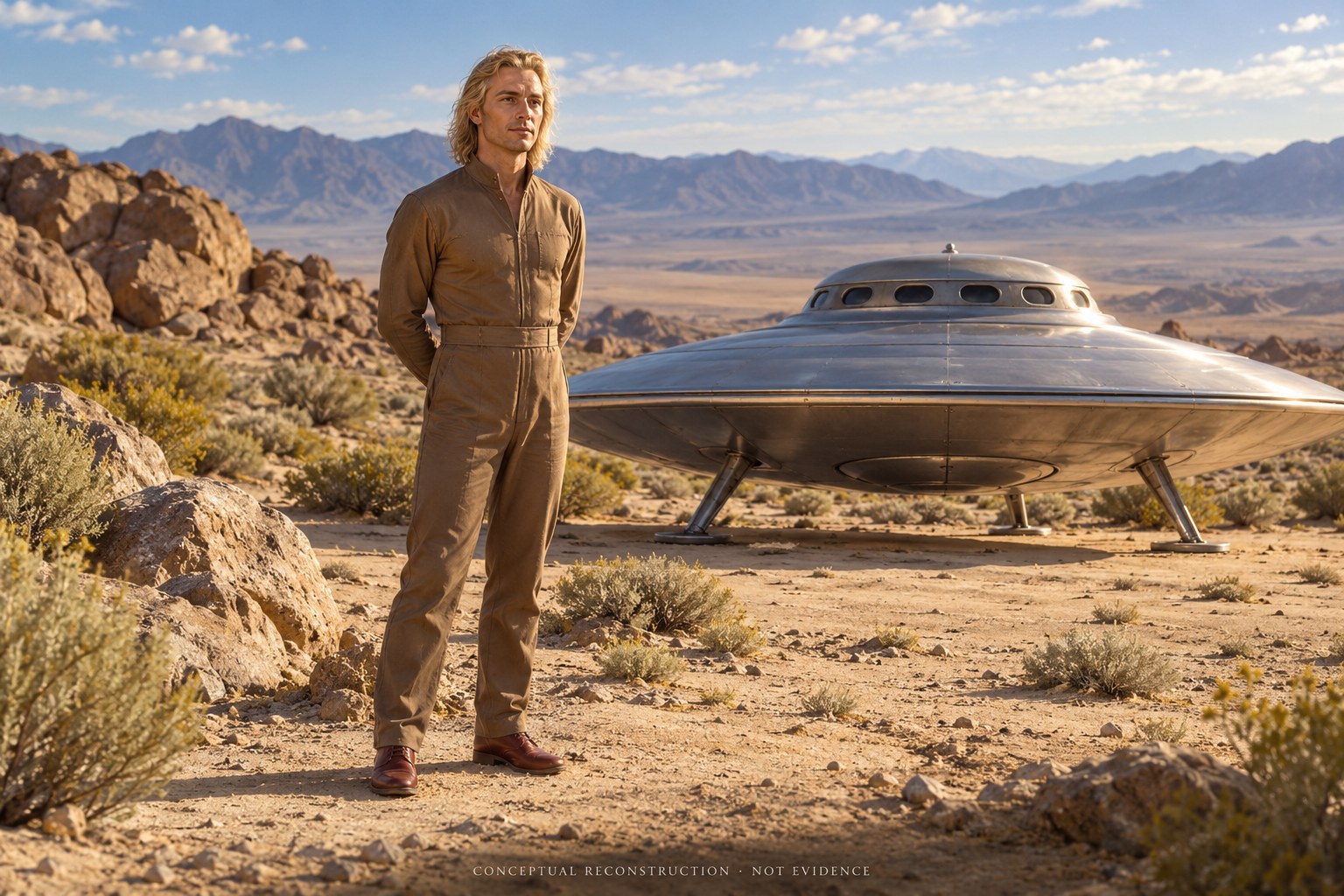
What was described
A human-appearing, long-haired visitor in Adamski’s published story. The association with the later “Nordic” label is an editorial grouping, not evidence of a biological population.
The account and its context
George Adamski said he met a visitor in the California desert and subsequently publicised photographs and accounts of contact. His foundation preserves the story. Its advocacy for authenticity should be read as the claimant tradition’s position, not an independent scientific finding.
Claimed origin
Venus, according to Adamski. This does not establish inhabitants of the observed planet Venus.
Evidence limit
An unrelated aerial sighting in the same broad region cannot independently prove a face-to-face meeting. Modern measurements of Venus’s surface environment also conflict with a straightforward Earthlike surface-civilization reading.
Angelucci: the figure called Neptune1952 / United States / Contact narrative

What was described
A human-appearing male visitor in a spiritual contact narrative. Human disguise and extraordinary abilities are elements of Angelucci’s story, not established anatomy.
The account and its context
Orfeo Angelucci’s The Secret of the Saucers recounts meetings and journeys beginning in 1952. The book mixes encounters with spiritual teachings and visionary experiences. It belongs in a history of contact claims without being mistaken for a verified field observation.
Claimed origin
Unverified. “Neptune” is the visitor’s name in the narrative; it should not automatically be read as the planet of origin.
Evidence limit
An authored spiritual narrative and an instrumented observation answer different questions. The map marks the broad Los Angeles setting, not a verified landing point.
Bethurum: Captain Aura Rhanes1952-07 / United States / Contact narrative

What was described
A small human-appearing woman, described with a dark-haired, slender face, a red skirt, dark blouse and beret. Her crew were also portrayed as humanlike.
The account and its context
Truman Bethurum described repeated nighttime meetings with a female spacecraft captain. A 1955 account by an interviewer preserves the Clarion story and its claimed peaceful, technologically advanced society.
Claimed origin
Clarion, a purported world described as beyond the Moon and hidden from terrestrial observation. It is not an accepted astronomical identification.
Evidence limit
The reported meetings were not independently documented as extraterrestrial encounters. Claims about a hidden nearby planet are not equivalent to a discovered celestial body.
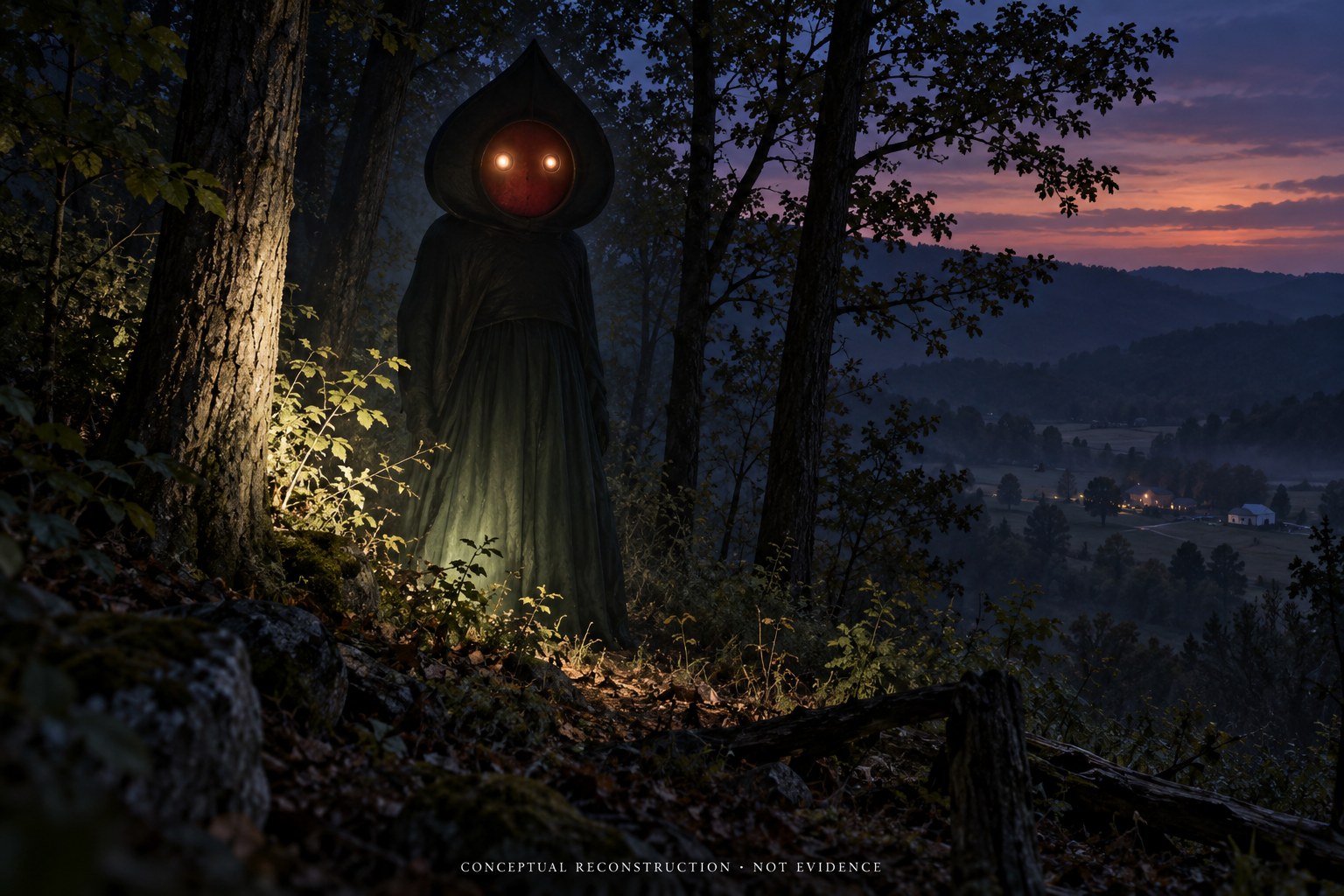
Flatwoods: the hooded silhouette1952-09-12 / United States / Reported observation
What was described
A tall dark form, bright eyes and a reddish face within a pointed hood-like outline. Accounts and subsequent pictures disagree about arms, claws and lower-body shape.
The account and its context
Kathleen May and a group of young people went up a wooded hill after seeing a bright object cross the evening sky. A brief flashlight observation became the basis of the Flatwoods Monster story. Its striking silhouette now belongs to local cultural history as well as UFO literature.
Claimed origin
Unknown. The story supplies no verified planet, star or species.
Evidence limit
The aerial fireball and the hillside figure should be examined separately. A meteor and a misperceived owl have been proposed as ordinary explanations; no authenticated photograph of a creature resolves the question.
Caracas: the hairy figures1954-11-28 / Venezuela / Reported observation

What was described
Small, hairy, strong figures with conspicuous eyes and clawlike hands in the account attributed to Gustavo González and José Ponce.
The account and its context
The men reported a confrontation near a glowing object during an early-morning journey. The episode became one of the best-known South American occupant stories of 1954.
Claimed origin
Unknown.
Evidence limit
The reported struggle is testimony, not a recovered specimen. Descriptions of strength or resistance to injury cannot establish alien physiology.
Cennina: the small caped figures1954-11-01 / Italy / Reported observation

What was described
Two small humanlike figures in grey clothing, short capes and helmets with earflaps. A spindle-shaped object and carnations are distinctive details of Rosa Lotti’s account.
The account and its context
Lotti said the figures approached her on a walk and took flowers and a stocking. The CUFOS catalogue records the story and its reporting sources.
Claimed origin
Unknown.
Evidence limit
The unusual details belong to a witness narrative. Neither the catalogue nor this rendering independently verifies the exchange.
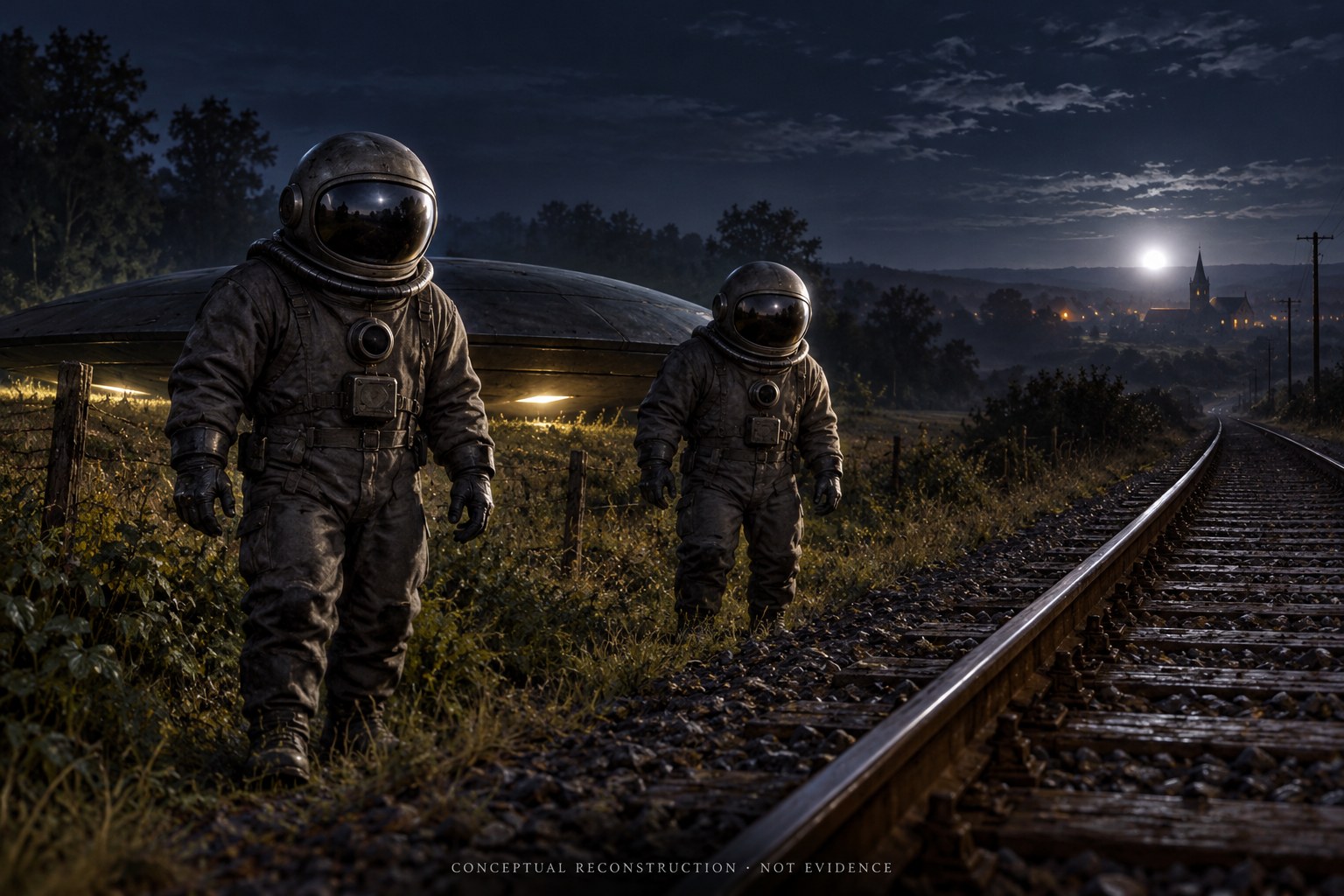
Quarouble: Dewilde’s helmeted figures1954-09-10 / France / Reported observation
What was described
Two small, broad figures in enclosing headgear near a dark object beside a railway, in Marius Dewilde’s account.
The account and its context
Dewilde reported a nighttime encounter and a dazzling light. The case became part of the European occupant-report wave of 1954.
Claimed origin
Unknown.
Evidence limit
A later catalogue preserves the description and bibliography; it does not verify a creature or a spacecraft. The illustration leaves the faces hidden.
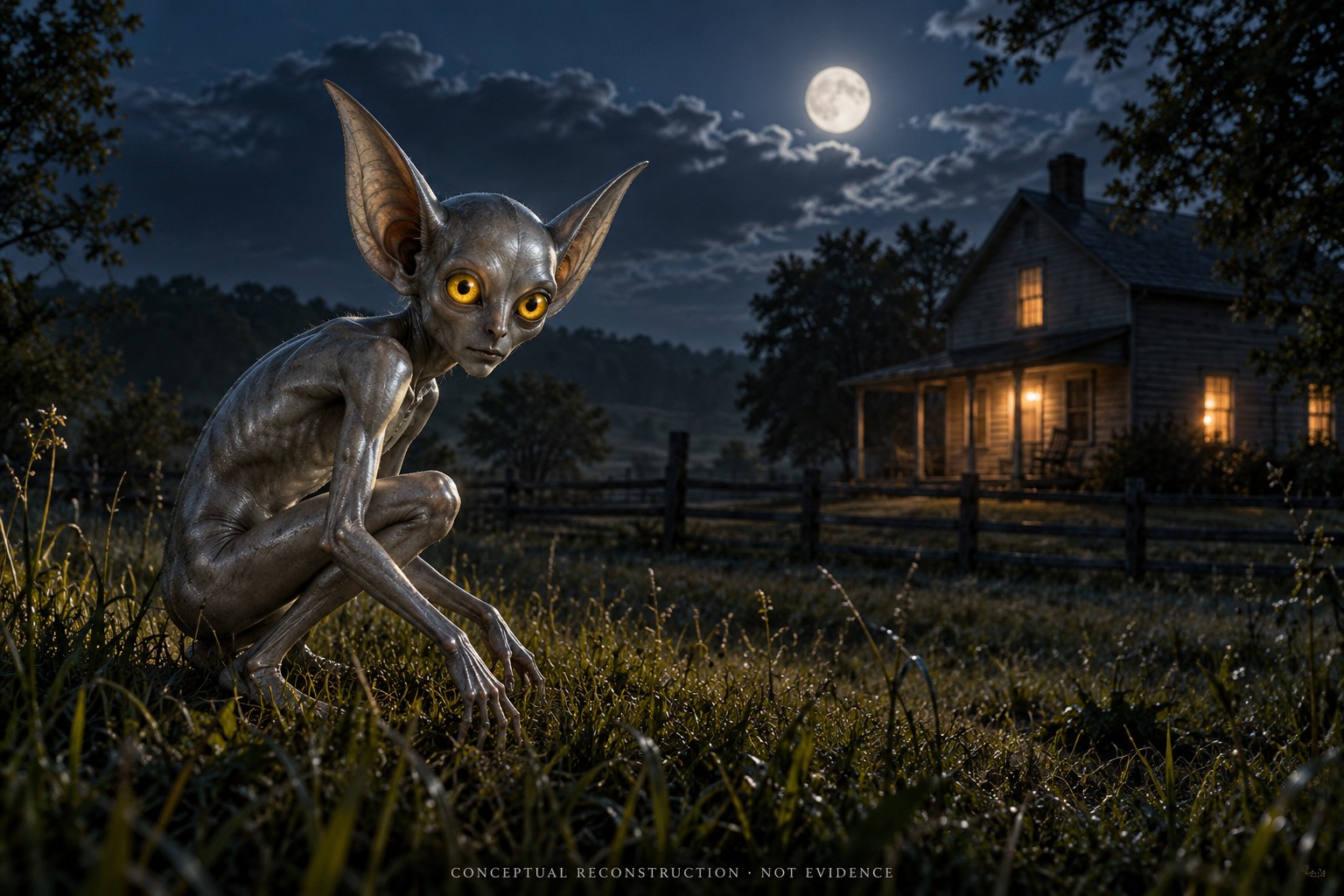
Kelly–Hopkinsville: the farmhouse visitors1955-08-21 / United States / Reported observation
What was described
Small figures with oversized ears, bright eyes, long arms and clawlike hands. The familiar green colour is not a reliable description of the original reports.
The account and its context
Members of the Sutton–Lankford household reported figures repeatedly approaching their farmhouse during the night of 21–22 August. They sought help from Hopkinsville police. Later investigators collected interviews and reconstructed the descriptions with drawings.
Claimed origin
Unknown. An alleged aerial light does not supply a point of origin.
Evidence limit
Police attendance confirms that a complaint was made. It does not authenticate the figures. The famous drawings were interpretations made with witness input, not photographs; animal misidentification has also been proposed.
Klarer: Akon and the Meton claim1956 / South Africa / Contact narrative

What was described
A human-appearing male named Akon, portrayed in Klarer’s autobiographical story as a technologically advanced visitor. No authenticated portrait establishes his existence as an extraterrestrial.
The account and its context
Elizabeth Klarer’s Beyond the Light Barrier describes a relationship with Akon, a journey to another world and a child. The publisher’s synopsis establishes what the book claims; it is not independent confirmation of interstellar travel.
Claimed origin
Meton in the Alpha Centauri / Proxima Centauri system, according to Klarer’s narrative. Meton is not an independently confirmed planet.
Evidence limit
A real nearby stellar system does not authenticate a named world or a personal journey. Modern exoplanet discoveries cannot be retrofitted as confirmation of the memoir.
Menger: the humanlike space people1956-03 / United States / Contact narrative

What was described
Human-looking men and women, often described as fair-haired and wearing unusual fitted clothing. A portrait cannot distinguish the claimed visitors from people.
The account and its context
Howard Menger’s From Outer Space to You describes meetings, messages and purported craft photographs. His High Bridge contacts became part of the 1950s contactee movement. Later interviews also complicated a simple literal reading of the original interplanetary narrative.
Claimed origin
Venus and other worlds in the contact narrative. These are attributed claims; Menger also later entertained an Earth-based explanation.
Evidence limit
The claimant’s book is a source for the story, not independent authentication. Similar descriptions among contactees may reflect shared culture as well as any proposed common experience.
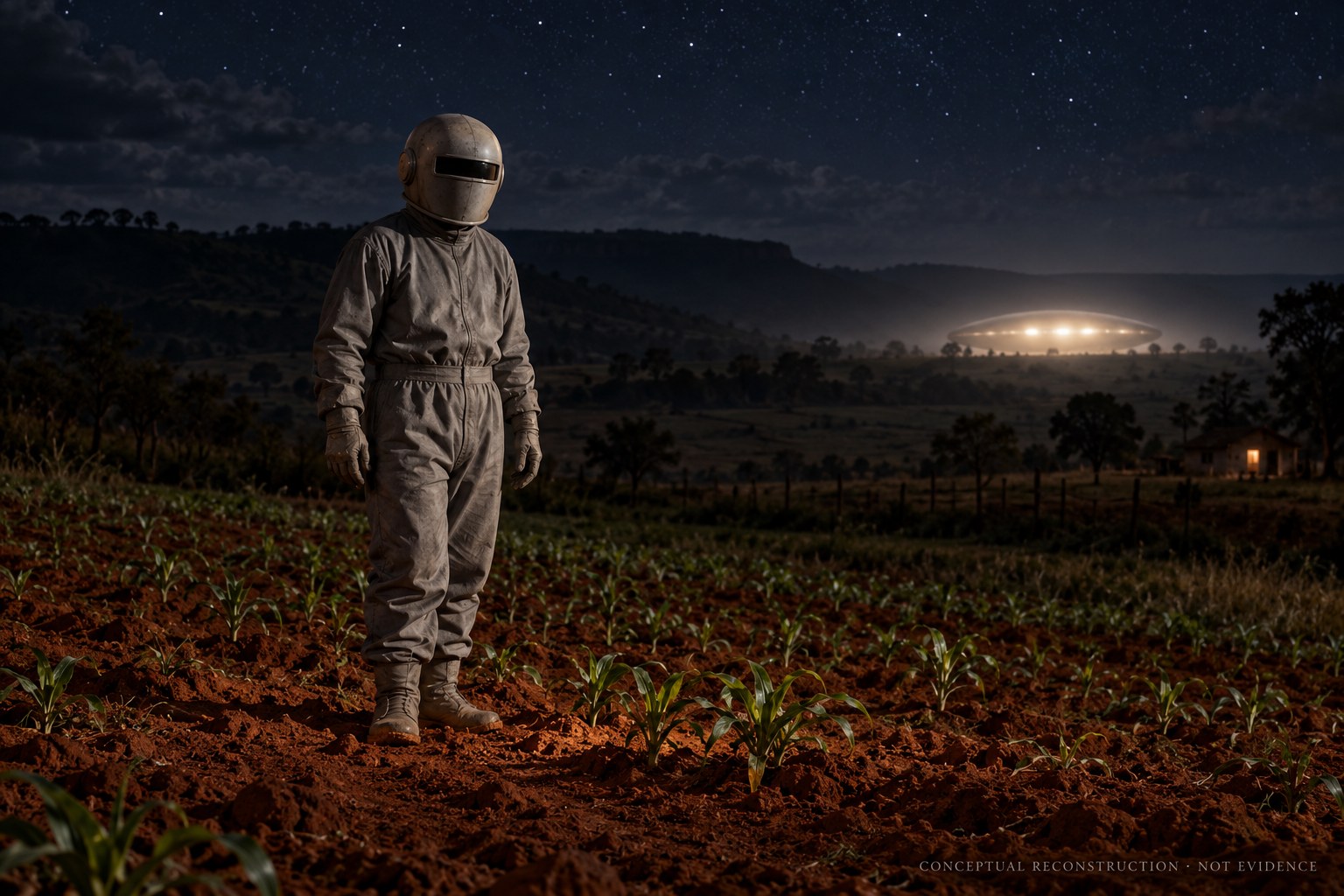
Antônio Vilas-Boas: the helmeted crew1957-10-15 / Brazil / Reported encounter / abduction claim
What was described
Small crew members in grey coveralls and enclosing headgear. His narrative also describes a human-appearing woman, a distinct figure within the same account.
The account and its context
Vilas-Boas said he was taken from his farm into a strange craft during the night. Later interviews made the story an early example of the abduction genre.
Claimed origin
Unknown; no planet demonstrated.
Evidence limit
The sexual and medical elements are allegations, not clinical findings. This entry uses a non-explicit crew illustration and makes no diagnosis of the witness.
Boianai: the waving deck figures1959-06-26 / Papua New Guinea / Reported observation

What was described
Humanlike silhouettes on top of a luminous object. The distance did not permit an anatomical portrait; calling them “men” in a report is not a biological identification.
The account and its context
William Booth Gill and other observers described lights and apparent figures over the coast on 26–27 June 1959. Gill recorded an apparent exchange of waves. His compiled July report, letters and sketches survive in Australian archival material.
Claimed origin
Unknown. No source location was established.
Evidence limit
The apparent waving and the figures’ identity depend on visual interpretation. Gill’s later size estimates depended partly on assuming human-sized occupants, so those estimates are not independent measurements.
Eagle River: Simonton’s humanlike crew1961-04-18 / United States / Contact narrative
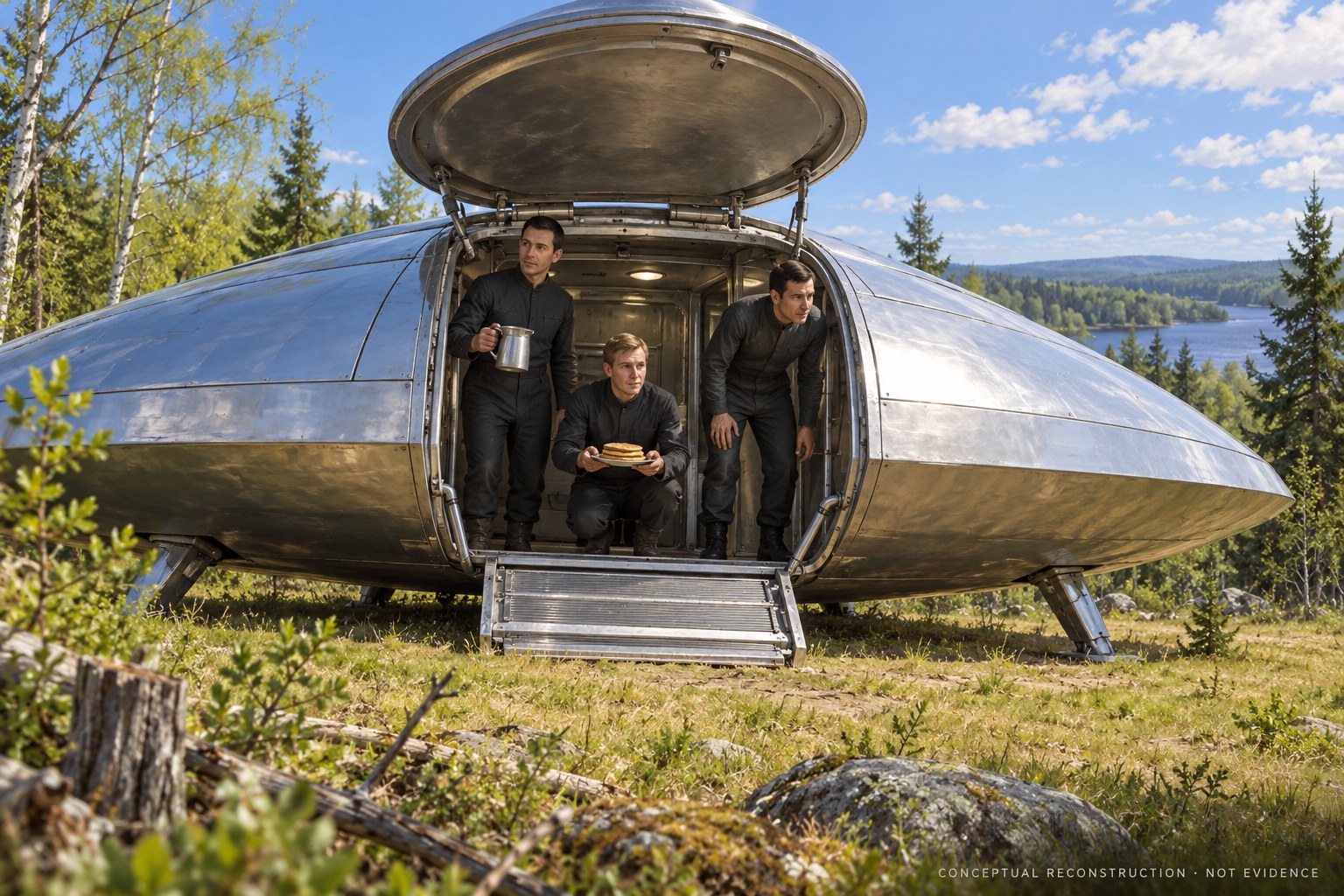
What was described
Three humanlike occupants in the witness’s description, rather than the enlarged-headed Grey familiar from later imagery.
The account and its context
Joe Simonton said occupants of an unusual craft asked for water and gave him small cakes. Investigators interviewed him, and samples were submitted for analysis. The surviving file is unusually useful because it records both the claim and the investigators’ reservations.
Claimed origin
Unknown. The alleged exchange did not establish a home world.
Evidence limit
The cakes were ordinary food material in the reported analysis, not evidence of extraterrestrial chemistry. Historical investigators proposed a psychological explanation; the atlas does not turn that proposal into a retrospective clinical diagnosis.
The Hill case: figures and a later star map1961-09-19 / United States / Later hypnosis / recollection
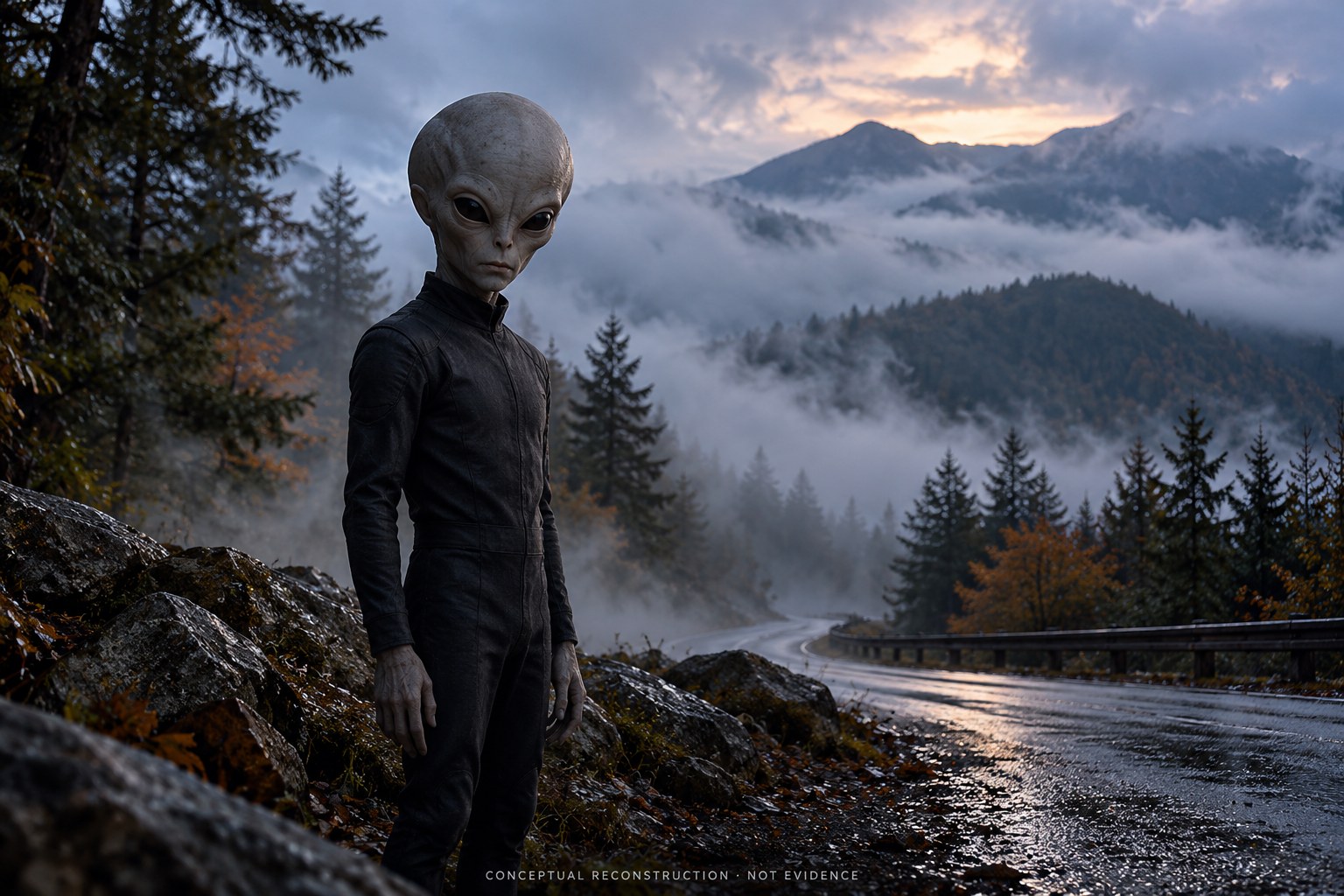
What was described
Humanoid figures with unusually prominent eyes and dark clothing. Descriptions developed across the initial sighting, dreams, hypnotic sessions and later published artwork.
The account and its context
Betty and Barney Hill reported an unusual late-night experience during their journey home on 19–20 September. The better-known abduction narrative emerged later, including hypnosis in 1964. The University of New Hampshire preserves extensive papers and objects associated with the case.
Claimed origin
Zeta Reticuli is a later interpretation of Betty Hill’s remembered star map, not a confirmed destination or an astronomical measurement made during the encounter.
Evidence limit
The surviving archive establishes the history of the claim. Hypnotic recall and a proposed resemblance between star patterns cannot independently establish travel from another star system.
Gary Wilcox: the claimed Martian visitors1964-04-24 / United States / Contact narrative
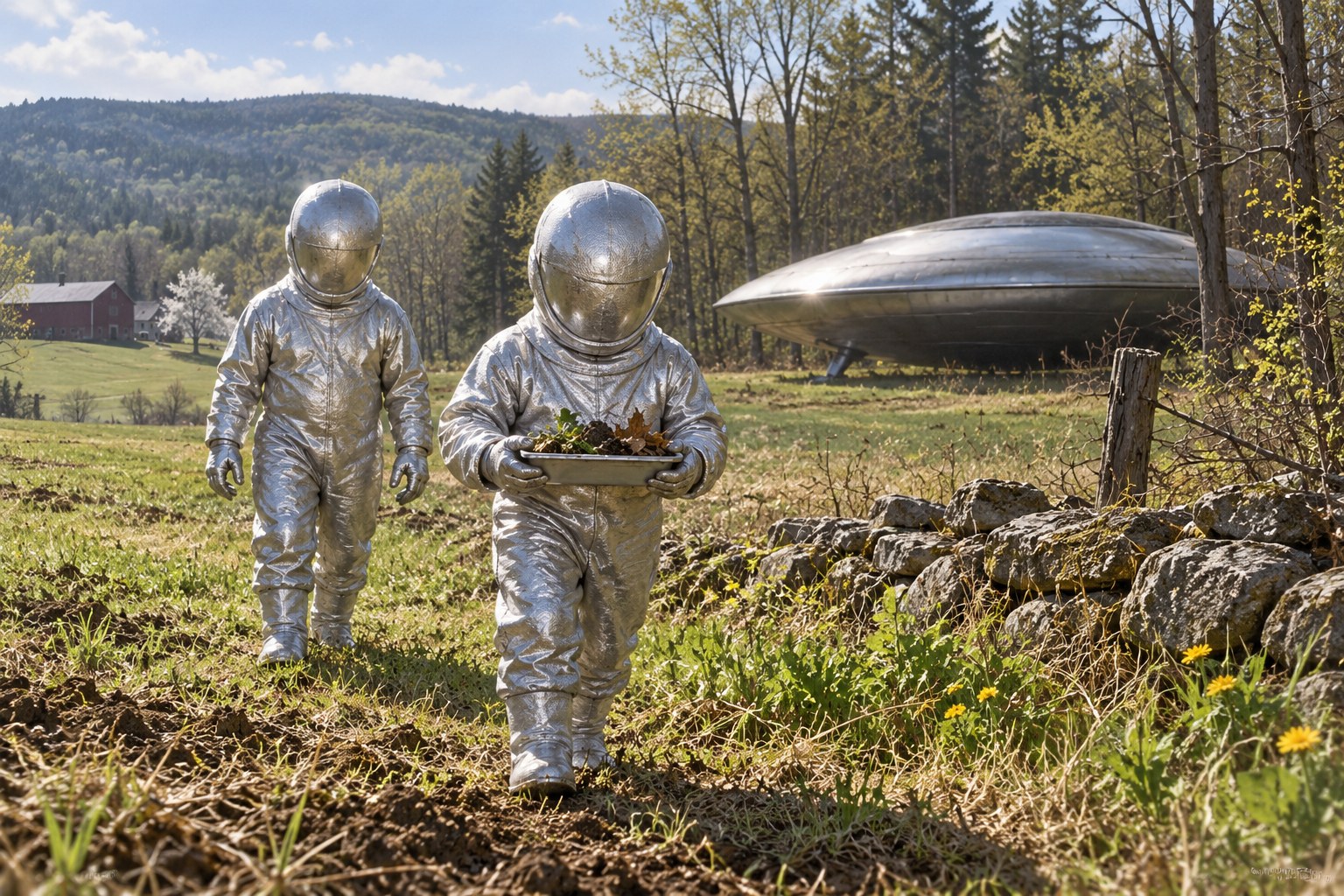
What was described
Two short figures enclosed in silvery outfits, associated with trays of soil or plant material in the account.
The account and its context
Farmer Gary Wilcox said he conversed with visitors on his land. The story included questions about farming and fertilizer. A contemporary reporting trail places it in Newark Valley, New York, despite incorrect locations in some later online summaries.
Claimed origin
Mars, according to the visitors as reported by Wilcox. The statement is part of his claim, not a verified origin.
Evidence limit
A precise planet name can make a story sound testable, but it is not itself a measurement. The account does not establish a Martian civilization or independently verify the conversation.
Socorro: the white-clad figures1964-04-24 / United States / Reported observation

What was described
Two small humanlike figures in white clothing near an oval object. The distance and brevity of the observation do not establish facial anatomy.
The account and its context
Police officer Lonnie Zamora described a low object, a loud departure and two figures he initially took for people. The Air Force investigated the site. Its unresolved identification is an important part of the record, but it does not tell us what the figures were.
Claimed origin
Unknown. No home planet was established in Zamora’s report.
Evidence limit
The ground marks and burned vegetation are separate evidence questions from the figures. Neither an unresolved case nor an official investigation identifies an extraterrestrial species.
Valensole: the figures in the lavender1965-07-01 / France / Reported observation

What was described
Two small humanoid forms near an object in Maurice Masse’s account. Renderings give them rounded heads and simple close-fitting clothing, but fine details remain witness descriptions.
The account and its context
Masse reported the encounter in his lavender field early on 1 July. Gendarmerie records and later commentary form the case file. Ground marks became an important subject of discussion separate from the claimed occupants.
Claimed origin
Unknown. No origin was established.
Evidence limit
GEIPAN explains that the case’s D label was assigned by default in 2015 to aid retrieval, without a new in-depth GEIPAN investigation. It is not certification of an alien landing.
Ummo: the purported extraterrestrial correspondents1966 / Spain / Document narrative / admitted fabrication

What was described
Humanlike correspondents described in letters, not a biological group established by an authenticated encounter photograph.
The account and its context
Letters attributed to visitors from Ummo circulated in Spain and beyond. José Luis Jordán Peña later claimed responsibility for fabricating the affair. The extensive document tradition and the admission are essential context for any atlas entry.
Claimed origin
Ummo, associated in the letters with Iumma and identified with Wolf 424. The identification belongs to the letters’ narrative.
Evidence limit
An elaborate technical correspondence can look authoritative without an extraterrestrial author. Supporters have disputed the scope of Peña’s responsibility, but that dispute does not establish alien authorship. The Madrid pin marks a cultural/document setting, not a verified arrival.
Betty Andreasson: the later recovered account1967-01-25 / United States / Later hypnosis / recollection

What was described
Small grey humanoids with enlarged heads and prominent eyes, often represented in fitted suits. The best-known visual details come from the later investigation and reconstructions.
The account and its context
Raymond Fowler’s The Andreasson Affair describes an alleged 1967 household encounter investigated years later. Hypnotic sessions were central to the detailed narrative. The case also contains visionary and religious interpretations that should be attributed to the experiencer rather than treated as biological observations.
Claimed origin
No astronomical origin verified. A visionary journey is not a surveyed celestial destination.
Evidence limit
The gap between the reported event and the detailed investigation matters. A coherent hypnotic narrative is not an independent test that the remembered events happened externally.
Cussac: four dark silhouettes1967-08-29 / France / Reported observation
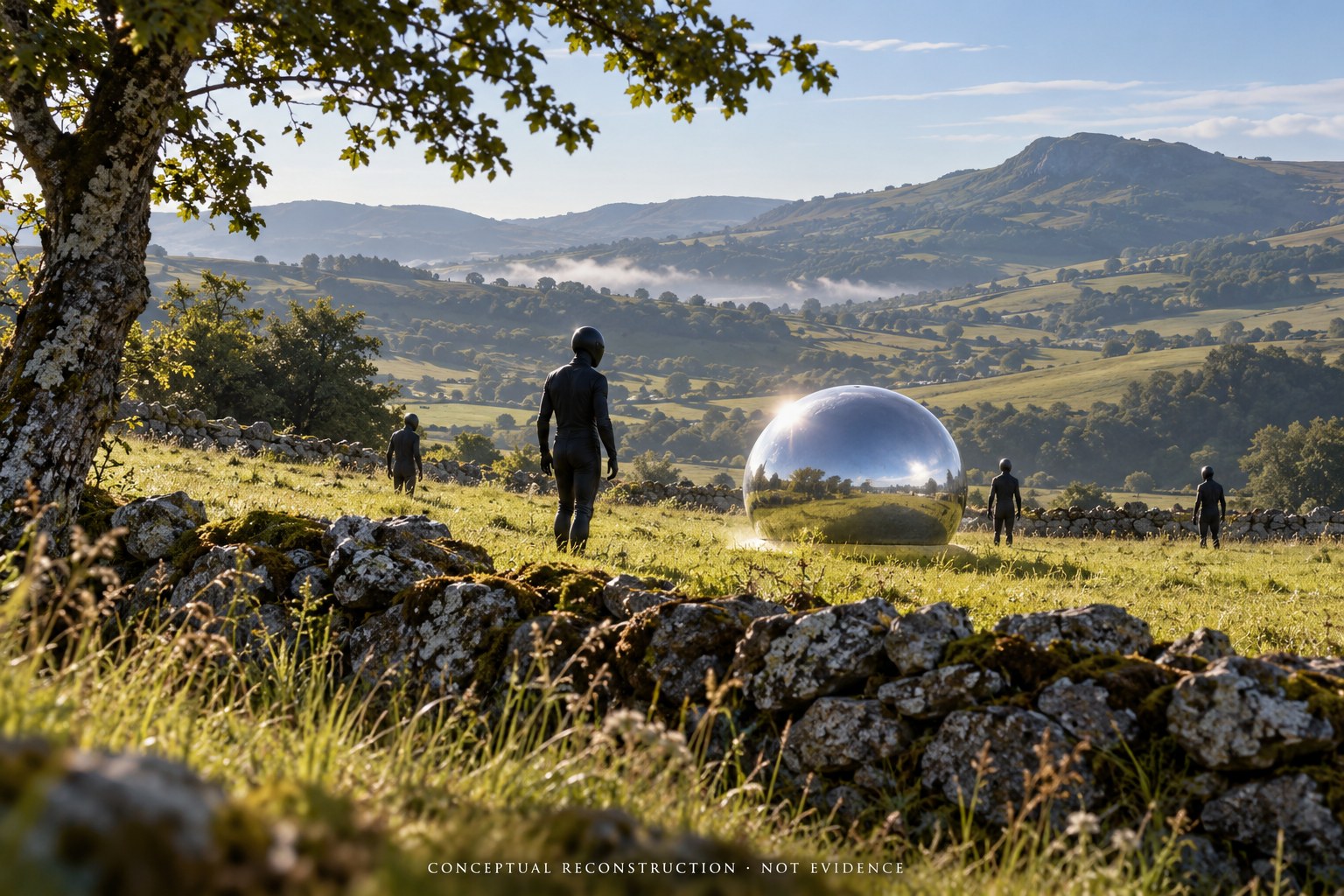
What was described
Four small dark figures near an intensely bright sphere, according to the two child witnesses. The reports do not justify a detailed skin texture or a modern Grey face.
The account and its context
Two siblings tending cattle reported figures and an object leaving the field. Investigators returned years later. The case is often misdated in popular catalogues; 29 August is the date used in the early investigation reproduced here.
Claimed origin
Unknown. The report contains no verified home world.
Evidence limit
Early descriptions and the later reconstruction should be compared, not merged. COMETA is an independent report hosted by GEIPAN; its presence there does not make every interpretation a CNES finding.
Herbert Schirmer: the helmeted contact account1967-12-03 / United States / Later hypnosis / recollection
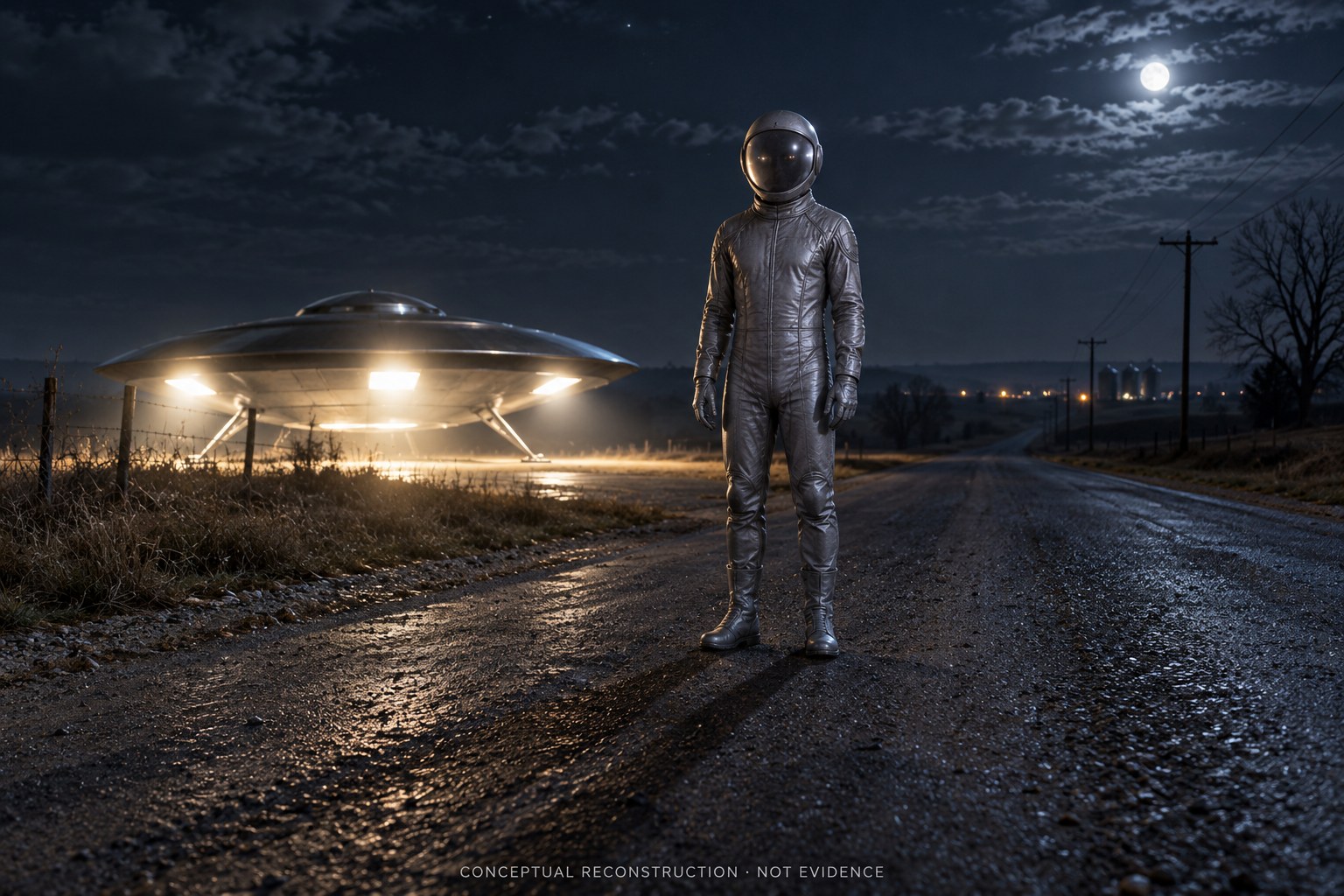
What was described
Humanlike occupants in close-fitting clothing and headgear in the later contact narrative. A suit or helmet conceals anatomy rather than defining a species.
The account and its context
Schirmer, a police officer, reported an unusual object near Ashland. The Colorado study considered the case; a more elaborate occupant encounter was described after hypnosis. The early object report and the later recalled conversation need separate treatment.
Claimed origin
Not established. Statements attributed to remembered occupants cannot be treated as a verified travel history.
Evidence limit
The Condon-era investigation did not establish that a physical craft had been present. Later hypnosis adds a claim, not an independently recorded meeting.
Wodonga: the silver-suited pair1967-08-24 / Australia / Reported observation

What was described
Two humanlike figures in silvery suits and rounded helmets in Ron Hyde’s reported encounter.
The account and its context
A catalogue records Hyde’s account of figures beside a disc-shaped object near Wodonga. One allegedly gestured toward him before he fled.
Claimed origin
Unknown.
Evidence limit
This is a catalogue-level record. The short source summary limits the detail that can responsibly be illustrated or inferred.
Imjärvi: the small figure with a box1970-01-07 / Finland / Reported observation

What was described
A small figure with a pointed cap and a box held in its hands; green clothing and pale gloves occur in the detailed descriptions.
The account and its context
Aarno Heinonen and Esko Viljo said that a strange object approached while they were skiing. Finnish broadcaster Yle preserves a 1971 interview with Heinonen. UFO-Sweden’s investigation discusses both the initial encounter and the complications of later contact claims.
Claimed origin
Unknown. Later stories should not be used to assign an origin to the initial observation.
Evidence limit
Reported illness is not by itself a diagnosis of radiation exposure or proof of an alien cause. The early account and later elaborations require separate sourcing.
Kinnula: the green-suited story1971-02-05 / Finland / Disputed / reported hoax
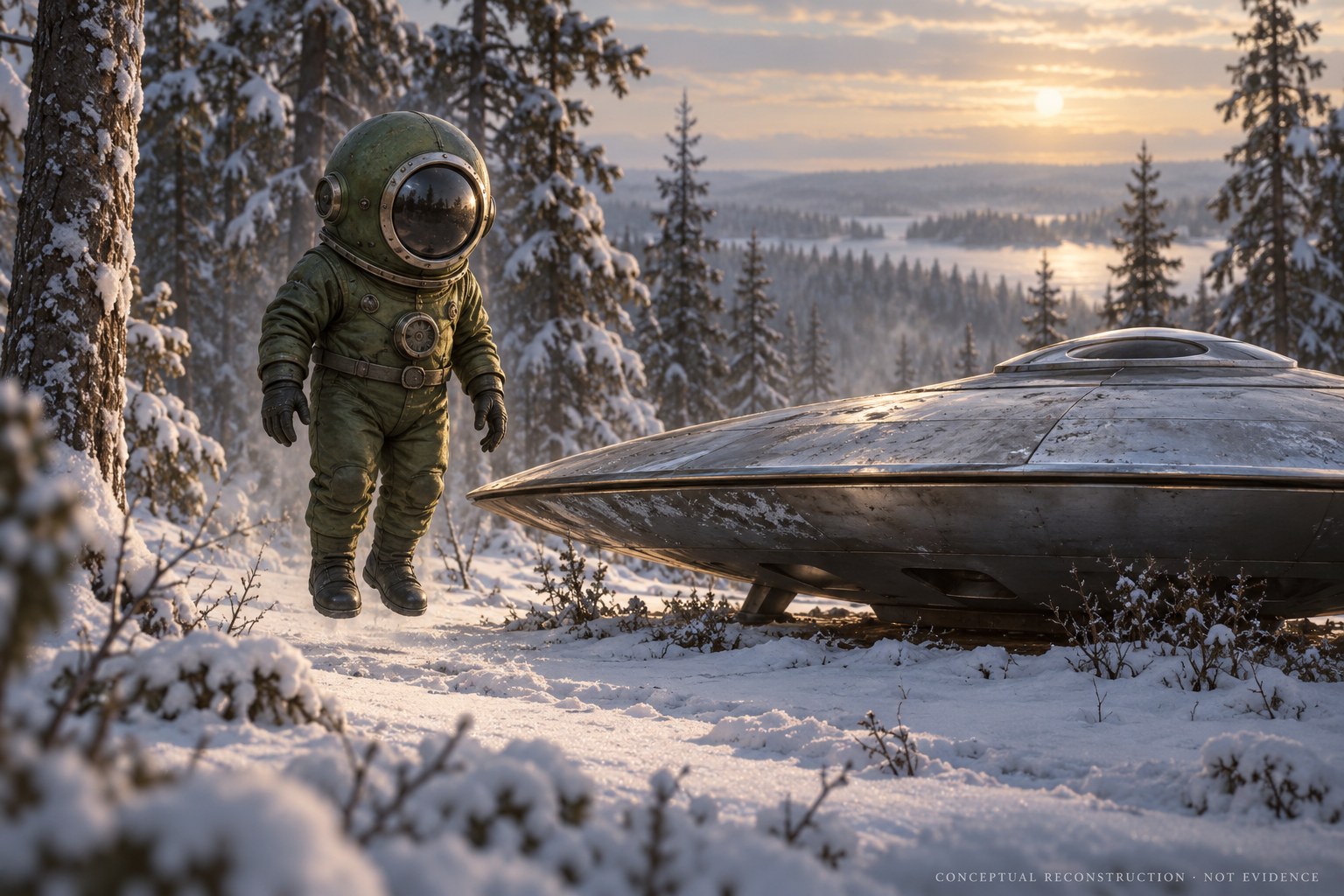
What was described
A small figure in a green enclosing suit and round faceplate, described in a forestry encounter story.
The account and its context
Two men were reported to have seen a figure and a craft in snowy woodland. The account circulated through Flying Saucer Review. A later catalogue flags information that the story was a locally arranged hoax.
Claimed origin
Unknown; no origin established.
Evidence limit
The hoax information in the linked critical catalogue is itself attributed to later correspondence. The entry is retained to show how a famous visual story can acquire serious authenticity problems.
Falkville: the reflective-suited figure1973-10-17 / United States / Disputed photograph
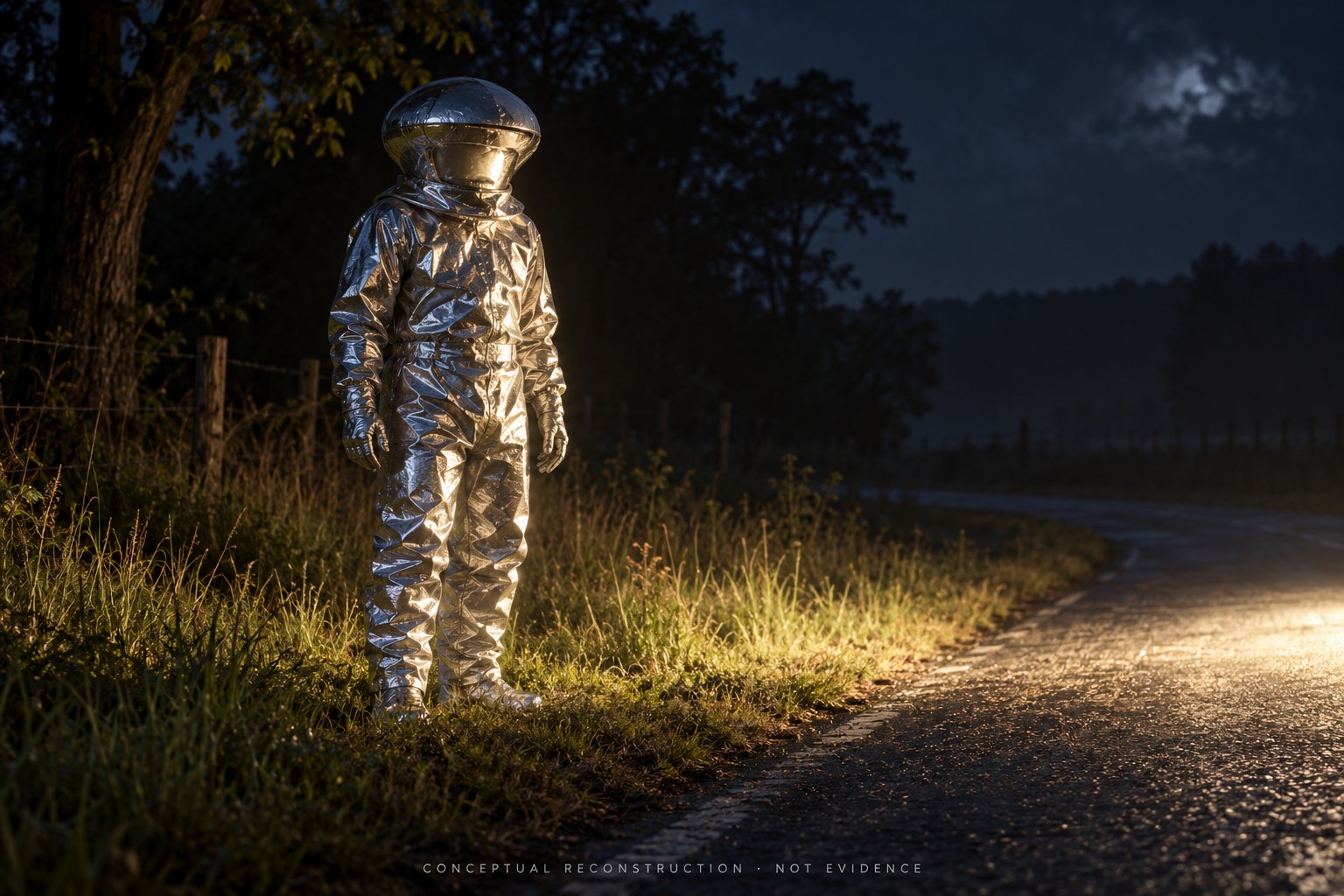
What was described
A human-sized figure apparently enclosed in a highly reflective suit. The published images do not securely distinguish a costume, protective clothing or something unknown.
The account and its context
Police chief Jeff Greenhaw reported photographing a strange figure during a rural nighttime call. The photographs made the case unusual, but their existence is not the same as authentication of an extraterrestrial subject.
Claimed origin
Unknown. A planet of origin cannot be read from the photographs.
Evidence limit
A person in reflective protective clothing is a conventional interpretation. Our illustration visualises the reported suit; it is deliberately separate from the disputed original frames.
Pascagoula: the wrinkled figures1973-10-11 / United States / Reported encounter / abduction claim
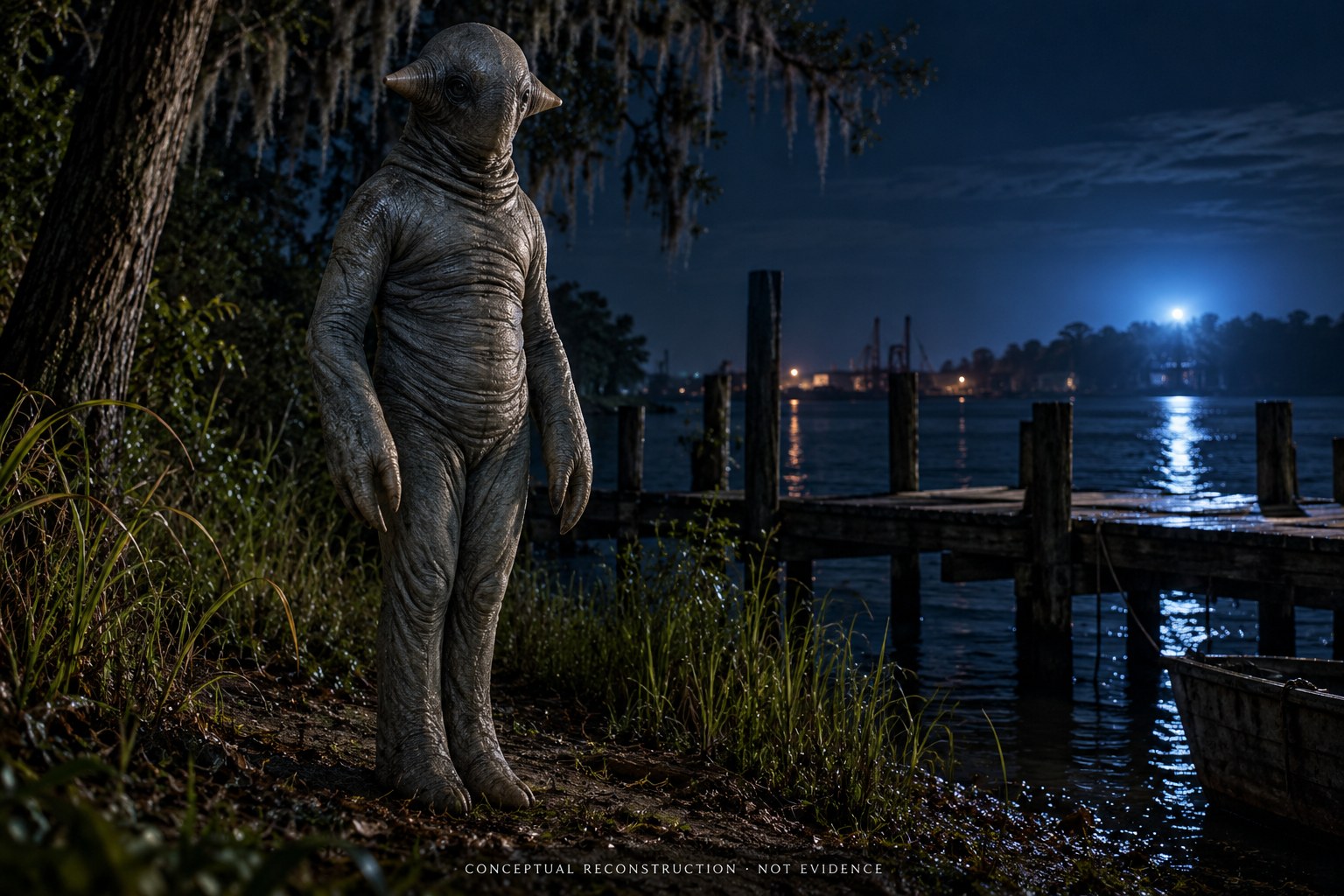
What was described
Grey, wrinkled figures with conical facial projections, unusual hands and stiff or closely joined legs. The appearance differs markedly from the familiar smooth-faced Grey.
The account and its context
Charles Hickson and Calvin Parker reported being taken from a riverside fishing spot into a strange object. Their visit to the sheriff’s office and the recorded conversations became central source material. Their account of the beings remains testimony, even where recordings preserve their distress.
Claimed origin
Unknown. No reliable origin was demonstrated.
Evidence limit
A recording can preserve an account and an emotional reaction without proving its external cause. Later retellings should not be silently substituted for the earliest available statements.
Raël: the Elohim encounter narrative1973-12-13 / France / Religious contact narrative

What was described
A small humanlike visitor in Raël’s account. The modern movement presents the Elohim as advanced biological creators, rather than as a scientifically identified species.
The account and its context
Claude Vorilhon, known as Raël, says he met a visitor at a volcanic crater and received teachings about humanity’s origins. The encounter is the founding narrative of the Raelian movement. Its own publications are primary sources for those beliefs.
Claimed origin
An extraterrestrial world in the religious narrative, without an independently verified astronomical identification.
Evidence limit
Describing a movement’s beliefs does not validate its scientific claims. The word Elohim also has a much older religious history that should not be reduced to this modern extraterrestrial interpretation.
Sixto Paz: the guide called Oxalc1974 / Peru / Contact narrative

What was described
A humanlike guide in the Mission Rahma tradition. Physical representations vary, so the atlas uses a restrained, non-specific clothed humanlike figure.
The account and its context
Sixto Paz Wells and associated groups describe messages beginning in January 1974 and meetings or sightings in the Chilca desert. Automatic writing, claimed mental communication and reported observations are different elements of the narrative.
Claimed origin
Morlen, identified in the group’s account with Ganymede, Jupiter’s moon. This is a contact claim, not a discovered population on Ganymede.
Evidence limit
A group anticipating an experience does not provide a controlled independent test of its cause. The real moon’s existence does not verify the identity of a claimed communicator.
Kōfu: the wrinkled vineyard figure1975-02-23 / Japan / Reported observation

What was described
A short, deeply wrinkled brown figure in familiar reconstructions of the boys’ account, often shown with a projecting mouth or metallic tooth-like features. Later imagery is more precise than the surviving early reporting.
The account and its context
Two boys reported an object and a figure near a vineyard. The story appeared in Japanese reporting and was translated into UFO literature. A later interview with Katsuhiro Yamahata preserves a participant’s retrospective account.
Claimed origin
Unknown. No planet was demonstrated.
Evidence limit
The later interview is recollection, not 1975 footage of a being. Claims about radiation or detailed anatomy need an original measurement or source, not repetition across modern websites.
Meier: Semjase and the Plejaren narrative1975-01-28 / Switzerland / Contact narrative

What was described
A human-appearing woman called Semjase, generally represented with long fair hair and a close-fitting suit in the contact tradition.
The account and its context
Eduard “Billy” Meier published contact reports and photographs associated with his claimed meetings. The first published dialogue, dated 28 January 1975, attributes statements to Semjase. FIGU maintains the material as a continuing body of contact claims.
Claimed origin
The early dialogue says Pleiades; later FIGU terminology uses Plejaren and a different cosmological explanation. These versions should not be flattened into a verified address in the visible Pleiades cluster.
Evidence limit
A dated transcript on an advocate’s website does not authenticate a conversation with an extraterrestrial. The photographs and the origin narrative require separate evidential assessment.
Travis Walton: the figures in the chamber1975-11-05 / United States / Reported encounter / abduction claim

What was described
Walton describes three short, bald figures with large brown eyes. His wider narrative also contains human-appearing figures; those should not be collapsed into one supposed species.
The account and its context
A forestry crew reported a dramatic light encounter and Walton’s disappearance in November 1975. After returning, Walton described waking in an unfamiliar interior. His own website and book provide the first-person narrative. The film Fire in the Sky is a dramatization and is not the source for the anatomy shown here.
Claimed origin
Unknown. Walton’s description does not establish a home system.
Evidence limit
The coworkers’ reported light encounter and Walton’s later interior account are different parts of the evidence. Witness statements and disputed tests do not amount to a verified biological specimen.
Talavera la Real: the luminous figure1976-11-12 / Spain / Press-mediated claim
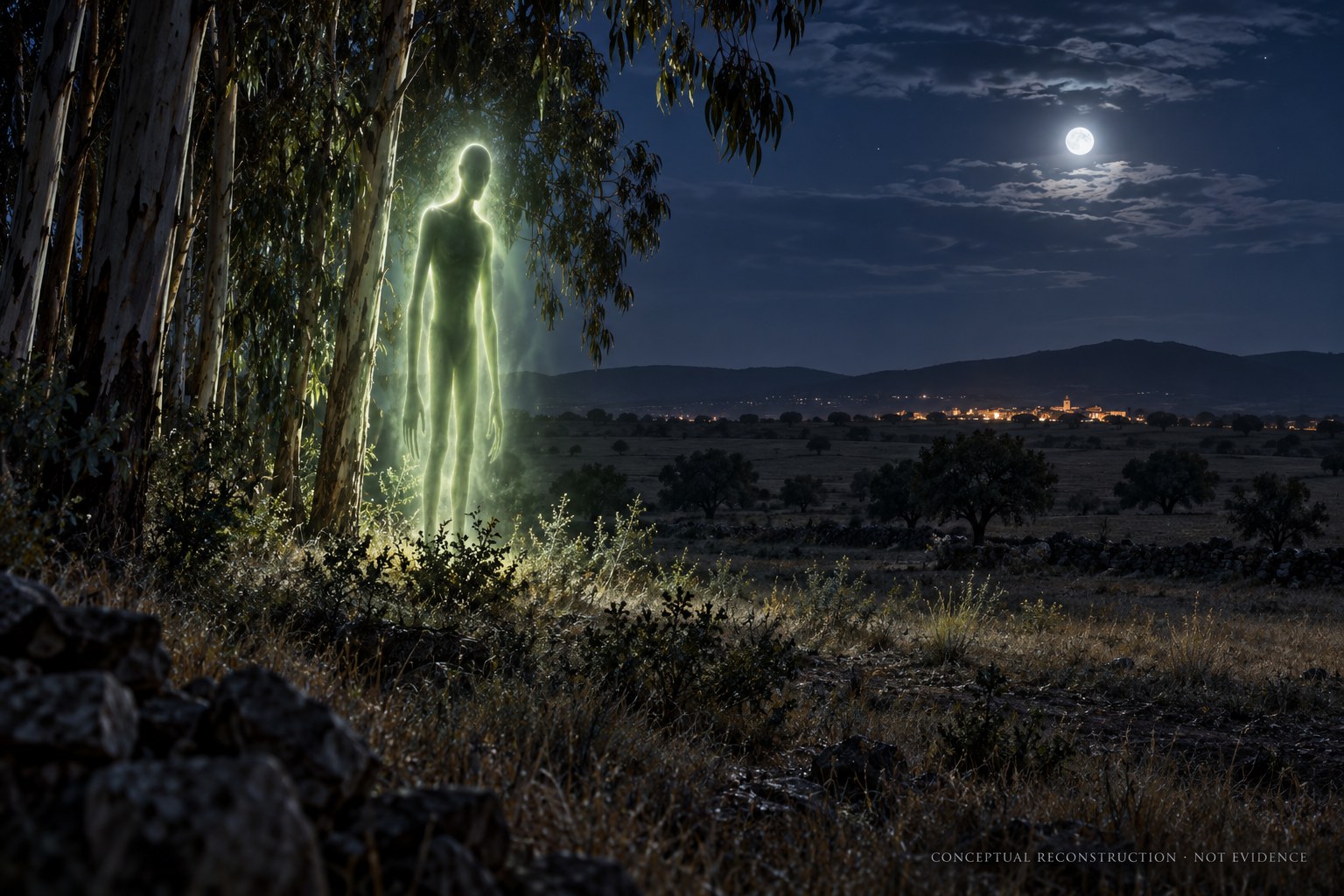
What was described
A tall greenish luminous humanoid form with long arms in the published account, with indistinct hands, feet and facial detail.
The account and its context
A story attributed to air-base sentries describes sounds, a light and a figure, followed by gunfire. A later official compilation preserves the reporting history. Its administrative existence must not be confused with a surviving original witness statement or an authenticated ballistic record.
Claimed origin
Unknown. No origin was established.
Evidence limit
The linked later review of the released file notes that its summary says searches did not locate the original investigation. The detailed narrative is known through later reporting, making strong physical claims difficult to check.
Broad Haven: the silver-suited figure1977-02-04 / United Kingdom / Reported observation
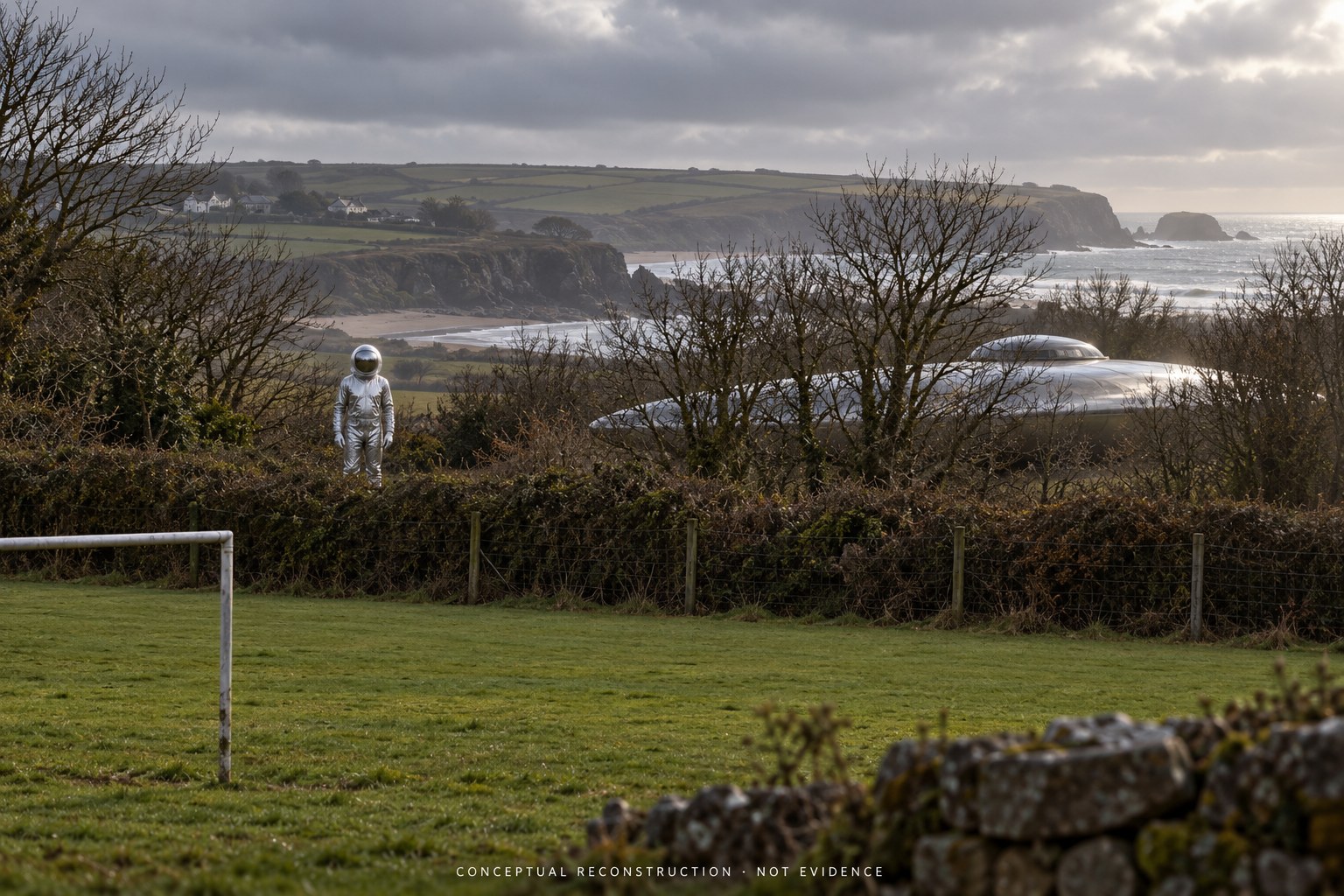
What was described
A silver-suited humanlike figure appears in some pupils’ descriptions and drawings. It was not a detail reported uniformly by every child.
The account and its context
Children reported an unusual object near their school. Headteacher Ralph Llewellyn collected accounts and drawings after the weekend. David Clarke’s examination of the school record helps distinguish those documents from later claims that the drawings were immediate and wholly uninfluenced.
Claimed origin
Unknown. No origin was established by the school report.
Evidence limit
School reports, the wider Pembrokeshire wave and later silver-suit prank claims are related history, not automatically corroboration of the same event. A protective suit can conceal an ordinary person.
Emilcin: the green-faced passengers1978-05-10 / Poland / Reported encounter / abduction claim
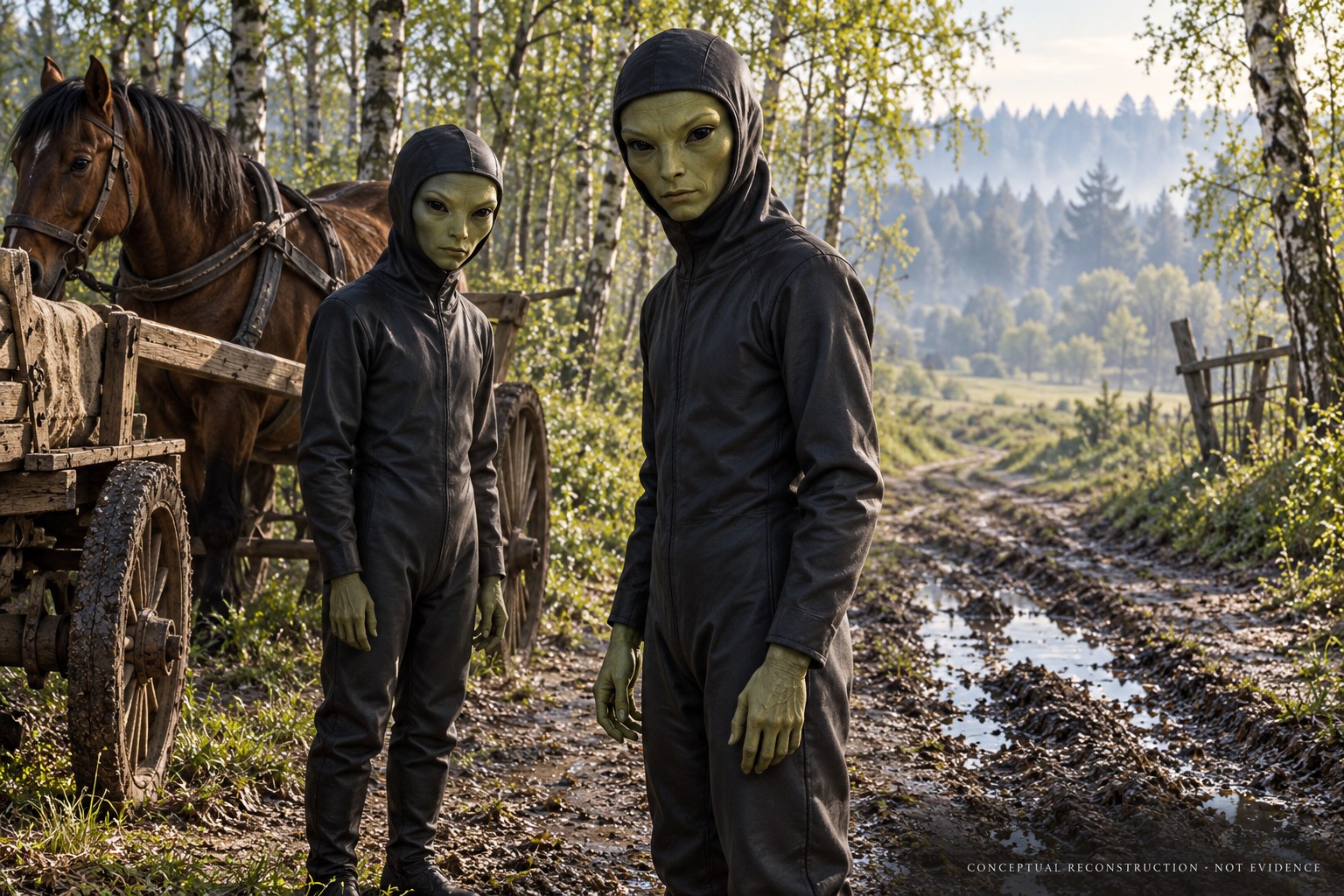
What was described
Small, lightly built figures with greenish faces and hands, dark hooded outfits and prominent cheekbones in Jan Wolski’s description.
The account and its context
Wolski said he encountered the figures while travelling by horse-drawn cart and was taken into an unusual vehicle. The encounter became a major Polish UFO story. Fundacja Nautilus maintains a detailed account and commemorative activity around the location.
Claimed origin
Unknown. The recorded narrative does not establish an astronomical origin.
Evidence limit
A monument commemorates a story; it does not certify it. Later reconstructions, soil claims and the first witness interview should be assessed as different kinds of material.
Zanfretta: the beings called Dargos1978-12-06 / Italy / Later hypnosis / recollection

What was described
A very tall figure with folded or corrugated skin, pointed ears and triangular yellow eyes in the early published description. Later versions often colour the beings green and call them reptilian.
The account and its context
Night guard Pier Fortunato Zanfretta reported an encounter during his rounds. Journalist Rino Di Stefano investigated and published the case. Subsequent hypnosis and interviews expanded it into repeated contacts with beings called Dargos.
Claimed origin
Later accounts use Titania or Teetonia and a “third galaxy.” These are narrative names, not a verified astronomical address, and should not be equated with Uranus’s moon Titania.
Evidence limit
A guard’s distress and reports of unusual lights do not independently confirm the beings’ identity or the later origin story. Our image follows the early grey, folded-skin description rather than treating every later drawing as consistent.
Communion: Strieber’s visitors1985-12-26 / United States / Personal experience / recollection

What was described
Small visitors, including a pale, large-eyed form that became culturally associated with Communion. Strieber has described more than one appearance and has resisted a simple identification of their nature.
The account and its context
Whitley Strieber’s account of a frightening cabin experience entered public discussion through Communion in 1987. It is both a personal narrative and an influential part of modern alien imagery. The illustration here is newly rendered and does not reproduce the book’s cover.
Claimed origin
Unspecified. Strieber’s word “visitors” should not be translated into a confirmed extraterrestrial origin.
Evidence limit
A published memoir is primary evidence for what its author says, not independent confirmation of the event described. A broad regional pin avoids identifying a private cabin.
Ilkley Moor: the photographed shape1987-12-01 / United Kingdom / Disputed photograph
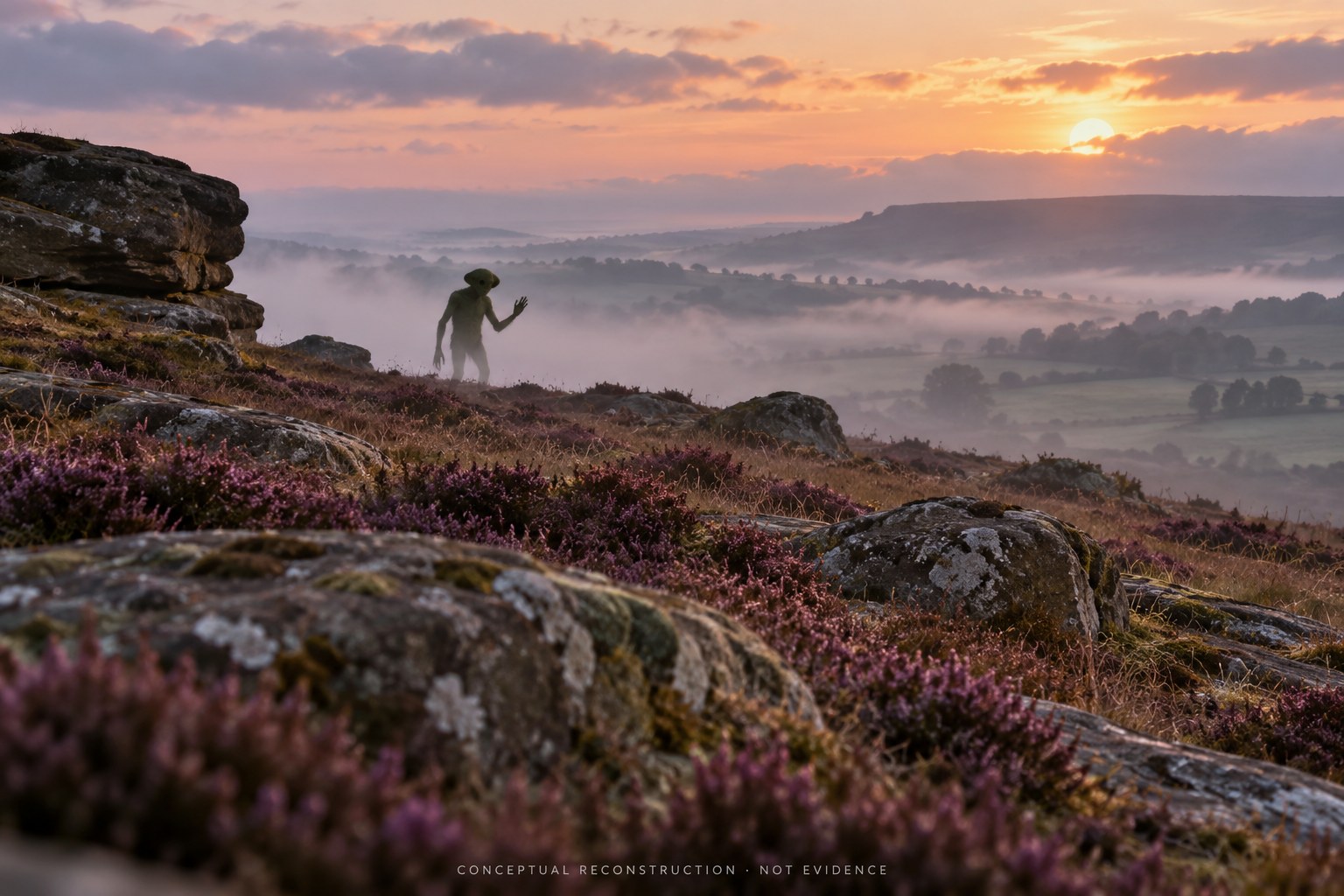
What was described
A small dark or greenish humanoid shape in a grainy photograph attributed to a witness using the name Philip Spencer. Its exact form is difficult to resolve.
The account and its context
Peter Hough and Jenny Randles investigated the photograph and the associated encounter narrative. A 1988 report discusses the image and the way later hypnosis changed parts of the chronology.
Claimed origin
Unknown. A shape on a negative does not identify a home planet.
Evidence limit
Showing that a shape belongs to an original photographic exposure would not identify what was photographed. Our clear rendering is an interpretation of the claim, not an enhancement that recovers missing image information.
Voronezh: the three-eyed giants story1989-09-27 / Russia / Press-mediated claim

What was described
Very tall humanoids with small heads, three eyes and metallic-looking clothing, accompanied by a robot in the widely circulated press account. Published details vary.
The account and its context
TASS publicised a reported park encounter in autumn 1989, and international news agencies repeated it. The result was a worldwide story. Contemporary UPI reporting also recorded Soviet specialists’ doubts and cautions.
Claimed origin
Unknown. A state news agency carrying a story does not establish an interplanetary journey.
Evidence limit
Headlines saying that scientists had “confirmed” a landing outran what was demonstrated. Keep the existence of the news report separate from authentication of its extraordinary content.
Ariel School: the figures near the playground1994-09-16 / Zimbabwe / Reported observation
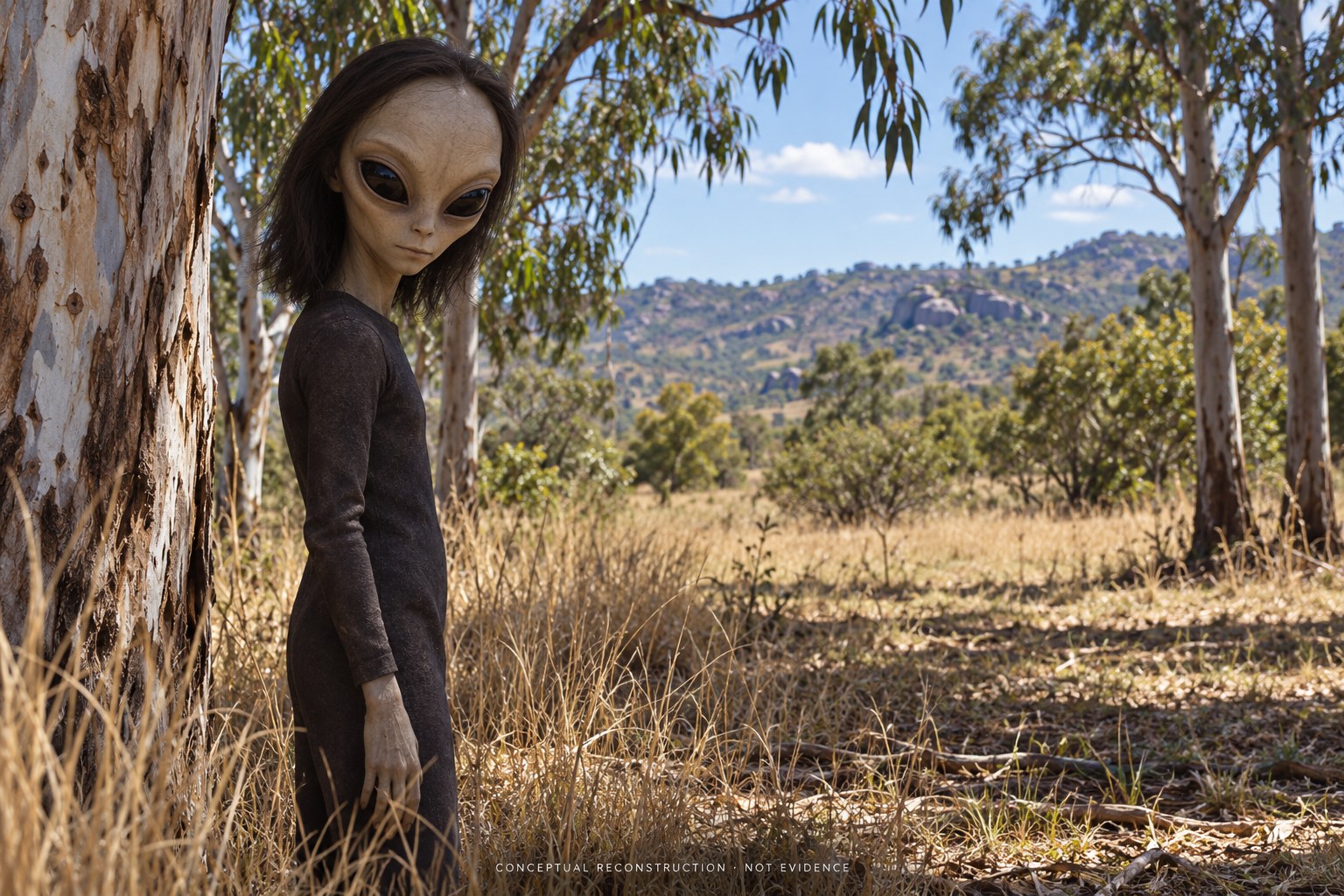
What was described
Children described small figures with large eyes and dark clothing; some accounts include long dark hair. Descriptions differ, and not every child said that they saw a being.
The account and its context
The school report was investigated by Cynthia Hind and later discussed in John Mack’s interviews. Early accounts, children’s drawings, later recollections and documentaries form different layers of the record. The atlas illustration combines selected motifs and cannot stand in for any child’s original drawing.
Claimed origin
Unknown. Environmental messages attributed in some interviews are not a geographic origin.
Evidence limit
“62 children” is a familiar case shorthand, not evidence that 62 independent witnesses saw the same details. Interview timing and shared discussion are important to interpretation.
Varginha: the brown, red-eyed figure1996-01-20 / Brazil / Reported observation

What was described
A small crouched brown figure with large reddish eyes, an enlarged head and three protrusions across the forehead. Colour, texture and proportions come from witness descriptions, not a specimen available for examination.
The account and its context
Three young women’s report became the visual centre of the Varginha story. Separate allegations concern military activity, capture, hospitals and a death. James Fox’s investigations brought further testimony to a wider audience, but those strands require their own documentary checks.
Claimed origin
Unknown. The women’s account does not identify a star system.
Evidence limit
No publicly authenticated creature photograph or accessible biological specimen establishes an extraterrestrial identity. A witness image and a later hospital claim are not interchangeable evidence.
Where are the alleged visitors said to come from?
For most cases in this collection, the honest answer is that the report supplies no origin. Witnesses described something in front of them; they did not measure an interstellar journey. A name enters the record in other ways: a conversation remembered by a contactee, a later interpretation of a drawing, or a document claiming to speak for another world.
These are different kinds of information. The origins guide keeps the attribution visible. The buttons filter the Earth map by the associated story; they do not plot a route through space.
Venus
Venus is prominent in George Adamski’s contact narrative and in Howard Menger’s accounts. Their human-appearing visitors helped shape the friendly “space people” image of the 1950s. The planet’s existence supplies a real astronomical name, but it does not verify the speakers’ identity.
The observed surface of Venus is extremely hot and has crushing atmospheric pressure. Those measurements create a substantial problem for a literal Earthlike surface society. They do not resolve every philosophical reinterpretation of a contact story. NASA’s Venus facts provide the planetary context.
Mars
Gary Wilcox’s alleged visitors explicitly identified themselves with Mars in the published account. His story is useful precisely because the attribution is clear: it is something he said the visitors told him. It is not an independent identification by investigators.
Questions about past microbial life on Mars belong to a different research programme from a claim that a talking crew visited a New York farm. The atlas preserves the distinction between a named origin in testimony and evidence of inhabitants.
Morlen and Ganymede
Mission Rahma publications identify Morlen with Ganymede in the story of the communicator Oxalc. Ganymede is a real moon of Jupiter. The name Morlen and the alleged guide’s residence are claims within the contact tradition.
Scientific interest in Ganymede includes evidence for an ocean beneath its icy exterior. That is a reason to study habitability, rather than confirmation of a humanlike population or of the messages. Read NASA’s Ganymede overview.
Zeta Reticuli
The Hill case’s association with Zeta Reticuli comes from a later interpretation of Betty Hill’s remembered star map. It is often repeated as though the Hills had obtained a precise astronomical address. That shortcut removes the inferential step on which the identification depends.
A resemblance between plotted points is sensitive to the stars included, the viewing position and the freedom allowed in matching. In this atlas, the origin field therefore says “later interpretation.” It remains attached to the Hill narrative rather than being assigned to every large-eyed figure.
Pleiades and Plejaren
The early Meier contact report uses the Pleiades, while later FIGU terminology uses Plejaren with a different explanation. Preserving that change is more informative than choosing whichever name is most familiar online.
The visible Pleiades, or Messier 45, is an actual open star cluster. Astronomy gives us observations of those stars; it does not authenticate a published conversation with Semjase. See NASA’s Pleiades entry for the object being named.
Meton and Alpha Centauri
Elizabeth Klarer’s memoir places Akon’s home, Meton, in the Alpha Centauri / Proxima Centauri setting. The real system contains multiple stars, and planets have been discovered around Proxima. Those discoveries do not independently identify the memoir’s Meton.
A nearby star makes an evocative setting for a contact story. A confirmed journey would require evidence connecting a traveller, a vehicle and a destination. NASA’s Proxima Centauri account explains the astronomical setting.
Ummo and Wolf 424
The Ummo correspondence uses a detailed extraterrestrial setting associated with Iumma and Wolf 424. Its technical language and sustained circulation helped give the story an appearance of documentary authority. The later fabrication admission is essential to understanding that authority.
The atlas includes the correspondents as a document narrative. Madrid marks the story’s public setting, not an authenticated encounter with a biological population.
Clarion, Titania and unnamed planets
Bethurum’s Clarion and the world associated with Zanfretta’s Dargos lack a verified astronomical identification. Different versions and spellings also circulate. A familiar name such as Titania can create a misleading association with a real moon; the story does not justify that identification.
Raël’s founding narrative has an extraterrestrial setting without an independently located home planet. These entries preserve the names as claims. We leave unlocatable worlds off astronomical maps rather than inventing coordinates for them.
Greys, humanlike visitors and stranger forms
Appearance labels help you browse. They are editorial descriptions of stories, not scientific species names. Two drawings can look similar while representing unrelated reports; two accounts of the same event can produce very different drawings.
Large-eyed humanoids
The oversized head and prominent dark eyes are familiar from later abduction imagery. The Hill case, Communion and Ariel School are often grouped together visually. Their reporting circumstances differ, and even their descriptions do not form a single anatomical template.
Human-appearing visitors
Adamski, Bethurum, Menger and other contactees described people who could pass as human. “Nordic” is a later popular grouping for some fair-haired representations. It is not a biological classification, and appearance alone would be especially weak evidence of an extraterrestrial identity.
Suits and helmets
Many reports describe clothing more clearly than bodies. A reflective suit, faceplate or rounded helmet may hide the features an illustrator is tempted to invent. Socorro and Wodonga therefore retain indistinct faces, and Falkville remains a disputed image of a suited figure.
Robotic or unfamiliar anatomy
Pascagoula’s wrinkled, stiff-looking forms and the alleged Voronezh robot do not fit neatly into the modern Grey image. “Robotic” here describes a witness impression. It does not establish whether an object was mechanical, biological, misperceived or invented.
Reptilian-looking figures
Later versions of Zanfretta’s Dargos are often called reptilian. The earlier published description is worth reading before accepting the standard green rendering. This atlas does not use reptilian stories to make allegations about real people, governments or human ancestry.
Hair, claws and ambiguous silhouettes
The Caracas and Kelly accounts describe features very different from most contactee portraits. Flatwoods is more ambiguous still: the famous outline grew from a short nighttime observation. Visual variety is part of the reporting history; it should not be forced into an evolutionary tree.
Interviews and documentary clips
Video lets us hear tone, wording and uncertainty that a summary can lose. These clips are evidence of how a story is told. They do not show authenticated footage of a creature.
Kōfu: a participant looks back
This 2025 interview features Katsuhiro Yamahata discussing the 1975 case. The long interval matters: it is a later participant account, not an interview filmed immediately after the reported encounter. The programme is in Japanese; check which captions are available in the player.
Ariel Phenomenon: the documentary’s own trailer
The official trailer introduces Randall Nickerson’s film and its adult witness interviews. For the early reports, Mack’s work and competing explanations, use our full Ariel School investigation alongside the film.
Sources, illustrations and the limits of a world atlas
The source trail is the most useful part of an encounter atlas. A compelling picture can make an uncertain story feel settled. We have designed the profiles to keep the reporting circumstances visible even when the image is memorable.
| Label | What it records | What to check next |
|---|---|---|
| Reported observation | An account of something seen, usually with a named witness or identifiable reporting history. | Earliest statement, observing conditions, distance, duration and any independent record. |
| Later hypnosis / recollection | Important details developed after the reported event, sometimes through hypnosis. | What was said before the sessions, the questions asked and the time between event and account. |
| Disputed photograph | An image exists within the case narrative, while the subject or interpretation remains disputed. | Original negative or file, provenance, scale, exposure and competing ordinary explanations. |
| Contact or religious narrative | A person or movement describes meetings, messages or teachings attributed to visitors. | Which claims have external support and which depend on the narrator’s authority. |
| Press-mediated claim | A story is known through journalism or agency dispatches, sometimes with missing primary testimony. | Who was actually interviewed, who checked the claim and whether later corrections were carried. |
| Disputed / fabrication history | The record contains serious authenticity problems or an admission of authorship. | The admission’s scope, the surviving documents and what remains independently verifiable. |
Selection and coverage
The 40 profiles are a curated starting collection. English-language accessibility, surviving documents and the availability of an attributable description influenced selection. The number of pins in a country reflects this edition’s contents, not the actual rate of unexplained experiences or the likelihood of visitors there.
Cases involving only lights, radar tracks or unoccupied objects generally belong in our UAP and UFO case atlas. Roswell has a substantial recovery narrative, but the chronology of its body claims needs more space than a simple anatomy card. Our Roswell investigation follows those layers in detail.
Approximate coordinates
We use locality-scale editorial markers, usually a nearby town or broad public landscape. They help readers understand geography. They do not assert that the event occurred at that exact point. The Strieber and Ummo entries are especially explicit: one uses a broad region and the other a correspondence setting.
How the pictures were made
All 40 profile images and the cover are original AI-assisted illustrations commissioned for this collection. Prompts were based on selected features in the linked descriptions. Lighting, surroundings, clothing textures and details needed to complete a picture are interpretive. We have avoided depicting identifiable witnesses, private homes, invasive examinations or an invented documentary photograph.
The infographics combine the corresponding illustration with the profile’s date, locality, reported appearance, attributed origin, evidence limit and source trail. Each carries its conceptual-image label in the downloadable file. A clear rendering is easier to read than a blurred photograph; it does not recover information that the photograph never contained.
Reading primary and advocate sources
A witness’s book is a primary source for what the witness says. A contact movement’s publication is a primary source for its beliefs. Those descriptions are useful, while their extraordinary content still needs independent support. Official archives also contain unverified reports, newspaper clippings and correspondence. Their inclusion preserves a record rather than validating every assertion in it.
For example, GEIPAN explains the special handling of Valensole’s classification; the Spanish Talavera compilation has gaps in its original investigative trail. Those details matter more than a generic “government file” badge. Where the available source is only a catalogue summary, the atlas keeps the entry short instead of filling the gaps with cinematic detail.
Corrections and future editions
Dates and place names were compared against the linked records where available. Some popular tables misdate Socorro, Valensole or Cussac; the profiles use the dates supported by the sources identified here. A new original statement, accessible case file or corrected translation can change an entry. We will keep that reporting history visible as the collection develops.
Source review: 31 October 2026. The research package retains the profile data, source list and illustration prompts. For our wider approach, see CosmicGravity’s editorial and fact-checking standards.
Questions about alien types, origins and sightings
How many alien species are known to exist?
No extraterrestrial species has been scientifically confirmed. Counts of alien “races” found in popular lists are counts within particular stories or belief systems. This atlas counts profiles and reports, with their sources attached. It does not turn those counts into a biological census.
Are all large-eyed figures supposed to come from Zeta Reticuli?
No. That connection is chiefly associated with a later interpretation of the Hill star map. Applying it to every superficially similar description would add an origin that many witnesses never supplied.
Does an unexplained case mean the witness saw an alien?
An unresolved identification leaves a question open. Establishing an extraterrestrial cause requires evidence that distinguishes it from ordinary, mistaken, manufactured or otherwise unknown causes. The atlas’s evidence notes explain what is missing in each case.
Are any creature pictures in this atlas real photographs?
The displayed creature pictures are original conceptual illustrations. Some case files discuss disputed historical photographs, including Falkville and Ilkley Moor, and link to their source material. The new renderings are labelled clearly so they cannot be mistaken for those originals.
Can I download a case infographic?
Yes. Open any profile and select “View / download infographic.” The case sheet includes the illustration, attributed description, origin claim, evidence limit and sources. It can be saved as a high-resolution PNG. Use the CSV or GeoJSON buttons to export the currently filtered records.
Why are spiritual contact accounts included with reported sightings?
They have strongly influenced what people mean by extraterrestrials and where they are said to come from. Keeping them in the collection makes those origins traceable. The report-type filter lets you separate contact narratives, observations, photographs and later recollections.
Where are the newest sightings?
This is a historical reference collection rather than a live reporting feed. Publication dates, encounter dates and later interview dates are different things. Browse our UFO coverage for new reporting, and use the date filter here to explore the period represented by each profile.
Read the full case studies and related atlases
Source directory
Primary accounts, archives, advocate publications and critical investigations serve different purposes. Their role is identified in the case files. Some historic PDFs are large; a link’s availability can change.
- 1969 Catoe bibliography: Wilcox reporting trail
- Adamski Foundation: 20 November account
- Adamski Foundation: supporting claims and documents
- Angelucci: The Secret of the Saucers, chapter IV
- Author-authorised Communion excerpt
- Benítez account reprinted in Flying Saucer Review 23/5
- Blue Book: Flatwoods fireball material
- Book and chapter index
- CIA: investigation of the Socorro report
- COMETA, section 4.2, hosted by GEIPAN
- CUFOS HUMCAT: Caracas reporting record
- CUFOS: Hynek-era Simonton investigation and analyses
- Condon Report: original case 42 text, archived reprint
- Contact-report compilation and later terminology
- Contemporary investigation discussed by Joe Nickell
- Contemporary ufological dictionary: Peña’s 1993 admission
- CosmicGravity: Varginha documents, witnesses and Fox’s investigation
- CosmicGravity: the full Ariel School investigation
- Critical catalogue: Kinnula and its reported hoax history
- David Clarke: school records and drawings
- Davis–Bloecher reporting trail and 1955 chronology
- Dunn occupant catalogue: Dewilde entry
- FIGU Sweden: first contact report
- Falkville case file and photographs
- Fowler: reconstruction appendix
- Fundacja Nautilus: detailed Emilcin narrative
- GEIPAN: Valensole case and records
- GEIPAN: classification explanation
- Gill’s report preserved in an RAAF file
- Hickson tape transcript and case material
- Isaac Koi: case bibliography
- Joe Nickell: Flatwoods discussion
- John E. Mack Institute: 1995 account
- Later review: the released Talavera file and its gaps
- Library of Congress: scientific-literacy discussion
- Light Technology Publishing: book announcement
- Menger: reproduced From Outer Space to You
- Mesnard and Pavy: reproduced 1968 investigation
- Mission Rahma: origin narrative and Oxalc
- NICAP entity-case catalogue
- Original-document archive and document history
- Participant interview: Katsuhiro Yamahata, 2025
- Pascagoula case directory
- Peter Hough: Northern UFO News 133, 1988
- Psychic Observer, 10 January 1955: interviewer’s account
- Publisher’s description of Fowler’s investigation
- Publisher’s synopsis and edition record
- Raelian movement: first encounter observance
- Raël: published autobiographical account
- Recorded interview programme with Peña and family
- Reporting trail to the contemporary newspaper translation
- Richard Hall: 1967 occupant-report chronology
- Rino Di Stefano: reproduced 1984 investigation
- Sixto Paz Wells: publisher’s book excerpt
- Spanish Defence Library: file 761112 image group
- Strieber: why he uses “visitors”
- The Walton Experience: dated account
- Travis Walton: official first-person account
- UFO-Sweden: Håkan Blomqvist’s contactee research
- UFO-Sweden: Imjärvi investigation
- UNH: the Betty and Barney Hill archive
- UPI: contemporary doubts and qualifications
- UPI: the initial TASS report
- Valor, 6 February 1954: description and claim
- Yle archive: Heinonen’s 1971 interview
- Zanfretta interview listing: later Dargos origin claim



latest video



news via inbox
Subscribe to our Cosmic newsletter to get notified when we have new articles.