The Ariel School Incident: Witnesses, Films and the Evidence
The Ariel School incident begins with a school break, a patch of rough ground and a group of children who said something extraordinary had appeared beyond their playground. On 16 September 1994, at a private primary school near Ruwa, Zimbabwe, pupils reported unusual objects and, in some accounts, small figures. Adults subsequently recorded their descriptions. Some of those children have continued to speak about the experience as adults.
The case is often introduced with a question: why would more than sixty children invent the same story? That question catches its emotional force, but it also compresses a complicated record. A reported witness total is not a collection of sixty-two complete, independently preserved statements. Similarities deserve attention. So do differences, the questions adults asked and the time between an experience and its recording.
Following the Ariel School incident through the records
This investigation follows the event through those layers: the initial reports, Cynthia Hind’s fieldwork, the later involvement of psychiatrist John E. Mack, the children’s drawings, adult recollections, Randall Nickerson’s Ariel Phenomenon, James Fox’s The Phenomenon, and Netflix’s Encounters. It then examines the principal explanations and the evidence that would help distinguish them.
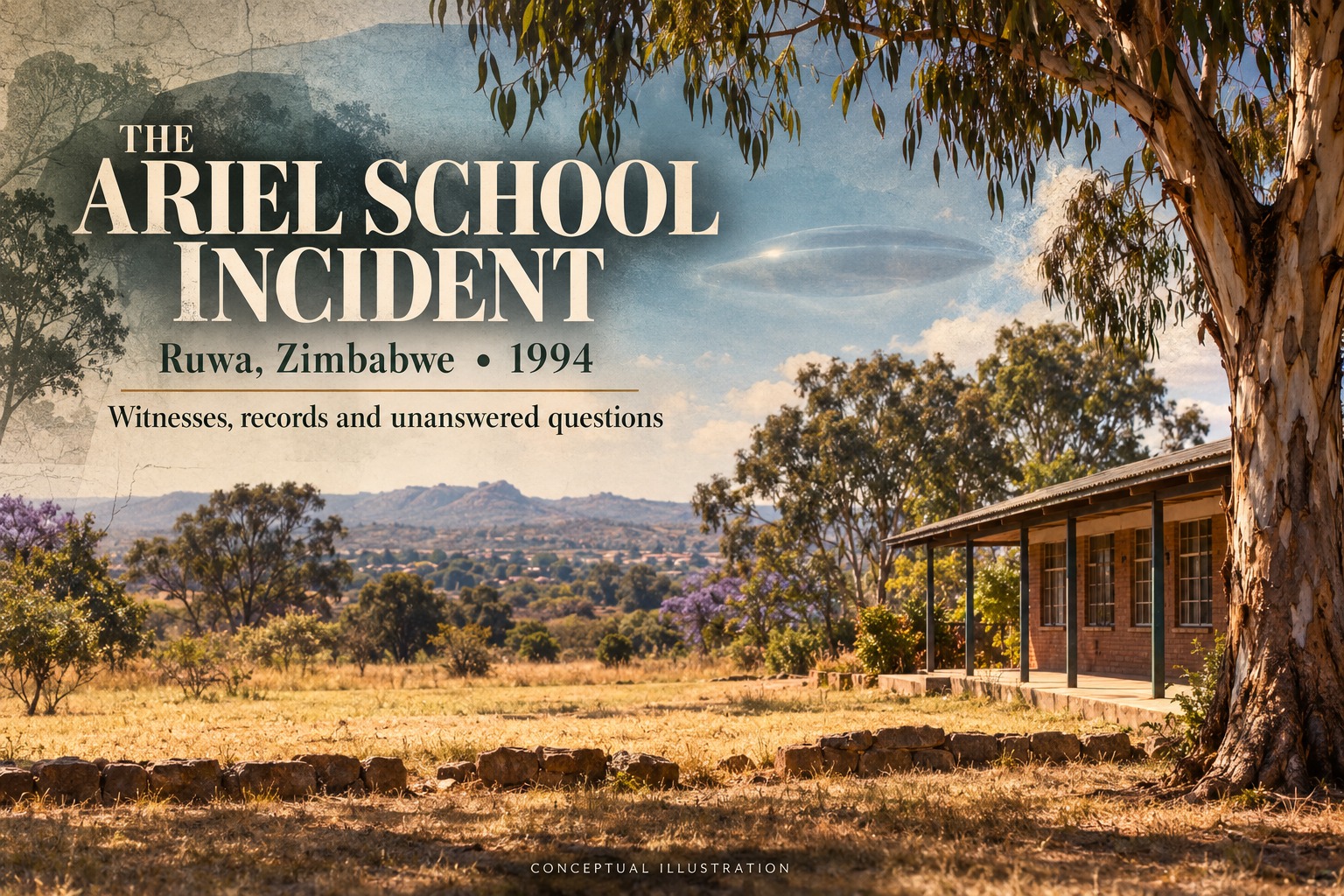
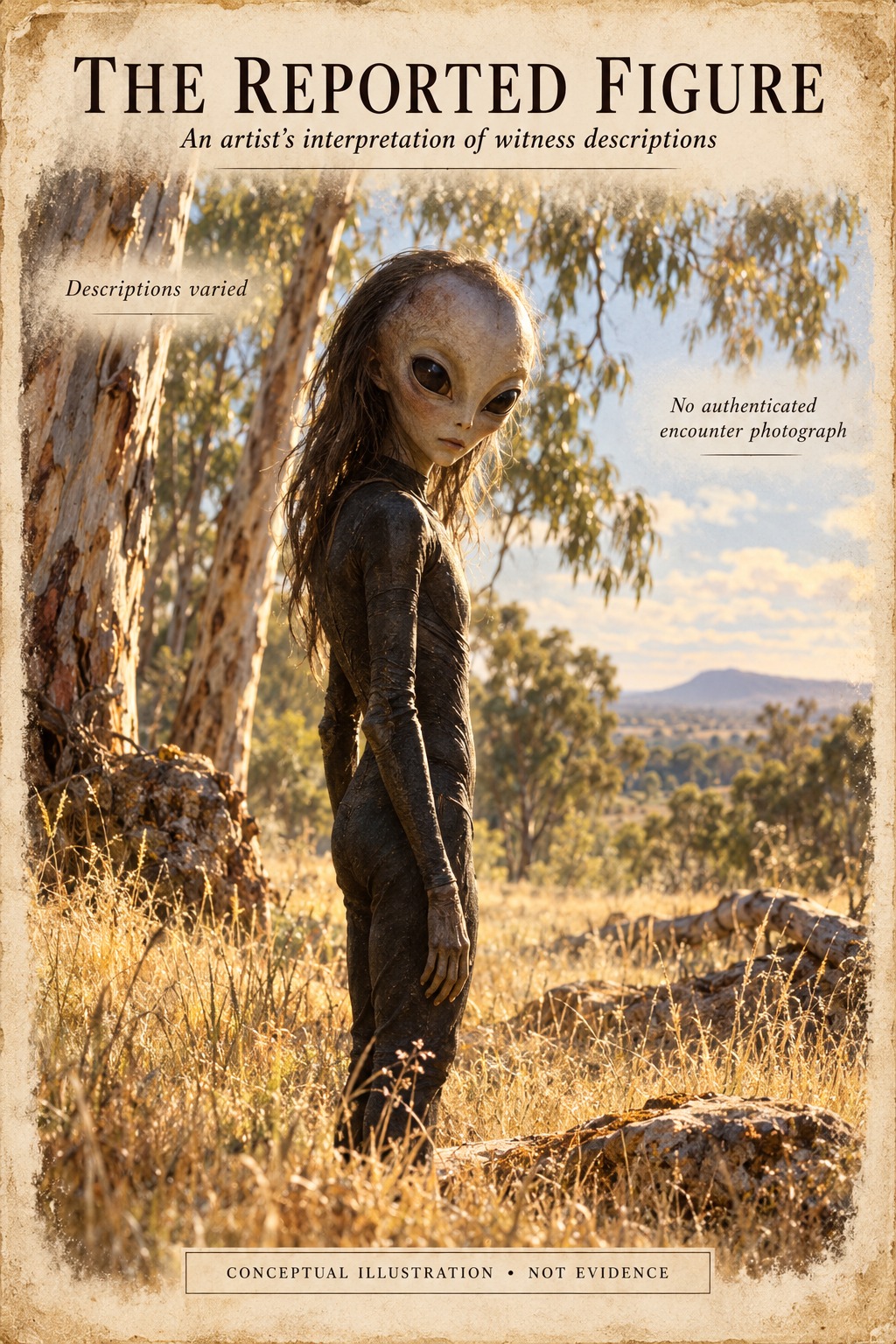
There is no authenticated photograph of an extraterrestrial visitor from this encounter in the material reviewed for this article. The illustrations below are expressly conceptual. They help readers follow the setting and the reported descriptions; they do not add evidence to the case.
How to read this investigation
1. The Ariel School incident: a Friday morning in Ruwa
The date is one of the least controversial parts of the story. The disputed encounter belongs to Friday, 16 September 1994, during the morning break. Ruwa is near Harare, Zimbabwe’s capital. The setting was a functioning school community, rather than an isolated expedition or an anonymous roadside report. That matters because classmates, teachers and families created an immediate social setting around whatever prompted the children’s attention.
Put yourself at the edge of a busy playground. Children are moving, talking and looking in different directions. A cry from one group draws another group towards it. Someone has a clear view between trees; someone else sees only the backs of older pupils. An experience in such a setting can be shared without being identical. This is a reconstruction of the observational problem, not a claim to know each child’s position.
A shared setting, different views
The school setting gives the case both its strength and its difficulty. There were people available to report an unusual disturbance, and a community through which accounts could be gathered. At the same time, a playground is an environment where information moves quickly. What a pupil personally saw and what a pupil immediately heard from a friend need to be distinguished, even if both were remembered as part of one alarming morning.
A careful account therefore starts with a modest proposition: something led a group of pupils to make unusual reports. It should not begin by assuming either a landing or a coordinated deception. Those are explanations to investigate. The historical starting point is the reporting episode itself.
2. The rough ground beyond the playground
Hind’s early writing places the focus beyond the playing area, in vegetation and uneven ground. Her December 1994 report describes uncertainty about whether the reported object touched down or remained above the surface. It also records a subsequent search that produced neither an instrument response nor a discovered impression in the foliage. These are important qualifications in a report written by an investigator sympathetic to the case. Read the reproduced December report and its original-document references.
The words “landed near the school” can turn into a much more definite scene in the reader’s imagination: an unobstructed silver disc, a clear perimeter, figures standing in open view. A report involving scrubland is less straightforward. Vegetation can hide parts of an object, interrupt a person’s movement or make different observers assemble different shapes from partial views.
Reconstructing the sightlines
None of that proves a misidentification. It defines the questions a reconstruction would have to answer. Which trees stood there in 1994? How tall was the undergrowth? Where did each pupil stand? Was the sun in front of the observers or behind them? A present-day photograph cannot automatically answer those historical questions, because both vegetation and the built environment can change.
The location should therefore be treated as evidence with a history. A later visit can establish where a witness now identifies the scene. Establishing the original sightline requires additional support. Readers should be especially cautious when an online diagram presents precise distances or positions without identifying the survey, photograph or statement from which they were obtained.
3. What does the number sixty-two actually mean?
Sixty-two has become the signature number of the Ariel School incident. The December report uses that figure; other sources describe approximately sixty or more than sixty children. The difference is not a reason to dismiss the case. It is a reason to ask what is being counted: pupils present, pupils who reported something, pupils interviewed, or pupils whose recorded statements remain available.
Those categories can overlap without being interchangeable. A child who saw a light does not automatically become a witness to a figure. A pupil who arrived after others began shouting may have an important account of the response, even if that pupil missed the stimulus. Someone who appears in a later documentary is not necessarily representative of every child in the original group.
Imagine a hypothetical school incident involving fifty observers. Ten see its beginning, thirty turn towards it midway and ten arrive at the end. “Fifty witnesses” could be correct as a broad description while still concealing substantial differences in what those people can corroborate. That example illustrates a counting problem; it is not a substitute roster for Ariel.
The useful question is not whether a large number sounds impressive. It is whether the available record allows an investigator to connect individual observations, times and locations. A reliable witness register would make the case easier to analyse. Without one, the headline total should remain a reported group count, rather than a statistical demonstration of sixty-two independent confirmations.
4. Objects first, interpretations second
A description can move through several stages in a single sentence. A child notices something bright; interprets it as an object; decides it is a machine; calls it a spacecraft. A listener may remember only the last word. For historical investigation, the intermediate stages are valuable because they show which parts of an account are sensory description and which parts are interpretation.
That distinction does not belong exclusively to sceptics. A supporter seeking the strongest version of the case should want the original colour, apparent shape, direction and duration preserved. Those observations are more useful than an investigator replacing them with a confident label. If an extraordinary cause is eventually established, it will be established through evidence that survives scrutiny, not through the early removal of ambiguity.
The same care applies to apparent movement. “It vanished” might mean a rapid departure, a change in brightness, concealment behind vegetation or an interruption in attention. These possibilities are not equally supported in every account. They simply show why the original wording and the surrounding questions matter more than a polished summary.
Ariel’s enduring appeal comes partly from the combination of reported aerial objects and figures near the ground. That combination is more specific than a distant light. It also increases the number of claims that need checking. Evidence for one component cannot automatically authenticate every other component of a composite story.
5. Where were the adults?
Hind’s February 1995 account says the teachers were in a staff meeting. It describes children seeking help from Alyson Kirkman at the tuckshop and records Kirkman’s reluctance to leave the shop. This is an account of the school’s response, not an adult confirmation of a craft or visitor. The distinction is fundamental: hearing frightened or excited children is different from seeing what frightened or excited them. See Hind’s original newsletter scan, especially the Ariel report beginning on printed page 19.
It is tempting to make the adults’ absence from the alleged encounter do too much work. One argument says it is suspicious that children saw something and adults did not. Another says the adults’ failure to look explains everything about the absence of adult confirmation. Neither argument settles what the pupils saw.
A witness is useful only to the extent that the witness had an opportunity to observe. An adult indoors cannot contradict a brief outdoor observation merely by having been nearby. Conversely, being nearby does not turn that adult into an eyewitness. The reasonable response is to document availability and sightlines, rather than award authority according to age alone.
The school’s institutional reaction also needs its own evidence. A headteacher’s belief in pupils’ sincerity can tell us about the relationship between children and staff. It does not identify an external cause. A staff member’s initial disbelief has the same limitation in the opposite direction. Both reactions belong to the story; neither replaces observation.
6. The first days: from a playground report to a recorded case
The Ariel account did not enter the public record through a photograph of the alleged event. It entered through people speaking, adults investigating and cameras recording the aftermath. That is a different evidentiary pathway. Its value depends on how early the accounts were preserved, how the interviews were conducted and how much of the original context remains available.
BBC correspondent Tim Leach became involved in reporting the case. Later films draw on this early reporting, while the BBC itself returned to the story in a 2021 retrospective. A report recorded near the time of an event can preserve details that later recollection cannot recreate. It can also preserve the assumptions of the interviewer and the social situation around the interview. The BBC’s retrospective presents the schoolchildren’s story and later testimony.
Why the interview date matters
“Near the time” is still not “during the event.” Once schoolmates have spoken, families have asked questions and an unusual story has become a topic of conversation, there is already a reporting history. The existence of that history does not erase the original observation. It means the observation reaches us through a sequence that should be reconstructed rather than ignored.
This is why an interview date belongs beside a quotation. A statement made on the following Monday and a statement made thirty years later can both be sincere and historically important. They answer different questions. The first is closer to the initial experience; the second can reveal what that experience came to mean in a person’s life.
7. Cynthia Hind: the local investigator who preserved the case
Cynthia Hind was already investigating UFO reports in southern Africa. Her role at Ariel was not incidental: she visited the school, gathered descriptions and drawings, and published accounts that remain central to the case’s documentary history. Her December report dates her visit to 20 September 1994 and says she interviewed roughly ten or twelve older pupils.
The enduring value of such a field report is not that its author can resolve every uncertainty. It is that readers can inspect what the author recorded, including qualifications that might disappear from later retellings. A sympathetic investigator can preserve evidence against an oversimplified extraordinary narrative. A critical investigator can preserve evidence against an oversimplified dismissal. The record is stronger when neither side edits away inconvenient details.
Hind should therefore be read as a participant in the investigation, with access and commitments, rather than as an impersonal laboratory instrument. Her credibility assessments are judgments. Descriptions of the work preserve investigative activity. Proposed origins belong to another category again.
Keeping those categories separate allows readers to recognise her contribution without being required to adopt every conclusion. It also avoids a common mistake in UFO debates: treating an investigator’s enthusiasm as if it automatically invalidated every observation that investigator preserved. The answer to bias is examination of methods and records, not a shortcut based on personality.
8. The Ariel School drawings and their selection history
The December report says the school had approximately thirty to forty drawings and that Hind obtained twenty-two photocopies selected from clearer examples. That is a useful provenance detail. A set chosen for clarity should not be described as an unfiltered collection of every drawing made by every pupil.
Selection does not mean manipulation. It means selection. Someone preparing a television segment or report naturally prefers an image viewers can understand. But an investigator studying agreement and variation needs the unclear, awkward and apparently irrelevant drawings too. Those may reveal uncertainty, a different viewpoint or a child who saw much less than the headline narrative suggests.
A drawing can be both a witness record and an act of explanation. Children have to convert a remembered scene into lines on paper. They may indicate movement with repeated shapes, exaggerate a striking feature or draw an object larger than its apparent size because it is the subject of the picture. Without the child’s accompanying explanation, a reader can mistake a drawing convention for a physical claim.
The right approach is to preserve image, date, instructions and explanation together. A dramatic collage of similar drawings can be persuasive while still being analytically incomplete. A useful archive would allow comparison across the whole collection and would state which images were made before interviews, which were made during them and which were produced in later years.
9. The ground search and the evidence it did not find
Hind’s account of the search is sometimes overshadowed by the reported figures. It should not be. The reported absence of instrument responses and a landing impression matters because it limits the case’s physical support. It is not evidence of recovered material, measured radiation or a tested biological specimen.
A negative search result can be interpreted only in relation to the search. What instruments were used? How sensitive were they? Where were measurements taken? How long after the alleged event? Were control measurements recorded? A narrative that says equipment found nothing is useful, but it is not equivalent to a complete instrument log with calibration records and a mapped survey.
What a negative search can establish
Equally, a claim that an object hovered cannot become a universal explanation for every missing trace. If a proposed event predicts no measurable residue, lack of residue cannot distinguish it from other scenarios that also predict no residue. That makes witness documentation more important; it does not make physical verification unnecessary.
The honest formulation is narrow. The reviewed early account reports a search without a positive result. It does not demonstrate that every possible trace was absent, and it does not provide a physical finding that identifies an unusual visitor. That balance is less dramatic than either “radiation confirmed” or “the search disproved it,” but it is closer to the record.
10. John Mack arrived after the first investigation
John E. Mack’s involvement gave the Ariel School incident international visibility, but it did not begin the reporting. Hind’s newsletter dates his arrival in Harare to 28 November 1994. The distinction is worth making because accounts sometimes collapse the sequence into a single visit immediately after the playground event.
Between September and the later interviews lay weeks of conversation, reporting and interpretation. That interval does not make later interviews worthless. It means they must be read as later interviews. They can preserve the witnesses’ accounts at that point, including thoughts they had not previously articulated. They cannot retroactively become recordings made before any discussion occurred.
Mack’s professional background also needs precise handling. He was a psychiatrist associated with Harvard Medical School, not a spacecraft engineer dispatched by the university to authenticate a landing. His involvement brought experience in listening to unusual and distressing accounts. It did not provide an instrument capable of independently identifying what had stood or moved beyond the playground.
A fair assessment can respect the importance of his attention to the children while recognising that professional confidence and external verification are different forms of support. The question is not whether Mack was entitled to investigate. It is which conclusions his interviews could establish, and which conclusions required evidence beyond an interview room.
11. Dominique Callimanopulos and the published account
A particularly useful participant source is Dominique Callimanopulos’s 1995 essay. She describes interviewing twelve children with Mack over two days and reports accounts involving objects, unusual figures and environmental concerns. She also places the visit within a broader programme studying extraordinary experiences across cultures. This gives readers both an account of the work and a view of its interpretive framework. Read her original participant essay, republished by the John E. Mack Institute.
A participant account has an advantage over a distant retelling: its author took part in the activity being described. It also has limits. It is a selected presentation, composed for publication, rather than a complete log of everything said by everyone present. The surrounding framework helps readers understand why certain observations or meanings received attention.
This is not an argument for discarding interpretation. Every investigation makes choices about what to ask and how to organise information. It is an argument for making those choices visible. A reader can then distinguish a child’s reported observation from an investigator’s larger argument about human experience, culture or the nature of reality.
In Ariel, that separation is especially useful because the later discussion became much broader than an unusual object near a school. Questions about consciousness and the environment entered the public story. Those themes may matter deeply to participants. Their presence does not by itself establish a physical mechanism or a source beyond Earth.
12. The environmental message
Among the most memorable elements of the later record are reports that the encounter conveyed concern about damage to Earth. Callimanopulos’s essay presents this through particular children’s accounts, including a pupil identified with a pseudonym and another called Isabelle. It should not be generalised into a statement that every reported witness received an identical message.
There are several separate questions here. Did a child describe a thought or feeling? When was that description first recorded? What question immediately preceded it? Did the child attribute the thought to the figure at the time, or explain that attribution later? Each answer would help clarify the report without requiring the reader to prejudge whether communication occurred.
A message can be emotionally compelling and difficult to test at the same time. Environmental destruction is an important human concern regardless of the Ariel case. The validity of that concern does not establish the identity of a messenger. Conversely, uncertainty about a messenger does not make concern for the environment foolish or insincere.
Reports of telepathy present an additional evidentiary challenge: they do not leave an ordinary shared audio recording. An investigator can document what an individual reports experiencing. Establishing that information was transferred from an external intelligence requires a further test. It is essential to distinguish documentation of a claimed experience from experimental confirmation of the proposed process.
13. Were the Ariel School interviews leading?
This is one of the central methodological questions in the Ariel debate. A question such as “What happened next?” invites a different kind of response from “What do you think the visitor wanted to tell you?” The second introduces both a visitor and an intention. It may explore a witness’s interpretation, but it should not be confused with an unprompted sensory description.
Research on interviewing children provides a relevant general principle. The NICHD has described methods that emphasise open-ended recall, permission to say “I don’t know” and encouragement to correct an interviewer. That work concerns child-witness interviewing in other contexts; it is not a study that tested Ariel or diagnosed its pupils. See the NICHD explanation of research-based interviewing techniques.
Applying that principle to a historical clip requires care. A short excerpt may omit earlier open questions. An apparently spontaneous answer may follow an omitted prompt. A responsible analysis therefore examines the sequence rather than treating a striking sentence as the whole interview. Where the sequence is unavailable, the uncertainty should be stated.
The presence of a leading question does not prove the entire experience was fabricated. The absence of an obviously leading question in a selected clip does not prove the whole process was immune to influence. Interview quality is a feature of the evidentiary record, not a personality verdict on either the child or the adult.
14. Harvard, academic freedom and an often-misused outcome
Mack’s wider work became the subject of a Harvard Medical School inquiry. Contemporary reporting in The Harvard Crimson says the school decided not to censure him, reaffirmed his academic freedom and also stressed academic standards. That was an institutional outcome concerning his work and professional position. It was not Harvard’s scientific certification of an extraterrestrial encounter at Ariel. Read the 4 August 1995 report.
Institutional language is easy to overstate. “Allowed to investigate,” “not disciplined,” “endorsed by colleagues” and “proved correct” are different claims. An institution can defend a scholar’s freedom to pursue a controversial question while leaving the scholar’s conclusions disputed. That distinction protects meaningful inquiry as well as accurate reporting.
The reverse error is to describe controversy as if it were disqualification. A disputed research programme is not automatically fraudulent or worthless. The relevant questions remain public and specific: what evidence was gathered, how it was gathered and what inferences it supports. Neither a prestigious affiliation nor criticism of that affiliation should be allowed to do the evidentiary work.
For readers encountering Ariel through a brief video, this is a useful safeguard. A title card that mentions Harvard can supply biographical context. It cannot transform a witness interview into a controlled experiment or establish a visitor’s origin. The substance of the case remains in the records, regardless of the institution named beside the interviewer.
15. What did the alleged figures look like?
Descriptions in the published record include small stature, dark clothing and conspicuous eyes. Some descriptions include hair or elongated features. They should be presented as reported characteristics, with variation, rather than combined into a single anatomically precise portrait. Hind’s July follow-up also records a pupil who was unsure whether a dark feature was a person at all. The reproduced July report preserves that hesitation alongside stronger descriptions.
An illustrator has to make choices a witness may never have made. Where does a shadow end? What shape is the unseen side of a head? How should a moving form be frozen into a pose? The finished image can look more definite than the underlying description because pictures require edges. That is why conceptual artwork needs a visible label, not merely a disclaimer hidden elsewhere.
Reading the conceptual portrait
The illustration in this article is an interpretation of reported motifs. It is not a recovered photograph, an official forensic reconstruction or a reproduction of an individual pupil’s drawing. It should not be circulated as though it settled the case. Its purpose is to show what the discussion concerns while keeping its evidentiary status obvious.
The most interesting question is less cinematic than “What did the alien really look like?” It is: which features were described by which observers, at what distance and in which early records? An archive that answered those questions would be more valuable than an increasingly polished generic image of a visitor.
16. Similarity without forced uniformity
A group encounter need not produce identical statements to be real. People attend to different things and have different vocabularies. But variation should not be celebrated indiscriminately either. If two accounts make incompatible claims about a central feature, that discrepancy deserves investigation. The appropriate response depends on the kind of difference.
Consider three hypothetical discrepancies. One observer calls an object silver while another calls it bright. Those descriptions might be compatible. One says a figure was beside a tree while another says there were two figures at opposite ends of the clearing. That may require a time sequence. One says nothing moved while another describes continuous motion across the same uninterrupted view. That is a more substantial conflict.
These examples illustrate a way of reading testimony; they are not additional Ariel statements. The method avoids the habit of counting every similarity as confirmation and every difference as trivial. It also avoids the opposite habit of treating any variation as proof that nothing happened.
For Ariel, the strongest future presentation would preserve differences at witness level. It would allow a reader to see the common core without being handed a composite scene assembled from whichever detail is most vivid in each account. Such a scene might be memorable, but it could describe something no individual ever reported seeing in full.
17. The children who were less certain
Uncertainty is often lost when a case becomes famous. A child who says “I couldn’t see” or “I’m not sure” contributes something important: a limit. That limit can help establish viewing conditions, the distribution of observers and the point at which interpretation begins. It should not be treated as an embarrassing interruption in an otherwise impressive story.
Hind’s follow-up is useful here because it includes hesitation about one apparent figure. The significance is not that this single uncertainty explains every other account. It is that a sympathetic investigator preserved a less definite observation. A responsible long-form account should do the same rather than present all witnesses as equally certain about every detail.
Non-witnesses matter too. A pupil at the same school who did not see an unusual object might have been indoors, facing away or elsewhere on the grounds. Such a pupil might also be able to describe how quickly the story spread. The absence of an observation becomes informative when the opportunity to observe is known.
A useful historical interview would ask separately about seeing, hearing and later learning. Those are ordinary distinctions, but they become powerful when applied consistently. They make room for pupils whose experience does not fit the most familiar version and reduce the pressure to turn a varied school community into one collective voice.
18. Fear, curiosity and sincerity
The emotional quality of the Ariel testimony is a major reason people find it persuasive. A child’s expression, a pause or an adult witness’s account of continuing distress can communicate something that a written summary cannot. It is reasonable to take those reactions seriously. It is not reasonable to assume that an emotion identifies its external cause.
Fear can accompany a correctly identified danger, an ambiguous stimulus or something learned from another person. Curiosity can coexist with fear. A calm account can be accurate, and a distressed account can contain mistakes. These possibilities do not tell us which explanation applies at Ariel; they show why sincerity and accuracy should be evaluated separately.
There is also an ethical reason to keep them separate. A reader should not have to choose between believing an extraterrestrial explanation and accusing a witness of lying. A person can describe an experience honestly while its mechanism remains uncertain. That middle position allows respectful questioning without pretending that all interpretations have been verified.
The most humane investigation is not automatically the most credulous. It listens without ridicule, preserves the account faithfully and states the limits of what it can establish. That approach gives witnesses a place in the record while leaving room for evidence that may complicate everyone’s preferred explanation.
19. Memory across the decades
When a former pupil returns to a school decades later, two histories meet: the event as remembered and the life lived since it. An adult can explain consequences a child could not have articulated. The adult can also have encountered documentaries, discussions and other witnesses’ accounts. Neither fact cancels the other.
For an investigator, the practical task is comparison. Which elements appear in the earliest available account? Do they remain stable or become more specific? Are some details newly mentioned? A new detail should not automatically be labelled invented; earlier interviewers may never have asked about it. But it should be dated rather than silently inserted into a reconstruction of the original report.
A long interval is particularly important when an account contains an interpretation. An adult may now understand a childhood feeling as communication, a warning or an encounter with an intelligence. That understanding is part of the person’s present testimony. Establishing when the interpretation arose is a separate historical question.
Ariel’s later witnesses deserve to be heard as adults with their own views, not frozen permanently as children in a famous clip. At the same time, the adult interview should not replace the early record. The value lies in being able to read the two together, with their dates intact.
20. Randall Nickerson’s Ariel School investigation
Randall Nickerson’s Ariel Phenomenon brought sustained attention to the former pupils and the material surrounding their case. In his director’s statement, Nickerson describes travelling to Zimbabwe and elsewhere to interview members of the school community. He also explicitly acknowledges that he does not know what happened that day. That combination—commitment to the witnesses and an unresolved cause—is important to preserve. Read Nickerson’s own statement.
The film’s production account describes work with archival material and follows Emily Trim’s return to Zimbabwe. Its focus is not simply an object in the sky. It is what an extraordinary reported experience can do to a person’s relationships, confidence and willingness to speak. That is a legitimate documentary subject even when the cause of the reported experience remains disputed. The filmmakers explain the project and its archive.
A documentary can contribute new interviews, retrieve overlooked material and make an archive accessible to a public audience. It is still a constructed presentation. Editing, music, juxtaposition and selection create a narrative. Recognising that process is not an accusation against a filmmaker; it is part of understanding the form.
For a researcher, the ideal relationship between film and archive is complementary. The film introduces people and questions. The underlying records allow detailed checking. A moving sequence can encourage someone to investigate, but a viewer should not have to infer that every omitted witness agreed or that every available recording was shown.
21. Watch: the official Ariel Phenomenon trailer
The following trailer is published on the documentary’s own YouTube channel and is also embedded on its official website. It offers a short introduction to the film’s subjects and tone. It contains selected material from the documentary, rather than continuous footage of the alleged playground event.
Source: Ariel Phenomenon’s official trailer. Video and preview image belong to the original creator. The recording documents testimony and the film’s presentation; it is not an authenticated recording of a craft arriving at the school.
When watching, pay attention to the transition between childhood interviews and adult recollections. The visual continuity can feel immediate, although the recordings belong to different dates. A useful question after any excerpt is whether you have heard the witness’s complete answer and the question that introduced it.
There is no need to distrust a trailer simply because it is a trailer. Its purpose is to introduce a film. It becomes misleading only if a viewer is encouraged to treat a few selected minutes as a substitute for the complete evidentiary record. The article’s source notes provide a route beyond the promotional presentation.
22. James Fox and The Phenomenon
James Fox’s The Phenomenon, released in 2020, also helped introduce Ariel to a wider audience through its treatment of UFO history and witness testimony. It is a different film from Nickerson’s Ariel Phenomenon. It is also different from Fox’s Moment of Contact, which concerns the Varginha case in Brazil. These titles are frequently mixed up in online discussion.
The distinction matters because attribution is part of evidence handling. An interview conducted for one production, an archival clip licensed to another and a later podcast conversation are not three independent witnesses. They can be three presentations of one witness or one original recording.
Fox’s broader place in this discussion is that of a filmmaker investigating and presenting testimony. Readers can value the persistence involved in finding witnesses while still asking to see the documentation behind a particular claim. The same standard should apply to documentary advocates and documentary critics.
Our Varginha cornerstone investigation examines a separate set of witnesses, medical claims and investigative questions. Comparing the cases can be useful, but evidence does not transfer between them. A persuasive interview about Brazil cannot authenticate an observation in Zimbabwe, any more than uncertainty at Ariel decides what happened at Varginha.
23. Netflix Encounters and the return of the school story
Netflix’s 2023 series Encounters revisited Ariel in the episode Believers. The official series guide identifies it as episode four. This is worth specifying because summaries sometimes place the Zimbabwe story in the wrong episode. The series places the school case alongside other reported encounters, but those stories retain separate evidence and histories. Netflix’s official episode guide gives the programme’s structure.
Television exposure changes a case’s audience. People who have never encountered Hind’s reports may first meet Ariel through a highly produced hour of film. They may then seek older clips, drawings or interviews. That renewed attention can help surface material, but popularity is not itself a scientific finding.
Series descriptions also use confident promotional language. An editorial investigation should not silently adopt that language as its own conclusion. A programme can describe an encounter in vivid terms while the article continues to distinguish what witnesses report from what has been independently established.
The useful question is what a new production adds: a new witness, a previously unseen recording, a contradiction, a recovered document or a clearer account of an old interview. A fresh edit of familiar material may still be valuable storytelling. It should simply be identified as a fresh presentation, rather than automatically treated as newly discovered evidence.
24. The disputed prank account
A later strand of the public debate concerns a former pupil identified as Dallyn, whose account in Encounters attributes the episode to a prank involving a shiny object or rock. Public discussions also point to an earlier interview associated with Nickerson and argue that the two versions conflict. This controversy should be included, but it should not be turned into a verdict on motive based on fragments.
The published overview of the case’s aftermath summarises the competing accounts and provides further references. This article has not independently authenticated a complete, uninterrupted pair of original recordings from both interview dates. Consequently, it does not claim to have resolved exactly how every statement compares or why a witness’s account changed.
A prank explanation is a claim about a causal sequence. It needs to show how the initial action led to particular reports, which pupils saw what and when other details entered the story. A contradictory earlier account would complicate the later explanation. It would not, by itself, prove an extraterrestrial cause.
The same principle works both ways. A confession-like statement can be important evidence, but it is not automatically self-verifying. Investigators should check its chronology and corroboration. Dismissing it because it conflicts with a preferred narrative would be poor method; accepting it as a complete solution without checking would be poor method too.
25. Adult testimony and the right to remain uncertain
The case has become part of the public identities of some former pupils. That can make discussion feel personal. An interviewer asking what happened is also speaking to someone who may have spent years being challenged, mocked or asked to repeat the same story. Those pressures belong in an account of the interviews without being used to decide their factual content.
There should be room for several positions within a former school community. A person may remain convinced. Another may remember an unusual event but reject an extraterrestrial explanation. Another may remember very little or prefer not to discuss it. The public record should not be organised so that only the most certain voices count.
Likewise, continued testimony has a specific evidentiary value. Continued testimony establishes that an account or interpretation persists. That persistence may make a casual, momentary joke less satisfying as an explanation for the individual’s later position. It does not supply an independent measurement of what was present in 1994.
A respectful investigator can ask difficult questions without demanding that a witness surrender ownership of a personal experience. The distinction is between recognising an experience as part of a person’s life and recognising a proposed external explanation as established fact. Keeping that distinction visible allows the discussion to continue without turning every uncertainty into an accusation.
26. The Ariel School incident and the extraterrestrial interpretation
The interpretation that made Ariel famous is that the pupils encountered a craft and non-human visitors. Supporters point to the group setting, striking descriptions and the persistence of testimony. These are reasons to examine the case, but the interpretation makes a larger claim than the reporting episode alone establishes.
To identify an extraterrestrial origin, an investigation would need something that distinguishes that origin from alternatives. An unusual shape or a witness’s inability to recognise a figure does not by itself establish where it came from. Even demonstrating that a scene contained a physical object would leave questions about that object’s nature and origin.
A testable extraordinary explanation should therefore make its expectations explicit. What would a complete set of independent early statements show? Are there physical effects that investigators should expect? Which observations would be difficult to explain if no extraordinary visitor were present? These questions strengthen an argument by making it possible to discover that the argument is wrong.
Calling for that discrimination is not a demand that every historical event come with a laboratory specimen. Historical reasoning often depends on converging records. It is a demand that the strength of the conclusion match the strength and specificity of the evidence. At present, the reviewed Ariel material supports an enduring witness case more directly than it supports an identified extraterrestrial cause.
27. An ordinary stimulus interpreted as something extraordinary
A broad alternative is that an ordinary object, person or visual effect supplied the initial stimulus and that its interpretation changed within the group. This is a family of possibilities, not a single demonstrated explanation. Naming a possible source is the beginning of an investigation, not its conclusion.
A successful reconstruction would need to connect the proposed stimulus to the actual reported circumstances. Could it have been visible from the relevant part of the playground? Would its appearance change through the vegetation? Could it account for the sequence of attention and movement? Is there a contemporaneous record that it was there?
Without those connections, an explanation can become a story as flexible as the one it seeks to replace. It is easy to imagine an ordinary thing that might look unusual somewhere. It is harder to show that this particular thing explains these particular reports at this particular school on this particular morning.
The burden is symmetrical in an important respect. A proponent of a visitor must support the visitor. A proponent of a specific mundane reconstruction must support that reconstruction. The overall uncertainty may justify withholding belief in either. It does not require assigning equal probability to every imaginable possibility.
28. Rumour, shared attention and the limits of a group count
Another explanation focuses on the way a group can develop a shared interpretation. One pupil’s description directs attention. Others look towards an ambiguous area. Questions and repeated descriptions supply a vocabulary. In principle, such a process could produce sincere accounts without a coordinated plan to deceive.
That possibility is often reduced to the phrase “mass hysteria.” The phrase can obscure more than it explains when used without a case-specific account. It does not tell us what prompted the first report, how information moved, which observations were independent or why particular details appeared. Those are the questions an explanation must answer.
The idea is also not a diagnosis of the Ariel pupils. This article has not assessed them clinically, and a historical review of public records cannot legitimately assign a group medical condition. The more useful discussion concerns observable reporting relationships: who heard whom, who spoke together and what was recorded before later conversation.
Supporters sometimes respond that children could not maintain an invented story for decades. But a social-influence explanation need not propose decades of conscious invention. It can propose sincerely held memories. Whether that explanation fits Ariel remains an evidentiary question. Rejecting a crude conspiracy model does not automatically eliminate every ordinary account of shared interpretation.
29. Puppets, performers and the difference between a hypothesis and a finding
A puppetry or performance scenario also appears in the critical literature on Ariel. The appeal of such an explanation is easy to understand: it proposes a physical stimulus capable of looking like an unusual small figure. But plausibility in the abstract is different from documentation that a relevant performance occurred at the right place and time.
Any specific version would need records of participants, transport, location and timing. It would need to explain why an activity near a school did not leave a clearer ordinary trail. It would also need to account for the reported aerial component without quietly abandoning the parts of the case it finds inconvenient.
A defender of the hypothesis can reasonably ask for it to be considered. A defender cannot reasonably describe it as established merely because puppets exist and children can misinterpret them. The same evidentiary discipline applies to claims about gardeners, aircraft, balloons or unusual vehicles.
For now, this article treats such scenarios as proposed reconstructions, rather than solved identities. The useful next step is not to make a more vivid animation. It is to find a dated, checkable record connecting a proposed stimulus to the school’s actual surroundings. Without that connection, visual resemblance remains suggestive rather than decisive.
30. The 14 September sky event was a separate episode
Two days before the school reports, a widely seen night-sky display occurred over southern Africa. An analysis hosted in the SeeSat archive identifies that display with the re-entry of the Kosmos-2290 rocket body, catalogue designation 1994-053B. Its date and circumstances distinguish it from the Friday morning playground reports. Read the documented re-entry analysis.
That distinction prevents two opposite errors. Footage or descriptions of the Wednesday night display should not be presented as footage of the alleged Ariel encounter. Equally, identifying a Wednesday night stimulus does not directly identify something children reported on Friday morning. The events occupy different times and observational settings.
There is a possible contextual connection: public discussion of unusual lights could affect expectations. Establishing that influence at Ariel would require evidence of what particular pupils heard or saw before the school report. A general atmosphere of interest is not the same as proof that it caused a specific account.
The re-entry episode is therefore useful as context and as a warning about merging stories. A newspaper’s UFO coverage can place distinct reports under one headline. A historical investigation should separate them again. Otherwise, evidence that explains one observation can be mistakenly used either to confirm or dismiss another.
Two additional witness perspectives
The documentary’s official channel makes additional interview material available outside the main trailer. Two examples are embedded below. They are useful because they show why a case should be read through individual accounts. A former pupil discusses a reported observation; a teacher discusses the children and her assessment of them. Their roles should remain distinct.
Both source pages were checked, and their publicly available YouTube captions were reviewed for this article. Those captions are automatically generated and contain transcription errors, including names and ordinary words. They are useful for locating passages, not a substitute for checking the recording before quoting exact language. No uncertain caption wording is treated here as a precise technical measurement.
Dallyn’s interview, labelled 2008 by the uploader
In the clip published by Ariel Phenomenon, Dallyn describes coloured lights and an experience he could not explain. Importantly, he distinguishes this from seeing beings, which he says he did not see. He also describes coming towards the group after hearing from other children and qualifies his estimate of how much time had passed. Those distinctions make his account more specific than a blanket statement that every pupil saw the same scene.
Source: Ariel Phenomenon’s upload of Dallyn’s interview, labelled 2008. The channel presents the clip in response to the later Encounters controversy. That framing is the uploader’s; it should be distinguished from the interview’s contents. This is a published extract, not an independently authenticated continuous master of every interview.
The significant point is not simply that a later account appears different. It is that this extract contains useful boundaries: what the speaker claims to have observed, what he says he did not observe and what he regards as uncertain. A reconstruction should preserve all three. Selecting only the most dramatic passage would remove information that helps an investigator understand his role.
Where observation and interpretation separate
His mention of discussion with a friend also belongs in the record. It shows that the interview occurs within a history of conversation, rather than in isolation from everyone else. That is neither an admission of deception nor a guarantee of corroboration. It is a relationship an investigator should document when assessing independence.
The apparent speed of intermittent lights is another point requiring restraint. A witness can report flashes at different positions without providing a timed, calibrated trajectory. Turning that account into a numerical velocity would require assumptions about distance, elapsed time and whether each flash represented the same object. This article makes no such calculation.
A teacher’s recollection of the children’s response
The second clip is identified by the same official channel as an interview with a teacher initially sceptical of the story. She describes the children as excited and noisy after the break and explains that the consistency of what they told her changed her assessment. Her testimony concerns the aftermath and her judgment of the pupils; she is not presented as someone who personally watched a craft and figures outside.
Source: Skeptical Ariel School Teacher — additional content from Ariel Phenomenon. Video and preview image belong to the original creator. The excerpt does not establish an independently verified interview date, and no uncertain name from the automatic captions is assigned to the speaker.
A witness to the aftermath
This is a valuable form of corroboration when described accurately. A teacher can provide context about a classroom community and about how an account was received. The teacher can also explain why she found particular reports persuasive. That helps establish the history of the case without turning her judgment into an additional direct sighting.
Notice how different the evidentiary questions are. For the pupil’s account, an investigator asks about the observation, position and sequence. For the teacher’s account, the questions concern when she heard the reports, which pupils she spoke to and what she regarded as consistent. Both interviews deserve attention, but adding them together as two equivalent encounter witnesses would misrepresent them.
Together, these clips make the public record more interesting, rather than simpler. They show a case containing limits, judgments and changes of perspective. A long investigation should make those features accessible to readers. It should not edit every interview into the same conclusion merely because the underlying event has acquired a familiar name.
31. Is there a photograph or video of the alleged encounter?
The distinction between encounter footage and interview footage is crucial. A film can contain genuine recordings of children describing an event without containing a recording of that event. An authentic interview establishes that a statement was made on camera. It does not automatically authenticate the object or figure described in the statement.
No authenticated encounter photograph identifying a non-human visitor was found in the sources reviewed for this investigation. That statement concerns the reviewed record. It should not be inflated into a claim that every private collection has been searched, nor weakened into an insinuation that a decisive photograph must exist somewhere undisclosed.
When a dramatic image circulates with the name Ariel attached, ask for its provenance. Who made it? When was it first published? Is the original file or physical negative available? Does it depict the school, a witness drawing, a reconstruction or an unrelated UFO story? A caption can travel farther than the explanation that originally accompanied it.
AI-assisted artwork makes that problem more urgent. A beautiful conceptual image may be appropriate in a magazine investigation, provided its status is visible. Once detached from its caption, it can acquire a false documentary life. The images in this article carry explicit conceptual labels, and the captions repeat that qualification so the distinction does not depend on one introductory warning.
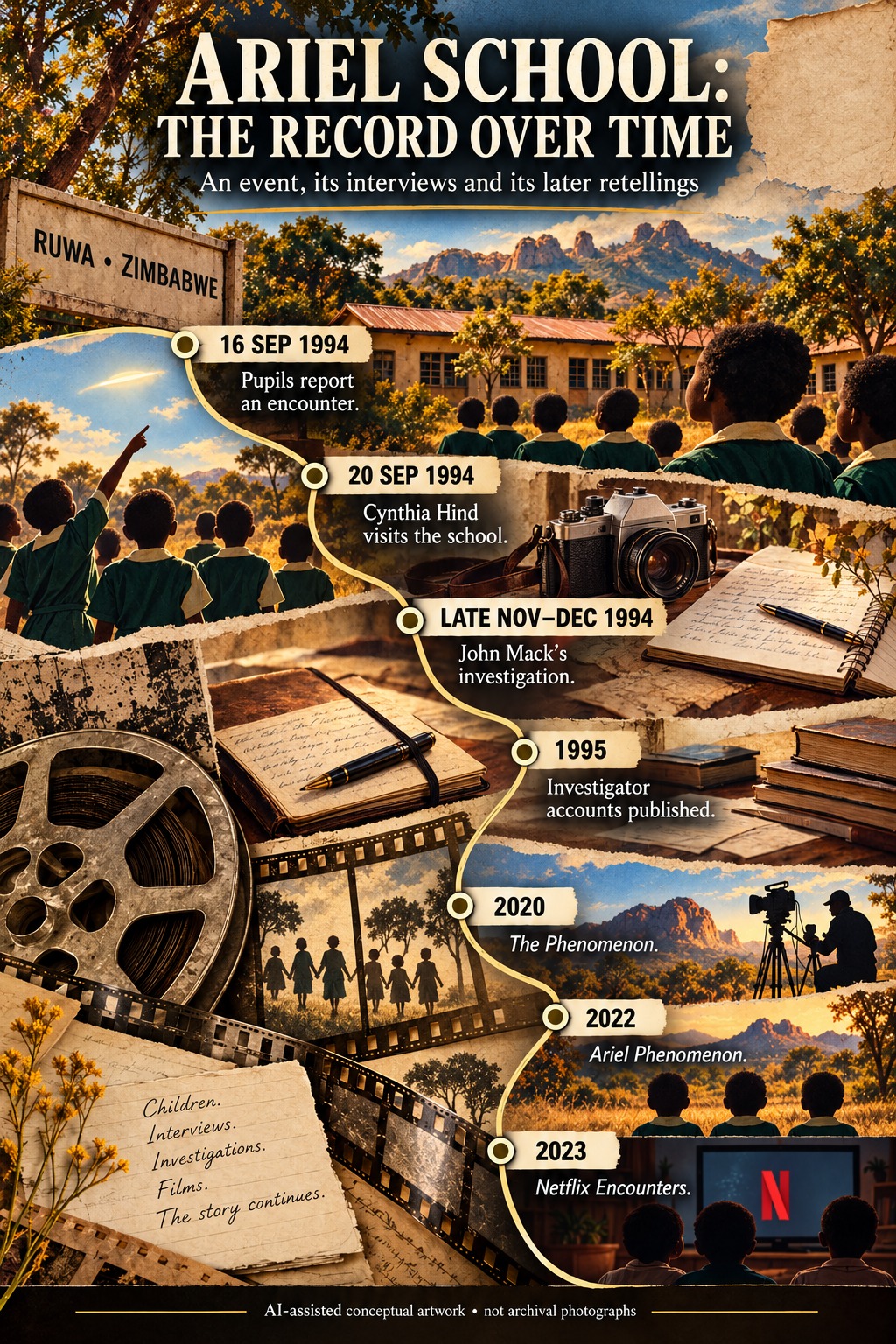
32. A chronology that keeps the layers apart
The broad sequence is more informative than a seamless dramatic retelling. First comes the reported school event in September. Next come the early interviews, drawings and local investigation. Mack’s involvement follows later that year. Published investigator accounts appear in the following period. Decades later, filmmakers and journalists return to witnesses who have grown into adults.
Each stage can add information, but each stage also belongs to a different date. A later interviewer may ask a question that an earlier interviewer never considered. Published accounts may summarise several visits, while a documentary can intercut records separated by years. The viewer needs those dates to understand what kind of evidence is being presented.
There are three dates worth recording for any item: the date of the event it describes, the date the statement or image was made, and the date it was published. They are often different. An upload marked 2023 might contain an interview labelled 2008 about an event in 1994. Confusing those dates can create a false impression of either contemporaneity or novelty.
The timeline infographic above is designed around that separation. It marks the principal phases rather than suggesting that one continuous camera followed the case from the playground to the present. Chronology is a way of organising evidence. It is not a proof of the cause that any participant ultimately favoured.
33. What would independent corroboration look like?
Independence is more demanding than a different face on screen. Two witnesses can be different people while their descriptions have influenced each other. Two publications can have different publishers while reproducing the same interview. A large collection becomes stronger when its information pathways are visible.
For Ariel, useful corroboration would include separately recorded early accounts, an adult observation from a relevant sightline, a dated image tied to the event or a physical finding with a documented collection history. These are examples of potentially discriminating evidence, not claims that such items have been found.
Suppose two pupils independently recorded a distinctive feature before speaking together. That would be more informative than discovering the same feature in two adult interviews after both had watched a documentary. The latter might still be sincere. It would simply offer a different degree of protection against shared influence.
Likewise, an independent record should corroborate the specific proposition under discussion. A staff member confirming that children were upset supports a report of distress. It does not independently confirm a figure’s anatomy. A photograph showing the school confirms a setting. It does not establish what appeared there. Precision about the proposition prevents evidence from being stretched beyond its reach.

34. What a modern reconstruction could still achieve
A useful reconstruction would begin with the least glamorous work: assembling an archive. Original drawings would be scanned with their backs and margins. Tapes would be digitised without removing pauses or questions. Publication versions would be linked to the recordings they used. Dates and uncertain dates would be distinguished rather than silently standardised.
Next would come a witness-by-witness chronology. That would record where each person says they stood, what they personally observed and when the account was first preserved. Unknown positions would remain unknown. A map containing honest blanks is more useful than one filled with invented precision.
The physical setting could then be studied through dated photographs, plans and other surviving records. A present-day site visit might reveal the broad geography while leaving the 1994 vegetation unresolved. A reconstruction should show those limits explicitly. It should not place a fully detailed visitor into a photorealistic scene and call the result a measurement.
Finally, rival explanations could be compared against the same archive. Advocates should not receive one set of statements while critics use another. A shared record would make disagreement more specific: this sightline, this question, this date, this inference. Even if no final identification emerged, that would be a substantial improvement over repeating competing summaries.
35. Why Ariel should not be merged with Roswell or Varginha
CosmicGravity’s Roswell investigation, Varginha investigation and Ariel article share an interest in witnesses and the history of reporting. They do not share one interchangeable evidence base. Each case needs its own chronology, source relationships and assessment.
A comparison can clarify methods. In a debris case, collection history becomes central. Sightlines and early interviews may carry more weight for a reported close encounter. Cases involving medical claims place particular importance on records and qualified testimony. The appropriate test follows the claim rather than the popularity of the story.
It is tempting to argue that several disputed cases together establish what none establishes individually. Sometimes independent evidence can genuinely accumulate. But simply grouping unresolved accounts does not make their unresolved causes identical. The proposed connection itself needs support.
The Global UAP/UFO Case Atlas helps readers explore that diversity. A marker identifies a case or record, not a verified extraterrestrial visit. Ariel belongs in that wider historical conversation while retaining its specific strengths and limitations.
To compare the figures described at Ariel with reports from other places, explore our Alien Encounter Atlas. Its illustrated profiles bring together reported appearances, attributed origins and approximate encounter locations, with a separate source trail for each account.
36. Comparing explanations without invented percentages
Readers often want a probability: how likely is it that the children saw visitors from elsewhere? The accessible record does not justify a precise numerical answer. Assigning a confident percentage would require assumptions about witness independence, error rates and alternative causes that have not been measured for this case.
A more useful comparison asks what each explanation predicts and which parts remain unsupported. The table below is an editorial framework, not a statistical model. It distinguishes a hypothesis’s possible fit from evidence that would be needed to establish it.
| Interpretation | What it tries to explain | What still needs support |
|---|---|---|
| Extraordinary physical encounter | The reported objects and figures | Independent evidence identifying the object, figures and origin |
| Ordinary stimulus, mistaken identification | A real visual prompt interpreted as unusual | A specific stimulus tied to the place, time and reported sequence |
| Shared interpretation and social influence | Agreement and sincere reporting within a group | A documented pathway from initial stimulus to individual accounts |
| A prank or deliberate performance | An intentional trigger followed by a wider response | Corroborated participants, timing, actions and an account of the full sequence |
The table also reveals why “unexplained” is a limited conclusion. It can describe a record for which the cause has not been established. It does not name a new class of visitor. Remaining uncertain is a legitimate outcome when the available evidence cannot discriminate confidently between the competing accounts.
37. What could a future release or discovery change?
A newly available archive could improve the case without containing anything as dramatic as a craft photograph. An unedited interview might clarify the order of a conversation. A dated drawing might establish that a feature was recorded earlier than previously thought. A school document might identify who was present or how the first accounts were collected.
Such findings would need authentication. A scan appearing online with a familiar name is not enough. Its custody, date and relationship to known material should be checked. If an item is incomplete, that should be visible. If a date comes from an uploader rather than the original record, that distinction should travel with it.
A government release would require the same care. A file can show that officials received or discussed a report without establishing that the report’s extraordinary interpretation was correct. Official possession is a fact about the document’s history. It is not automatically a finding about the underlying event.
The strongest update would change a specific evidentiary question. It might establish an earlier independent account or identify a plausible ordinary stimulus with contemporary documentation. Either result would matter. A useful investigation should be capable of being improved by evidence that disappoints the author’s expectations as well as evidence that supports them.
38. How to watch Ariel clips without losing the context
Start by identifying the source and the role of the speaker. A child describing a remembered scene, a teacher recalling the school’s response and a filmmaker explaining an investigation are all valuable voices. They are not performing the same evidentiary function. The caption should make that role clear.
Then look for the question. A response to an open invitation is different from an answer to a detailed proposition. Both can be informative, but the interviewer’s contribution should remain visible. If the clip cuts between question and answer, avoid assuming that nothing significant was removed.
Next, separate three kinds of statement: what the person says they saw, what they felt and what they believe it meant. A witness may move naturally between them. An investigator should not flatten them into one claim. A reported feeling of communication, for example, requires a different test from a reported bright object.
Finally, resist the pressure of presentation. Music, slow motion and a return to a childhood location can make a sequence powerful. They can also encourage a sense of resolution before the evidence has supplied one. You can find a witness moving and credible while still asking what external cause the record establishes.
39. Ariel School incident: frequently asked questions
When and where did the Ariel School incident happen?
The reported event took place on 16 September 1994 at Ariel School near Ruwa, Zimbabwe, during the morning break. The date of a modern upload or documentary is not the date of the alleged encounter. Keeping the event date separate from interview and publication dates is essential when comparing sources.
Did all sixty-two children report exactly the same thing?
The familiar figure is a reported witness count, not proof of sixty-two identical, independently preserved statements. Accounts and drawings contain variation, and the available interview groups were smaller than the headline total. The useful task is to compare individual observations rather than treat the pupils as one perfectly uniform witness.
Did John Mack investigate immediately after the event?
No. His investigation followed the initial September reporting and Hind’s involvement. The later visit is important, but its interviews should not be described as accounts recorded before the children had opportunities to speak with others. Their later date is a feature to document, not a reason to discard them automatically.
Did Harvard prove the children encountered aliens?
No. Mack’s affiliation and the outcome of the institutional inquiry into his wider work do not constitute Harvard verification of an extraterrestrial encounter. A defence of academic freedom is different from scientific confirmation of a particular explanation. The Ariel evidence has to be assessed on its own terms.
Were physical traces found?
The early report reviewed here describes a ground search without positive instrument responses or a discovered landing impression. It does not provide an authenticated recovered craft component or biological sample. The scope and documentation of the search should be considered when interpreting that negative result.
Is the creature image in this article real footage?
No. It is an original AI-assisted conceptual illustration based on broad reported motifs. Descriptions varied, and the illustration makes artistic choices that the record cannot settle. It is labelled in the image and caption so readers can distinguish it from evidence and from the original children’s drawings.
Which James Fox film includes Ariel?
The Phenomenon includes Ariel within a wider treatment of UFO reports. Randall Nickerson’s dedicated documentary is Ariel Phenomenon. Moment of Contact is Fox’s Varginha film. Similar titles and overlapping interview subjects do not make these productions one investigation or one collection of independent evidence.
Has the case been conclusively debunked?
The sources reviewed support several proposed explanations and substantial methodological questions. This article does not identify a fully documented reconstruction that settles every component. That is also not a declaration that an extraterrestrial explanation is established. A disputed or incomplete explanation leaves a question open; it does not decide the answer.
Could the children have been sincere and still mistaken?
Yes. Sincerity concerns whether someone is honestly reporting an experience or memory. Accuracy concerns how that report relates to the external event. The two can diverge without deception. That general possibility does not establish that it happened at Ariel, but it prevents an unhelpful choice between aliens and deliberate lying.
What should a reader examine first?
Begin with the early dated reports, then compare the recorded interviews and the later accounts. Watch the official clips with attention to the questions and edits. Use documentary narratives as routes into the archive, and keep the provenance of images, dates and witness descriptions attached as you move between sources.
40. The case that remains
Ariel deserves better than a slogan. The children’s reports generated a real investigation, recordings and a history that continued into their adult lives. Those records have cultural and historical value regardless of whether a future investigation identifies an extraordinary visitor, an ordinary stimulus or a more complicated sequence of perception and interpretation.
The strongest reason to preserve the case is not that its cause is already obvious. It is that its evidence can still be examined more carefully. Early accounts can be distinguished from later meanings. Witnesses can be heard individually. Drawings can be studied without forcing them into one composite scene. Proposed solutions can be asked to produce documentation.
For now, the defensible conclusion is specific: the Ariel School incident is an important witness case with an unresolved cause in the accessible record reviewed here. An extraterrestrial encounter is one interpretation of that record, not an established finding. A mundane hypothesis likewise needs a demonstrated connection to the event before it can be called the solution.
That position leaves room for curiosity without pretending to possess certainty. It also leaves the people at the centre of the story visible. A schoolyard report became an international argument, but it began with children trying to describe what they thought they had seen. The obligation of a serious investigation is to preserve those descriptions faithfully and ask what the evidence can support.
41. Sources, credits and reporting notes
Source hierarchy: Early investigator publications and participant accounts are used for the history of reporting. Official filmmaker and broadcaster pages establish production context and the identity of supplied clips. Later compilations help locate material and disputes; they are not treated as independent confirmation of the encounter. The interpretation and proposed research framework in this article are CosmicGravity’s editorial analysis.
Primary records and source guides
- Cynthia Hind’s December 1994, February 1995 and July 1995 reports, reproduced with original-document references. A hosted transcription should be checked against scans when exact wording matters.
- UFO Afrinews No. 11, February 1995, Archives for the Unexplained scan. Printed page numbers and PDF image numbers differ.
- Dominique Callimanopulos, Exploring African and Other Alien Encounters, originally published in CenterPiece, Spring/Summer 1995. Participant account, not an independent replication.
- BBC Witness History, The schoolkids who said they saw ‘aliens’, 9 July 2021. Public browser page checked; the automated research fetch was unavailable.
- Randall Nickerson’s director’s statement and official production account.
- John E. Mack Institute’s documentary listings, including the later film and television presentations.
- Netflix’s official Encounters guide, identifying Believers as episode four.
- Andrew L. Wright, Harvard Medical School’s decision concerning Mack, The Harvard Crimson, 4 August 1995.
- September 14 southern African re-entry analysis, hosted in the SeeSat archive. This concerns a separate night-sky event.
- NICHD guidance on research-based child-witness interviews. General methodological context, not a clinical or experimental study of Ariel.
Visual credits and scope
Images: Four original AI-assisted editorial graphics created for CosmicGravity. Landscapes, buildings, figures and archival-style props are conceptual; no actual school survey, documentary encounter photograph or recovered specimen is implied. The timeline separates dates of reporting and later productions. The evidence infographic is an explanatory framework, not a score or measurement.
Video: Embedded through Avada’s YouTube player from the identified source channel. Clips remain subject to the uploader’s availability, regional restrictions and editing choices. A clip labelled with a historical interview date is not necessarily an uninterrupted original master recording.
Last researched: 31 October 2026. Corrections and newly accessible primary records can change the assessment. See our editorial and fact-checking standards, or browse the wider Guides & Atlases collection.


latest video



news via inbox
Subscribe to our Cosmic newsletter to get notified when we have new articles.