
The Varginha Case: Witnesses, James Fox and the Search for Evidence
VARGINHA CASE • COSMICGRAVITY CORNERSTONE INVESTIGATION
The Varginha case begins with three young women, a vacant lot and a description that has refused to disappear: a small, crouching figure with brown skin, a large head and red eyes. From that encounter grew a much larger story about a damaged craft, military captures, hospital examinations, a police officer’s death and an alleged transfer to the United States. Thirty years later, those strands still need to be untangled.
James Fox’s Moment of Contact brought the story to an international audience in 2022. An expanded edition added an extraordinary account from neurosurgeon Ítalo Venturelli. In 2026, witnesses travelled to Washington, a former Brazilian defence minister spoke publicly about the case, and a US congressman sought records from the CIA and FBI. These developments make Varginha worth revisiting carefully, with the witnesses heard in full context and the documentary record close at hand.
This investigation follows the principal publicly available accounts, the military inquiry, the doctors’ different roles, Fox’s filmmaking and the unresolved questions. It does not claim access to every private interview Fox recorded. No authenticated public specimen, clinical image or photograph of the alleged creature was established in the material reviewed for this article. The illustrations below are explicitly labelled reconstructions or explanatory graphics.
Research cut-off: 29 October 2026. The distinction throughout is simple: a record can establish that someone made a statement without establishing that the statement’s explanation is correct.
1. The Varginha case: what happened?
Varginha is a city in the southern part of Minas Gerais, Brazil. Its importance in UFO history rests on events associated with January 1996, especially the reported encounter on 20 January. The three best-known witnesses are Liliane Silva, her sister Valquíria Silva and their friend Kátia Xavier. English-language retellings vary in spelling, and some use Souza where other sources use Sousa for another central witness. Those differences should not create imaginary additional people.
The basic encounter is narrower than the familiar crash-retrieval narrative. The women said they saw an unfamiliar being beside a wall in a vacant lot. They did not say that they watched a spacecraft land beside it. They did not personally follow it through a hospital and onto an American aircraft. The connection between their sighting and those later allegations is the subject of the case, rather than a fact built into their original observation.
One case, several different claims
That separation matters because Varginha is often presented as a single event supported by a single collection of witnesses. In practice, it is a series of different reports. One person describes an object in the sky; another describes vehicles; another recalls a patient; another discusses tissue from a deceased police officer. A persuasive reconstruction would need to show that these accounts intersect in time and place, and that they concern the same objects or individuals.
Calling it “Brazil’s Roswell” conveys its cultural prominence, but it can also smuggle in a ready-made plot: crash, recovery, secrecy, foreign intervention. The nickname is useful as a reference point, not as evidence. Varginha should be examined on its own records, with Brazilian institutions, language and witnesses kept at the centre.
The afternoon encounter
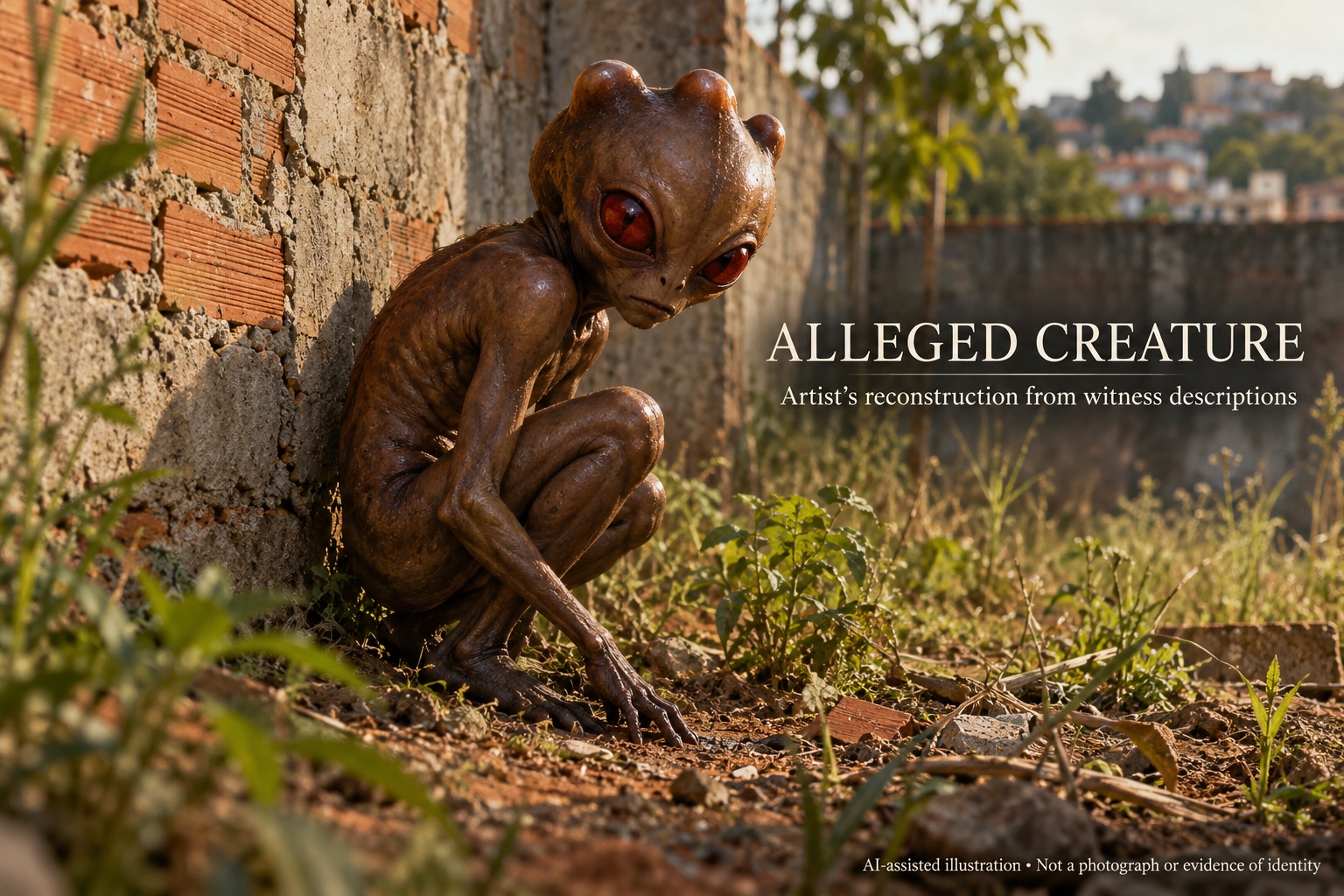
In their public accounts, the women described approaching a figure that appeared unusual and frightening. The recurring features are a crouched posture, brown skin with a wet or oily appearance, an enlarged head, prominent red eyes and three raised features on the head. Later artistic representations turned these into a remarkably consistent visual identity. The underlying descriptions, however, were spoken recollections rather than measurements taken at the scene.
The encounter’s emotional force is easy to understand without inventing a cinematic scene. Someone unexpectedly confronted by an unfamiliar figure may experience fear before forming a settled explanation. The women’s accounts have included the impression that the being was itself frightened or distressed. That impression belongs in the story because it is part of what they remember; it does not independently identify the figure’s biology or origin.
Description before interpretation
There is an important difference between seeing red eyes and proving that eyes emit red light. Likewise, an oily appearance does not establish a chemical secretion, and protrusions do not establish horns. A careful illustration should preserve those distinctions. Small changes in language can turn an observation into a physiological claim that the witness never demonstrated.
The three women remain central because they put their names and faces to an account relatively early. But three people sharing one brief experience are not equivalent to three independently documented encounters. Their agreement is relevant; so are their shared location, conversation and exposure to later reporting. Neither point erases the other.
The first national television report
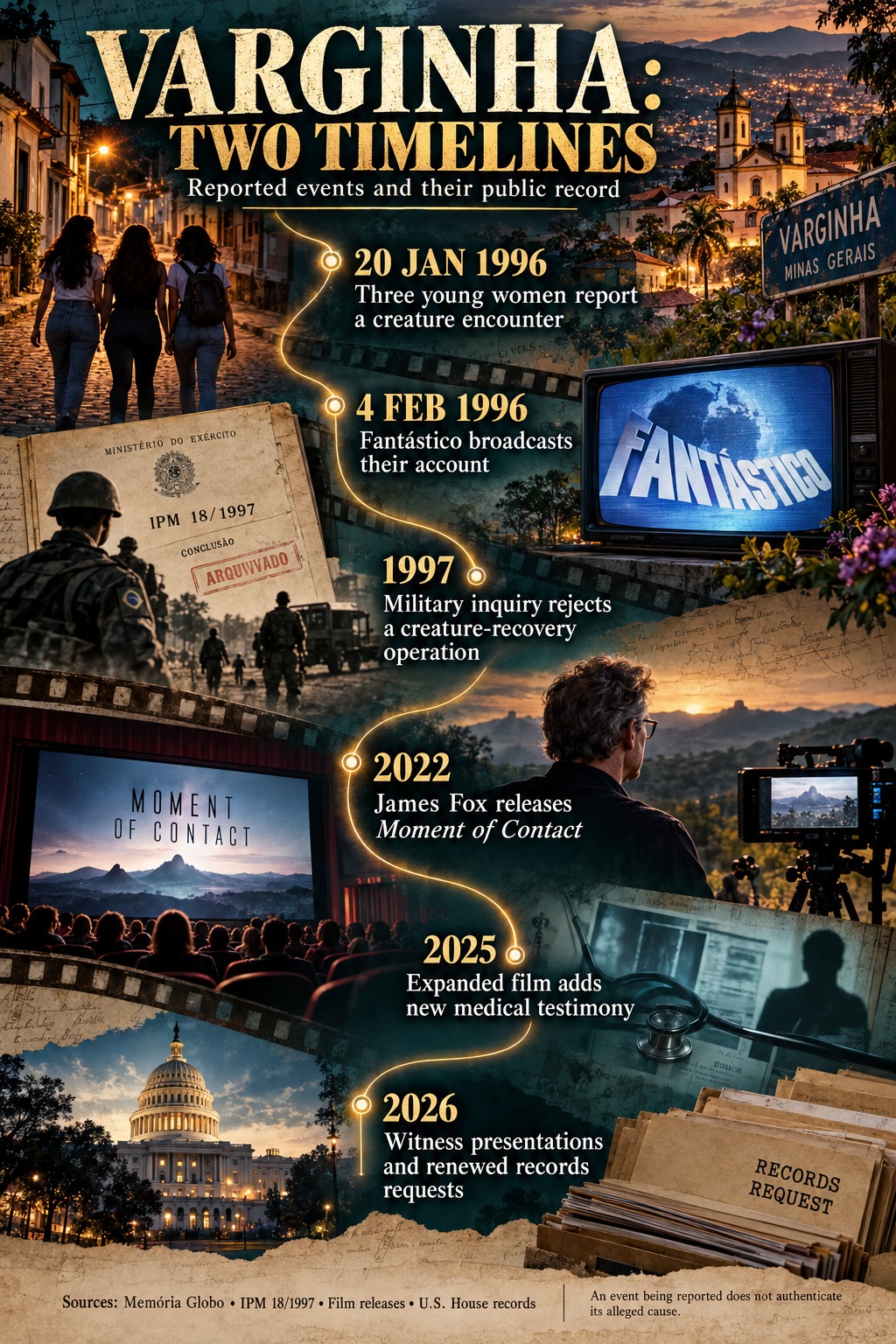
Globo’s archive identifies Fantástico’s first report on the case as 4 February 1996. Reporter Luiz Petry and cameraman Júlio César Moraes interviewed the women and local investigator Ubirajara Franco Rodrigues. That early broadcast is an essential reference because it places their account close to the alleged event, before decades of documentaries and anniversary coverage. Memória Globo preserves the broadcast’s background.
The report establishes an early public statement. It is not a camera recording of the encounter itself. Those are different kinds of evidence, and the difference survives however sincere a witness appears. An interview can preserve a person’s words, their appearance and their recollection at that moment. It cannot show the observer what happened before the camera arrived.
For a historical investigation, the earliest recordings should be compared with later ones without setting a trap for ordinary differences in wording. A witness can describe the same experience differently in successive interviews. The useful questions concern substance: did the claimed distance change, did a new anatomical feature appear, did an uncertain impression become a certainty, and when did the witness first connect the figure with military activity?
Good comparison also requires the questions. A spontaneous description and a response to a leading prompt should not be treated as interchangeable. An unedited interview can reveal pauses, uncertainty and corrections that a television segment necessarily compresses. Early footage is valuable partly because it offers a baseline against which later elaboration can be assessed.
The family’s return to the site
Later presentations include the account of Luíza Helena da Silva, mother of the sisters, who said she went to the site after the encounter. Her recollections include an unusual footprint and, in the broader narrative, an alleged attempt to induce the family to change its story. These are additional allegations with their own evidential requirements. They should not be silently folded into what the three women themselves saw.
A footprint would be potentially important if it had been photographed with a scale, cast, preserved and compared against known possibilities. A remembered footprint, however striking, cannot now provide those measurements. The same applies to reported smells. An odour experienced by several people could be a useful lead, but without a sample or controlled recording it remains difficult to connect to a particular source.
The alleged offer of money is serious. Establishing it would require more than concluding that a family had no obvious reason to invent it. Useful corroboration would include a contemporaneous note, a second independently recorded witness, an identified visitor or a traceable communication. An unidentified group of men cannot responsibly become a named government agency through repetition alone.
These distinctions are not a judgement on the family’s character. They determine which questions can still be answered. The encounter, the footprint and the alleged pressure are separate historical propositions. Each deserves its own source trail.
2. The wider Varginha case: a damaged craft and alleged captures
The wider Varginha narrative connects the women’s encounter with reports of an aerial object in distress. The most prominent crash witness in Fox’s work is Carlos de Sousa, an ultralight pilot and geography teacher. In his Washington statement on 20 January 2026, he placed his alleged sighting on 13 January 1996, a week before the women’s encounter. That date should not be automatically replaced by 20 January to make the story simpler.
De Sousa described a cigar-shaped object losing altitude, releasing white smoke and showing damage along its side. He said he followed it towards a field near Varginha, approached wreckage and handled a light fragment that returned to shape after being crumpled. He also alleged that soldiers forced him away and that men later threatened him. These are his claims, delivered publicly; the presentation did not supply the fragment for independent analysis.
Following the alleged crash step by step
The account is compelling partly because it contains a sequence rather than a momentary glimpse: sky observation, pursuit, approach, contact with material and confrontation. Each step could, in principle, leave a different trail. A road journey might have external witnesses; a wreckage field might have environmental traces; a military deployment might have logs. The more detailed an account becomes, the more opportunities it offers for verification.
It also creates more opportunities for disagreement. The date, route, precise field, arrival time of vehicles and duration of the witness’s presence all matter. A dramatic return to a location can identify where a witness now believes an event occurred. It cannot, by itself, establish that the event occurred there thirty years earlier.
The crash date is a real question
Why insist on a week’s difference? Because a proposed connection between wreckage and later creatures depends on elapsed time. A same-day crash suggests one set of movements. A crash a week earlier requires an explanation for where the alleged survivors were, how they reached the city and why particular captures occurred when they did. These are not fatal objections, but they are necessary questions.
De Sousa’s public presentation provides an identifiable claim to investigate, not a licence to fill that intervening week with imagined events. If no witness describes the period, a reconstruction should leave it blank. A gap on a timeline is information about the limits of the record.
There are also questions about when accounts first became available. Fox has described a long effort to locate de Sousa after an earlier statement to a Brazilian researcher. Older published timelines mention his emergence in the investigation during 1997. The apparent differences between the date of an interview, the date it was made public and the date a filmmaker rediscovered the witness should be resolved with the original recordings where possible.
A responsible history can report that discrepancy without pretending it has been settled. The underlying task is archival: locate the earliest surviving version, establish who recorded it, check its date and compare it with the modern statement. That is more useful than choosing whichever date best supports a preferred narrative.
The Freitas family’s aerial account
Another strand concerns Eurico and Oralina de Freitas, whose account appears in early Brazilian UFO reporting. They described an unusual elongated object near their rural property during the early hours associated with 20 January. In proponents’ reconstruction, this object was moving slowly and appeared to release a vapour or smoke-like substance. Their account is distinct from de Sousa’s road-and-crash narrative.
An elongated aerial shape does not establish that two witnesses saw the same craft on different dates. Matching would require reliable timing, direction, location and distinctive features. Similar words such as “cigar” or “submarine” are descriptive analogies, not unique serial numbers. They may express how an observer reached for a familiar comparison.
The early Revista UFO chronology is useful as a record of how researchers assembled the story. It is a participant publication, however, not an independent confirmation of every event listed. Its placement of accounts in a sequence demonstrates the researchers’ proposed connection; it does not itself demonstrate a continuous chain of events.
Firefighters, a net and a wooden container
One of the most repeated allegations is that firefighters captured a creature in the morning and handed it to military personnel. Versions describe a net, a container and a transfer to an Army vehicle. If true, this would be much more than an unusual sighting: it would involve numerous people, equipment, movement and custody of a living subject.
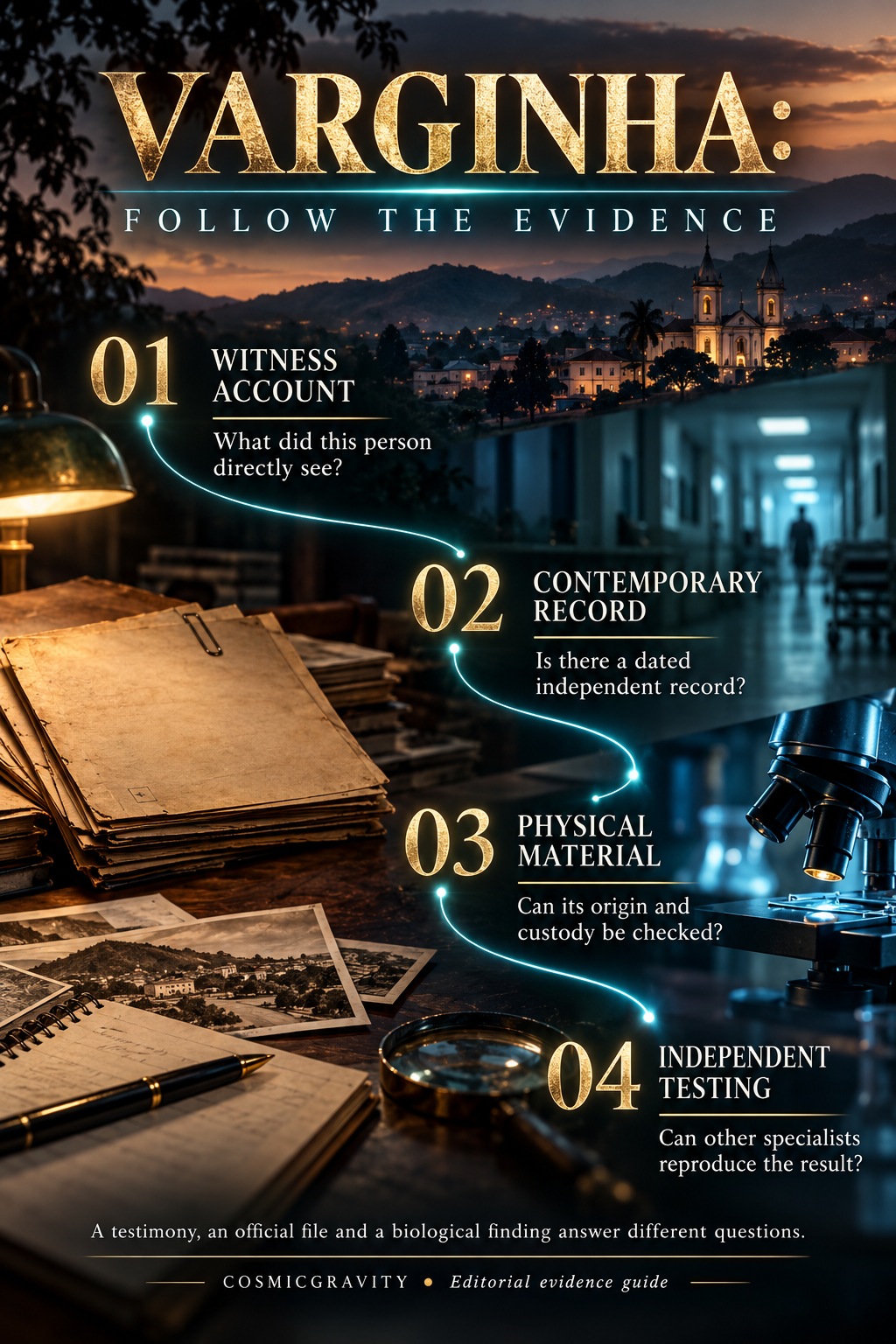
The strongest possible evidence would therefore be operational rather than atmospheric. A duty roster could place named personnel on a shift. A dispatch record could identify a call. A vehicle log could place a truck at a location. Independent accounts could be compared before the witnesses heard each other’s versions. A container’s existence would matter most if its contents could be established.
Seeing a truck is not equivalent to seeing its cargo. Hearing that firefighters answered an animal call is not equivalent to observing an extraterrestrial capture. Conversely, an official statement that a shift was routine does not automatically answer every allegation about it. The investigation needs to work at the level of the specific action claimed.
Some people cited in recovery stories have denied involvement, while some sources have remained anonymous. A cornerstone account should preserve that unevenness. It would be misleading to transform every unnamed or disputed source into an additional confirmed participant.
The police-capture allegation
The second major capture narrative involves military police officer Marco Eli Chereze and an alleged encounter with another being. Supporters link that contact to his subsequent illness and death. The claim is emotionally powerful because it joins a real bereavement with a proposed explanation for an unresolved family concern.
But the chain contains several separate links: that the officer encountered the being; that physical contact occurred; that exposure introduced an infectious agent; that this agent caused the later illness; and that the agent originated outside Earth. Demonstrating one link would not automatically demonstrate the others. The medical discussion later in this article examines that chain more closely.
Claims about a fellow officer, commonly named in retellings, also require care. A person’s unwillingness to speak to a film crew is not a confession. Refusal, anger, silence or concern about publicity can have several explanations. Unless the person’s actual statement establishes participation, an article should not recruit him into the narrative against his words.
Chereze’s death deserves a human account before it becomes an argument. It involved a young man, relatives and medical professionals who had to explain a rapidly deteriorating patient. The uncertainty surrounding an alleged capture should not obscure the reality of that loss.
3. The alleged hospital trail
The hospitals are where Varginha’s story changes character. A brief sighting outdoors may leave little recoverable evidence. A living patient inside a medical institution is different. Admission, observation, imaging, treatment, staff activity and movement between rooms could produce multiple records. The alleged hospital encounter is therefore one of the most consequential claims in the entire case.
Accounts commonly refer to Varginha’s Regional Hospital and Humanitas, followed by a proposed onward journey towards Campinas. These names should not be turned into a single continuous itinerary unless the transfers themselves are documented. Different witnesses may be discussing different times, different patients or different pieces of a story they learned later.
A crowded corridor, an unusual smell, a restricted room and armed personnel are observations that can potentially be investigated. None alone identifies what was inside a room. Their value depends on who saw them, what the person’s job allowed them to know, and how precisely the person connected the activity to a particular patient.
This is why the doctors’ roles matter so much. A physician claiming direct observation offers a different kind of testimony from a clinician discussing a human patient’s infection. A pathologist examining human tissue offers something different again. Using the plural phrase “doctors examined the alien” erases distinctions that are essential to understanding what has actually been alleged.
The anonymous imaging account
Fox has discussed an anonymous medical-imaging witness who said an unusual being was X-rayed. At the January 2026 press conference, Fox distinguished that source from Venturelli when an audience member asked about medical procedures. He said his team had identified the person and obtained details needed to assess the person’s role, while respecting the request not to publish the name.
This is an important lead, but readers cannot independently check the witness’s identity on the same basis as Fox. A journalist may have good reasons to protect a source. The resulting limitation remains real: the public cannot verify employment, duty assignment or access simply because a filmmaker says he has done so.
The obvious next item would be the original radiograph, film envelope or equipment record, accompanied by provenance. An X-ray without a traceable history can depict a model, an animal, a human condition or an unrelated object. An image with proper custody could be examined by radiologists and other specialists without requiring them to accept a witness’s proposed extraterrestrial explanation.
No such authenticated public radiograph was established in this review. The anonymous account belongs in the case history as testimony, with the missing image identified as an important unresolved item.
What a hospital claim should allow us to test
Even where clinical records are unavailable, a hospital has a physical history. Rooms are renovated. Departments move. Equipment is acquired and retired. A witness’s description can be compared with plans, photographs, maintenance records and staff recollections from the relevant period. This does not require disclosing unrelated patients’ private information.
Specificity helps. “There was a partition” is a start; the material, position, sightline and adjacent rooms make the claim testable. “A colleague filmed it” leads to questions about the camera, recording format, tape custody and whether anyone else saw the recording. These details are worth asking because they could produce independent evidence, not because every imperfect memory is suspicious.
The same principle applies to the alleged transfer. A route drawn on a map is a proposal. A dated dispatch, two independent observations of the same vehicle and a receiving record would begin to establish movement. To establish the cargo, the evidence must reach inside the vehicle rather than stop at its exterior.
The hospital story is therefore both the most extraordinary part of Varginha and one of its most practical investigative opportunities. It points towards things that might still exist: a recording, a staff document, a contemporaneous note or a clearly identified additional witness.
4. James Fox’s Varginha case investigation
James Fox did not originate the Varginha case. Brazilian investigators, journalists and witnesses had been working on it for years before his documentary became its most familiar international introduction. His contribution was to bring a filmmaker’s persistence, visual storytelling and access to a wider English-speaking audience to an already extensive Brazilian controversy.
The original Moment of Contact, released in 2022 and narrated by Peter Coyote, combines archival material, interviews and visits to locations. Its structure encourages viewers to follow the alleged sequence across the landscape. That is a useful corrective to short retellings that reduce the case to a creature drawing. It also makes the distinction between a location visit and contemporaneous evidence particularly important.
A camera can show the road, wall or field where a witness says something happened. It can show a person’s reaction on returning. Those are real present-day observations. The historical claim still comes from the witness. The strongest documentary viewing keeps both levels in view, allowing the emotional encounter to register without confusing it with footage from 1996.
The film’s screening description identifies contributors including Stanton Friedman, Brazilian Air Force General José Carlos Pereira and Brazilian ufologist A. J. Gevaerd. Their presence provides context and informed opinion. It should not make them eyewitnesses to the Varginha recovery by implication. A contributor can be knowledgeable about UFO history without having seen the event under investigation.
Watch: the original trailer
The trailer below is promotional material for Fox’s 2022 film. It introduces the investigation and its witnesses; it is not authenticated footage of a captured creature.
Tracking down Carlos de Sousa
One of Fox’s most memorable sequences involves de Sousa returning to the place he associates with the alleged crash. Fox has described his team’s lengthy search for the witness and their effort to persuade him to speak again. At the 2026 press conference, he credited Brazilian collaborator Marco Leal with helping locate him.
The value of that work should not be dismissed. Locating a witness can recover an account that would otherwise be lost, clarify an earlier statement and identify places for further inquiry. Longstanding local investigators may have material that never reached national archives or international audiences. Filmmaking can preserve it in a durable and accessible form.
The emotional response is also part of the record, but it cannot settle the account’s accuracy. People can be distressed by truthful memories, mistaken memories, publicity, conflict or the act of retelling an experience. An observer cannot reliably calculate historical truth from tears or composure. The next useful step is corroboration of the details the witness supplies.
De Sousa’s story is particularly suitable for that work because it names a route and describes physical material. A future investigation should distinguish between verifying the witness’s background, verifying that he travelled in the area and verifying the alleged wreckage. Those are progressively stronger claims. Confirming the first two would strengthen the context without automatically establishing the third.
The military and transport witnesses
Fox’s films and public presentations include accounts from people said to have military or transport knowledge, with some identities withheld. One recorded statement presented in Washington described seeing a being at a hospital and transporting it through Três Corações towards Campinas. The public cannot check an anonymous source in the same way it can check a named official, and that restriction needs to remain visible.
It is tempting to treat anonymity itself as evidence of danger. Sometimes it reflects a genuine fear of retaliation. Sometimes it reflects privacy, employment concerns, uncertainty or a wish to avoid scrutiny. Establishing why a source remains anonymous is part of the reporting task, rather than a conclusion the audience can safely infer from a blurred face.
The relevant questions are concrete: what unit or workplace did the person belong to, what did the person personally see, what was learned from someone else, and what documents support the person’s access? A driver could have direct knowledge of a journey but only secondhand knowledge of the cargo’s origin. Those two levels can coexist in one testimony.
Likewise, a statement that Americans eventually received something may be a later report rather than an observed transfer. A filmmaker’s composite narrative can bring these pieces together. The reader still needs the joins marked so that a secondhand statement does not inherit the apparent directness of the scene before it.
The expanded edition
Moment of Contact: New Revelations of Alien Encounters is an expanded edition associated with 2025, rather than simply the original film with a new promotional title. The Apple TV listing describes a 122-minute production featuring new interviews, including Venturelli’s account of a roughly four-minute interaction with an alleged non-human patient.
That addition changes what viewers are being asked to assess. The central medical witness now has a name, an identifiable profession and a first-person hospital account. It creates questions that were difficult to ask of anonymous hospital rumours: which colleague was present, which room was used, what was on the recording and what exactly was examined?
It does not mean that every person with a medical title in the film says they examined the same being. Some medical contributors concern the officer’s death. Others concern an alleged patient. A full account of the expanded film must resist merging them into one clinical team.
Watch: expanded-edition trailer
This trailer introduces the newer medical testimony. The promotional language belongs to the film’s presentation; the existence and origin of the alleged patient remain unverified in the public evidence reviewed here.
Watch: the medical witness in his own words
For a longer source alongside the film trailers, the NewsNation recording below opens at Venturelli’s public presentation on 20 January 2026. It includes interpretation and his explanation of the alleged hospital encounter. This is a press-conference statement, not a scene from the film or independent confirmation of the account.
From documentary to public advocacy
Fox is both an investigator and an advocate for further disclosure. His January 2026 presentation openly argued that Varginha could resolve the question of whether humanity is alone. That conviction helps explain his persistence, and readers should understand it as his position rather than an independent finding of the event’s organisers.
Advocacy does not make a witness wrong. It does make it especially useful to publish the materials from which conclusions are drawn. Full interviews, date-stamped notes, document provenance and unsuccessful leads let other investigators test the argument. The public should be able to follow the evidence even if it does not share the advocate’s confidence.
There is also a distinction between preserving testimony and proving a discovery. Fox has clearly helped bring accounts into public view. Whether those accounts establish an extraterrestrial recovery is a further question, one that requires evidence extending beyond the film’s persuasive arrangement.
5. Ítalo Venturelli: the claimed bedside encounter
Venturelli’s account deserves detailed attention because it is the most explicit named medical claim of direct observation in the recent Varginha discussion. In the NewsNation recording of the January 2026 press conference, he described seeing an unfamiliar being in Varginha’s Regional Hospital in 1996. The description was delivered through interpretation, so names and anatomical wording should be checked against the original Portuguese before being quoted as exact clinical terminology.
He said a fellow neurosurgeon called him into an improvised intensive-care space and showed him black-and-white video on a large camera. He initially thought the image resembled a child with severe hydrocephalus. In his account, the colleague then directed his attention beyond a partition, where he saw the subject itself.
This sequence contains two separate claims: that a recording existed, and that Venturelli personally observed what it depicted. The second is stronger than merely recalling a video, but it also creates an additional opportunity for verification. If the colleague filmed the subject, the camera, tape and other viewers become important parts of the investigation.
What he says he saw
Venturelli described a being with the apparent size of a child, a pale or white appearance, very thin arms, a small mouth and lilac, teardrop-shaped eyes. He described the head as having a similarly unusual shape. His account of the hand included three fingers and an opposing thumb. This should not be shortened into a universally agreed three-digit anatomy for every alleged Varginha creature.
He said a sheet covered the lower body and that the subject appeared conscious, calm and able to breathe, with no obvious bleeding or visible distress. Those observations describe appearance and behaviour. They do not amount to a published examination containing vital signs, laboratory results, diagnostic imaging or an anatomical report.
The doctor also described an impression of intelligence, awareness and peacefulness. He interpreted the subject’s gaze as conveying comprehension and gratitude. Those are important elements of his personal experience. They are not the same as a demonstrated exchange of information, a controlled test of communication or a recorded language interaction.
The distinction matters particularly when retellings use the word “telepathy.” A person can feel understood without a test establishing that information passed between minds. To evaluate such a claim scientifically, an investigator would need to know what information was conveyed, whether it was independently verifiable and whether ordinary cues could account for it.
Did he treat, operate on or simply observe the being?
At the press conference, an audience member asked precisely this question. The answer described a medical assessment by observation and referred to materials suggesting that a small procedure had already been performed. It did not present an operative report showing that Venturelli himself conducted surgery, collected tissue or ordered laboratory tests.
That makes the phrase “the doctor who operated on the alien” too strong for the material reviewed here. His central public claim is that he observed an unfamiliar living patient at close range and assessed its condition visually. A separate claim about another clinician’s procedure would need its own firsthand statement or record.
The identity of the colleague he named is also important. Automatic English captions render Portuguese names inconsistently. This article therefore avoids constructing a second fully confirmed medical witness from an uncertain caption spelling. The appropriate next step is an original-language transcript, professional identity verification and a direct response from the named colleague or a reliable record of that person’s earlier account.
A witness’s professional expertise can improve the quality of an observation. It does not convert every inference made during a brief encounter into an established diagnosis. “Not a human condition I recognised” would be a meaningful medical judgement. “Therefore an extraterrestrial organism” requires additional evidence about origin.
Why the account emerged decades later
Venturelli said that in 2023 he told Fox’s team he had seen a video, and that a near-fatal heart attack in 2024 prompted him to reveal more. Fox described returning to Brazil in January 2025 and being taken into the hospital, where the fuller account emerged. These are their explanations for the sequence of disclosure.
A delayed account is not automatically false. People sometimes withhold significant experiences because of reputation, family, employment or uncertainty about how they will be received. A long delay does, however, make contemporaneous corroboration more valuable. Staff may have moved away, rooms may have changed and recordings may have been lost.
The best follow-up would establish what Venturelli told colleagues before the renewed publicity. A dated message, diary entry or independently recorded recollection could help distinguish a longstanding account from a recently developed one. A colleague remembering an old conversation would still be testimony, but it would be a distinct piece of the chronology.
The doctor’s willingness to speak publicly is relevant to understanding the human story. It is not a substitute for the missing records. Readers can take the testimony seriously while keeping the alleged patient’s identity unresolved.
Why his description differs from the women’s
The difference is substantial enough to state plainly. The women’s familiar account centres on brown skin and red eyes. Venturelli described a pale subject with lilac eyes. A reconstruction should not silently repaint one witness’s being to match the other’s, nor assume that every difference is merely a lighting effect.
Possible explanations include different subjects, imperfect recall, different observation conditions or an incorrect proposed connection. The public evidence does not allow a confident choice. Claims involving multiple creatures offer one way to reconcile the accounts, but the number and identity of those creatures would themselves need to be established.
This is an especially good place for investigators to preserve raw testimony. If a case involves different anatomies, that information may be significant. If later storytelling has compressed different descriptions into one icon, the original interviews can reveal where the compression happened.
6. Marco Eli Chereze: a death and a proposed connection
Chereze died in February 1996 after a serious illness. In Varginha’s larger narrative, supporters allege that he became infected after physically handling a creature. The medical record and the alleged encounter must be evaluated separately before a causal connection can be established.
Three different questions are often collapsed into one: what caused his fatal deterioration, where the infection entered his body and whether an alleged earlier encounter was responsible. A diagnosis can address the first question without resolving the second or third. Severe illness after an event is a sequence, not by itself proof of causation.
The doctors’ recent comments have renewed attention to this strand. That attention should not be described as a laboratory confirmation of extraterrestrial contact. It is a combination of clinical history, pathology, recollections and interpretations, some made many years after the death.
Armando Fortunato Filho’s role
In a signed public account, forensic physician Armando Fortunato Filho said he performed Chereze’s autopsy and sent tissue and blood material for further assessment by pathologist João Batista Macuco Janini. He described a recent underarm scar from drainage of an infectious lesion and a rapidly progressive infection. His published statement also explains that his later belief in an extraterrestrial presence draws on other people’s accounts.
This is a crucial distinction. Fortunato’s direct professional role concerns the human officer’s body. His broader interpretation concerns the alleged surrounding events. The latter does not mean that he personally autopsied a non-human creature. The similar names “Fortunato” and “Fortunato Badan Palhares” have also encouraged confusion; they refer to different doctors.
The same care should be used with claims about possible errors in treatment. Fortunato described the context in which an investigation was requested. That does not permit a publisher to identify a particular clinician as negligent without a finding establishing it. A tragic outcome and a request for investigation are not the same thing as a demonstrated professional failure.
João Janini’s assessment
Janini’s written statement, read at the 2026 press conference, limited his access to tissue fragments from Chereze’s autopsy. He said that subsequent circumstantial reports from UFO investigators informed a later review. He described unusual aggressiveness in the infection and raised an extraterrestrial-origin hypothesis, while anticipating further molecular work.
That wording matters. A hypothesis about origin is not an origin determination. Janini’s experience in pathology gives his observations professional significance, but a claim that a bacterium came from outside Earth needs evidence beyond the severity of the illness. No authenticated genome, cultured isolate or independently reproduced analysis establishing such an origin was presented in the material reviewed here.
His statement also makes the flow of information visible: human tissue first, additional UFO-related reports later. Those later reports may have prompted useful questions. They do not become biological observations simply by entering a pathologist’s interpretation.
A useful scientific publication would separate the original results from the later hypothesis, reproduce the relevant laboratory findings and explain what competing terrestrial explanations were tested. That would allow specialists to examine the argument without having to decide in advance whether they believe the wider Varginha story.
The earlier treating-doctor account
An older interview with physician Cesário Lincoln Furtado, summarised in the March 2005 MUFON UFO Journal, concerns Chereze’s treatment and deterioration. It places the patient’s care in the ordinary work of local hospitals and discusses clinical events rather than an examination of an alleged creature. The interview summary is useful for comparing earlier medical discussion with recent interpretations.
It should not be treated as a complete medical chart or a new independent autopsy. The interview was itself summarised, and clinical details require the original records for precise comparison. Its value here is to show that the medical story has its own documentary history, which should be examined rather than replaced by the newest headline.
Why a rare bacterium would not establish alien origin
The organism name Staphylococcus schleiferi appears repeatedly in discussions of the case. Whatever the interpretation of Chereze’s particular results, the species itself is terrestrial and was described from human clinical specimens before 1996. The original paper by Freney and colleagues was published in April 1988.
A 1989 clinical paper reported its involvement in two opportunistic hospital-associated infections. A later 1998 investigation of surgical-site infections in the Netherlands documented an outbreak with substantial clinical consequences. These studies do not diagnose Chereze retrospectively; they show why the species name cannot serve as a signature of extraterrestrial life.
There is a further scientific distinction between identifying a species and characterising a particular strain. A familiar species can contain strains with different behaviour or resistance patterns. Demonstrating an unusual strain would require actual comparative results. Demonstrating a non-terrestrial origin would require a much larger argument about provenance, biology and contamination.
In other words, “unexpected,” “rare,” “aggressive” and “unexplained” answer different questions. They should not be used as steps in an automatic ladder to “alien.” An unusual medical outcome can justify more investigation while remaining within an entirely terrestrial range of possibilities.
What an exhumation could and could not answer
Janini’s public statement referred to anticipated legal procedures for an exhumation. This article did not verify a completed exhumation or a published molecular result establishing the proposed connection. A future procedure should be reported as a future procedure until its completion is documented.
Even if remains were examined, the questions would be difficult. Investigators would need to distinguish material associated with the original illness from later environmental contamination and account for preservation conditions. The absence of a recoverable organism decades later would not necessarily identify what happened in 1996. Its presence would still require careful interpretation.
The strongest comparison might involve preserved original laboratory material, if suitable material still exists and its custody can be established. That possibility should be checked rather than assumed. A surviving slide is not automatically a surviving viable culture, and a written organism identification is not the same as an available sample.
The family’s interests should remain central. Scientific questions do not make a deceased person’s remains public property. Any legitimate inquiry must proceed through the appropriate consent and institutional processes, without promising relatives a definitive answer that the available material may not be able to provide.
7. The Varginha case military inquiry
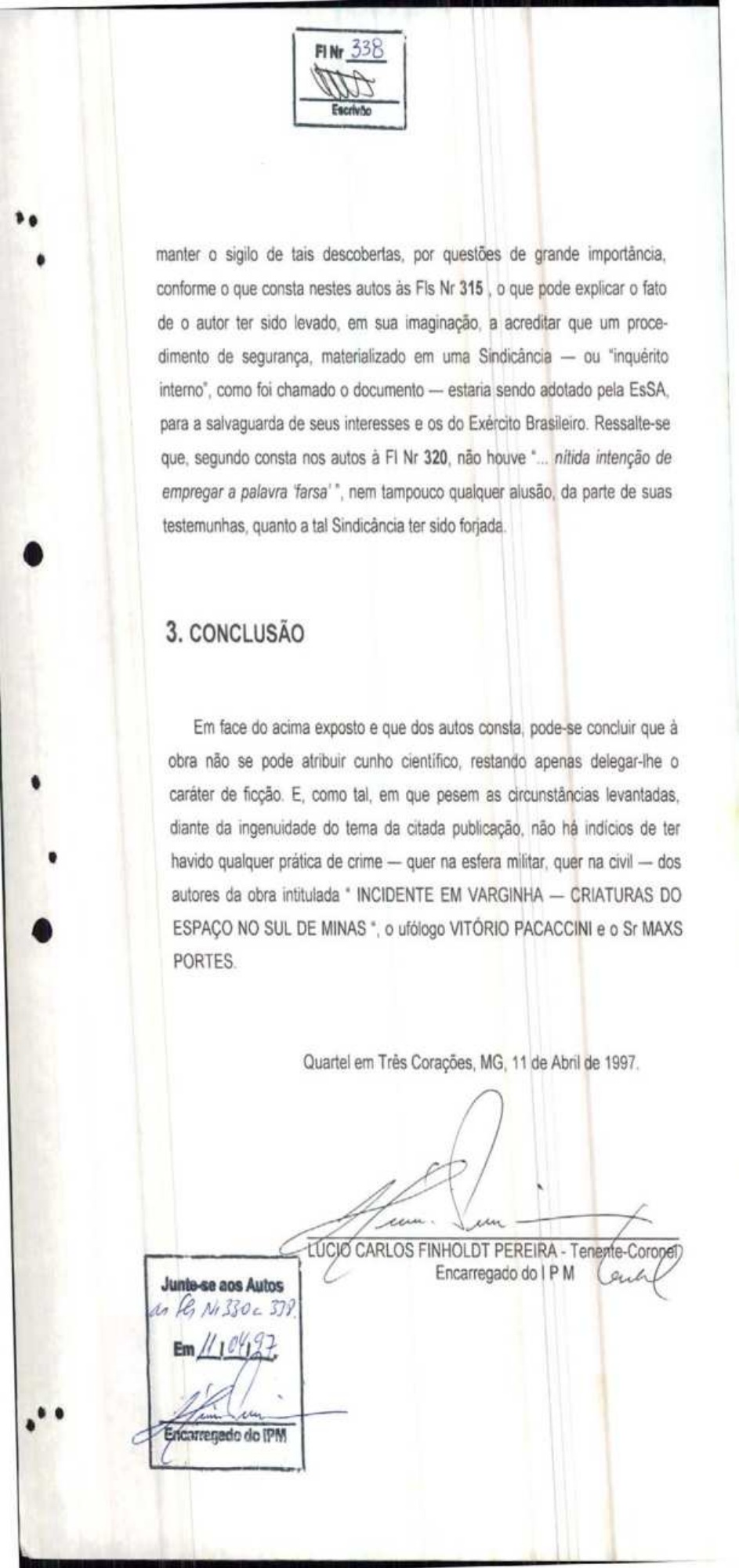
The central military file is Inquérito Policial Militar 18/1997, catalogued by Brazil’s Superior Military Court. Its existence is not an admission that the Army recovered a creature. It records an inquiry into allegations made about military personnel and institutions, including assertions in Vitório Pacaccini and Maxs Portes’s book Incidente em Varginha.
The report dated 11 April 1997, signed by Lieutenant Colonel Lúcio Carlos Finholdt Pereira, rejected the extraordinary reconstruction. It discussed ordinary explanations for vehicle movements, questioned the reliability of anonymous sources and proposed that a local man known as “Mudinho” could have been misidentified. Its conclusion found no indications of a military or civilian crime by the book’s authors. These points appear in the scanned report, particularly folios 333–338. The STM catalogue identifies the case; a public mirror of volume two allowed the report pages to be inspected when the court’s direct file was unavailable.
A legal inquiry is not a biological examination
The distinction is easy to lose in headlines. A military inquiry can collect statements, review movements and decide whether conduct warrants further criminal proceedings. A scientific examination of a recovered organism would require a specimen and an entirely different body of methods. The file should be read for what it contains and for the question it was designed to answer.
Its rejection of the recovery story is a significant part of the historical record. It is also an institutional response from the organisation accused of involvement. That does not make its findings automatically unreliable, but it makes supporting documents, witness selection and the scope of questioning especially important.
Equally, disagreement with the inquiry does not prove concealment. A researcher can identify an incomplete question, an inference or a weakness in an official argument without establishing a secret operation. The next step is to produce the evidence that addresses the weakness, rather than treating the weakness as a recovered specimen.
One useful reading practice is to ask of each page: is this an investigator’s finding, a witness’s statement, an attached newspaper clipping or an allegation reproduced from a book? Official files often contain all four. The government’s custody of a claim does not turn it into the government’s endorsement of that claim.
The “Mudinho” explanation
The proposed misidentification concerns a real local person, not a fictional character created for a debate. Reporting should preserve his dignity. Reproducing humiliating photographs or casually equating disability with an alien creature adds nothing to the evidential question. The inquiry’s explanation and the witnesses’ rejection of it can be discussed without doing that.
The core dispute is whether the person suggested by investigators was present in the relevant place and could account for what the women described. The women have rejected that identification in later accounts. Their rejection matters, particularly if they were familiar with the person, but it does not itself identify an alternative subject.
A strong misidentification explanation would need more than resemblance in a posed image. It would need location, timing, clothing, posture, viewing conditions and an account of how the specific reported features arose. A strong rebuttal would engage with those same elements. Neither a dismissive label nor an emphatic denial replaces that comparison.
There is also no requirement that one explanation account for every later rumour. A human misidentification at a wall, if established, would directly address the women’s encounter. It would not automatically establish what every truck was doing, just as an unexplained truck would not establish what the women saw.
Routine movements and suspicious movements
The inquiry’s ordinary explanations for military vehicles deserve to be compared with the allegations at the level of individual journeys. A maintenance trip and a recovery convoy can look similar to a bystander observing only military trucks. Documentation can help distinguish them; atmosphere cannot.
An especially useful question is whether a proposed ordinary explanation fits the right date and vehicle. A receipt for one truck on one day does not settle the movements of every vehicle that week. Conversely, a vague sighting of a convoy does not defeat a specific documented maintenance record.
The same standard applies to witness identification. A recollection of insignia, rank or unit may be accurate, but it should be tested where possible. A person familiar with local military activity may know more than a casual observer. A person repeating another’s identification may know less than the final account suggests.
This sort of work is slow and unglamorous. It is also how a decades-old case can make progress. A verified journey can remove a false lead or strengthen a genuine one. Either result improves the reconstruction.
Why anonymous-source disputes persist
Investigators sometimes protect identities to preserve access or shield a source from consequences. Institutions sometimes reject anonymous accusations because they cannot question the person responsible. Both positions create practical difficulties, and neither automatically resolves the truth of the underlying allegation.
A possible middle ground is confidential verification by an independent investigator who can report the checks performed without exposing the identity. That still asks the public to trust an intermediary, but it is stronger than a bare assertion. The intermediary should describe the source’s actual access and distinguish direct observation from later interpretation.
Retractions, where relevant, should receive the same attention as original statements. An investigator should establish whether a person denied an allegation outright, changed a date, disputed a quotation or withdrew because of pressure. Those are different developments. Calling every change a coerced retraction would assume the very concealment the case is supposed to demonstrate.
8. Campinas, Unicamp and the alleged American transfer
The proposed journey to Campinas is a hinge in the wider story. It links a local encounter to a claim of state-controlled examination and international movement. Yet the public trail is uneven. A report of a convoy arriving in a city does not establish a delivery to a particular university laboratory, and a university name repeated in several accounts does not establish that the sources are independent.
Early proponents’ accounts include indirect chains: a person knows someone at a university, who heard from another person that unusual material arrived. Those chains should be displayed honestly. A thirdhand account may contain a useful lead, but it cannot be presented as equivalent to a signed receiving document or a clinician’s direct examination.
Forensic pathologist Fortunato Badan Palhares is frequently named in these allegations. His reported denials of performing an alien autopsy are part of the case and must accompany the allegation. A later recollection of being told that material from Varginha might arrive is not the same as saying it arrived, and certainly not the same as identifying it as extraterrestrial.
Readers should also keep him separate from Armando Fortunato Filho, who discussed Chereze’s autopsy. Similar names have helped turn two different medical roles into an apparently continuous examination team. That confusion makes the story sound more corroborated than the underlying accounts justify.
The alleged cargo aircraft
At the January 2026 event, retired US Air Force Colonel Fred Claussen discussed reports of a US cargo aircraft landing in the Campinas area. He referred to information attributed to Brazilian air-traffic personnel, including Marcos Feres, and explained what records such a flight might generate. He was presenting a proposed investigative route, not saying that he personally flew the alleged retrieval mission.
That distinction is worth preserving because his operational experience is relevant in a particular way. It can help identify the kinds of records to request: tasking, flight plans, crew activity, refuelling and ground support. It does not independently establish that the flight occurred or identify its cargo.
Aircraft-performance claims also depend on configuration, payload, routing and mission conditions. A hypothetical distance-and-refuelling calculation should not be mistaken for an actual mission record. The most productive use of the argument is to ask the relevant custodians to search for specific records, not to treat the calculation as proof of a classified flight.
Even a verified American military arrival would leave another question: what was being transported? International military cooperation has many purposes. Demonstrating a flight would be an important step; connecting it to an alleged non-human patient would require additional evidence.
9. The Brazilian minister: what Aldo Rebelo actually said
The official referred to in recent discussions is Aldo Rebelo, a former Brazilian defence minister, not the serving minister at the time of the 1996 events. Brazil’s own Defence Ministry archive records his ministerial period in 2015–2016. That background makes his comments newsworthy, while also placing him almost twenty years after the alleged encounter.
In his 11 June 2026 interview with Jesse Michels, Rebelo expressed belief in the witnesses, discussed classified information and argued for coordinated disclosure with the United States. The original interview is more informative than a clipped headline because it contains both strong statements and important limitations.
Around 1:08, when asked whether he looked into UFOs in his official capacity, his answer in the interview’s English rendering was that other concerns occupied the ministry. He then described intelligence structures and classified information. Around 1:11, he expressed belief in Venturelli. Around 1:15–1:17, the discussion returned to secrecy and what had happened at Varginha.
The interview’s English rendering includes this short statement: “The phenomenon existed. It was there. The objects were there. The creature was seen.” It is a strong public expression of his position. It does not specify a document number, publish a photograph or establish that he personally inspected a recovered organism.
The condition involving the United States
Rebelo said that information held by the ministry was classified and connected possible release with an international agreement and American disclosure. In the relevant passage, he framed the reciprocal-release scenario as hypothetical. Earlier reporting on his social-media position also linked disclosure to what he would do if elected president. This is more conditional than “Brazil has now released confirmation.”
It would also be misleading to turn his general discussion of cooperation into a documented transfer of bodies. In the interview, he discussed why American authorities would be interested and acknowledged uncertainty about what specifically took place. Interest, cooperation and possession are separate propositions.
For readers, the most important missing detail is the basis of knowledge. Was Rebelo relying on a briefing, a file he read, conversations with witnesses, public reporting or some combination? A former officeholder can have access unavailable to the public, but a particular claim still needs that access connected to it.
His later clarification belongs beside the dramatic statement
On 12 June, Metrópoles published Rebelo’s clarification that he had not disclosed state secrets and had been commenting on information, medical testimony and military testimony already in public circulation. He distinguished his remarks from revelations based on reserved Defence Ministry information.
That clarification does not erase his belief in the case. It changes how the public should characterise his remarks: an influential former minister endorsing accounts and discussing secrecy is different from an official government release authenticating recovered extraterrestrial beings. Both his initial position and his explanation of its basis should be reported together.
A useful follow-up would ask him for the specific record categories he believes should be released and whether he can identify them without disclosing protected content. That would turn a broad political statement into a checkable archival lead. It would also reduce the risk of attaching the word “classified” to a file whose existence or relevance has not been established publicly.
10. Parliament, Washington and the difference between attention and confirmation
Varginha has entered political discussion on both sides of the equator. That matters because legislators can request records and challenge restrictions that ordinary researchers cannot easily contest. It does not make a politician’s interest equivalent to a scientific finding.
The Brazilian Chamber of Deputies transcript of 16 September 2025 records a public hearing on ufology, access to information and related issues. Participants included Pacaccini and other UFO researchers. The chair acknowledged criticism of the panel’s composition and referred to earlier information requests. Assertions voiced at that hearing remain attributable to their speakers; they are not findings independently adopted by the entire legislature.
The January 2026 National Press Club presentation in Washington likewise made witness statements publicly accessible. The venue, cameras and attendance of public figures demonstrate a presentation occurred. They do not transform it into a congressional committee hearing or make every statement sworn testimony. The distinction is especially important when short clips circulate without the event’s introduction.
The witnesses presented in Washington
The public programme brought together different kinds of contributors. De Sousa described an alleged crash. Venturelli described a claimed hospital encounter. Fortunato discussed a human autopsy. Janini’s written statement concerned tissue and a proposed biological interpretation. Recorded statements added civilian and transport accounts, while other speakers supplied historical context or arguments for disclosure.
That range is worth hearing. It should not be counted as a single large group of people all independently seeing the same creature. Their observations concern different places and different stages of the proposed story. The work of verification lies in connecting those stages through evidence rather than through the shared setting of a press conference.
Supportive experts also need their roles identified. Jacques Vallée offered a wider case-history perspective. Kirk McConnell discussed oversight and disclosure issues. Their contributions help explain the intellectual and political setting. They do not make either man a witness to what happened inside a Varginha hospital in 1996.
The July 2026 records request
A concrete development came on 8 July 2026, when Representative Eric Burlison announced requests to the CIA and FBI for an accounting of possible records associated with Varginha and Campinas. His official release identified potential categories including flight records, liaison reporting, contractor material and transfer documentation. It explicitly said the letters did not ask the agencies to validate a particular public claim.
This is an appropriate way to frame the next stage: search for records and explain the result. A request is not confirmation that responsive documents exist. An acknowledgement of records would not automatically confirm every allegation in the request. Released contents would need to be examined for what they actually establish.
The same applies to a refusal to confirm or deny records. Such a response can frustrate researchers, but it is not a coded admission of a recovery. The phrase describes the agency’s disclosure posture. It cannot tell the public what an unseen document contains.
This review did not establish a public agency release that authenticates the alleged American transfer. Readers should watch for actual documents or a clearly attributable official response, rather than treating each renewed demand as a fresh revelation of the same underlying event.
11. Other reported episodes: the zoo, later sightings and pressure
Longer Varginha chronologies contain more than the January encounter. They include a later alleged sighting at the municipal zoo, unexplained animal deaths, reports of threats and claims that evidence was suppressed. These episodes help explain why participants came to see a pattern. They also need to be investigated as separate events before that pattern can be treated as established.
The zoo strand is a good example. A visitor’s account of an unfamiliar figure and the deaths of animals may sound connected when told consecutively. Establishing a connection would require dates, veterinary findings, enclosure conditions and evidence that the alleged figure was responsible. Without those links, the sequence remains a proposed association.
Local memory and separate incidents
A city’s heritage dossier may preserve these accounts because they are part of local memory. That is valuable historical work, but its purpose differs from a veterinary investigation. A cultural document can explain what residents tell about a place without certifying the biological cause of every event in the narrative.
Threat allegations require similar precision. Who made the threat, when, in whose presence, and was it recorded or reported at the time? An unidentified person claiming authority may not actually represent the institution invoked. Naming a particular agency without corroboration would turn uncertainty into an accusation.
The fact that a witness fears ridicule can be established through the witness’s own account. A coordinated campaign of intimidation requires a further evidential case. Keeping those questions separate allows genuine pressure to be investigated without making every uncomfortable interaction proof of a cover-up.
12. How Varginha became a city identity
Whatever the cause of the original reports, their cultural consequences are visible. Varginha adopted the ET as a public symbol, with statues, a saucer-shaped landmark and a memorial. The city’s official tourism page describes the registration of “O Caso do E.T. e a Identidade Varginhense” as cultural heritage, approved in May 2023 and homologated in June that year.
The protected subject is the case and its place in community identity. Heritage recognition is not a scientific certification that extraterrestrial visitors arrived. It acknowledges a story’s social, architectural and symbolic importance. A city can preserve the history of a disputed event without resolving its cause.
Reading the city’s landmarks
For visitors, the distinction improves the experience. A statue is evidence of how the city remembers the account, not evidence of the creature’s anatomy. A marked route shows the places associated with the story, not a verified chain of custody. Those features are interesting precisely because they show how people transform an encounter narrative into public space.
Tourism also has consequences for witnesses. A private memory becomes a public attraction. Familiar images may influence what new audiences expect to hear. That does not tell us whether the original encounter was accurate, but it makes preservation of early versions especially valuable.
Varginha’s enduring significance therefore has two histories: the unresolved history of the alleged events and the well-documented history of their effect on a city. They overlap without being identical. Understanding both gives the people involved more depth than either a sensational headline or a dismissive joke can offer.
13. How strong is the Varginha case?
The case’s strongest publicly accessible feature is its human record: named witnesses, early television coverage, continuing interviews and identifiable institutions that became involved in responding to allegations. That is enough to make it a legitimate subject for historical investigation. It is not enough to identify an extraterrestrial species or establish an international recovery operation.
Its principal weakness is the gap between the narrative’s physical claims and the public availability of physical evidence. The story contains wreckage, a living patient, a camera recording, imaging, biological exposure and transport. Yet the material needed to authenticate those claims has not been established in the record reviewed here. The most dramatic parts of the account remain dependent on testimony.
That does not leave only two possible judgements, complete belief or complete dismissal. Some observations may be accurate while their proposed connections are mistaken. Some witnesses may have direct knowledge of ordinary activity that later acquired an extraordinary interpretation. A particular encounter could remain unresolved even if a proposed convoy or hospital transfer were disproved.
A useful assessment therefore works claim by claim. The existence of an early report is well supported. The identity of the reported figure is unresolved. The military’s rejection is documented. The proposed biological and international explanations require further evidence. These judgements can change independently when new material appears.
The most valuable missing item: the alleged recording
If Venturelli’s described camera recording survives, it would be a major investigative target. The first requirement would be the original medium or the earliest traceable copy, rather than a short compressed social-media upload. Investigators would need to document who recorded it, who retained it, how copies were made and whether editing occurred.
Authentication has several layers. A genuine tape from the 1990s could still contain a staged scene. A convincing image could still depict a known condition, a model or unrelated material. Conversely, a poor-quality recording could contain useful historical information. Establishing age, continuity and context would be the beginning of examination, not its conclusion.
Independent specialists should be able to inspect the same material. Their work should not rely solely on a filmmaker’s selected frames. Medical assessment, image analysis and historical provenance would address different questions. The more openly those methods and limitations are reported, the less the result depends on personal trust.
The most valuable documentary lead: a matched transfer record
A record connecting two stages of the alleged journey could materially change the case. For example, a dated dispatch referring to an unusual patient, matched by a receiving entry and an independently identified witness, would offer more than another recollection of military vehicles. It would begin to connect location, time and custody.
Records do not need dramatic wording to be useful. An equipment movement, staff assignment or transport request can test a specific claim. The key is whether the document is authentic, contemporaneous and actually related to the event. A generic security classification or an unrelated aircraft arrival cannot carry that connection by itself.
Researchers should publish negative results too. If a particular vehicle was elsewhere, a proposed flight did not operate or a hospital room did not exist in the described form, that information narrows the inquiry. An investigation that only preserves supportive details becomes harder to correct.
The most valuable scientific lead: original material with custody
A biological claim becomes testable when actual material can be connected to the proposed event. That connection is as important as the laboratory technique. A remarkable sequence from an untraceable sample would leave open where the sample came from. A well-documented sample with ordinary results could be more informative about the history.
For Chereze’s illness, the relevant work would begin with the original clinical and laboratory records and a clear account of any surviving material. Researchers would need to distinguish the organism identified at the time from later speculation about its behaviour. Results should be assessed by specialists who are free to disagree with the proposed extraterrestrial interpretation.
Testing should be designed so that a result could count against the hypothesis as well as support it. If every ordinary finding is treated as concealment and every uncertain finding as confirmation, the claim becomes impossible to evaluate. A serious investigation needs a way to learn that a favoured explanation was wrong.
What scepticism owes the witnesses
Respectful scepticism asks precise questions and avoids pretending to know more than the evidence allows. It does not diagnose witnesses from a video, infer dishonesty from their social background or use a person’s disability as a punchline. The women’s willingness to repeat their account over decades deserves accurate representation even from readers who doubt its explanation.
The same courtesy applies to medical professionals and military personnel. A witness can be mistaken without being foolish, and a professional can make an inference that extends beyond the evidence without losing every aspect of their expertise. The appropriate response is to identify the inference and ask what would test it.
Supporters have a corresponding obligation. They should not portray every denial as proof of coercion, every critic as an agent or every bereavement as evidence of alien contact. Treating people as real participants with limited knowledge produces a better history than assigning them fixed roles in a conspiracy narrative.
14. Questions readers keep asking
Is there a real photograph of the Varginha creature?
No authenticated public photograph establishing the alleged creature’s identity was verified for this article. Drawings, sculptures, reconstructions, alleged leaks and film illustrations circulate widely. Their visual detail does not establish provenance. The creature illustration here is an AI-assisted artistic reconstruction of reported features, clearly captioned as such.
Did several doctors examine an alien?
The public accounts describe different roles. Venturelli alleges direct observation of an unfamiliar living patient. An anonymous imaging source alleges radiography. Fortunato and Janini discuss the human officer’s autopsy material and infection. These should not be merged into a confirmed team that examined one extraterrestrial subject. Additional clinicians’ involvement requires their own verified accounts or records.
Did James Fox prove the case?
Fox preserved and publicised significant testimony, located witnesses and pursued documentary leads. His films argue strongly for an extraordinary interpretation. A persuasive documentary and an authenticated scientific discovery are different achievements. The available public record still leaves major questions about physical evidence and the connections between accounts.
Did a Brazilian minister confirm that something happened?
Former defence minister Aldo Rebelo publicly expressed belief in the witnesses and described the phenomenon as real. He discussed classified information and reciprocal disclosure with the United States. His later clarification said he had not revealed state secrets and was discussing public information. It is accurate to report his endorsement; it is too strong to call it a published government authentication of alien recovery.
Does classification prove that the official explanation is false?
No. Restrictions can concern intelligence methods, personnel, international relationships or records whose contents remain unknown to the public. A classified file may be relevant, irrelevant, accurate or mistaken. Its label does not reveal its conclusion. A meaningful disclosure would publish the content and explain its relationship to a specific claim.
Was the Washington event a congressional hearing?
The public event discussed here was a National Press Club presentation on 20 January 2026. Attendance by legislators does not make it a committee hearing. The witness accounts remain important public statements, but they should be described according to the setting in which they were delivered.
Has the military inquiry settled every question?
It records an official rejection of the recovery narrative and a conclusion about the allegations and possible offences it examined. It is an essential source. Its existence does not eliminate the need to examine specific claims, and criticism of its reasoning does not automatically prove those claims. Readers should compare its evidence with the evidence offered against it.
What would most change this assessment?
An authenticated original recording, a traceable clinical or transfer record, independently corroborated direct testimony, or physical material with reliable custody could substantially change the case. Each would still require examination. The important change would be the arrival of evidence that other people can test, rather than another confident summary of evidence they cannot see.
15. An enduring case with a clear next step
Varginha survives because its central image is so unusual and its witnesses have remained willing to speak. Fox’s investigation renewed that encounter for an international audience, while the doctors’ recent statements and Rebelo’s comments made the questions feel immediate again. Those developments warrant attention without requiring the history to be rewritten as a settled extraterrestrial event.
The next decisive advance would connect a claim to a checkable item: the camera recording to its maker, the alleged patient to a contemporaneous record, the proposed transfer to documented custody, or the medical hypothesis to independently examined material. Until then, the honest account is both rich and unfinished: people reported extraordinary experiences, institutions disputed the interpretation, and the most consequential physical claims remain to be demonstrated publicly.
For related investigations, read CosmicGravity’s examination of the Skinwalker Ranch files, our guide to UFO files tranche 7, and our analysis of drone reports over nuclear sites. They explore the same practical question: what does a record actually establish?
Source guide and editorial method
This article compares publicly accessible primary records, witness presentations, participant publications and relevant scientific literature. It is a synthesis, not a claim of original field interviews or access to Fox’s private research archive. English translations and automatic captions can distort names and medical terms; no disputed caption spelling has been treated as independent identity verification.
- Memória Globo: the 4 February 1996 Fantástico report — early broadcast history and witness identification.
- Revista UFO: early chronology — a participant account of the expanding narrative, not independent validation of each entry.
- Superior Military Court catalogue and volume-two scan mirror — the inquiry’s report was visually checked at folios 333–338. The mirror’s filename is not the official case number.
- NewsNation: full 20 January 2026 press conference — public first-person statements, interpretation and questions. This records claims rather than independently authenticating them.
- Jesse Michels: original Aldo Rebelo interview — the minister discussion, particularly approximately 1:08–1:17.
- Metrópoles: Rebelo’s subsequent clarification — his explanation that he had not disclosed state secrets.
- Armando Fortunato’s signed public statement — his autopsy role and his later interpretation.
- MUFON UFO Journal, March 2005 — a summary of an earlier treating-physician interview, with the limitations of a summarised interview.
- Freney and colleagues, 1988; Jean-Pierre and colleagues, 1989; Kluytmans and colleagues, 1998 — primary microbiology and clinical literature relevant to claims about S. schleiferi, not a retrospective diagnosis.
- Chamber of Deputies hearing transcript, 16 September 2025 — the official record of what participants said.
- Representative Burlison’s July 2026 announcement — the scope of the records requests.
- Varginha tourism and heritage record — the city’s cultural recognition of the case.
- Original film trailer, expanded-edition trailer, and Venturelli’s public testimony — two film trailers and one press-conference recording, embedded from their public YouTube hosts without downloading or republishing video files.
Visual disclosure: the cover, creature reconstruction and explanatory graphics are original AI-assisted editorial artwork. They do not depict authenticated recovered evidence. The inquiry page is a reproduction of an actual public-record scan, with its provenance identified in the caption.

latest video



news via inbox
Subscribe to our Cosmic newsletter to get notified when we have new articles.