
UFO Files Tranche 7: New Records, a Triangle Report and Open Questions
Feature image: AI-generated editorial illustration; not an observation or verified reconstruction.
UFO files tranche 7 arrived on 23 October 2026, adding another instalment to the US government’s PURSUE archive. The release is drawing attention for a recent triangular-object report alongside historical material. The useful question is what each record actually establishes.
A department statement, reproduced by Public Technologies, confirms the seventh release and says further files are being prepared. That confirms the publication, while the contents require their own examination.
What is reported in UFO files tranche 7?
EarthSky’s 25 October coverage reports 28 PDF files, with no separate video or audio files. It describes historical sighting records, BAASS contractor reports and a June 2026 triangular-object case investigated by AARO and the FBI.
In that recent case, the coverage describes witnesses reporting a dark triangular object with unusual movement and no audible engine noise. Those are reported observations. They should not be presented as independently measured performance figures or a demonstrated explanation of the object’s origin.
The file identifiers associated with the case are DOW-UAP-D176 and FBI-UAP-D043. They offer a useful way to locate the records without relying on changing headlines.
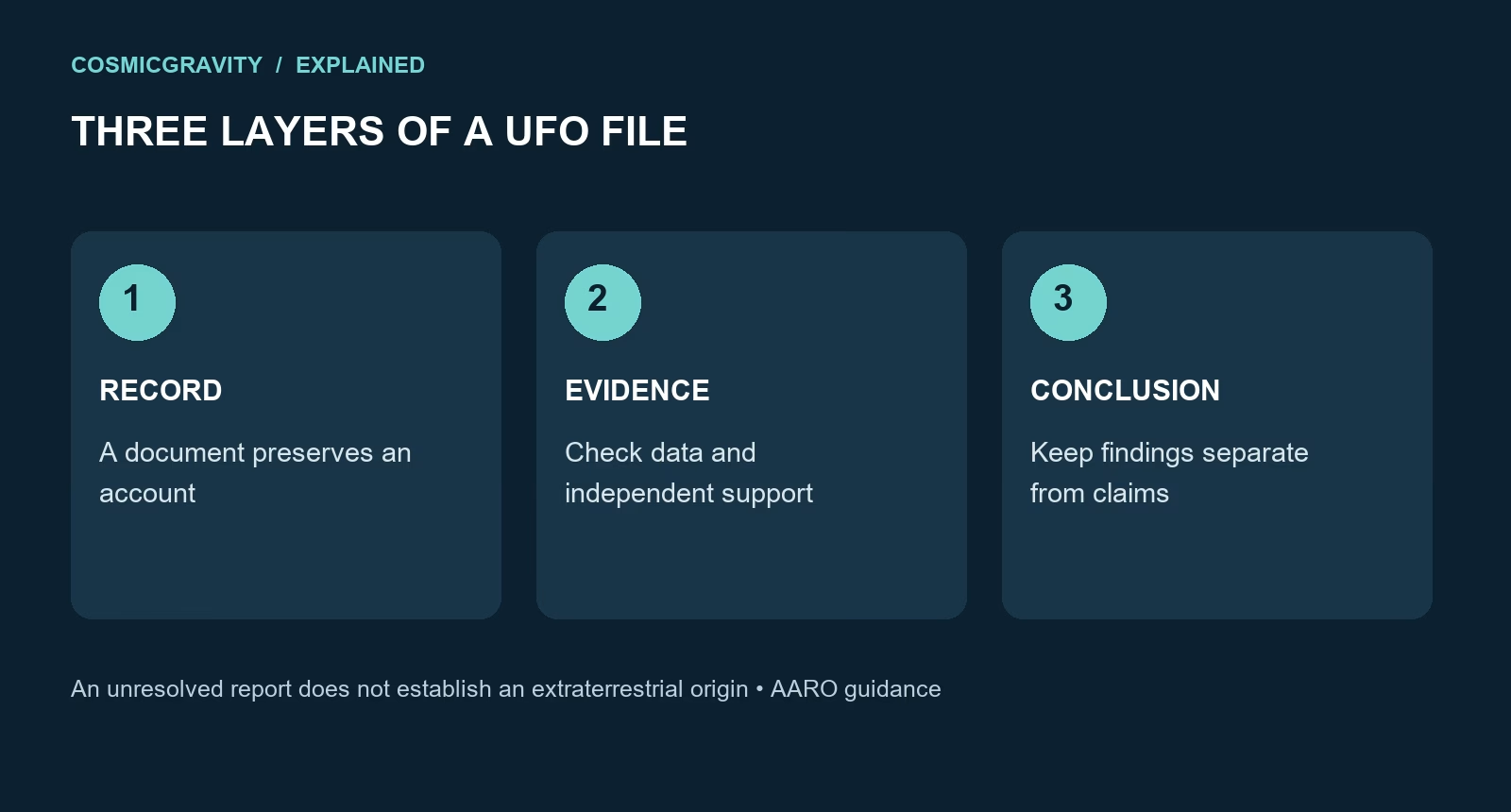
A government record has layers
A released interview establishes that an account was recorded. An investigator’s memorandum can establish what was discussed or assessed. Neither automatically verifies every estimate or inference inside it.
Read the wording carefully. Does a sentence describe what a witness believed, what a sensor recorded, or what an analyst concluded? Those distinctions can disappear when a long file becomes a short social-media post.
What does “unresolved” mean?
AARO’s transparency guidance explains that an unresolved label means the government cannot make a definitive determination about the observed phenomenon. Insufficient data can be one reason.
The same evidence gap does not supply an extraterrestrial explanation. It leaves an identification question open. It also does not justify assigning an ordinary explanation without checking whether that explanation fits.
How to read the release usefully
Start with the full document and preserve its identifier and page reference. Separate the event date from the publication date. Look for independent observations and whether time, location, distance or sensor information is available. AARO’s FAQ explains why well-documented data matters to analysis.
A sketch or reconstruction can clarify a witness account, but it is not a photograph of the event. The same care applies to historical reports and contractor material: publication makes the record available for scrutiny; it does not settle every claim within it.
The new release is worth reading for that reason. Better access allows more precise questions, even where the answers remain incomplete.
Continue exploring
Why UAP videos can mislead even when witnesses are honest
Sources and further reading



latest video



news via inbox
Subscribe to our Cosmic newsletter to get notified when we have new articles.