Could Life Be Hiding Beneath Europa’s Ice?
Europa looks silent from a distance. The Jovian moon is smaller than Earth’s Moon, covered by water ice and marked with long reddish-brown fractures. Its surface temperature can fall below minus 160 degrees Celsius. Nothing about it appears welcoming.
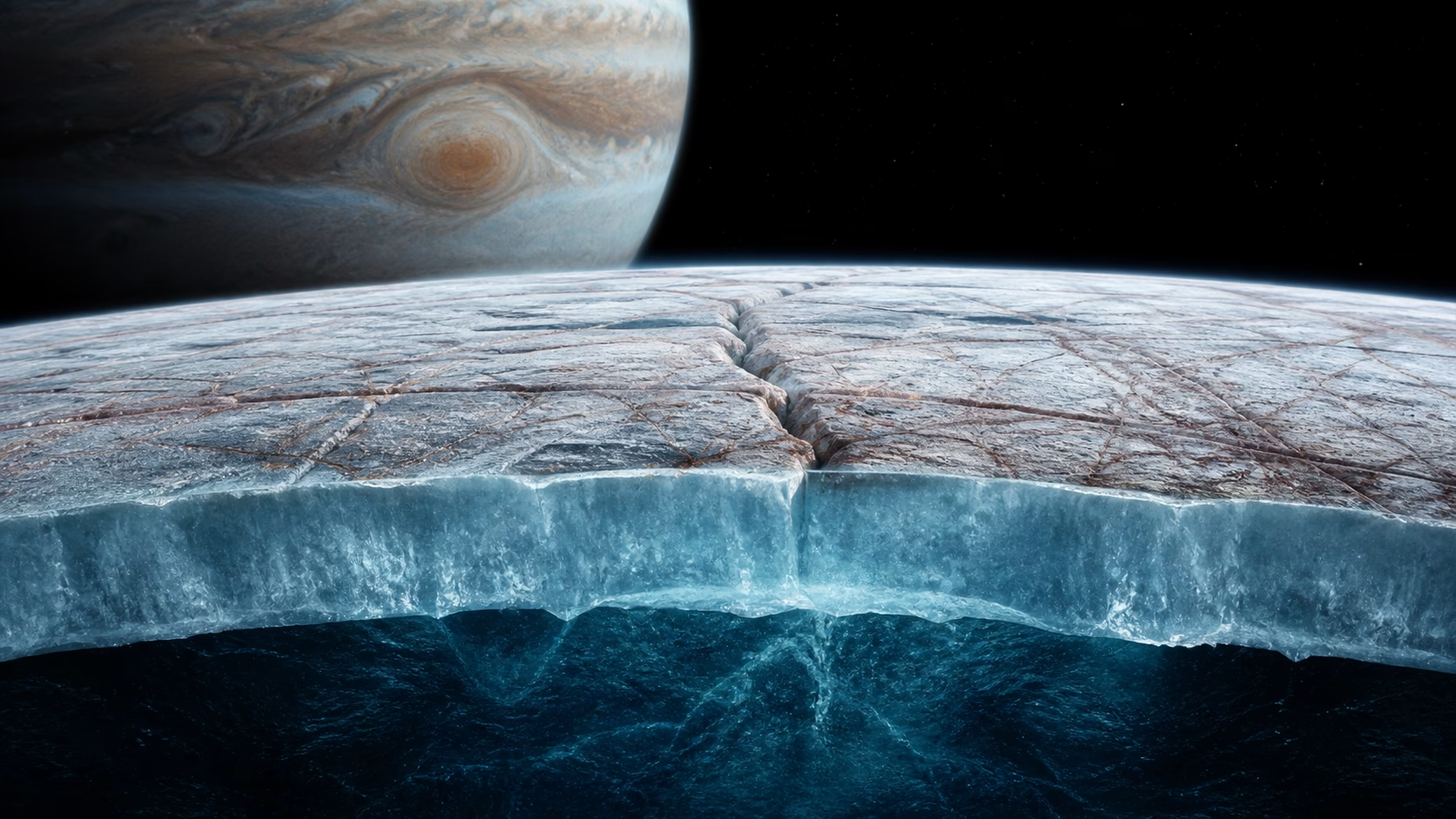
But the most important part of Europa may be hidden. Multiple lines of evidence suggest that a global ocean lies beneath its frozen crust—an ocean that may contain more liquid water than all of Earth’s oceans combined.
That makes one question unavoidable: could life beneath Europa’s ice exist today?
There is no confirmed evidence of biology on Europa. What scientists do have is a compelling combination of liquid water, chemical ingredients and a possible source of energy. Those three factors make the moon one of the most serious places to search for life beyond Earth.
How we discovered an ocean without seeing it
The first close spacecraft images showed a surface unlike the heavily cratered terrain of many other moons. Europa appeared relatively smooth and young, crossed by ridges, bands and disrupted blocks of ice. In some regions, pieces of crust seem to have shifted and rotated before freezing into place again.
NASA’s Galileo spacecraft provided stronger evidence in the 1990s and early 2000s. Measurements of Europa’s magnetic environment revealed an induced magnetic field. The best explanation is a global layer of electrically conductive fluid beneath the surface. Salty liquid water fits the data.
Gravity measurements and geological models support the same picture. Europa is probably differentiated into a rocky interior, a water layer and an outer shell of ice. The exact thickness of that ice remains uncertain; estimates vary from several kilometres to a few tens of kilometres.
Why the ocean stays liquid
Europa is far from the Sun, but sunlight is not its main heat source. The moon travels around Jupiter on a slightly elliptical orbit. As its distance from the giant planet changes, Jupiter’s gravity stretches and relaxes Europa’s interior.
This tidal flexing produces heat. The same basic process drives the extraordinary volcanoes of nearby Io, although Europa experiences it less violently. Enough energy may be generated to keep a deep ocean liquid beneath an insulating ice shell.
If the rocky seafloor is also warmed, water could react chemically with minerals. On Earth, similar water-rock interactions around hydrothermal systems provide energy for ecosystems that do not depend directly on sunlight.
The ingredients for habitability
Habitability is not the same as habitation. A place can offer suitable conditions without ever producing life. Still, researchers usually begin with three broad requirements: liquid water, useful chemistry and a continuing energy source.
Europa appears to meet the first requirement. The other two are less certain but plausible. Its ocean may contain salts and carbon-bearing compounds. Material from Jupiter’s radiation environment alters chemicals on the icy surface, producing oxidants that could release energy if carried down into the ocean.
The challenge is mixing. A thick, unbroken shell would keep surface chemicals separated from the water below. A dynamic shell with cracks, convection and temporary melt pockets could transport material in both directions.
The chaotic terrains seen on Europa suggest that the ice has not always behaved like a rigid lid.
What might Europan life look like?
Popular illustrations often jump to large swimming creatures. That is possible only in the broadest sense; there is no evidence for complex life. If biology exists, microorganisms are the more realistic starting point.
On Earth, microbes survive in deep rock, acidic water, Antarctic ice and hydrothermal vents. Some ecosystems use chemical reactions involving hydrogen, sulfur or methane instead of sunlight. These organisms do not prove that life exists on Europa, but they show that darkness and cold are not automatic barriers.
The harder question is origin. Even if Europa’s ocean is habitable now, did it ever have the right conditions for life to begin? We do not yet know whether life emerges readily when water, chemistry and energy meet or whether Earth’s history depended on a rare chain of events.
Are there plumes above Europa?
Observations with the Hubble Space Telescope have suggested possible water-vapour plumes above Europa. Other observations have not always confirmed them. If active plumes exist, they could carry ocean or near-surface material into space, allowing a spacecraft to sample it without drilling through ice.
The uncertainty is a good example of how planetary science advances. A faint feature seen at the edge of detection is not ignored, but it is not promoted to certainty either. Researchers look for repetition, different instruments and alternative explanations.
Europa may be active enough to release material. We need better measurements to know how often, from where and from what depth.
What Europa Clipper will investigate
NASA’s Europa Clipper mission was designed to determine whether the moon has environments that could support life. It is not a direct life-detection mission. Instead, it will study the ice shell, ocean, composition and geology during dozens of close flybys.
Its instruments will use ice-penetrating radar, cameras, thermal imaging, magnetic measurements and spectroscopy. Together they can estimate ocean depth and salinity, search for warm regions, map surface compounds and identify areas where ocean material may have reached the surface.
The mission’s repeated flybys are necessary because Jupiter’s radiation is harsh. A spacecraft orbiting Europa continuously would accumulate damaging radiation quickly. By looping around Jupiter and approaching Europa only during planned encounters, Clipper can gather detailed data while limiting exposure.
Evidence without exaggeration
Europa is sometimes presented as though an inhabited ocean has already been discovered. That goes too far. Scientists have inferred an ocean; they have not photographed it, sampled it or found an organism.
The underlying case is nevertheless powerful. Surface geology, magnetic measurements, tidal heating and chemical observations all point toward a dynamic ocean world. Each piece is incomplete by itself. Together they make Europa much more than a speculative target.
That is the honest excitement of Europa. We are not inventing a mystery where none exists. We are looking at a world with conditions that may resemble environments where life thrives on Earth, while lacking the decisive sample that could answer the question.
Beneath the ice may be a sterile sea—or the nearest living ecosystem beyond our planet. Europa Clipper will not settle every question, but it will tell us where the evidence points next.
Related reading

latest video


news via inbox
Subscribe to our Cosmic newsletter to get notified when we have new articles.