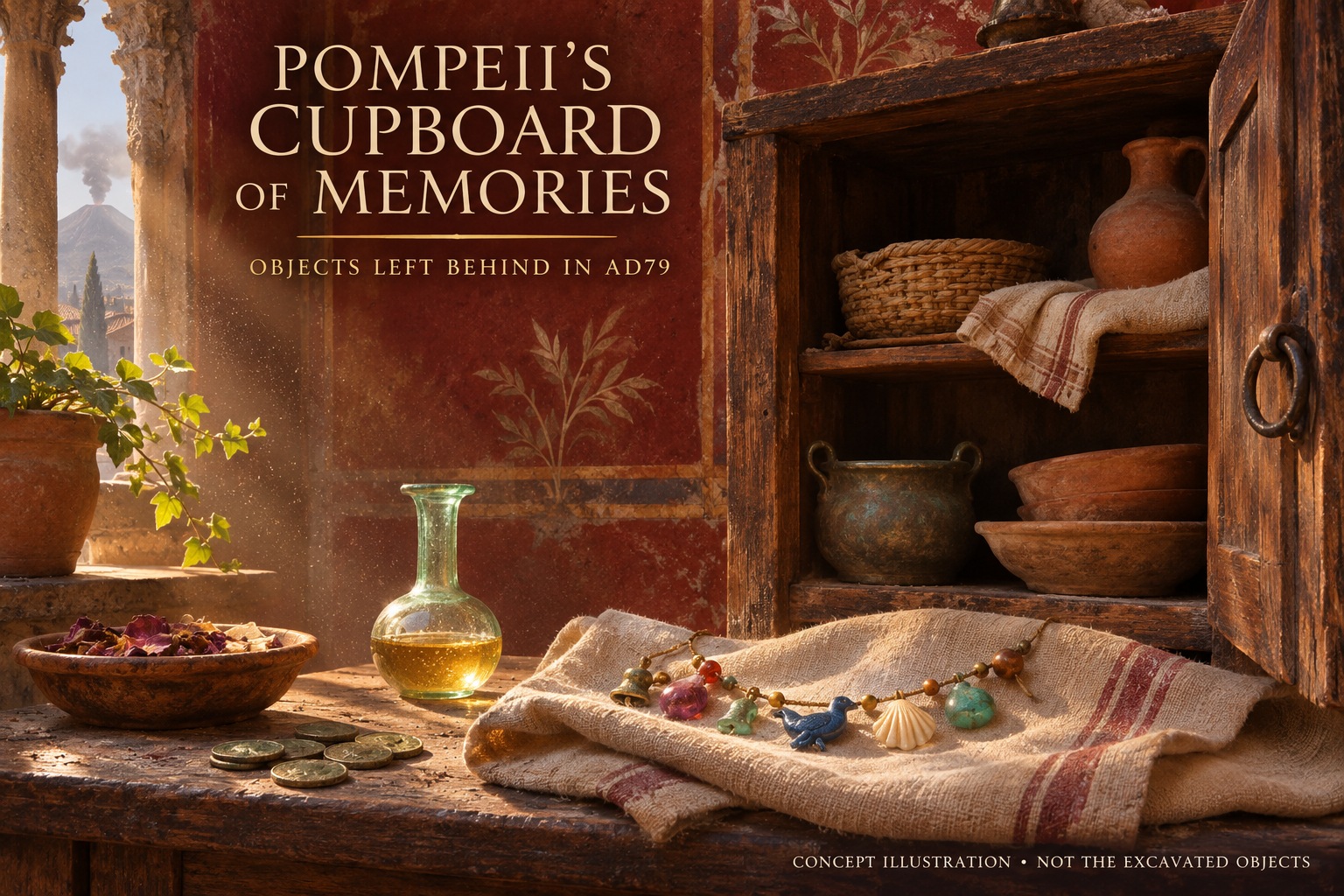
The Pompeii Cupboard: Childhood Charms, Coins and a Life Left Behind
A newly reported Pompeii cupboard brings the Roman city into unusually intimate focus. Inside were objects for personal care, coins, household utensils and a group of tiny pendants associated with childhood. Together they suggest the overlapping demands of a life: looking after oneself, working, keeping valuables and holding on to things that might have mattered long after their first use.
The discovery, announced by the Archaeological Park of Pompeii on 29 October 2026, also raises a question that no inventory can answer. Who chose to keep these objects together? Archaeologists can describe the surviving material more securely than they can recover the identity or fate of its owners.
What was found in the Pompeii cupboard?
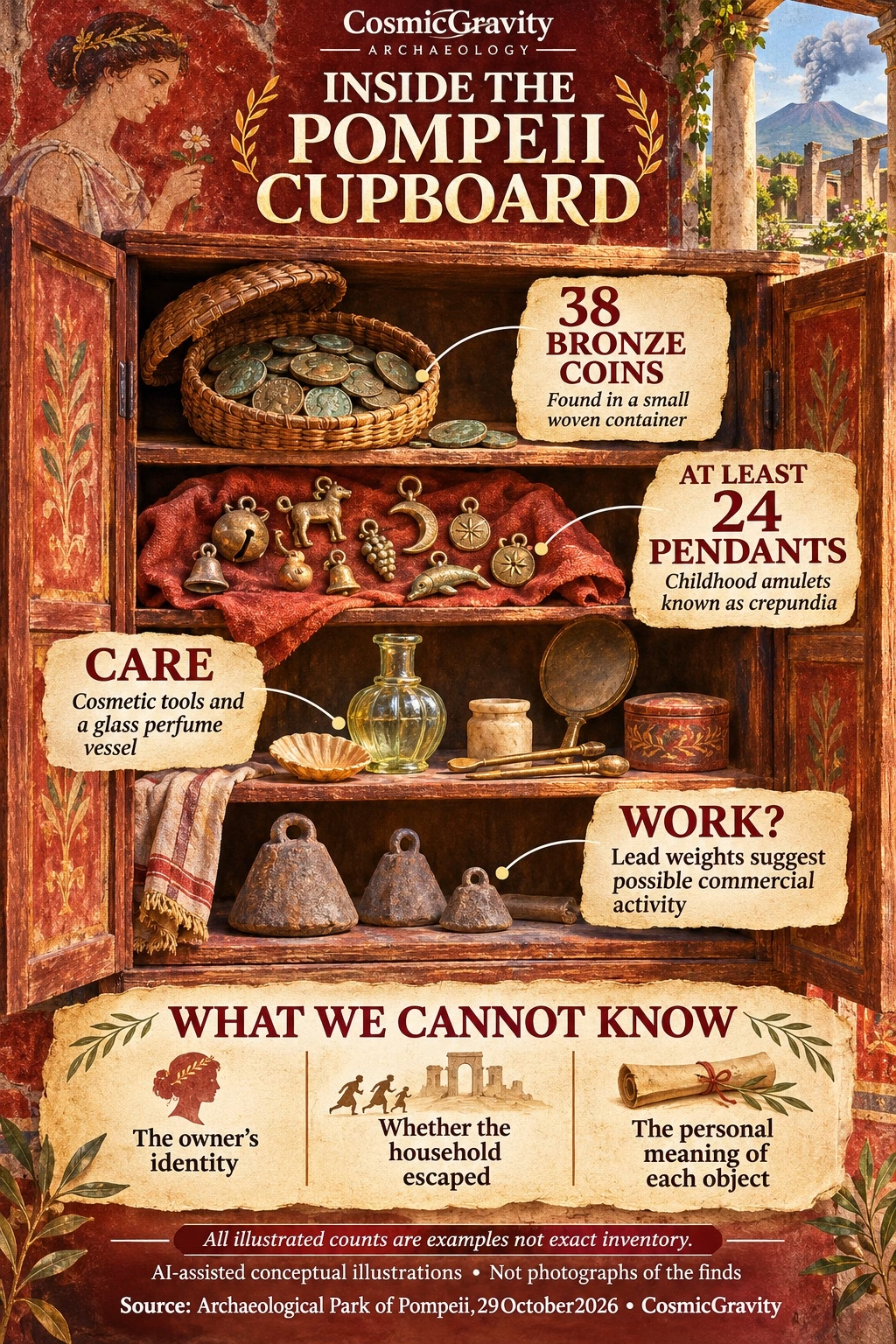
The park’s announcement describes a cupboard in house IX 11, 7 on Via dell’Abbondanza. The finds include 38 bronze coins in a small woven container and at least 24 miniature pendants. Cosmetic tools, a glass perfume vessel, a bronze lamp and other containers broaden the picture beyond jewellery.
Excavation evidence allows researchers to reconstruct the Pompeii cupboard. That wording is more informative than imagining an untouched cabinet whose doors simply swung open. Surviving traces, recorded positions and associated objects allow researchers to recover the arrangement of something that has not survived in its original everyday condition.
An inventory by itself can flatten that achievement. “Coins” sounds like a category. Coins found with traces of the container that held them preserve a relationship. They tell us something about storage and grouping, even when the person who made those choices remains anonymous.
The childhood charms called crepundia
The excavation report’s published overview describes pendants made from faience, bone, glass paste and rock crystal. Their subjects include the deities Bes and Mercury, hands, feet and plant forms. Suspension holes show how people could hang these objects.
The researchers place the assemblage within the category of crepundia: little objects or charms associated with children, protection and rattling sounds. That interpretation gives the group a cultural setting without requiring a story about a particular child.
The Getty Museum’s study of ancient amulets places strings of protective objects within a much longer Mediterranean and Near Eastern tradition. It discusses their connections with the charms used as children’s rattles in the Roman world. This broader context matters because an object can be decorative, protective and practical at the same time.
A small pendant need not fit neatly into a modern choice between “toy” and “religion”. The sound, the material, a recognisable figure and the person who gave it could all contribute to its significance. That is a way to think about possible functions, rather than a claim that every wearer understood every charm identically.
What the Pompeii cupboard suggests about childhood
The park suggests that childhood amulets could remain meaningful to adults who kept them. It is an appealing interpretation, especially for objects stored rather than worn. But “kept as a memory” remains an interpretation of behaviour, not an inscription in which an owner explains a personal attachment.
There are useful comparisons without treating all Roman amulets as the same thing. The University of Cambridge Museums’ account of childhood protection describes the bulla, a protective pendant worn by freeborn Roman boys. A bulla is not a label for every item in the newly reported necklace. It shows, instead, how protective objects could participate in the social experience of childhood.
That distinction prevents a familiar mistake: finding an ancient word for one object and applying it to every similar-looking piece. Archaeological interpretation becomes stronger when the similarities and differences both remain visible.
Work and daily life around the Pompeii cupboard
Lead weights found with faint traces of a small wooden box may point towards commercial activity. The excavation overview explicitly treats their specific function as a question to assess through context and associations with other finds.
A weight is evidence of measuring. Turning it into a complete biography requires more steps: what people weighed, where transactions happened and who carried them out. The objects make work a reasonable line of investigation; they do not identify a known shopkeeper or establish a particular business.
Likewise, cosmetic equipment does not by itself identify one named woman as the sole owner of a room. Households contain shared spaces and objects with different histories. The park’s evocative presentation of a woman’s life should be read alongside its explicit statement that the residents’ identities are uncertain.
Why the house name needs a qualification
Researchers traditionally associate the house with Cornelius Maximus, but the park describes that attribution as uncertain. Excavators uncovered its facade in 1912; the recent work investigated part of the rooms behind it in connection with the neighbouring Insula dei Casti Amanti project.
A traditional building name is convenient for locating a discovery. It is not automatically a securely identified owner. Keeping that qualification does not diminish the find. It protects the difference between a label used by researchers and an identity established by evidence.
What the cupboard cannot tell us about the eruption
The coins and other belongings remained behind when Vesuvius buried the city in AD 79. Their survival does not tell us whether the people connected with them escaped. The park leaves that question open.
We can imagine someone intending to return for a valued possession. We can also imagine reasons why they could not. Neither imagined scene becomes evidence simply because it feels recognisably human. The restraint matters most when a discovery invites an emotional response.
Our report on the Senden Celtic grave explores another context in which objects raise questions about personal identity and social meaning. A burial and a household cupboard preserve different kinds of decisions; neither gives unrestricted access to a person’s thoughts.
An ordinary object with an extraordinary context
A cupboard gathers things that daily life normally scatters: care, work, money, habit and perhaps memory. Here, their association is the real discovery. The objects do not need to belong to a famous Roman to make that association historically valuable.
The park’s open-access excavation journal provides a route into the research behind the announcement. Reading that work alongside the press account lets the small, well-supported details remain in view. They are enough to bring this household closer without pretending that its whole story has been recovered.
Research checked 2 November 2026. Counts and excavation details follow the Archaeological Park of Pompeii; cultural comparisons are separately linked. Original illustrations are labelled conceptual.



latest video



news via inbox
Subscribe to our Cosmic newsletter to get notified when we have new articles.