Senden Celtic Grave: Jewellery and an Animal Offering
The Senden Celtic grave contains the sort of discovery that makes archaeology feel unexpectedly personal: a woman, substantial bronze jewellery, a dark arm ring and the remains of a lamb or young goat placed with her. The objects survive. Her name and the meaning of that final gesture do not.
Archaeologists found the burial in 2024. Its renewed prominence comes from this weekend’s Archäologie in Bayern meeting in Senden, held from 30 October to 1 November 2026. That distinction matters: this is new public discussion of an earlier excavation, rather than a grave suddenly uncovered this morning.
Where was the Senden Celtic grave found?
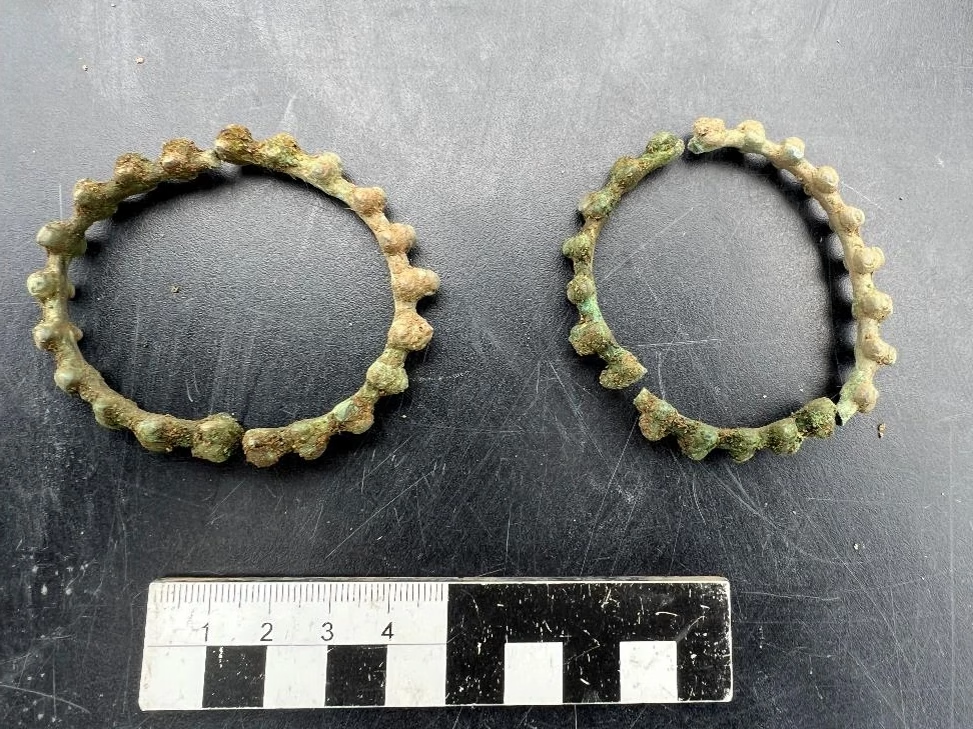
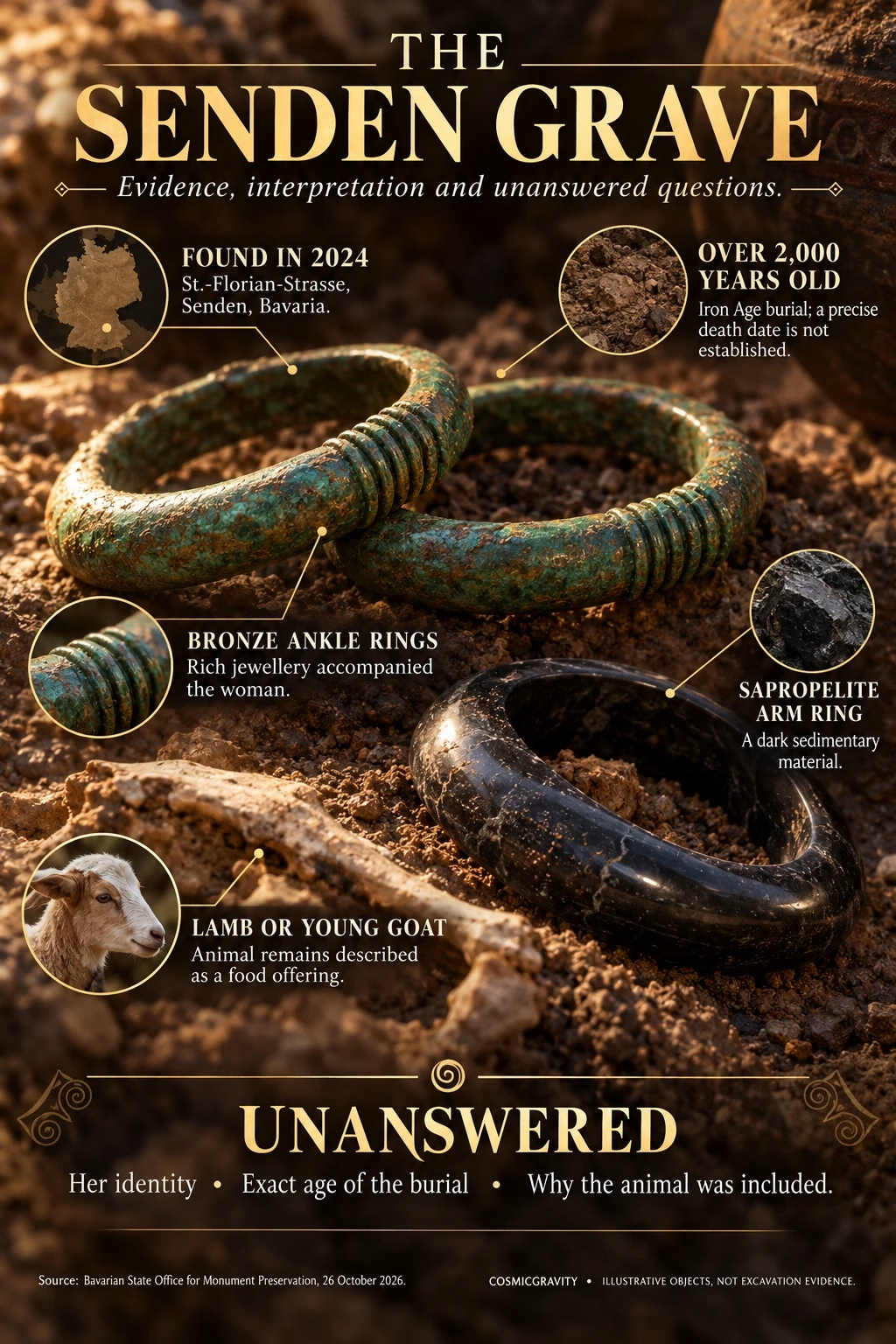
The Bavarian State Office for Monument Preservation, known as BLfD, places the discovery on St.-Florian-Straße in Senden, in an area planned for commercial development. Its 26 October announcement identifies an Iron Age woman’s burial more than 2,000 years old, accompanied by bronze ankle rings, a sapropelite arm ring and animal remains described as a food offering.
There is a larger landscape behind the individual grave. BLfD archaeologist Stefanie Berg describes settlement evidence spanning the Celtic period and the Roman imperial era. The burial is therefore one episode in a place repeatedly occupied and used, rather than an isolated treasure detached from its surroundings.
A building site can briefly expose those overlapping histories. After archaeologists excavate a grave, they cannot inspect its relationships to surrounding soil layers and features in precisely the same way. The excavation record becomes essential evidence alongside the objects themselves.
What the jewellery can tell us
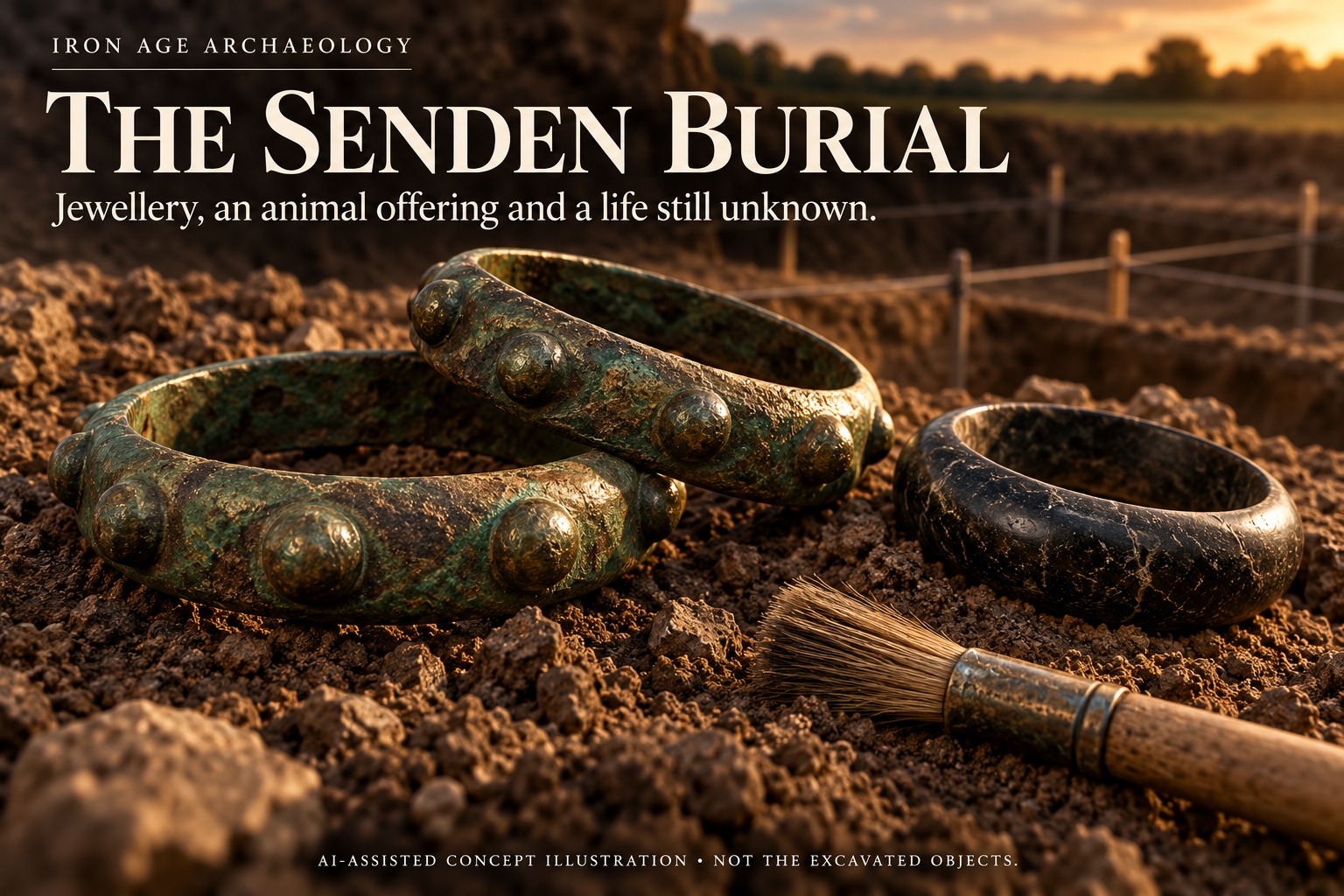
The actual photograph of the bronze rings is worth studying before turning to any reconstruction. Their surviving shapes and surfaces provide evidence that an imagined scene cannot replace. BLfD describes them as Knotenringe, rings with prominent knot-like or knobbed decoration.
The dark arm ring offers a different material. Sapropelite is a sedimentary substance formed from organic-rich deposits, rather than a precious metal. Its presence beside bronze makes this an assemblage of different materials, not simply a single measurement of wealth.
Our interpretation is that a rich burial warrants questions about identity and social distinction, but does not by itself settle a person’s occupation or rank. Calling this woman a queen, priestess or tribal leader would require evidence beyond the objects named in the announcement. Mourners’ choices of funeral jewellery may express their own priorities as well as the life of the deceased.
This is a useful way to read other discoveries, too. A finely made object tells us that someone made, obtained and eventually deposited it. Establishing how those actions connect requires context. Our account of the Lake Mezzano bronze sword explores a different example of an object whose survival opens questions about its original setting.
Why was a lamb or young goat buried with her?
The animal is the most intriguing part of the announcement, and the easiest detail to turn into a story more definite than the evidence allows. BLfD uses the German term Speisebeigabe, a food offering. That is the published interpretation. The brief release does not provide a complete specialist report establishing the animal’s exact species, age, anatomical completeness or treatment.
Those distinctions could change the questions researchers ask. Did mourners deposit a complete animal? Did they place selected portions beside the woman? Were there marks associated with preparation? The announcement does not answer these questions. Consequently, we should not treat the possibilities as findings.
There is nothing evasive about retaining “lamb or young goat” in a headline or caption. Historic England’s animal-bone handbook explains that some skeletal features are shared across related animals, while fragmentation or the absence of diagnostic elements can limit identification. Specialists may consequently use broader categories such as sheep/goat.
That methodological point does not diagnose the Senden remains from a distance. It explains why a cautious identification can be a scientifically informative result. Giving the animal a more specific identity for the sake of a neat narrative would conceal the present uncertainty.
Food offering, companion or ritual?
A food offering is already a ritual act in the ordinary sense of a deliberate funerary practice. The categories need not be mutually exclusive. However, identifying the intention behind a particular deposit requires more than recognising animal bones near a human burial.
One possible reading is provision for the dead. Another question is whether a particular relationship with the animal mattered. These are questions for investigation, not equivalent established explanations. A claim that the animal was a beloved pet, or that mourners sacrificed it during the funeral, would need specific supporting evidence.
The wider discipline is zooarchaeology: the study of animal remains from archaeological sites. Historic England’s account of its work describes research, guidance and comparative collections that support such analysis. Looking closely at a small group of bones can be as consequential as identifying a spectacular piece of metalwork.
How old is the Senden Celtic grave?
The strongest wording in the primary announcement is “more than 2,000 years old”. Some secondary coverage places the grave around 2,300 years ago, and dates the jewellery more narrowly. Those are useful leads, but the brief BLfD announcement does not publish a laboratory age or a precise year of death.
Objects can help establish a chronological range through comparison with known types. Scientific dating addresses a different part of the problem. Radiocarbon dating measures surviving radioactive carbon in suitable once-living material; laboratory preparation aims to remove later contamination.
A measurement also has to belong to the event researchers are investigating. Historic England’s guidance on archaeological dating stresses the relationship between a sample and its context. An object may have circulated before burial, and material in a grave’s fill need not have arrived at the same moment as the body.
Those are general methodological cautions. We have not found a published Senden radiocarbon result in the primary announcement reviewed here, so this article does not invent one.
What does “Celtic” mean in this story?
The label follows BLfD’s description of the grave and its archaeological setting. It should not be used to collapse every place and period associated with Celtic history into a single timeless culture. Nor does it let us transfer a modern funeral tradition, or a medieval literary account, directly onto this woman’s burial.
The local question is more productive: how did this community bury its dead, and how does this grave compare with others nearby? Evidence for a repeated practice would carry a different meaning from an exceptional arrangement.
Likewise, this Iron Age burial should be kept chronologically distinct from the much older monument traditions collected in our world megalithic atlas. Similar interests in death, memory and landscape do not establish that two sites belonged to the same people or beliefs.
What a fuller Senden Celtic grave study could resolve
A detailed Senden Celtic grave publication could bring together the grave plan, human and animal bone assessments, object descriptions and dating evidence. That would allow readers to see which interpretations rely on which observations, rather than treating the whole story as a single claim.
For now, however, the arresting part is also the human part. Someone chose to place these objects and animal remains with a woman whose biography is largely lost. Archaeology can recover aspects of that act without pretending to hear every thought behind it.
The official conference listing places the find among current research, digital recording and plans for archaeological storage. Discovery, analysis and long-term care are all part of the same story. A beautiful ring is only the beginning.
Source and image note: Checked on 1 November 2026 against BLfD’s announcement and conference listing. General explanations of dating and animal-bone analysis are linked to Historic England guidance; they are not claims that those tests have been completed on this grave. The documentary photograph is credited to BLfD and used under its permission for current reporting. Concept illustrations are explicitly labelled and do not reproduce the excavated objects.

latest video



news via inbox
Subscribe to our Cosmic newsletter to get notified when we have new articles.