Lake Mezzano’s Bronze Sword: The Story Beneath the Sharp Edge
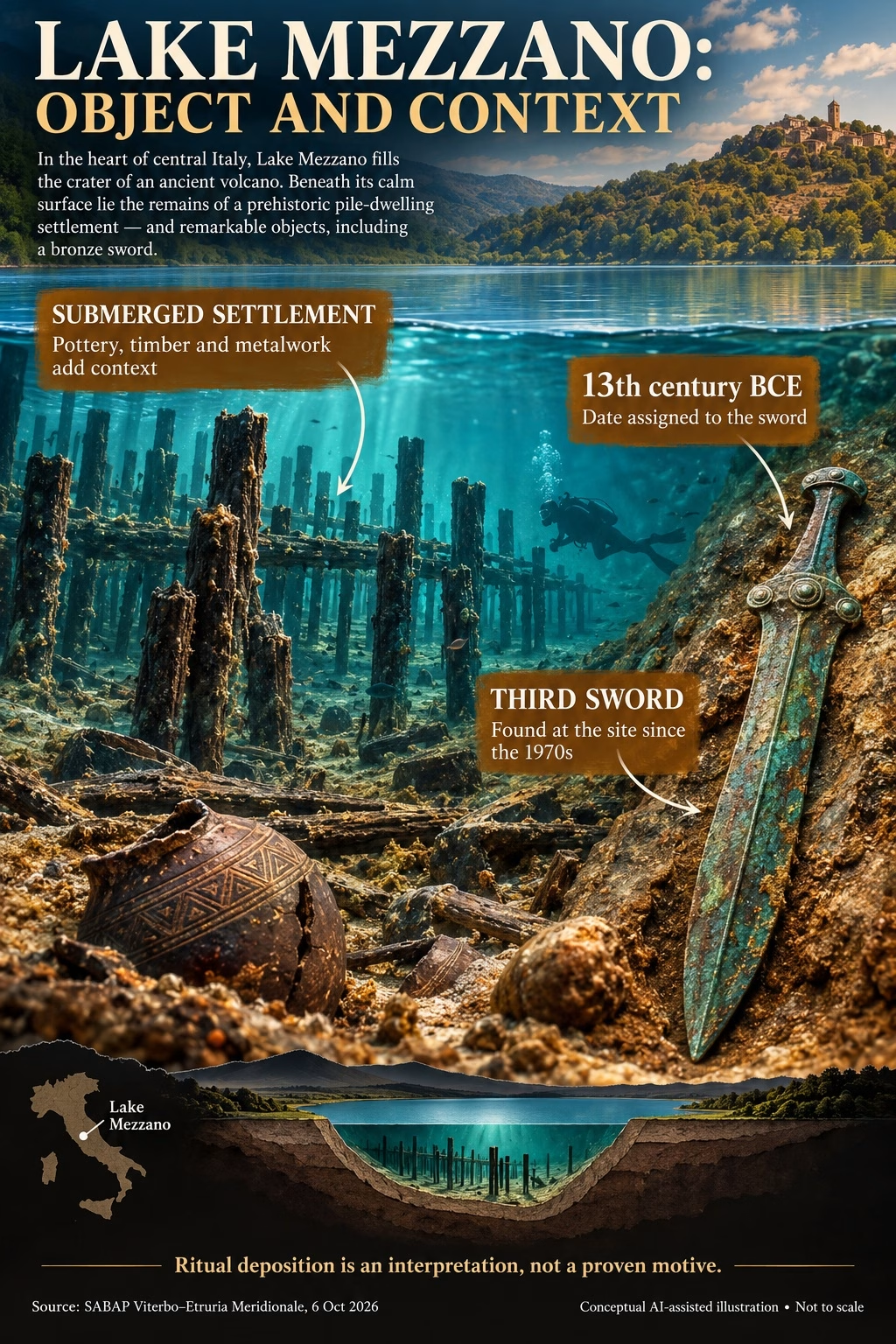
The striking detail is the edge. A bronze sword recovered from Italy’s Lake Mezzano remains sharp, according to the archaeological authority that directed the work. But the Lake Mezzano bronze sword has a more revealing setting than a headline about preservation can convey: a submerged settlement, other metal objects and a question about why valuable things entered the water.
The Soprintendenza for Viterbo and southern Etruria announced the find on 6 October 2026. Renewed coverage later this month has drawn attention to it again. The discovery should not be mistaken for an announcement made today.
What the Lake Mezzano bronze sword announcement establishes
In its official report, the authority assigns the weapon to the 13th century BCE and describes excellent preservation. It was recovered during work around the lake’s submerged pile-dwelling context. It is the third sword found at the site since investigations began in the 1970s.
The campaign also recovered pottery and other metalwork. The announcement highlights a bronze razor near the sword and discusses the possibility of intentional deposition and high-status associations. These are interpretations of the setting, not proof of a particular ceremony or a named owner.
The lake occupies an ancient volcanic crater in central Italy. That setting matters because the weapon belongs within an inhabited landscape. It is evidence of people using a place, rather than an isolated curiosity with no connection to daily life.
A sharp edge does not tell the whole biography
Preservation is a condition observed when an object is recovered. It is not a complete history of how that object was made, used, lost or placed. A sharp-looking edge cannot by itself tell us how often a sword was carried, whether it was used in combat or what happened immediately before it entered the lake.
Those are different questions, requiring different kinds of work. A detailed study might examine manufacture, wear and repairs alongside the find position. The distinction is useful when reading future reports: a newly described surface feature should not silently become an entire warrior’s biography.
Nor does excellent preservation remove the need for conservation. Recovery moves an object into a new environment. The responsible story continues through documentation and treatment; the dramatic moment when something leaves the water is only one stage.
Was the Lake Mezzano bronze sword an offering?
Water deposition offers an attractive explanation for a valuable weapon found in a lake. The authority places the discovery within a wider discussion of weapons in watery settings and possible symbolic practices. Yet “an offering” remains an interpretation to test against the context.
Ask what observations would distinguish deliberate placement from other routes into the water. Was an object found in a meaningful association? Can that association be dated? Could later disturbance have brought separate objects together? These questions do not dismiss a ritual explanation; they make its supporting evidence explicit.
It is particularly important to separate proximity from demonstrated contemporaneity. Two things found near one another can be a valuable clue without necessarily having been deposited by one person on one occasion. A careful excavation can preserve the information needed to investigate that possibility.
Why a submerged settlement changes the story
A sword naturally pulls attention towards warfare and prestige. A settlement invites a wider set of questions: where people lived, how they worked, what they exchanged and how different activities occupied the same shoreline. The finds need not all have the same explanation to belong to the same archaeological landscape.
For readers, the useful habit is to resist choosing between a spectacular object and its less spectacular surroundings. Both matter. A beautiful weapon may reveal skilled metalworking; its relationship to timber, pottery and the lakebed can help explain the community around it.
Our report on the Kekova shipwreck candidate explores a related issue: how underwater context shapes the strength of an archaeological claim. The Alexandria bronze ring discovery offers another example of a small object carrying questions about a much larger place.
What would make the next update valuable?
Detailed find documentation, a fuller explanation of dating and specialist work on the artefact could sharpen the interpretation. Until that material is available, the public announcement supports a significant recovery and a promising archaeological setting. It does not justify inventing a particular battle, sacrifice or lake deity.
The edge makes a memorable first impression. The more substantial story is the chance to connect one finely preserved object to the people and practices of a lakeside community.


latest video



news via inbox
Subscribe to our Cosmic newsletter to get notified when we have new articles.