New UAP Radar File: What the 1,650 mph Estimate Actually Means
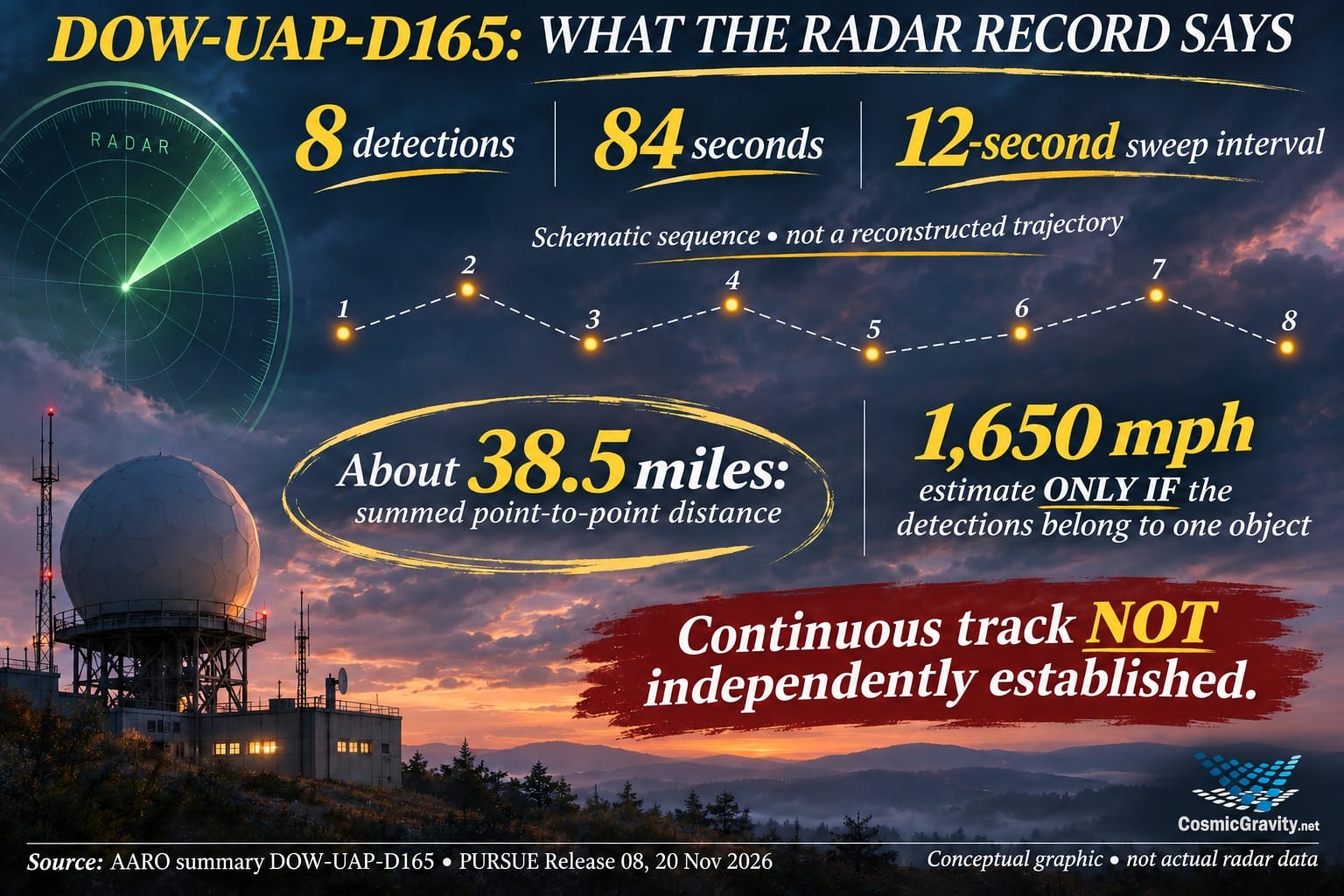
The new UAP radar file DOW-UAP-D165 contains a striking number: an estimated 1,650 mph. It also contains the condition that makes the number scientifically interpretable. That speed applies if eight detections can be associated with one object travelling along a continuous track. The released summary does not independently establish that association.
Taking the case seriously means examining both parts together. The detections deserve investigation; the stated uncertainty is part of the evidence, rather than an inconvenient footnote.
What the UAP radar file reports
The original one-page AARO summary describes a civil air-surveillance radar event in the western United States in 2023. It reports eight detections over 84 seconds, at an estimated altitude of 55,000–70,000 feet. Their summed point-to-point distance is approximately 38.5 miles.
The document derives the 1,650 mph minimum mean horizontal ground-speed estimate under the single-object assumption. It also notes an apparent 39-degree counter-clockwise change in bearing after approximately 48 seconds. The 12-second sweep interval cannot independently establish that all the returns belong to one object.
The official PURSUE entry places the file in Release 08, dated 20 November 2026. Its incident-date field displays 7/15/05, while the title, explanatory text and PDF describe 2023. This article follows the document’s stated year and flags the catalogue discrepancy rather than silently resolving it.
Reading the speed calculation in the UAP radar file
The arithmetic is straightforward: 38.5 miles divided by 84 seconds, multiplied by 3,600 seconds per hour, equals 1,650 mph. The important question comes before that division: what justifies treating the measured locations as successive positions of the same object?
Eight points sampled twelve seconds apart span seven intervals, or 84 seconds. Joining neighbouring points gives a sequence of straight segments. That drawing is a useful bookkeeping device, but does not show everything that happened between observations.
If one object followed a longer, curved route between genuine positions, the summed straight segments could underestimate its distance travelled. If the returns were not all from one object, however, the combined distance would not measure that object’s journey. The same formula can therefore have very different physical meanings depending on the association evidence.
A bearing change is not an acceleration measurement
Direction changes calculated from successive segments describe the geometry of the reported detections. Establishing a detailed manoeuvre requires more: reliable association, timing and positional uncertainties, and information about movement between samples.
In particular, a heading change alone does not supply the duration over which a real object turned. Without that duration, it cannot support a defensible claim about an instantaneous acceleration or the forces experienced by an occupant. The released slide explicitly describes the connecting line as a displacement illustration, not a reconstructed trajectory.
What would make the next analysis stronger?
As an analytical checklist, useful additions would include the underlying detection records, uncertainty estimates, the criteria used to associate returns, and independent observations covering the same time. Such information could test whether the sequence is physically continuous and whether an apparent change survives a more complete treatment of the measurements.
This is a request for testable evidence, not a declaration that a particular conventional or exotic explanation has won. An unresolved classification describes the current state of an investigation; it does not identify an origin.
Our guide to FAA UAP reporting explains why timestamps, observer details and preserved records matter before interpretation begins. D165 provides a concrete example of the next stage: keeping an impressive calculation attached to the assumptions that make it valid.



latest video



news via inbox
Subscribe to our Cosmic newsletter to get notified when we have new articles.