FAA UAP Reporting: What Happens After a Pilot Sees Something Unexplained?
FAA UAP reporting begins with a practical question: what did someone see, and what information can be preserved? The current US air traffic instructions provide a route for those observations. They do not require a controller to decide whether a strange light is an aircraft, a sensor problem or something more unusual before passing the report onward.
That makes the reporting chain worth understanding. A government record can show that an observation reached the right office while leaving its cause entirely unresolved. The paperwork and the physical explanation are different parts of the story.
What the current FAA UAP reporting instructions say
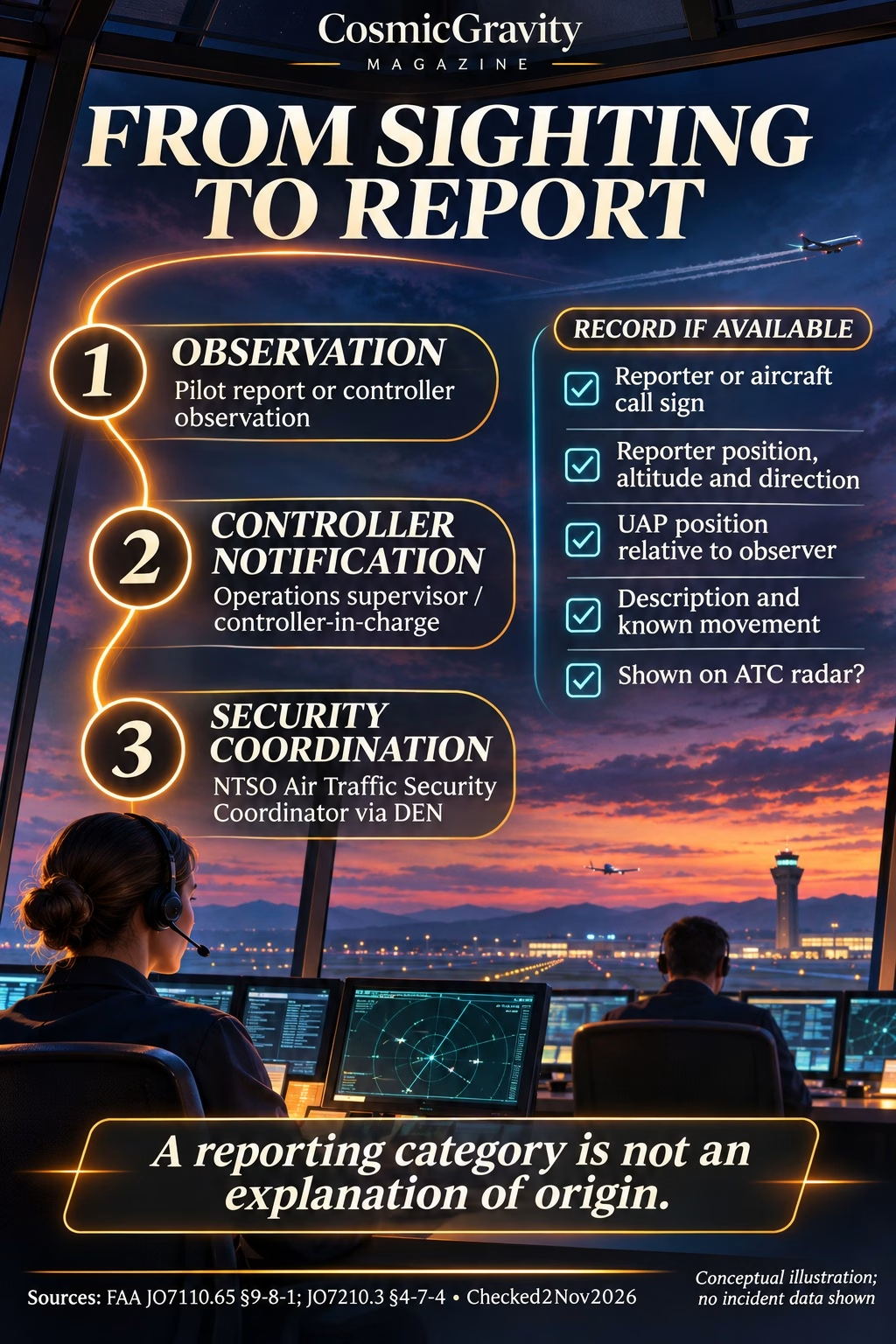
Paragraph 9-8-1 of FAA Order JO 7110.65BB tells controllers to inform the operations supervisor or controller-in-charge of reported or observed UAP or unexplained-phenomena activity. It then refers to the facility-management order for the reporting details.
The next step appears in JO 7210.3, paragraph 4-7-4. Pilot reports and controller observations must reach the National Tactical Security Operations Air Traffic Security Coordinator team through the Domestic Events Network, usually shortened to DEN.
Those official titles can make a simple sequence sound complicated. The observation enters the air traffic system, reaches a supervising role and moves through a security-coordination channel. A referral does not mean that every recipient has independently seen the object or verified every detail.
The five groups of information that matter
The facility order asks for available information in five groups: the reporting aircraft’s call sign or identification of a controller observation; the observer’s position and, for the aircraft, altitude and flight direction; the UAP’s position relative to that observer; a description including known movement; and whether it appears on ATC radar displays.
The qualification “if available” matters. A report can contain missing information. A witness may have a clear visual impression without a reliable distance, or an estimated direction without a measured speed. An empty field is an investigative limitation, rather than permission to fill it with a confident guess.
Consider a light seen ahead of an aircraft. “Ahead” means little without the aircraft’s heading, position and time. A description anchored to those details gives another analyst a way to compare the sighting with other records. An adjective such as “incredible” cannot perform the same job.
Where AARO fits into FAA UAP reporting
The All-domain Anomaly Resolution Office’s reporting page says civilian pilots are encouraged to report sightings promptly to air traffic control and that AARO receives UAP-related pilot reports from the FAA. This describes a route through the aviation system.
The same page distinguishes operational reports from its historical-programme reporting mechanism. The latter is intended for current or former US government employees, service members or contractor personnel with direct knowledge of government UAP programmes or activities. At the time of this check, AARO says it will announce when a public reporting mechanism becomes available.
Consequently, a link to AARO does not establish that every visitor can use the same form for any sighting. The form’s stated eligibility and purpose still matter. Nor does the existence of a government reporting channel convert an account into a confirmed discovery.
Why older instructions can cause confusion
A search can turn up an authentic FAA notice that has already expired. For example, Notice N 7210.970 introduced changes effective 26 October 2025 and carried a cancellation date of 22 January 2026. The current online orders now contain UAP language.
The cancellation of a temporary notice therefore does not, on its own, show that the underlying reporting requirement disappeared. To establish what applies now, the useful comparison is between the notice, its dates and the current parent order.
It is rather like following an amendment to a handbook: once a change enters the maintained text, the short-lived announcement and the continuing instruction have different roles. Quoting only the announcement’s end date can produce the opposite impression from reading the current text.
Reporting a UAP is separate from identifying a hazard
The Aeronautical Information Manual’s safety-reporting section places UAP guidance alongside other reporting subjects. It directs people to AARO for UAP or unexplained-phenomena reporting information and to local law enforcement when life or property might be endangered.
That does not make a UAP label a substitute for reporting an actual collision hazard, accident or other operational event through the relevant procedures. Different records answer different questions. One preserves an unexplained observation; another may document a specific safety occurrence.
Our recent report on the Jersey Airport drone disruptions illustrates the distinction between an operational consequence and an unresolved identification. Jersey has its own jurisdiction; the US FAA chain described here should not be projected onto that investigation.
What a report does—and does not—establish
A call sign anchors an account to a reporting aircraft. It does not establish the identity of the observed object. A radar entry supplies another kind of observation, but it still needs interpretation. A measured position is stronger than an assumed one, and a preserved uncertainty is more useful than an invented precision.
For readers exploring older cases in our UFO and UAP case atlas, this is a useful way to read documents: separate what the witness reported, what the record actually preserves and what investigators later concluded.
The current instructions show that unexplained observations have a formal place in US aviation reporting. Their value lies in making an observation more traceable. Whether any individual case has an extraordinary explanation depends on the evidence that survives, not on the title printed above the reporting checklist.
Checked 2 November 2026. This is an explanatory report about published US guidance, not an announcement of a new rule today. Linked FAA orders and AARO eligibility information are the primary references.



latest video



news via inbox
Subscribe to our Cosmic newsletter to get notified when we have new articles.