How astronomers caught the Bao stellar merger before the flash
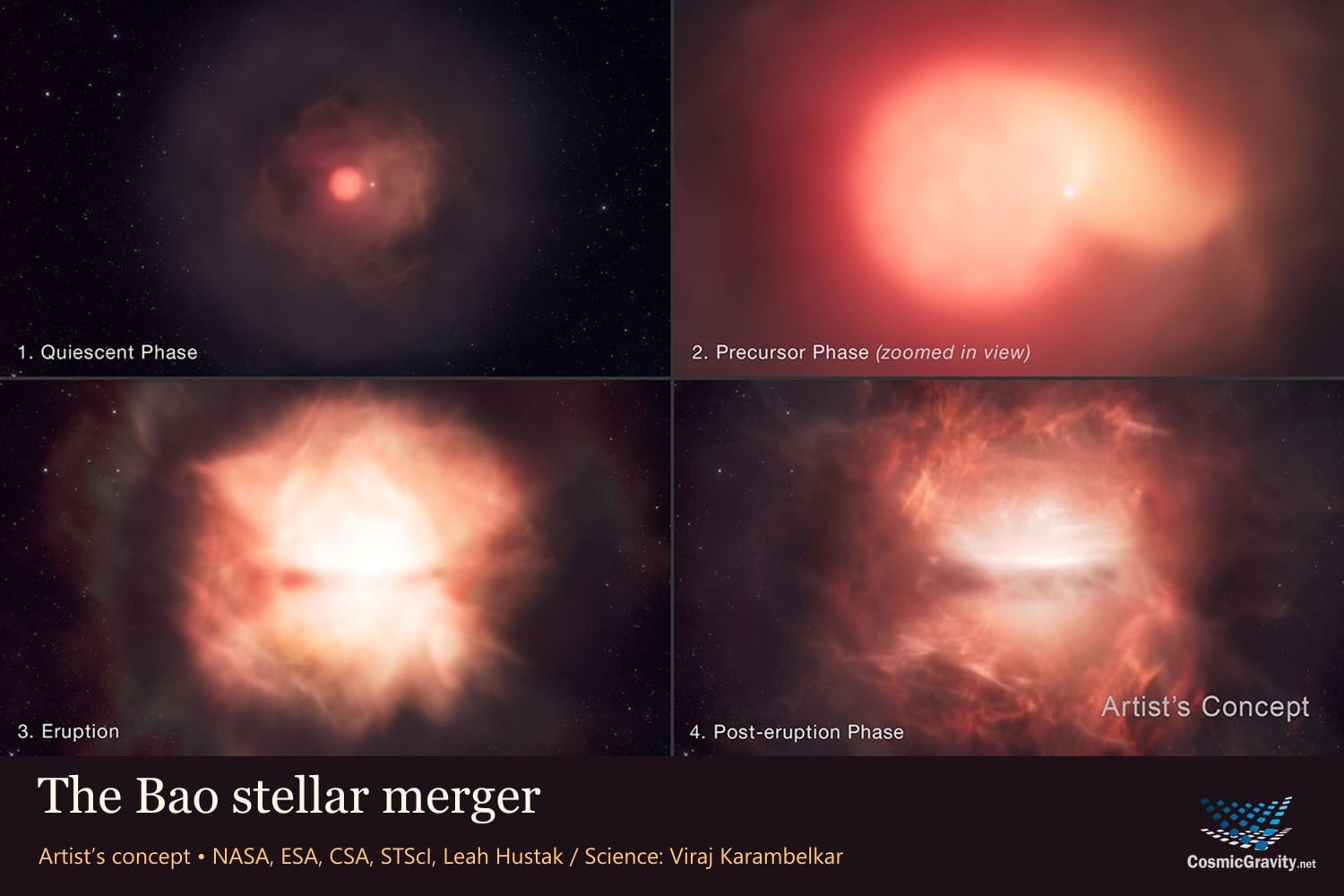
Feature image. Artist’s interpretation of the Bao system. The four panels illustrate the research team’s reconstruction. Illustration by Leah Hustak (STScI) for NASA, ESA, CSA and STScI. Science by Viraj Karambelkar (Columbia). Image and observation credits.
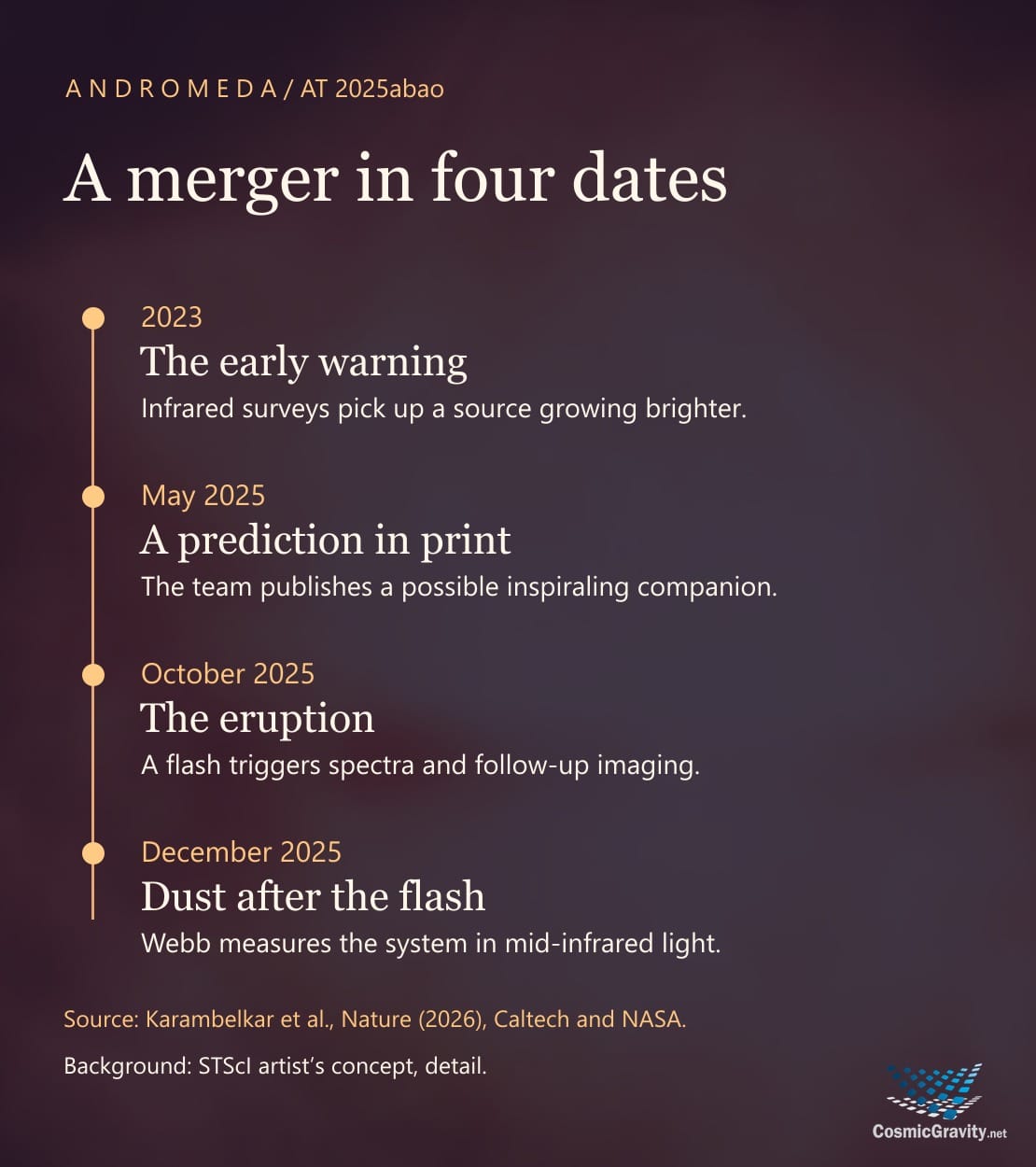
The warning came before the flash. In 2023 two astronomers working with different infrared surveys noticed a source brightening on the outskirts of Andromeda. Viraj Karambelkar saw it in observations from Palomar Observatory’s WINTER telescope. Kishalay De found it independently in NEOWISE data. They published a possible explanation in May 2025. That October, the source erupted. The Bao stellar merger offered something astronomers rarely get: observations made while there was still time for their explanation to be wrong. Caltech’s observing account.
Why one star got brighter as it faded
The nickname Bao belongs to a system formally catalogued after the eruption as AT 2025abao. In ordinary visible light, the object was fading before the outburst. At longer, infrared wavelengths it was growing brighter. In July 2025, the SPHEREx space telescope happened to observe it during this transition. Taken together, the records were consistent with an expanding giant shedding material. Dust around the source absorbs some starlight and radiates energy at longer wavelengths. A telescope that misses the infrared can miss much of the story.
The team proposed that a companion had begun orbiting inside the giant’s outer gas. Astronomers call this a common envelope because both stellar cores then occupy the same extended atmosphere. Moving through the gas robs the companion’s orbit of energy. Some of that energy can lift the gas away. If enough escapes, the two stars may survive in a much tighter orbit. If the gas remains dense around them long enough, the smaller star can spiral into the larger one’s core. The Columbia team on the two possible outcomes.
What the Bao stellar merger looked like in October
On October 17, 2025, telescopes registered a flash. Brightness alone left several explanations open. Spectrographs, which spread the light into wavelengths, supplied another clue. The researchers inferred that expelled material initially traveled at roughly 800 kilometers per second. As it ran into previously shed gas it slowed to roughly 150 kilometers per second. In their account, that collision turned motion into much of the light astronomers saw.
How the team weighed a companion it could barely see
Webb observed Bao on December 24, 2025, after the flash had faded. The mid-infrared observations preserved evidence of dust expelled over a much longer stretch of the giant’s life. With those measurements and ground-based spectra, researchers could constrain the surrounding material and compare simulations with the observed eruption. Their preferred reconstruction puts the giant at about seven solar masses and the companion at about seven-tenths of one. See the observations from three infrared missions.
The study, published in Nature on November 18, 2026, concludes that the companion spiraled inward and merged, ejecting about the outer tenth of the giant’s envelope. That fraction matters for other binaries. Models of two stars sharing gas need to specify how efficiently orbital energy clears the envelope. Bao provides an observed event against which astronomers can check that assumption. Applying the same value to a pair with two different masses would require another test. Read the research paper.
One part of Bao’s story still belongs to future observers. As the expanding material thins, the surviving object should become easier to study. Its brightness and temperature will help show what sort of star the merger left behind. For a look at how infrared telescopes can pick out stars against the light of another galaxy, read our account of Euclid’s resolved-star observations.

latest video

news via inbox
Subscribe to our Cosmic newsletter to get notified when we have new articles.