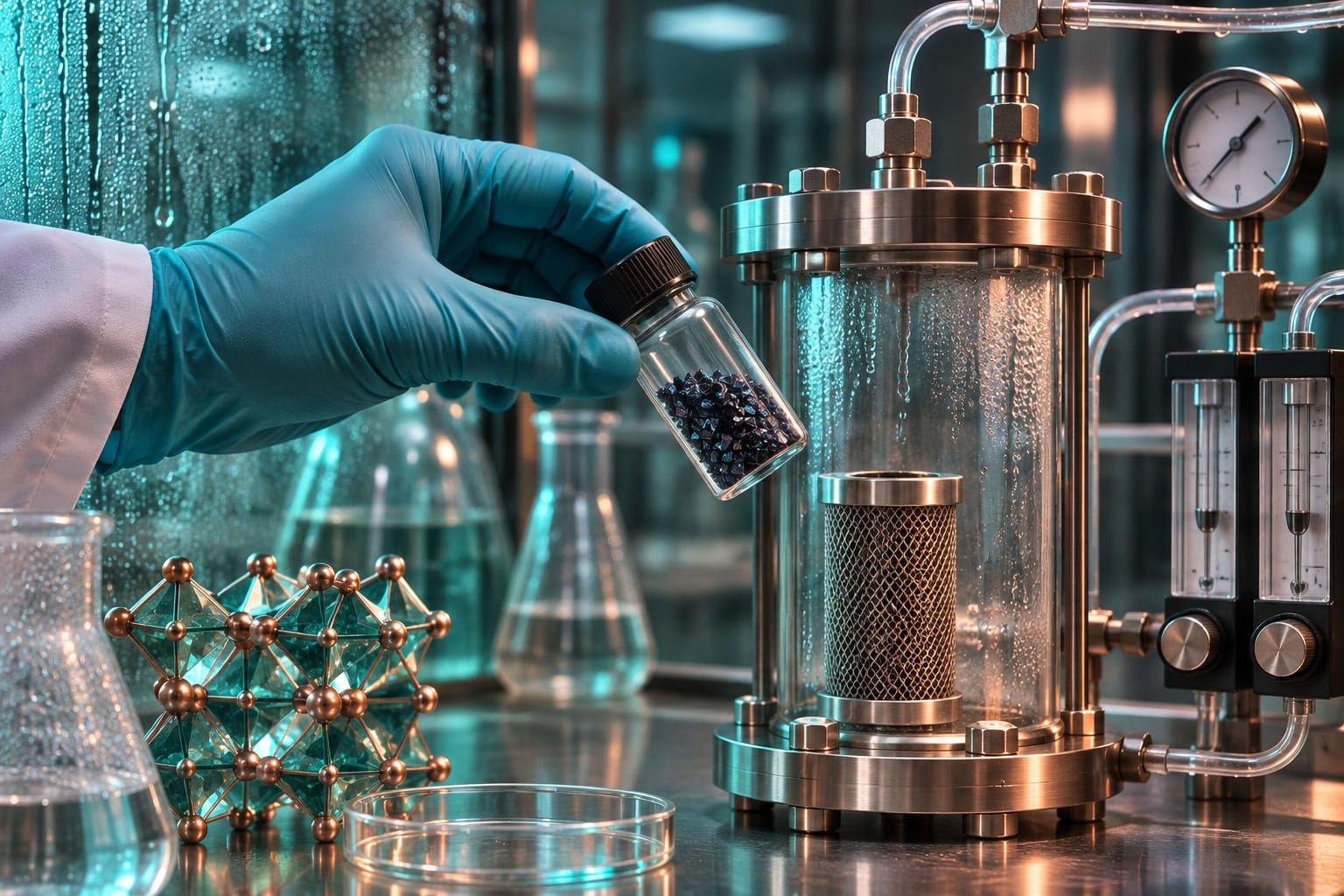
How BVR-X Captures Carbon Dioxide in Humid Gas
Industrial exhaust contains water vapour, and the water can take up space in materials designed to catch carbon dioxide. In a BVR-X carbon capture study, a team led by Oregon State University tested a porous crystal that responds differently. In a humid lab gas stream containing 4% CO2 by volume, water changed the chemistry at some of the crystal’s metal sites while CO2 collected in other areas of its pores. The results, published online in September, received renewed coverage in November. Yadav and colleagues’ paper · Oregon State University research account.
How can one crystal hold water and carbon dioxide?
The material, called BVR-X, is a metal–organic framework. Metal-containing units and organic linkers join into a repeating crystal with very small pores. Gas molecules can stick to regions of those internal surfaces, a process called adsorption. The size and chemistry of a pore help determine which molecules stay there and how strongly they are held.
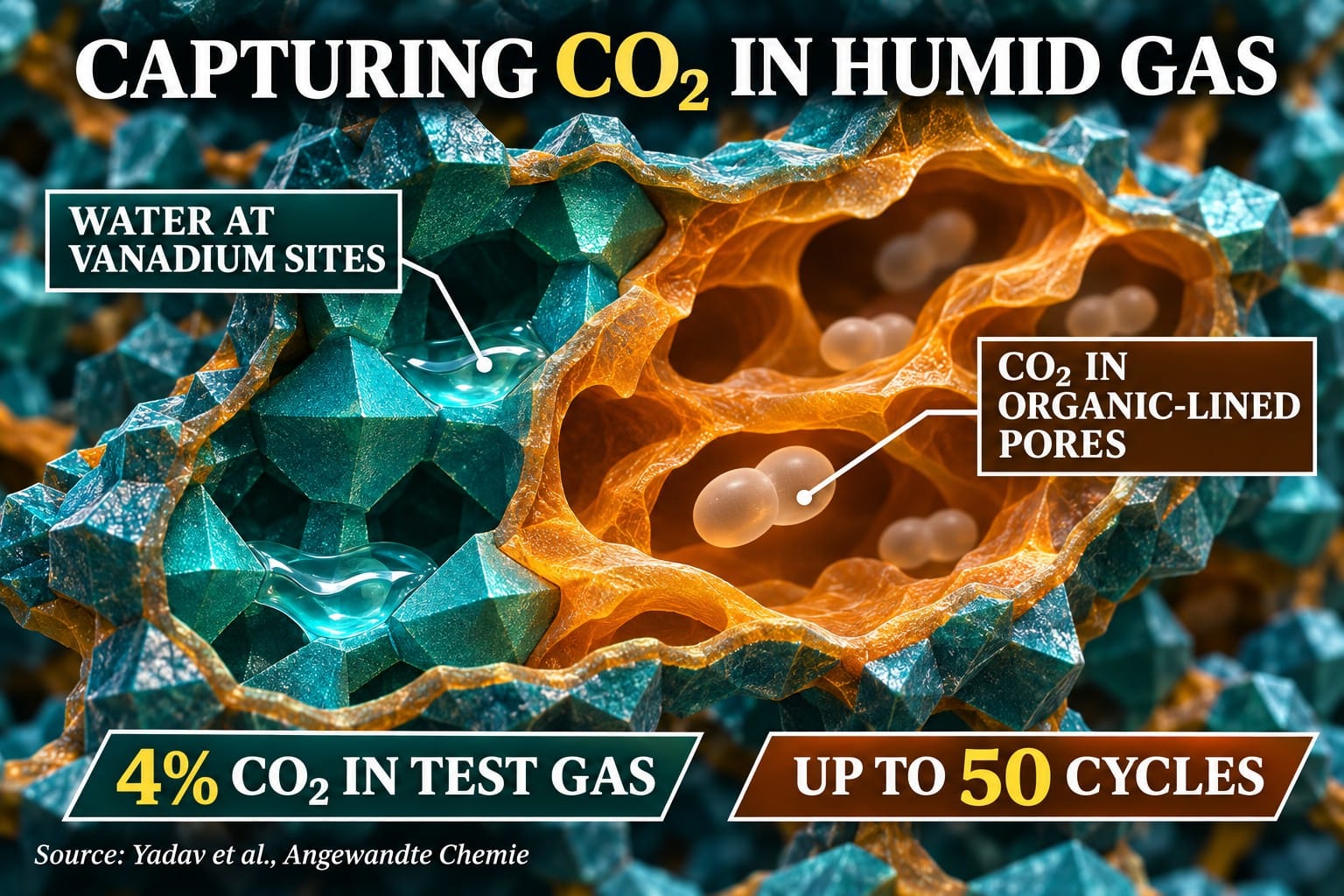
In BVR-X, some water reacts at vanadium centres. The authors report a reversible change in the oxidation state of the vanadium and the formation of hydroxide groups. CO2 is held by physical interactions in regions lined by the organic linker pyrazine. Excess water and carbon dioxide can favour different locations in the framework. The water-driven rearrangement gives the two adsorbates a way to coexist while preserving carbon dioxide uptake. Paper and graphical abstract.
What did the BVR-X carbon capture test measure?
Researchers passed a dilute, humid gas mixture through the material and measured how much CO2 it took up in a flowing test. The reported dynamic capacity was 2.04 ± 0.07 millimoles of CO2 per gram of adsorbent. Capacity was sustained for up to 50 capture-and-release cycles in the study. The paper also reports resilience to intense humidification and steam exposure. Those numbers apply to the tested material and conditions.
Passing a mixture through a bed gives researchers information that a measurement of an isolated gas cannot supply. A bed contacts a stream in which water and carbon dioxide compete, and the outlet eventually registers more carbon dioxide as the bed fills. The result helps show whether the material still performs when both gases are present and moving through it.
What would it take to use this in a plant?
The 4% concentration is relevant to dilute exhaust from natural-gas combustion. A plant-scale system would have to contend with bigger and less uniform flows, fluctuations in temperature, other compounds in the exhaust and the energy required to regenerate the material. Engineers would also have to turn the crystal into a form that a plant can handle repeatedly while allowing gas to reach the pores. Capture cost and industrial lifetime remain questions for further testing.
The larger idea is to design adsorption sites for a mixture as it actually arrives. If moisture changes the surface in a predictable, reversible way, that response can become part of the separation. Our report on a chip that sorts components in mixed light follows another experiment where the design starts with the mixture and asks how to distinguish what is inside it.



latest video



news via inbox
Subscribe to our Cosmic newsletter to get notified when we have new articles.