AI Training Reproducibility: Why Close Starts Can Lead to Different Models
AI training reproducibility sounds like a matter of keeping good records. Save the settings, use the same data, and a second run ought to teach a model the same thing. A study published on 5 November in Nature Machine Intelligence asks how far that idea can go. Andrew Ly and Pulin Gong found that even when they deliberately controlled the training setup, very small changes to the starting weights could send a network towards a different result. The published study by Ly and Gong.
The result is about what happens when the starting point changes. If every input and every operation is identical in a deterministic experiment, repeating it gives the same result. The harder question is how well that result holds up when another run starts almost, but not quite, in the same place.
What is a training basin?
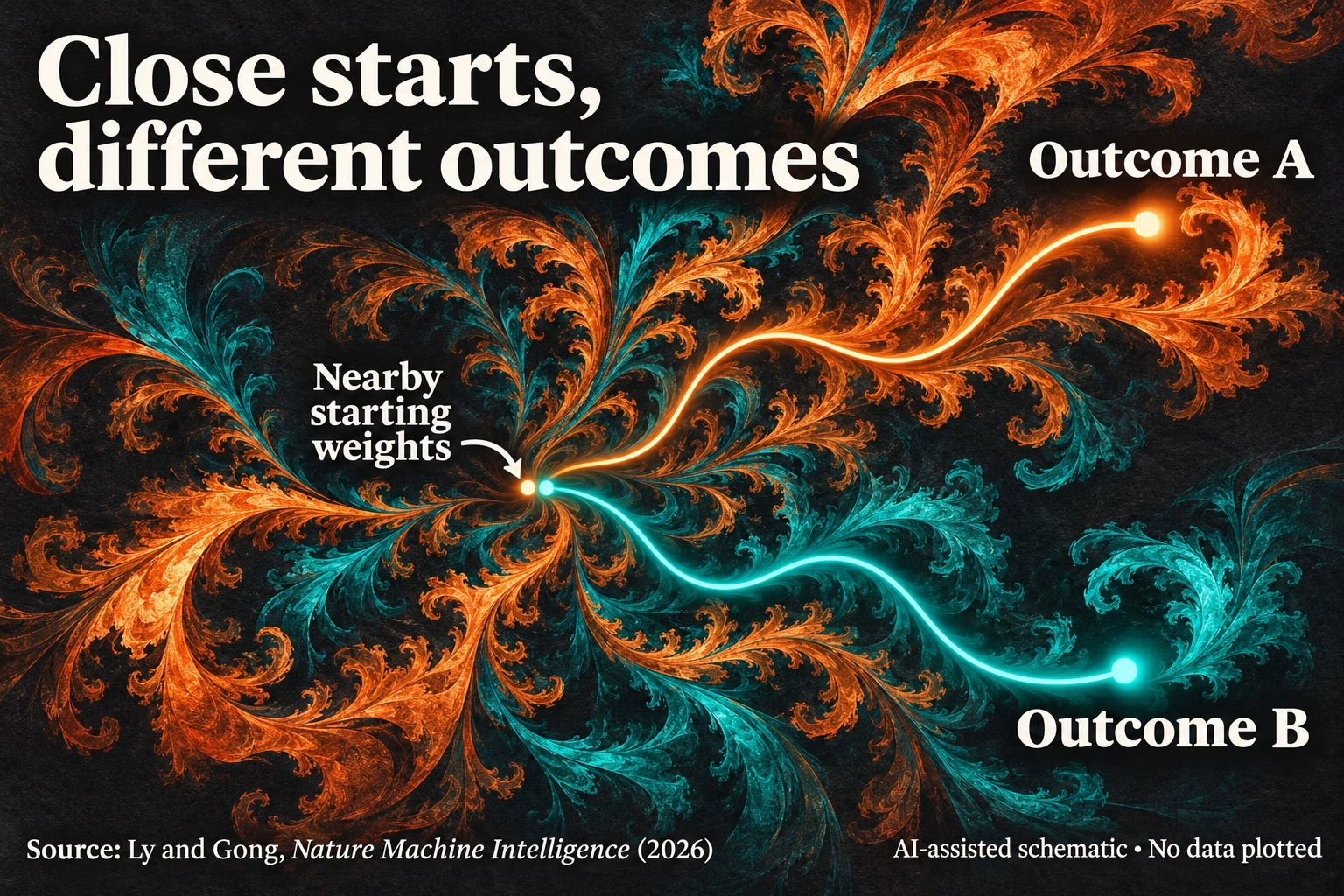
A neural network starts with weights that determine how strongly its parts affect one another. Training adjusts those weights. If you could draw a map with one dot for each possible set of starting weights, you could color every dot according to the outcome it reaches. All the dots that lead to one outcome make up its basin of attraction.
Imagine a map with two lakes. In a simple version, water on one side of a ridge flows to one lake and water on the other side flows to the second. Learn where you are relative to the ridge and you can predict the destination. The patterns Ly and Gong studied are more tangled. Around some starting points, even a closer look reveals a mix of neighbors leading to different destinations.
The authors call that geometry riddling. They proved a route to it in a small mathematical model. For larger networks, where they could sample a range of starting points rather than examine every possible one, they found patterns consistent with the same idea. The proof in the small model and the evidence from the larger experiments support different levels of certainty. The authors’ model and experimental methods.
How the team tested AI training reproducibility
One test starts with pairs of weights that differ only slightly. Train a model from each starting point and count how often the pair ends differently. Then repeat with even smaller differences. In the settings highlighted by the researchers, tightening that distance made the probability of disagreement fall very slowly or hardly change over the scales they could test.
The researchers varied the kinds of neural networks, datasets and training methods they tested. Their examples include image classification and sentiment classification. One comparison used a deterministic CPU implementation as well as a GPU run. A similar pattern in both gave the researchers a way to check whether hardware variability alone could explain that result. The larger experiments provide evidence of the effect in the tested cases. They do not establish how often it occurs in every training system. Deep network experiments and comparisons.
When do two trained models actually behave differently?
Different weights can still yield the same answers. Think of two sets of instructions that rearrange the steps but produce the same result. For that reason, the paper also compares predictions. One measure counts the share of test inputs on which two trained models disagree. A pair may have very similar overall accuracy while giving different answers on individual examples.
That distinction changes how we read a benchmark. If the goal is to compare aggregate performance, one summary score may answer part of the question. If the goal is to know whether a decision on a particular input is stable across training runs, it helps to examine those decisions directly. For AI training reproducibility, the paper makes a concrete distinction between getting a similar score and making similar decisions. Each can be measured separately. The University of Sydney’s explanation of the findings.
For a different example of why the test and the signal matter as much as the summary result, see our coverage of the Webb analysis that recovered a known planet from glare.

latest video



news via inbox
Subscribe to our Cosmic newsletter to get notified when we have new articles.