Göbekli Tepe Burials: What Two Graves Reveal About Scattered Bones
For years, scattered human bones at Göbekli Tepe raised a difficult question. Had people deliberately placed selected remains inside the monumental buildings, or had the fragments arrived there through a more complicated history of burial, breakage and moving soil? The first excavated Göbekli Tepe burials give researchers something they previously lacked: burial contexts against which to compare the loose bones.
Julia Gresky and Lee Clare published their study in PLOS ONE on 22 September 2026. This is a closer examination of that research, not a claim that the graves were discovered this week. Its argument is that erosion can help explain the scattered remains, while other mortuary practices still deserve investigation.
What the Göbekli Tepe burials study examined
The open-access paper describes two burial contexts associated with the Pre-Pottery Neolithic B, broadly 8700–8000 BCE. One was a collective burial beneath a plaster floor. The other held a largely articulated individual in a small space beside Special Building A.
These are two burial contexts, not two people. The collective grave contained remains representing at least three individuals, with uncertainty about whether a fourth was also present. Keeping the units clear matters when a compact headline becomes a reader’s lasting impression.
The study compares the condition of these bones with fragments recovered from the fill of the special buildings. The aim is to explain how remains reached their excavated positions, rather than assume those positions were where people originally placed them.
A grave beneath a floor, used more than once
The collective burial was found in 2017 during work on drainage associated with the protective shelter. Its pit cut into the plaster floor of a rectangular building. Within it, most bones had been rearranged, and skulls were grouped toward one corner.
The authors suggest that complete bodies were initially placed there, with earlier remains moved to make space for later interments. Small hand and foot bones help support the presence of whole bodies or articulated limbs. The proposed sequence is an interpretation of the surviving arrangement, not a written account of a funeral.
This is already a more human picture than an anonymous collection of fragments. A room, a floor and a repeatedly used grave connect death to the spaces occupied by a community.
Why the Göbekli Tepe burials are informative even when damaged
The single burial was first identified in 2012 and fully excavated in 2022. It lay in a flexed position on its left side, facing east. Some remains recovered earlier could not be assigned to the individual with certainty because the boundary between the burial and overlying loose fragments was unclear.
That limitation is worth retaining. Archaeology rarely offers a perfectly sealed scene with every object still in its original place. Recording uncertainty helps other researchers judge how much weight an interpretation can bear.
Even so, a largely articulated burial can reveal changes that happened while bones remained in a grave. If severe fragmentation occurs in that context, fragmentation elsewhere need not automatically imply deliberate smashing.
What soil, minerals and animals can do to bone
The study examines taphonomy: the processes that affect remains after death. Soil pressure can break bones. Mineral deposits can coat their surfaces and penetrate their structure. Animals can leave gnawing marks or move small elements.
Several of these features appear both in the excavated burials and among the loose fragments from the monumental buildings. The comparison supports the possibility that some scattered material began in ordinary burial contexts before becoming displaced.
A broken bone therefore has a history to reconstruct. The fracture pattern, deposits and associated marks matter together. Calling every break ritual damage would skip the work that distinguishes human action from later physical change.
Could erosion move remains into the lower buildings?
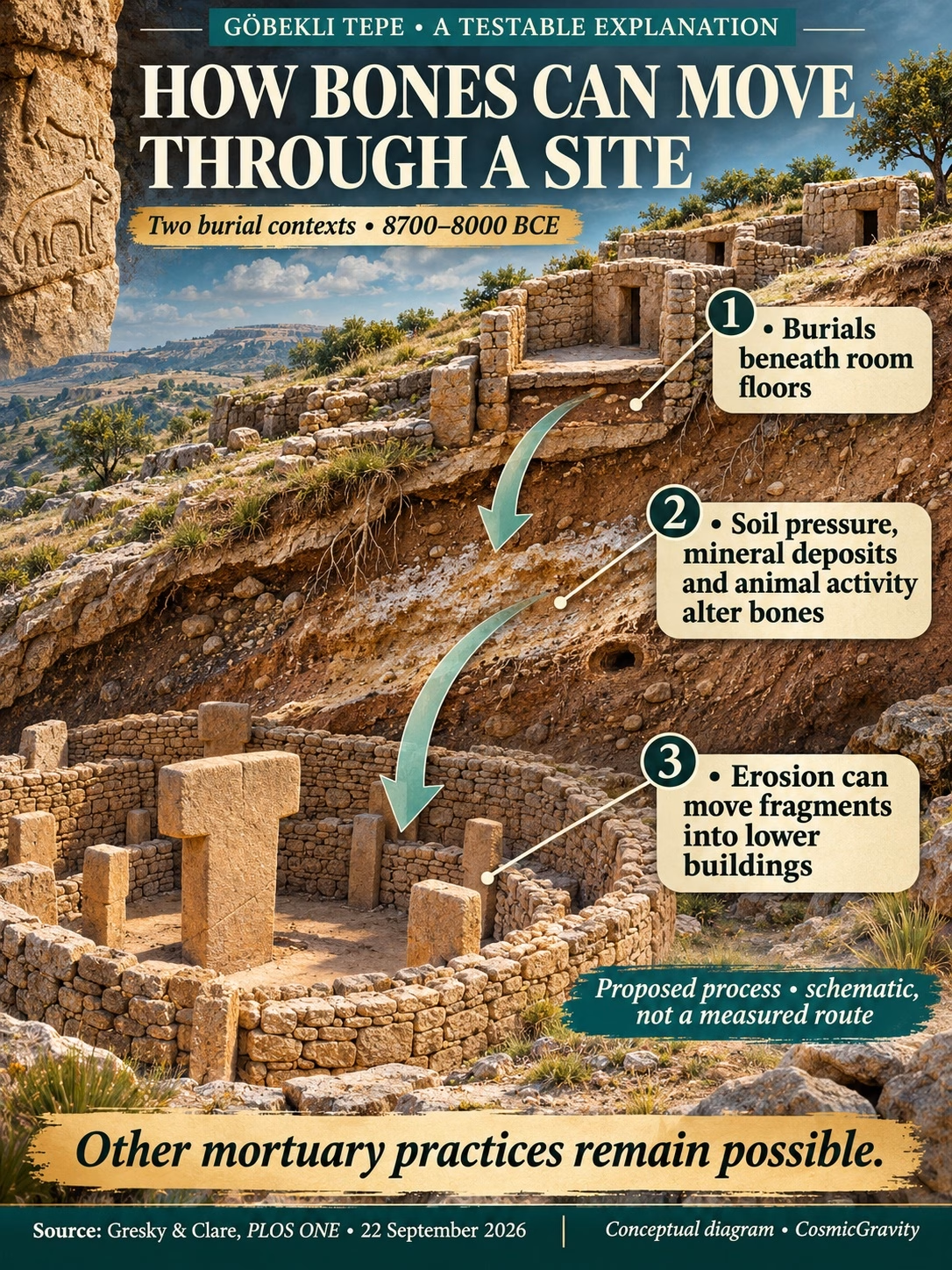
The proposed route begins with burials beneath rooms on higher parts of the settlement mound. Later erosion and slope movement could carry sediment and disturbed remains into lower areas, including the special buildings. The paper presents this as a plausible explanation for at least part of the dispersed assemblage.
This process also explains why find location and original burial location can differ. Imagine a deposit as the last place an object came to rest, rather than automatically the place it was first used. Excavation must reconstruct the journey between those points.
The infographic illustrates that hypothesis schematically. Its arrows are not measured tracks through a particular trench, and the imagined rooms do not reconstruct an individual funeral.
Do the Göbekli Tepe burials rule out a skull cult?
No. Some cranial fragments from the site have deliberate incisions, and the authors explicitly keep additional mortuary customs in view. A process that explains much of an assemblage need not explain every fragment.
The study also discusses different arrangements of human remains at other Neolithic sites. Those comparisons help frame possibilities, but they do not make every community’s practices identical. Dates, architecture and the placement of particular bones still need to be considered locally.
The useful change is one of interpretation: widespread scattered fragments can be investigated through burial disturbance and erosion without denying that deliberate treatment of some remains also occurred.
What this adds to the wider settlement picture
UNESCO’s account of Göbekli Tepe describes its monumental architecture alongside evidence for non-monumental structures that appear domestic. Burials beneath rooms fit a site where daily life and symbolic activity could coexist. The familiar choice between “temple” and “village” can oversimplify that relationship.
For the broader chronology, pillars and settlement debate, see our Göbekli Tepe evidence guide. Our world megalithic atlas places monumental sites in their own regional contexts, without assuming a shared origin.
Two burial contexts cannot reveal every custom practised across centuries. Further bone analysis and more secure dating are needed. They nevertheless provide a practical advance: archaeologists can now compare a proposed explanation with the physical condition of excavated burials, rather than build the entire story from loose fragments.
latest video



news via inbox
Subscribe to our Cosmic newsletter to get notified when we have new articles.