Quantum Contextuality: What Google’s Magic Square Experiment Shows
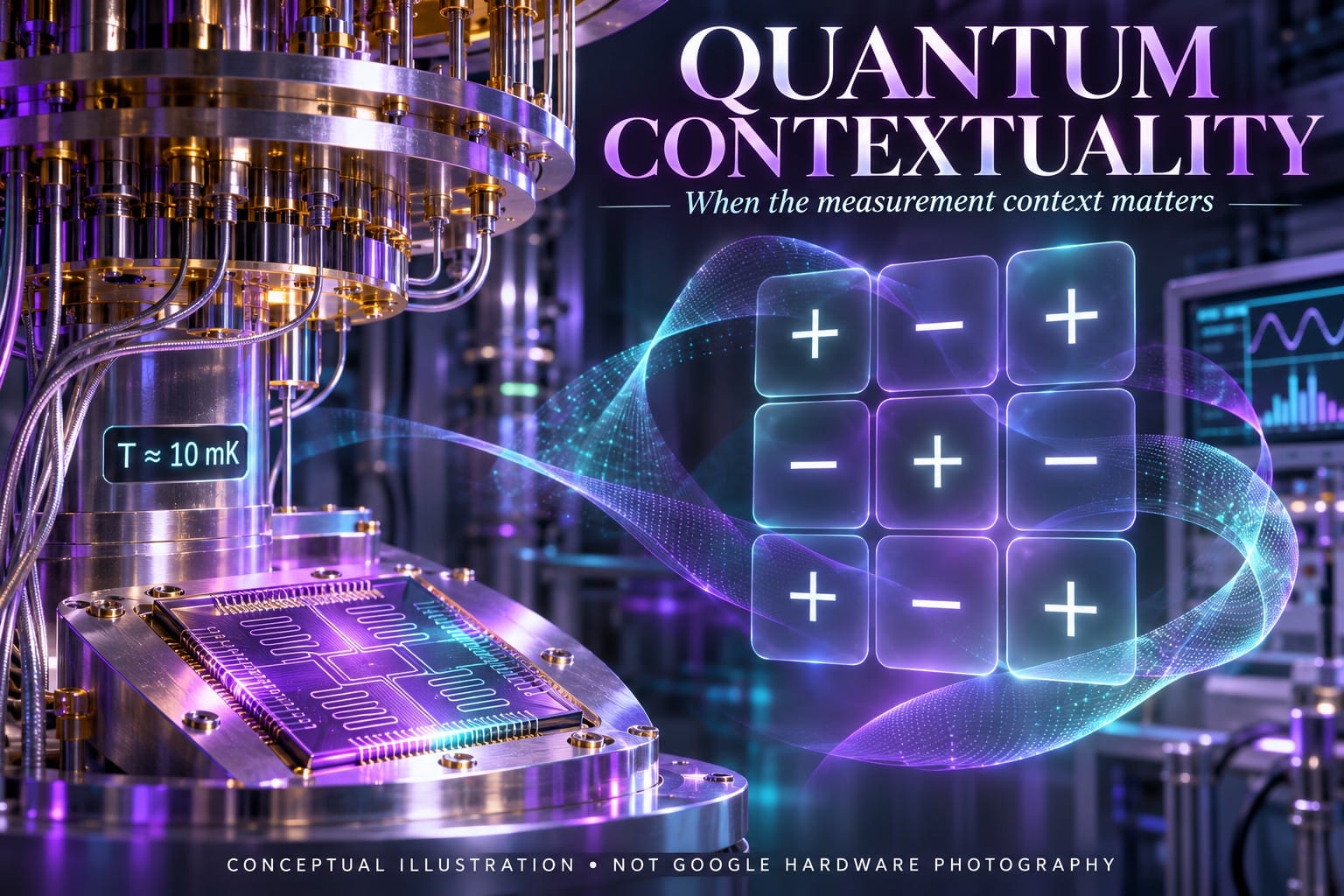
A three-by-three puzzle provides a surprisingly direct route into quantum contextuality: the difficulty of assigning one fixed set of values to quantum measurements independently of their compatible measurement context.
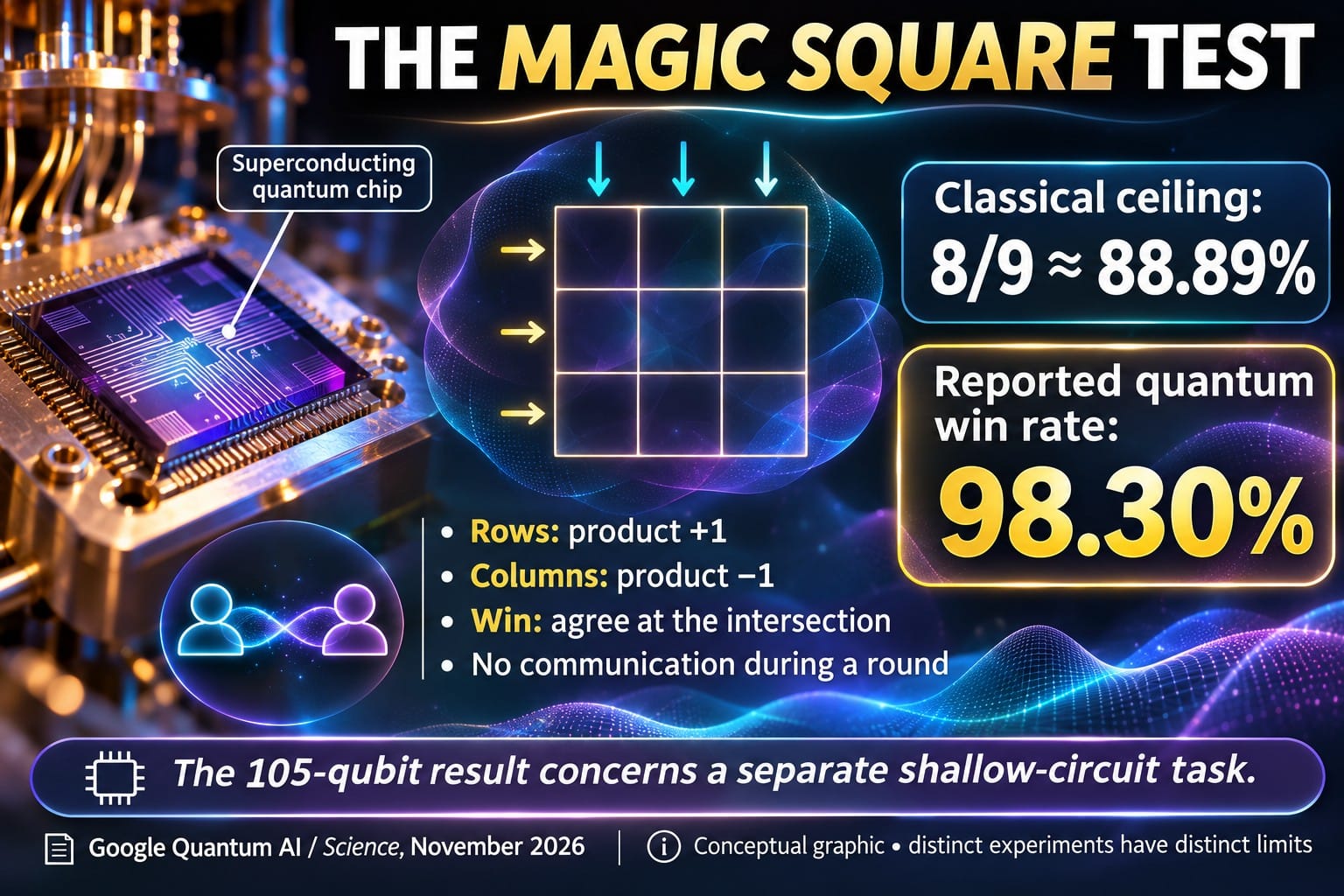
Google Quantum AI described new experiments on 19 November 2026 alongside publication in Science. Its researchers report a 98.30% win rate in a magic square game, exceeding the best classical strategy’s 88.89%. Related experiments explored larger systems, including a separate shallow-circuit task involving up to 105 qubits. These are distinct tests, with distinct comparisons.
Try the puzzle before the physics
Draw a three-by-three grid and put either +1 or −1 in every cell. Require the product along each row to be +1, and the product down each column to be −1.
The contradiction is easy to expose. Multiplying the three row products gives +1. Multiplying the three column products gives −1. Yet both calculations multiply precisely the same nine cell values, once each. A single fixed table cannot satisfy both requirements.
This algebra is also a useful guardrail for interpreting the experiment. A quantum processor does not print a fixed table that somehow escapes multiplication. The experiment concerns answers produced under different measurement arrangements.
How quantum contextuality enters the game
In the two-player version, Alice receives a row and Bob receives a column. Each must obey their own product rule. They win when their answers agree at the shared cell, without communicating during that round. A classical prearranged strategy can satisfy at most eight of the nine equally likely row-column combinations.
Google’s experimental explanation describes Alice and Bob sharing two entangled pairs of qubits. They use agreed measurement settings for the assigned row or column. Quantum theory permits perfect success in the ideal case; real hardware has noise. The reported 98.30% result comes from 100,000 trials for each of the nine question combinations.
The improvement concerns correlations among measurement outcomes. It does not allow the players to send arbitrary information instantaneously. Their agreement is assessed when the answers are brought together.
The 105-qubit result is a different experiment
The open research manuscript, first posted in December 2025, provides the technical background to this work. Alongside the game, it investigates sequential contextuality measurements, multipartite correlations and restricted-depth computational tasks. The November 2026 publication should therefore not be mistaken for the first public appearance of every result.
A shallow circuit has only a small number of operation layers. Restricting the depth constrains how information can move through a classical circuit. Such restrictions are part of the comparison: removing them changes the question.
In the hidden-linear-function experiment, the team used grids containing up to 105 qubits. This is a test of a particular computational setting, rather than proof that a quantum computer outperforms every classical machine on any chosen problem. The size should not be attached to the smaller magic square experiment as though the two were interchangeable.
Testing quantum contextuality can also expose hardware errors
The researchers describe these experiments as sensitive probes of coherent errors: small, systematic deviations that can become visible when many outcomes must agree in a precise way. That makes contextuality interesting both as a possible computational resource and as a tool for examining hardware.
Our report on quantum gas microscopy explores another way experimentalists use controllable quantum systems to answer sharply defined questions. The platforms and goals differ, but clear comparisons are essential in both.
What the result leaves open
Noise still separates laboratory outcomes from ideal quantum predictions. The connection between contextuality and useful computation also depends on the task and the resources allowed. A successful foundational experiment is not automatically a commercially useful algorithm.
The valuable advance is a measured separation under specified conditions. Readers can follow its meaning without accepting a sweeping claim about all future computing: the rules, the classical ceiling and the observed result are explicit.



latest video



news via inbox
Subscribe to our Cosmic newsletter to get notified when we have new articles.